


AI-powered CFO agents are intelligent software systems designed to support Chief Financial Officers by automating financial operations, generating insights, monitoring business performance, and assisting with strategic planning.
Unlike traditional finance software, these AI agents continuously analyze financial information, identify anomalies, forecast revenue, optimize budgets, and recommend actions based on changing business conditions.
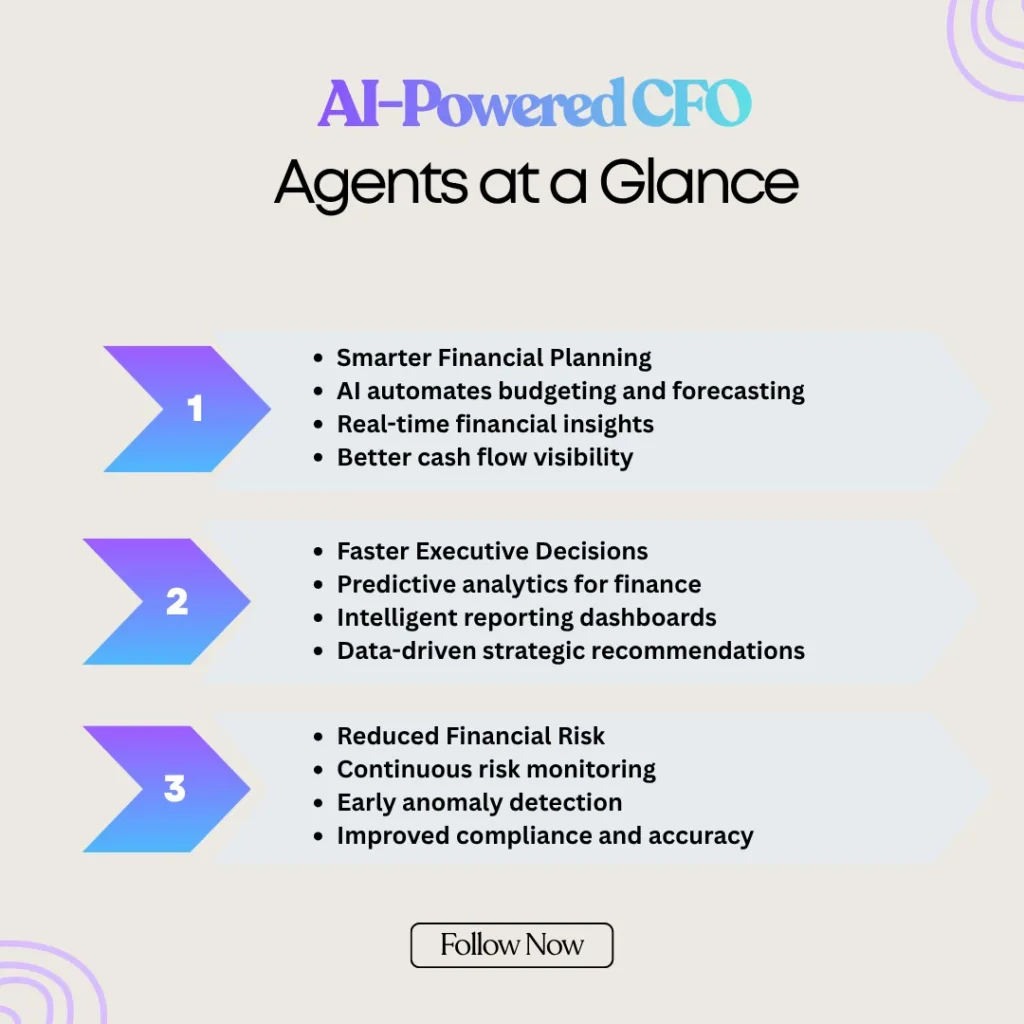
Organizations implementing AI Systems in Financial Services are improving operational efficiency while reducing manual financial workloads. These intelligent systems also strengthen Financial Risk Monitoring by detecting unusual transactions, cash flow issues, and compliance risks before they become major problems.
As finance departments continue adopting AI, Investment Banking Operations are also benefiting from automated valuation models, faster financial analysis, and intelligent reporting capabilities that support better investment decisions.
Why Finance Leaders Are Adopting AI CFO Agents
Finance teams handle enormous volumes of financial data every day. Manual analysis often slows decision-making and increases the possibility of human error.
Modern CFO AI tools enable finance leaders to automate repetitive processes while focusing on high-value strategic initiatives. Organizations are increasingly investing in executive finance automation because it improves productivity, reduces costs, and accelerates financial reporting cycles.
Core Capabilities of AI-Powered CFO Agents
| Capability | Business Benefit |
| Financial forecasting | Predicts future revenue and expenses |
| Budget optimization | Improves resource allocation |
| Cash flow monitoring | Identifies liquidity risks |
| Financial reporting | Generates automated executive reports |
| Risk detection | Flags unusual financial activity |
| Scenario planning | Evaluates multiple business outcomes |
AI Financial Decision Intelligence
One of the biggest strengths of AI CFO agents is delivering financial decision intelligence.
Instead of reviewing static monthly reports, executives receive real-time insights based on live financial data. AI evaluates thousands of variables simultaneously, helping organizations respond quickly to market changes, customer demand, and operational costs.
This intelligence enables CFOs to make informed strategic decisions with greater confidence.
AI Business Forecasting Is Becoming More Accurate
Traditional forecasting methods often rely on historical trends.
Modern AI business forecasting combines historical financial data with real-time operational metrics, customer behavior, market conditions, inflation trends, and external economic indicators.
Benefits include:
- More accurate revenue predictions
- Better expense planning
- Improved cash flow forecasting
- Early detection of financial risks
- Faster strategic planning
AI-Driven Financial Strategy
Organizations increasingly depend on AI-driven financial strategy to improve long-term planning.
AI agents analyze profitability, operating expenses, pricing strategies, and investment opportunities to recommend financially optimal decisions.
Rather than replacing CFOs, AI becomes an intelligent strategic advisor that supports executive decision-making.
Executive Finance Automation Across Departments
Modern finance operations involve numerous repetitive tasks including:
- Invoice processing
- Expense approvals
- Vendor payments
- Budget tracking
- Financial reconciliation
- Compliance reporting
With executive finance automation, organizations reduce manual effort while improving operational consistency and financial accuracy.
Finance Leadership Technology Is Evolving
Today’s CFO is expected to become a strategic business partner instead of simply managing accounting operations.
Advanced finance leadership technology helps executives:
- Monitor company performance
- Evaluate investment opportunities
- Improve profitability
- Manage financial risks
- Support executive decision-making
AI allows finance leaders to focus on business growth instead of administrative work.
Budgeting Automation AI Improves Planning
Annual budgeting often requires weeks of manual work.
Using budgeting automation AI, organizations can automatically:
- Analyze departmental spending
- Recommend budget adjustments
- Compare planned versus actual expenses
- Generate future budget scenarios
- Optimize capital allocation
This significantly reduces planning time while increasing budgeting accuracy.
Intelligent Reporting Systems
Executive reporting traditionally requires finance teams to prepare dashboards manually.
Modern intelligent reporting systems automatically generate:
- Board reports
- KPI dashboards
- Executive summaries
- Profitability analysis
- Cash flow reports
- Budget variance reports
Executives receive updated financial insights without waiting for month-end reporting.
Predictive Analytics Finance Enables Proactive Decisions
One of the most valuable capabilities of AI CFO agents is predictive analytics finance.
Instead of explaining what happened, AI predicts what is likely to happen next.
Examples include:
- Revenue decline prediction
- Customer churn forecasting
- Expense growth analysis
- Inventory optimization
- Market demand forecasting
- Capital planning recommendations
AI in Financial Research Workflows
Investment firms process massive amounts of financial documents every day.
AI significantly improves Financial Research Workflows by:
- Summarizing annual reports
- Extracting financial metrics
- Comparing company performance
- Identifying investment opportunities
- Monitoring market news automatically
Researchers can focus more on strategic analysis rather than manual data collection.
AI for Private Equity Due Diligence
Private equity firms evaluate thousands of financial documents during acquisitions.
AI accelerates Private Equity Due Diligence through:
- Financial statement analysis
- Contract review
- Risk identification
- EBITDA validation
- Financial anomaly detection
- Compliance verification
This reduces due diligence timelines while improving decision accuracy.
Autonomous AI Agents in Finance
The next generation of finance automation involves Autonomous AI Agents.
These intelligent systems can independently:
- Monitor financial KPIs
- Trigger alerts
- Generate reports
- Recommend investments
- Optimize budgets
- Execute predefined workflows
Human oversight remains essential, but AI performs much of the repetitive analysis automatically.
Industries Using AI CFO Agents
| Industry | Common Applications |
| Banking | Risk analysis and compliance |
| Manufacturing | Cost optimization |
| Healthcare | Budget planning |
| Retail | Revenue forecasting |
| SaaS | Subscription analytics |
| Private Equity | Investment evaluation |
| Insurance | Claims forecasting |
| Logistics | Cash flow management |
Financial Modeling for Analysts
Creating financial models manually requires significant time.
AI improves Financial Modeling for Analysts by:
- Building forecasting models
- Running sensitivity analysis
- Simulating business scenarios
- Identifying financial assumptions
- Updating models automatically
This allows analysts to evaluate multiple business outcomes much faster.
AI Agents in Wealth Management
Financial advisors increasingly rely on AI Agents in Wealth Management to provide personalized investment recommendations.
AI supports wealth managers by:
- Portfolio optimization
- Risk profiling
- Retirement planning
- Tax optimization
- Investment forecasting
- Client reporting
The result is better client service and more informed investment decisions.
Benefits of AI-Powered CFO Agents
| Benefit | Impact on Business |
| Faster reporting | Reduced reporting time |
| Improved forecasting | Better strategic planning |
| Cost optimization | Lower operational expenses |
| Risk management | Early issue detection |
| Better compliance | Reduced regulatory risk |
| Higher productivity | Finance teams focus on strategy |
Challenges of Implementing AI CFO Agents
Although AI provides significant advantages, organizations should consider several challenges:
- Data quality issues
- Regulatory compliance
- Integration with legacy ERP systems
- Cybersecurity concerns
- Employee adoption
- Governance and oversight
- Initial implementation costs
A successful implementation requires clean financial data, strong governance, and continuous monitoring.
Best Practices for Adopting AI CFO Agents
Organizations should:
- Define clear financial objectives.
- Start with high-impact automation use cases.
- Integrate AI with ERP and accounting systems.
- Ensure strong data governance.
- Maintain human oversight for strategic decisions.
- Train finance teams on AI-driven workflows.
- Continuously monitor AI performance and outputs.
Traditional CFO vs AI-Powered CFO Agent
| Traditional Finance | AI-Powered Finance |
| Manual reporting | Automated reporting |
| Historical analysis | Predictive insights |
| Spreadsheet-based planning | AI-driven planning |
| Periodic forecasting | Continuous forecasting |
| Human-only decisions | AI-assisted decisions |
| Slow analysis | Real-time intelligence |

The Future of AI in Finance
AI-powered CFO agents are expected to become central to enterprise financial operations. As generative AI, machine learning, and autonomous systems continue to evolve, finance leaders will rely more on intelligent assistants to manage forecasting, budgeting, reporting, compliance, and strategic planning.
Rather than replacing CFOs, AI will augment their capabilities by providing faster insights, reducing manual workloads, and supporting better financial decisions. Organizations that adopt AI responsibly today will be better positioned to compete in an increasingly data-driven business environment.
Frequently Asked Questions (FAQs)
1. What are AI-powered CFO agents?
AI-powered CFO agents are intelligent software systems that automate financial tasks, generate insights, forecast business performance, monitor risks, and support strategic financial decision-making.
2. How do CFO AI tools improve financial management?
CFO AI tools automate reporting, budgeting, forecasting, and financial analysis while providing real-time insights that help finance leaders make faster and more informed decisions.
3. Can AI replace a Chief Financial Officer?
No. AI enhances the capabilities of finance leaders by automating repetitive work and providing analytical support, but strategic leadership, governance, and final decision-making remain human responsibilities.
4. Which industries benefit the most from AI-powered CFO agents?
Banking, manufacturing, healthcare, retail, insurance, private equity, logistics, technology, and wealth management organizations benefit significantly from AI-driven finance automation.
5. What should businesses consider before implementing AI CFO agents?
Businesses should evaluate data quality, system integration, cybersecurity, compliance requirements, governance frameworks, employee training, and ongoing monitoring to ensure successful AI adoption.
