


The demand for SEO professionals continues to grow as businesses compete for higher visibility on search engines. Whether you are applying for an internship, SEO Executive role, Digital Marketing position, or SEO Manager profile, interviewers expect you to understand modern SEO strategies, Google’s ranking systems, and technical optimization techniques. Preparing with the right SEO interview questions can improve your confidence and help you answer both theoretical and practical questions. Many recruiters also combine SEO rounds with basic technical interview questions to evaluate your overall analytical and problem-solving skills.
SEO has evolved significantly over the last few years. Artificial intelligence, user intent, Core Web Vitals, and helpful content have become essential ranking factors. Candidates are now expected to understand more than keyword optimization—they should also know website performance, content strategy, analytics, and technical SEO. If you’re preparing for digital marketing jobs, reviewing associate software engineer interview questions can also strengthen your logical thinking, while knowledge of software engineering interview questions helps when interviewing at product-based companies where SEO teams collaborate closely with developers.
Why SEO Skills Matter in 2026
Businesses rely on organic search to attract customers without paying for every click. A skilled SEO professional helps websites improve rankings, increase qualified traffic, and generate more leads.
Modern SEO professionals should understand:
- Keyword research
- Search intent
- Technical SEO
- Content optimization
- Link building
- Local SEO
- Analytics and reporting
- AI-assisted SEO workflows
Interviewers often focus on real-world scenarios instead of definitions. They want to know how you solve ranking issues, recover traffic, and improve website performance.
Just like senior developer interview questions evaluate practical expertise and problem-solving skills, SEO interviews also test your ability to apply knowledge to real-world optimization challenges.
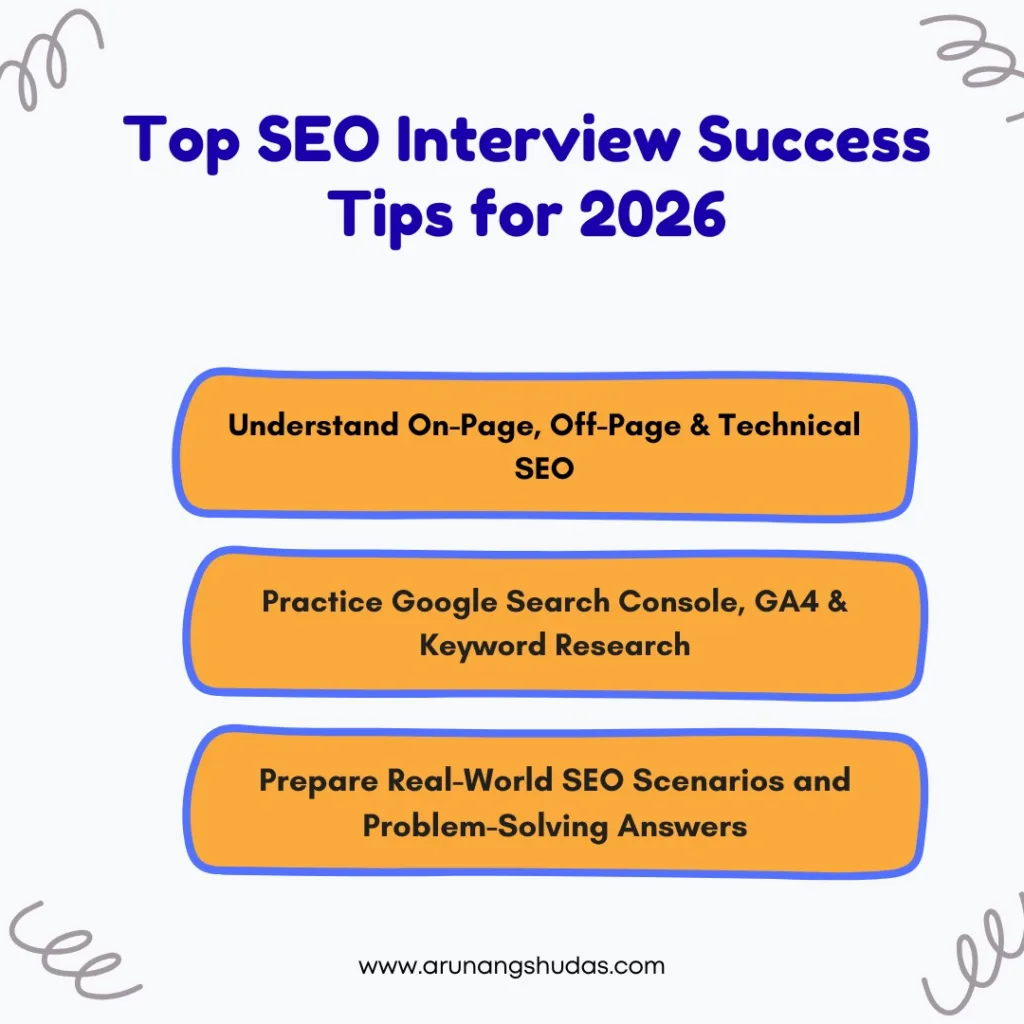
How to Prepare for an SEO Interview
Before attending an interview, make sure you can:
- Explain SEO concepts in simple language.
- Perform keyword research.
- Audit a website.
- Use Google Search Console and Google Analytics.
- Understand indexing and crawling.
- Read performance reports.
- Identify technical SEO issues.
- Stay updated with Google’s algorithm changes.
Essential SEO Skills Recruiters Look For
| Skill | Why It Matters | Common Interview Question |
| Keyword Research | Finds search opportunities | How do you select keywords? |
| On-Page SEO | Improves page relevance | How do you optimize a webpage? |
| Technical SEO | Improves crawling and indexing | What is the crawl budget? |
| Link Building | Builds authority | How do you earn backlinks? |
| Analytics | Measures SEO success | Which KPIs do you monitor? |
| Content Strategy | Improves rankings | How do you optimize content? |
Basic SEO Interview Questions and Answers
1. What is SEO?
SEO (Search Engine Optimization) is the process of optimizing a website to improve its visibility in search engine results. The objective is to increase organic traffic by making pages more relevant, useful, and technically accessible.
2. Why is SEO important?
SEO helps businesses:
- Increase organic traffic
- Build credibility
- Improve brand visibility
- Generate qualified leads
- Reduce dependency on paid advertising
3. What are search engines?
Search engines are platforms like Google and Bing that crawl, index, and rank web pages based on relevance and quality.
This is one of the most common search engine optimization interview questions asked during interviews.
4. What is Crawling?
Crawling is the process where search engine bots discover webpages by following links.
5. What is Indexing?
Indexing means storing discovered webpages inside Google’s database so they can appear in search results.
6. What is Ranking?
Ranking determines where a webpage appears on the Search Engine Results Page (SERP). Google considers hundreds of ranking signals before displaying results. Similar to interview questions for data structures and algorithms, SEO interviews often evaluate your ability to analyze complex problems, apply logical thinking, and choose the most effective optimization strategy.
7. What are Keywords?
Keywords are words or phrases users type into search engines while searching for information.
Example:
- Best running shoes
- SEO agency Jaipur
- Digital marketing course
8. What is Keyword Intent?
Keyword intent describes the purpose behind a search.
Types include:
- Informational
- Navigational
- Commercial
- Transactional
Understanding user intent helps create content that satisfies searchers.
Types of Search Intent
| Intent | Example Keyword | Goal |
| Informational | What is SEO | Learn information |
| Navigational | Google Search Console | Visit a website |
| Commercial | Best SEO tools | Compare products |
| Transactional | Buy SEO course | Make a purchase |
9. What is On-Page SEO?
On-page SEO includes all optimization activities performed directly on a webpage.
Examples include:
- Title tags
- Meta descriptions
- Heading structure
- Internal linking
- Image optimization
- Keyword placement
- URL optimization
Many interviewers include this among seo marketing interview questions because it tests practical optimization knowledge.
10. What is Off-Page SEO?
Off-page SEO includes activities performed outside your website.
Examples:
- Link building
- Brand mentions
- Digital PR
- Guest posting
- Social sharing
Quality backlinks improve authority and trust.
11. What is Technical SEO?
Technical SEO focuses on improving website infrastructure.
Examples include:
- XML Sitemap
- Robots.txt
- HTTPS
- Canonical tags
- Schema markup
- Core Web Vitals
- Mobile optimization
12. What is a Meta Title?
A meta title is the clickable headline shown in search engine results.
Best practices:
- Keep under 60 characters
- Include the target keyword
- Make it compelling
- Avoid keyword stuffing
13. What is a Meta Description?
A meta description summarizes the webpage.
Although it isn’t a direct ranking factor, it improves click-through rate (CTR).
Recommended length:
- 150–160 characters
14. What are Backlinks?
Backlinks are links from external websites pointing to your website.
Google treats quality backlinks as signals of trust and authority.
15. What is Domain Authority?
Domain Authority (DA) is a third-party metric that predicts how likely a website is to rank.
While Google doesn’t officially use DA, many SEO professionals monitor it when analyzing competitors.
16. What is Page Authority?
Page Authority predicts the ranking strength of a specific webpage rather than an entire domain.
17. What is Anchor Text?
Anchor text is the clickable text used in a hyperlink.
Descriptive anchor text helps users and search engines understand the destination page.
18. What is Internal Linking?
Internal links connect pages within the same website.
Benefits include:
- Better navigation
- Improved crawlability
- Passing link equity
- Increasing page views
This topic frequently appears in seo interview question discussions because it directly impacts website structure.
19. What is an XML Sitemap?
An XML sitemap lists important pages that search engines should crawl and index.
It helps Google discover new or updated pages more efficiently.
20. What is Robots.txt?
Robots.txt instructs search engine bots which pages they can or cannot crawl.
Incorrect configurations may accidentally block important pages from indexing.
21. What is Google Search Console?
Google Search Console (GSC) is a free tool that helps website owners monitor their site’s performance in Google Search.
With GSC, you can:
- Monitor keyword rankings
- Check indexing status
- Find crawl errors
- Submit XML sitemaps
- Analyze impressions and clicks
- Improve Core Web Vitals
Questions about GSC are common in seo questions to ask in an interview because almost every SEO professional uses this tool daily.
22. What is Google Analytics 4 (GA4)?
Google Analytics 4 helps measure website traffic and user behavior.
Some important metrics include:
- Users
- Sessions
- Engagement Rate
- Average Engagement Time
- Conversions
- Traffic Sources
SEO professionals use GA4 to evaluate the success of organic campaigns.
23. What is Keyword Research?
Keyword research is the process of identifying search terms that people use on Google.
Popular tools include:
- Google Keyword Planner
- Ahrefs
- SEMrush
- Ubersuggest
- Google Search Console
Good keyword research balances search volume, competition, and user intent.
24. What are Long-Tail Keywords?
Long-tail keywords are more specific search phrases that usually have lower competition and higher conversion rates.
Example:
- Short-tail: SEO tools
- Long-tail: Best free SEO tools for beginners
25. What is Keyword Cannibalization?
Keyword cannibalization occurs when multiple pages target the same keyword, causing them to compete against each other.
It can reduce rankings and confuse search engines.
26. What is Duplicate Content?
Duplicate content refers to identical or very similar content appearing on multiple URLs.
It can be resolved by:
- Using canonical tags
- Creating unique content
- Redirecting duplicate pages
- Improving internal linking
27. What is a Canonical Tag?
A canonical tag tells search engines which version of a webpage should be considered the original.
This helps prevent duplicate content issues.
28. What is a 301 Redirect?
A 301 redirect permanently moves one URL to another while passing most of the SEO value.
Common uses include:
- Website migration
- URL changes
- Deleted pages
- HTTPS migration
29. What is a 404 Error?
A 404 error occurs when a webpage cannot be found.
Too many broken pages create a poor user experience and waste crawl budget.
30. What is the Crawl Budget?
Crawl budget refers to the number of pages Googlebot crawls on a website within a specific period.
Large websites should optimize crawl budget by:
- Removing duplicate pages
- Fixing broken links
- Blocking unnecessary URLs
- Improving internal linking
Technical SEO Interview Questions
31. What are Core Web Vitals?
Core Web Vitals measure user experience based on:
- Largest Contentful Paint (LCP)
- Interaction to Next Paint (INP)
- Cumulative Layout Shift (CLS)
Improving these metrics enhances both user experience and SEO. Like coding interview questions with solutions, technical SEO interviews often assess your ability to identify performance issues and apply practical solutions to improve website speed and overall search performance..
32. What is Mobile-First Indexing?
Google primarily indexes the mobile version of websites.
Therefore, every webpage should:
- Be mobile responsive
- Load quickly
- Display readable text
- Use optimized images
33. What is Structured Data?
Structured data helps search engines understand webpage content.
It can generate:
- Rich snippets
- FAQ results
- Product ratings
- Review stars
- Recipe cards
34. What is Schema Markup?
Schema Markup is structured data code added to webpages.
Common schema types include:
- FAQ
- Organization
- Product
- Article
- Breadcrumb
- Local Business
35. Why is HTTPS Important?
HTTPS encrypts user data and builds trust.
Google also considers HTTPS a ranking signal.
36. What is Page Speed?
Page speed measures how quickly a webpage loads.
Ways to improve it include:
- Compress images
- Minify CSS and JavaScript
- Enable caching
- Use a CDN
- Reduce server response time
Popular SEO Tools and Their Purpose
| Tool | Primary Use | Best For |
| Google Search Console | Performance Monitoring | Indexing & Search Visibility |
| Google Analytics 4 | Traffic Analysis | User Behavior |
| Ahrefs | Backlink Analysis | Competitor Research |
| SEMrush | Keyword Research | SEO Audits |
| Screaming Frog | Website Crawling | Technical SEO |
| PageSpeed Insights | Performance Testing | Core Web Vitals |
Local SEO Interview Questions
37. What is Local SEO?
Local SEO focuses on improving visibility in location-based searches.
Examples:
- Dentist near me
- SEO company in Jaipur
- Digital marketing agency nearby
38. What is Google Business Profile?
Google Business Profile helps businesses appear in Google Search and Maps.
Optimizing the profile includes:
- Correct business information
- Business categories
- Reviews
- Photos
- Services
- Business hours
39. What are NAP Citations?
NAP stands for:
- Name
- Address
- Phone Number
Consistency across directories improves local search rankings.
40. Why Are Online Reviews Important?
Positive reviews:
- Increase trust
- Improve local rankings
- Influence customer decisions
- Improve click-through rates
41. What Are Local Citations?
Local citations are online mentions of a business across:
- Directories
- Local listings
- Business websites
- Review platforms
42. How Do You Improve Local Rankings?
Methods include:
- Optimizing Google Business Profile
- Building citations
- Getting customer reviews
- Creating local landing pages
- Using location-specific keywords
Many recruiters include these among seo questions for business because local SEO directly impacts lead generation. Similarly, companies that hire technical professionals often combine SEO assessments with full stack developer interview questions to evaluate candidates who work closely with development teams on website performance and optimization.
SEO Scenario-Based Interview Questions
43. Your traffic suddenly dropped. What would you do?
Steps:
- Check Google Search Console.
- Identify indexing issues.
- Review algorithm updates.
- Analyze backlinks.
- Audit technical SEO.
- Compare competitor rankings.
- Fix affected pages.
44. A page is indexed but not ranking. Why?
Possible reasons include:
- Weak content
- Poor search intent
- Low authority
- Keyword competition
- Slow page speed
- Thin content
45. How do you improve click-through rate (CTR)?
Ways include:
- Better title tags
- Attractive meta descriptions
- Structured data
- Featured snippets
- Strong value propositions
46. What KPIs Do You Track?
Important SEO KPIs:
- Organic Traffic
- Keyword Rankings
- Conversions
- Bounce Rate
- Engagement Rate
- Pages Indexed
- CTR
- Backlinks
Interviewers often include these in questions to ask an seo candidate because they reveal whether a candidate understands SEO performance measurement.
47. What is E-E-A-T?
E-E-A-T stands for:
- Experience
- Expertise
- Authoritativeness
- Trustworthiness
Google uses these principles to evaluate content quality, especially for industries like healthcare, finance, and legal services. Demonstrating first-hand experience, citing reliable sources, and maintaining transparent author information can strengthen E-E-A-T signals. Similar to restful api interview questions, SEO interviews also assess your understanding of industry best practices, technical concepts, and your ability to apply them in real-world scenarios.
48. What is Google’s Helpful Content System?
Google’s Helpful Content System rewards content created primarily for users rather than search engines.
Best practices include:
- Answer user queries completely.
- Write original content.
- Avoid keyword stuffing.
- Demonstrate real expertise.
- Update outdated content regularly.
49. What is Search Intent?
Search intent is the reason behind a user’s search query.
The four primary types are:
- Informational
- Navigational
- Commercial Investigation
- Transactional
Creating content that matches user intent improves rankings and conversions.
50. What is Semantic SEO?
Semantic SEO involves creating content around a topic rather than repeating the same keyword.
It includes:
- Related keywords
- Entity optimization
- Topic clusters
- Internal linking
- Comprehensive answers
This helps search engines understand context and improves topical authority.
51. What is Topical Authority?
Topical authority is earned when a website publishes comprehensive, high-quality content covering an entire subject.
For example, instead of writing only one SEO article, publishing guides on technical SEO, local SEO, keyword research, link building, and analytics establishes expertise.
52. How Does AI Affect SEO?
Artificial intelligence has transformed SEO by improving:
- Keyword research
- Content optimization
- Search intent analysis
- Content recommendations
- SERP analysis
- Predictive insights
However, AI-generated content should always be reviewed, edited, and enhanced with human expertise.
53. What is Voice Search Optimization?
Voice searches are typically conversational.
Optimization techniques include:
- Answering questions directly
- Using long-tail keywords
- Adding FAQ sections
- Improving page speed
- Optimizing for mobile devices
54. What Are Featured Snippets?
Featured snippets are highlighted search results that answer a user’s query directly.
To increase your chances:
- Use question-based headings.
- Write concise answers.
- Add numbered and bulleted lists.
- Include tables where appropriate.
55. How Do You Measure SEO Success?
Common performance metrics include:
- Organic traffic
- Keyword rankings
- Conversion rate
- Click-through rate (CTR)
- Impressions
- Indexed pages
- Backlinks
- Engagement metrics
- Revenue from organic traffic
56. Which SEO Tools Should Every Professional Know?
A strong SEO professional should be familiar with:
- Google Search Console
- Google Analytics 4
- Ahrefs
- SEMrush
- Screaming Frog
- PageSpeed Insights
- Google Keyword Planner
- Bing Webmaster Tools
Common SEO Interview Topics
| Interview Topic | What Interviewers Expect |
| Keyword Research | Finding relevant keywords based on search intent |
| Technical SEO | Understanding indexing, crawling, redirects, and Core Web Vitals |
| On-Page SEO | Optimizing titles, headings, content, and internal links |
| Off-Page SEO | Link building strategies and authority building |
| Local SEO | Google Business Profile, citations, and reviews |
| Analytics | Using GA4 and Google Search Console effectively |
| Problem Solving | Identifying ranking drops and proposing SEO solutions |

Conclusion
Preparing for SEO interviews in 2026 requires more than memorizing definitions. Recruiters look for candidates who understand search intent, technical SEO, content optimization, analytics, user experience, and Google’s evolving ranking systems. Building hands-on experience with real websites, performing SEO audits, and staying informed about algorithm updates will help you stand out from other candidates.
Whether you’re a fresher starting your digital marketing career or an experienced SEO professional aiming for a senior role, practicing these interview questions and understanding the reasoning behind each answer will significantly improve your interview performance. Keep learning, apply SEO best practices to real projects, and confidently showcase your skills during your next interview.
Frequently Asked Questions
1. What are the most common SEO interview questions?
Interviewers commonly ask about keyword research, on-page SEO, technical SEO, backlinks, Google Search Console, Google Analytics, Core Web Vitals, and website auditing. Practical scenario-based questions are also very common.
2. How should freshers prepare for an SEO interview?
Freshers should focus on SEO fundamentals, practice website audits, understand search intent, learn Google Search Console and GA4, and stay updated with recent Google algorithm changes.
3. Which SEO tools should I mention during an interview?
You can mention tools such as Google Search Console, Google Analytics 4, Ahrefs, SEMrush, Screaming Frog, Google Keyword Planner, and PageSpeed Insights. Explain how you’ve used them in real projects whenever possible.
4. Are technical SEO questions important in interviews?
Yes. Most employers expect candidates to understand topics such as XML sitemaps, robots.txt, canonical tags, redirects, schema markup, mobile-first indexing, HTTPS, and Core Web Vitals.
