



Freemium vs Free Trial represents one of the most critical strategic crossroads for any Software-as-a-Service (SaaS) business. This decision is far more than a simple pricing tactic; it is a fundamental statement about your product’s value proposition, your target audience, and your company’s long-term growth engine.
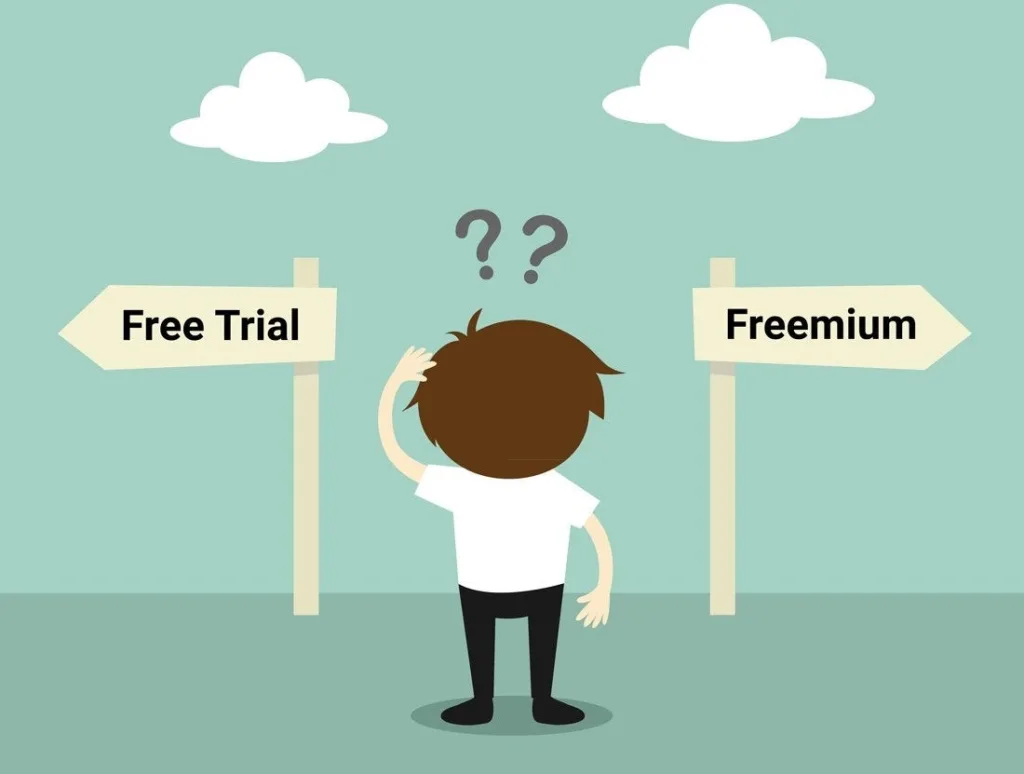
Choosing between freemium vs free trial is a pivotal decision for your SaaS pricing models. While both aim to lower the barrier to entry, they function as different growth engines.
- Freemium: A “forever free” version of your product with limited features or capacity.
- Free Trial: Full access to all premium features but only for a limited time (e.g., 14 days).
Freemium vs Free Trial: At a Glance
If you are looking for the quick answer on freemium vs trial conversion and strategy:
- Freemium works best for simple products with a “viral” hook. It focuses on massive user acquisition and long-term brand building.
- Free Trial works best for complex, B2B software. It focuses on high-intent users and faster sales cycles by showcasing the “full power” of the tool immediately.
Read more blog : Top 10 AI Websites to Create Stunning Images in 2026
Defining the Models with Real-World Examples
What is the Freemium Model?
The Freemium model offers a permanently free version of the software with limited features, capacity, or usage. The goal is to remove all barriers to entry, allowing users to experience the core value of the product indefinitely. Monetization occurs when a segment of these free users eventually hits a limitation—such as needing more storage, advanced features, or higher usage limits—and choose to upgrade to a paid plan.
Real SaaS Examples:
- Slack: Free for small teams with a 90-day message history limit.
- Dropbox: Provides 2GB of free storage to get users hooked on cloud syncing.
- Zoom: Unlimited 1-on-1 meetings for free, but group meetings are capped at 40 minutes.
- Canva: Thousands of free templates; premium elements require a Pro subscription.
What is the Free Trial Model?
The Free Trial model offers full, unrestricted access to the entire paid feature set of the software for a limited time, typically 7, 14, or 30 days. The objective is to immerse the user in the complete product experience, demonstrating its maximum value so compellingly that they feel compelled to pay to avoid losing access once the trial period ends.
Real SaaS Examples:
- Shopify: A 3-day trial (often followed by a discounted month) to build a store.
- Adobe Creative Cloud: 7 days to test Photoshop or Premiere Pro at full capacity.
- Salesforce: 30 days to integrate CRM data and see enterprise-level reporting.
Freemium vs Free Trial: Key Differences
| Feature | Freemium Model | Free Trial Model |
| Duration | Unlimited / Forever | Limited (7, 14, or 30 days) |
| Feature Access | Limited / Basic | Full / Premium |
| Primary Goal | User Acquisition & Virality | Sales Conversion & Revenue |
| Average Conversion | Lower (2% – 5%) | Higher (10% – 25%) |
| Ideal For | B2C or “Bottom-up” B2SaaS | Complex B2B / Enterprise |
| Support Cost | High (due to volume) | Low (focused on active leads) |
Weighing the Pros and Cons
The Case for Freemium
Pros:
- Viral Growth: Low friction leads to rapid word-of-mouth and “bottom-up” adoption.
- Data Goldmine: A massive user base provides endless data for product improvement.
- Lower Marketing Costs: The free product acts as its own lead magnet.
Cons:
- The “Free” Trap: Many users will never pay, leading to high server and support costs.
- Lower Urgency: Without a deadline, users may take months to decide to upgrade.
The Case for Free Trial
Pros:
- Higher Intent: People signing up for trials are usually ready to solve a problem now.
- Showcases Full Value: Users don’t hit “paywalls” while trying to see if the tool works.
- Faster Revenue: The 14 or 30-day limit creates a natural “buy” or “leave” decision point.
Cons:
- The “Empty House” Problem: If your software is hard to set up, users might quit before they see the value.
- Higher Friction: Some users are “trial-shy” and won’t sign up if they feel rushed.
Which One Should You Choose?
Choosing the right SaaS pricing models depends on your product’s DNA. Use this checklist to decide:
Choose Freemium if:
- Your product has a “Network Effect” (it gets better as more people use it).
- Your “Time-to-Value” is instant (users see the benefit in 5 minutes).
- Your cost to support one extra user is near zero.
Choose Free Trial if:
- Your product is “Enterprise” or requires complex integration.
- Your value proposition is only clear when using all the features.
- You have a dedicated sales team to follow up with leads during the trial.
This deep dive will unpack the mechanics of both the Freemium and Free Trial models, analyze their strengths and weaknesses, and provide a framework to determine which is the most effective choice for your specific product and business goals.
Before weighing the pros and cons, it’s crucial to clearly define what each model entails.
Conclusion: It’s About Alignment
The Freemium vs Free Trial debate has no single winner. The Freemium model is a long-term, wide-net strategy focused on building a community and monetizing through scale. The Free Trial is a short-term, targeted strategy focused on demonstrating overwhelming value to motivated buyers.
The best choice hinges on a deep understanding of your product’s inherent value, your customer’s journey, and your company’s operational strengths. By aligning your user acquisition model with these core factors, you can build a predictable and profitable pipeline for your SaaS business.
Frequently Asked Questions (FAQs)
1. Can I use both a Freemium and a Free Trial model?
Yes, this is a increasingly common and powerful hybrid strategy. A company might offer a permanent free plan with basic features to build its user base (Freemium) and also offer a 14-day trial of its “Pro” or “Enterprise” plan to allow free users to experience the advanced features before making a purchasing decision. This caters to different user intents simultaneously.
2. What is a good conversion rate for a Freemium model?
Freemium conversion rates are typically low. A rate between 2% and 5% is generally considered average for the model, though this can vary widely by industry and product type. The key is to ensure the lifetime value (LTV) of a converted customer is high enough to justify the cost of supporting the large number of free users.
3. Should I require a credit card for a Free Trial?
This is a hotly debated topic. Requiring a credit card (“hard gate”) leads to higher conversion rates from trial to paid because it attracts more serious users and creates a seamless transition to paying. However, it significantly reduces the number of people who sign up for the trial in the first place. Not requiring a credit card (“soft gate”) maximizes sign-ups but can lead to lower conversion rates and less qualified leads. The best choice depends on your product’s price point and complexity.
