



In an era where data reigns supreme, machine learning has emerged as a transformative force, enabling computers to learn from data and make predictions or decisions without being explicitly programmed. This technology has revolutionized industries, from healthcare to finance, marketing to transportation. But how does machine learning really work?
Understanding the Basics:
At its core, machine learning is a subset of artificial intelligence (AI) that focuses on enabling computers to learn from data and improve their performance over time without human intervention. The process involves feeding data into algorithms that iteratively learn patterns from the data and make informed decisions or predictions.
Read more blog : How Artificial Intelligence Works?
The 7-Step Lifecycle of an ML Model
Modern ML development follows a rigorous pipeline. To build a model that lasts, you must follow these phases:
| Phase | Key Objective |
| 1. Data Acquisition | Sourcing high-fidelity data from IoT, APIs, or synthetic generators. |
| 2. Preprocessing | Cleaning “noisy” data and normalizing features to ensure mathematical consistency. |
| 3. Feature Engineering | Selecting the most relevant variables that impact the prediction. |
| 4. Training | Running the data through algorithms like Neural Networks or XGBoost. |
| 5. Validation | Testing the model on “unseen” data to check for Overfitting. |
| 6. Hyperparameter Tuning | Fine-tuning the model’s internal settings for peak performance. |
| 7. Deployment & MLOps | Integrating the model into a live environment with continuous monitoring. |
Types of Machine Learning:
Machine learning algorithms can be broadly categorized into three main types:
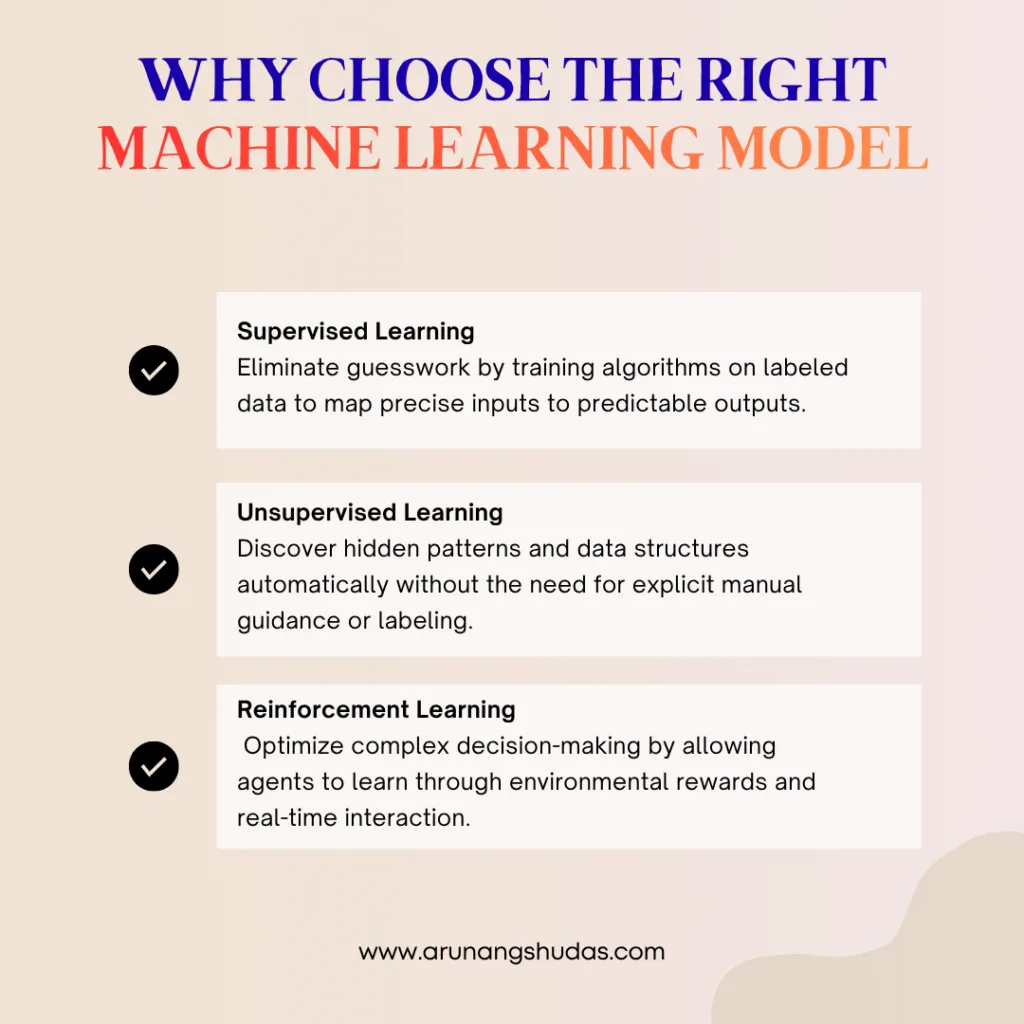
- Supervised Learning: In supervised learning, the algorithm learns from labeled data, where each input is tagged with the correct output. The algorithm then learns to map inputs to outputs, making predictions on unseen data. Common algorithms used in supervised learning include linear regression, decision trees, and neural networks.
- Unsupervised Learning: Unsupervised learning involves learning from unlabeled data, where the algorithm must find patterns or structure in the data without explicit guidance. Clustering algorithms, such as K-means and hierarchical clustering, are examples of unsupervised learning techniques used for tasks like customer segmentation or anomaly detection.
- Reinforcement Learning: Reinforcement learning is a type of learning where an agent learns to make decisions by interacting with an environment. The agent receives feedback in the form of rewards or penalties based on its actions, and it learns to optimize its behavior to maximize cumulative reward over time. Reinforcement learning has applications in gaming, robotics, and autonomous systems.
The Learning Process:
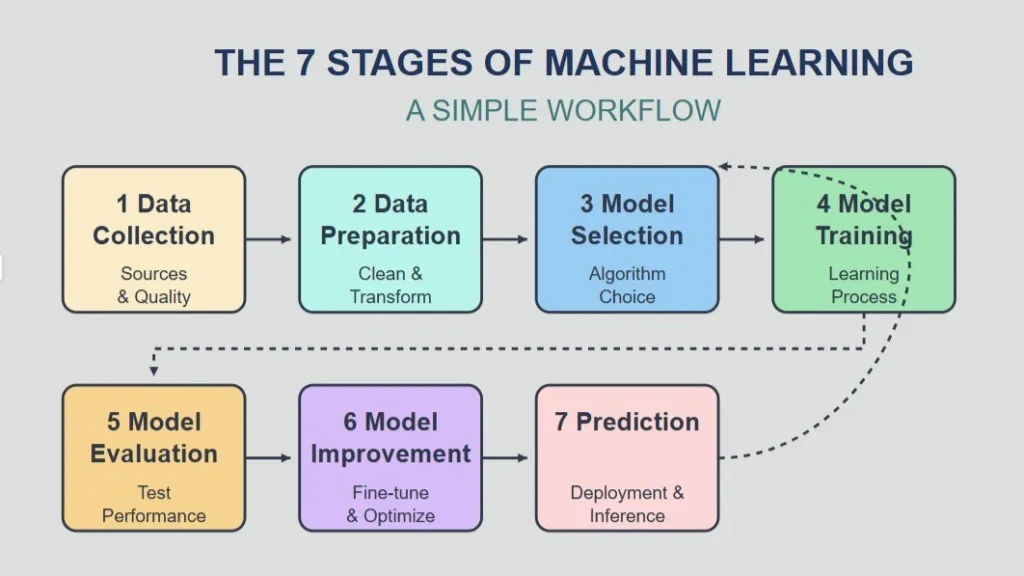
- Data Collection: The first step in any machine learning project is gathering relevant data. This data can come from various sources, such as databases, sensors, or web scraping.
- Data Preprocessing: Once the data is collected, it needs to be cleaned and prepared for analysis. This involves tasks like handling missing values, removing outliers, and scaling features.
- Model Selection: Choosing the right algorithm or model depends on the nature of the problem and the available data. Different algorithms have different strengths and weaknesses, so it’s essential to experiment with multiple models to find the best fit.
- Training: In the training phase, the algorithm is fed with the labeled or unlabeled data, and it adjusts its internal parameters to minimize a predefined error metric, such as mean squared error or cross-entropy loss.
- Evaluation: After training, the model’s performance is evaluated using a separate dataset, called the validation set or test set. This step helps assess how well the model generalizes to unseen data and identifies any overfitting or underfitting issues.
- Fine-Tuning: Depending on the evaluation results, the model may undergo further optimization, such as adjusting hyperparameters or incorporating additional features, to improve its performance.
- Deployment: Once the model meets the desired performance criteria, it can be deployed into production environments to make predictions or decisions in real-time.
Challenges and Considerations:
- Data Quality: The quality of the input data significantly impacts the performance of machine learning models. Noisy or biased data can lead to erroneous predictions and unreliable outcomes.
- Overfitting and Underfitting: Balancing the complexity of the model is crucial to avoid overfitting (where the model learns the training data too well but fails to generalize) or underfitting (where the model is too simplistic to capture the underlying patterns).
- Interpretability: Some machine learning models, particularly complex ones like deep neural networks, lack interpretability, making it challenging to understand how they arrive at their decisions. This is a significant concern, especially in domains like healthcare or finance, where transparency and accountability are essential.
- Ethical and Societal Implications: Machine learning systems can perpetuate or amplify biases present in the data, leading to unfair or discriminatory outcomes. Ensuring fairness, transparency, and accountability in machine learning algorithms is critical to mitigating these risks.
Read more blogs : How AI and Machine Learning Are Changing Stock Market Trading in 2026?
Future Directions:
As technology continues to advance, the field of machine learning is evolving rapidly. Some key areas of future development include:
- Explainable AI: Researchers are working on developing machine learning models that are more interpretable and transparent, allowing users to understand the reasoning behind their decisions.
- Federated Learning: Federated learning enables training machine learning models across decentralized devices or servers while keeping the data localized, addressing privacy concerns associated with centralized data storage.
- Automated Machine Learning (AutoML): AutoML aims to automate the process of model selection, hyperparameter tuning, and feature engineering, democratizing machine learning and making it accessible to non-experts.

Machine learning has ushered in a new era of computing, enabling computers to learn from data and perform tasks that were once thought to be the exclusive domain of human intelligence. By understanding the underlying principles and mechanisms of machine learning, we can harness its power to solve complex problems and drive innovation across diverse domains. As we continue to push the boundaries of technology, the possibilities of machine learning are limitless, promising a future where intelligent systems enhance human capabilities and transform the world we live in.
Frequently asked questions
1. What is the main difference between Supervised and Unsupervised Learning?
The primary difference lies in the labels. In Supervised Learning, the algorithm is trained on data that already contains the “correct” answers (labeled data), like a student learning with a teacher. In Unsupervised Learning, the algorithm is given raw data without any labels and must find its own hidden patterns or groupings (clustering) without guidance.
2. Why is “Data Preprocessing” considered a critical step in the process?
Raw data is often “messy”—it may have missing values, outliers, or inconsistent formats. If you feed poor-quality data into a model (a concept known as “Garbage In, Garbage Out”), the predictions will be inaccurate. Preprocessing ensures the data is clean, scaled, and organized so the algorithm can learn effectively.
3. What do “Overfitting” and “Underfitting” mean?
These terms describe how well a model has learned the patterns in data:
Overfitting: The model learns the training data too well, including the random noise. It performs great on its own data but fails to predict new, unseen data accurately.
Underfitting: The model is too simple to see the patterns at all. It performs poorly on both the training data and new data.
4. How does Reinforcement Learning differ from other types of ML?
Unlike Supervised or Unsupervised learning, Reinforcement Learning is based on an agent interacting with an environment. It doesn’t learn from a static dataset; instead, it learns through trial and error, receiving “rewards” for good moves and “penalties” for bad ones, similar to how one might train a dog or learn a video game.
5. Why is “Interpretability” a challenge in modern machine learning?
As models become more complex (like Deep Neural Networks), they often become “black boxes.” While they might provide highly accurate predictions, it is difficult for humans to see why the model made a specific decision. This is a major concern in high-stakes fields like healthcare or finance, where understanding the reasoning behind a decision is just as important as the decision itself.
