


Artificial Intelligence (AI) has become a buzzword in modern society, promising to revolutionize industries, reshape economies, and redefine the way we interact with technology. But how does AI actually work? What powers its ability to mimic human intelligence and make decisions? Lets find it
Understanding Artificial Intelligence:
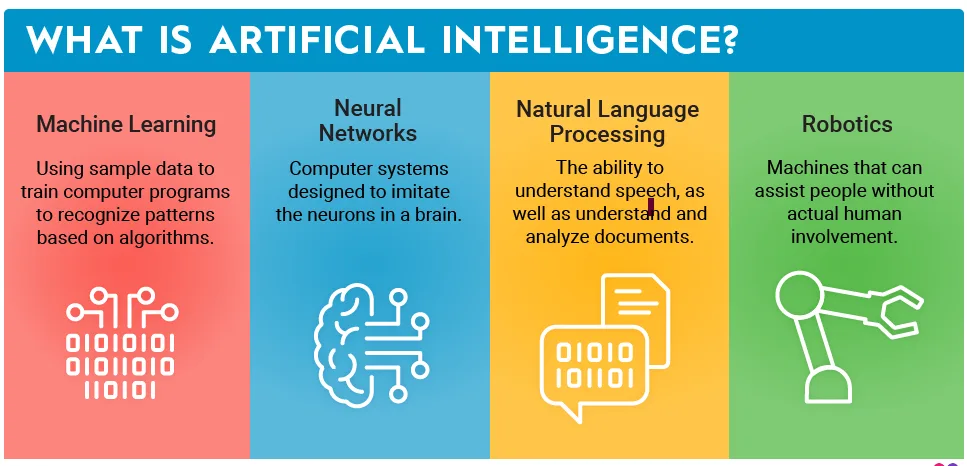
At its core, artificial intelligence aims to replicate human cognitive functions such as learning, reasoning, problem-solving, perception, and decision-making using machines. Unlike traditional computer programs that follow predetermined instructions, AI systems can adapt and learn from data, improving their performance over time.
To make this section truly “SEO-friendly” and engaging for your blog, we need to balance technical accuracy with high scannability. This helps readers (and search engines) identify the core “building blocks” of AI quickly.
Here is the optimized version for your blog, followed by a creative infographic plan for your social media.
The AI Overview: Tech, Tools, and Trials
| Category | Key Element | What it Does | Real-World Example |
| Core Components | Machine Learning | Learns patterns from data without direct coding. | Recommendation engines (Netflix/YouTube). |
| Neural Networks | Mimics the human brain to solve complex logic. | Advanced Deep Learning & AI Art. | |
| NLP | Understands and generates human language. | Chatbots like ChatGPT & Translation apps. | |
| Computer Vision | Processes and interprets visual information. | Face ID & Self-driving car navigation. | |
| Industry Apps | Healthcare | Early diagnosis and drug discovery. | Analyzing MRI scans for tumors. |
| Finance | Fraud detection and automated trading. | Instant alerts for suspicious bank activity. | |
| Transportation | Navigation and traffic optimization. | Autonomous Teslas & Waymo. | |
| Customer Service | 24/7 support and personalization. | Virtual assistants resolving refunds. | |
| Challenges | Ethics & Bias | Preventing human prejudice in code. | Ensuring hiring AI is fair to everyone. |
| Privacy | Securing personal data used for training. | GDPR compliance & data encryption. | |
| Society | Managing job shifts and automation. | Upskilling workers for a tech-first world. |
The Core Pillars: Key Components of AI
Modern Artificial Intelligence is built on a few foundational technologies. Think of these as the “senses” and the “brain” of the machine:
Read more blog : AI Tools Every Marketer Needs in 2026
AI for Students: Study Smarter, Not Harder
1. Machine Learning (ML): The Engine of Growth
Machine Learning is a subset of AI that allows systems to learn from experience rather than just following fixed rules. By processing vast amounts of data, ML algorithms identify hidden patterns and improve their prediction accuracy over time without being explicitly programmed for every scenario.
2. Neural Networks: The Digital Brain
Inspired by the human brain’s architecture, Neural Networks consist of layers of interconnected “neurons” (nodes). These networks are the powerhouse behind “Deep Learning.” During training, they adjust the strength of their internal connections to solve complex problems like facial recognition or strategic gamin. NLP is the bridge between human communication and machine understanding. It allows AI to read, interpret, and generate human language.
- Common uses: Sentiment analysis, real-time translation, and the conversational intelligence found in modern chatbots and virtual assistants.
4. Computer Vision (CV): The Machine’s Eyes
Computer Vision enables machines to “see” and interpret the physical world through digital images and video. By recognizing objects, gestures, and scenes, CV powers everything from self-driving car navigation to advanced medical diagnostics and security surveillance.
How AI Works: From Raw Data to Intelligence
Artificial Intelligence doesn’t just “happen”; it is the result of a rigorous, multi-step pipeline. Here is the journey of an AI model:
1. Data Collection: The Fuel
The foundation of any AI is data. Whether it’s text, images, or sensor readings, this raw information serves as the “fuel” for the system. The quality and diversity of this data directly determine how well the AI will eventually perform.
2. Data Preprocessing: The Refining Process
Raw data is often “messy”—full of errors, duplicates, or missing values. Preprocessing involves cleaning and normalizing this data. By using techniques like feature extraction, we highlight the most important information, making it easier for the model to learn.
3. Model Training: The Learning Phase
This is where the magic happens. The preprocessed data is fed into a machine learning algorithm. The model looks for patterns by adjusting its internal parameters (like weights in a neural network). The goal is to minimize the error between its guesses and the actual reality.
4. Evaluation and Validation: The Quality Check
Before an AI goes live, it must be tested against data it hasn’t seen before. We check for:
- Overfitting: The model memorized the training data but can’t handle new info.
- Underfitting: The model is too simple to understand the patterns. This step ensures the AI is reliable and accurate.
5. Deployment and Inference: The Real-World Application
Once validated, the model moves into “Inference” mode. It is deployed into a real-world app (like a chatbot or a self-driving system) where it takes live input and provides instant predictions or decisions.
The Power & Responsibility of AI
Real-World Applications: AI in Action
AI is no longer a futuristic concept—it is actively reshaping how global industries operate:
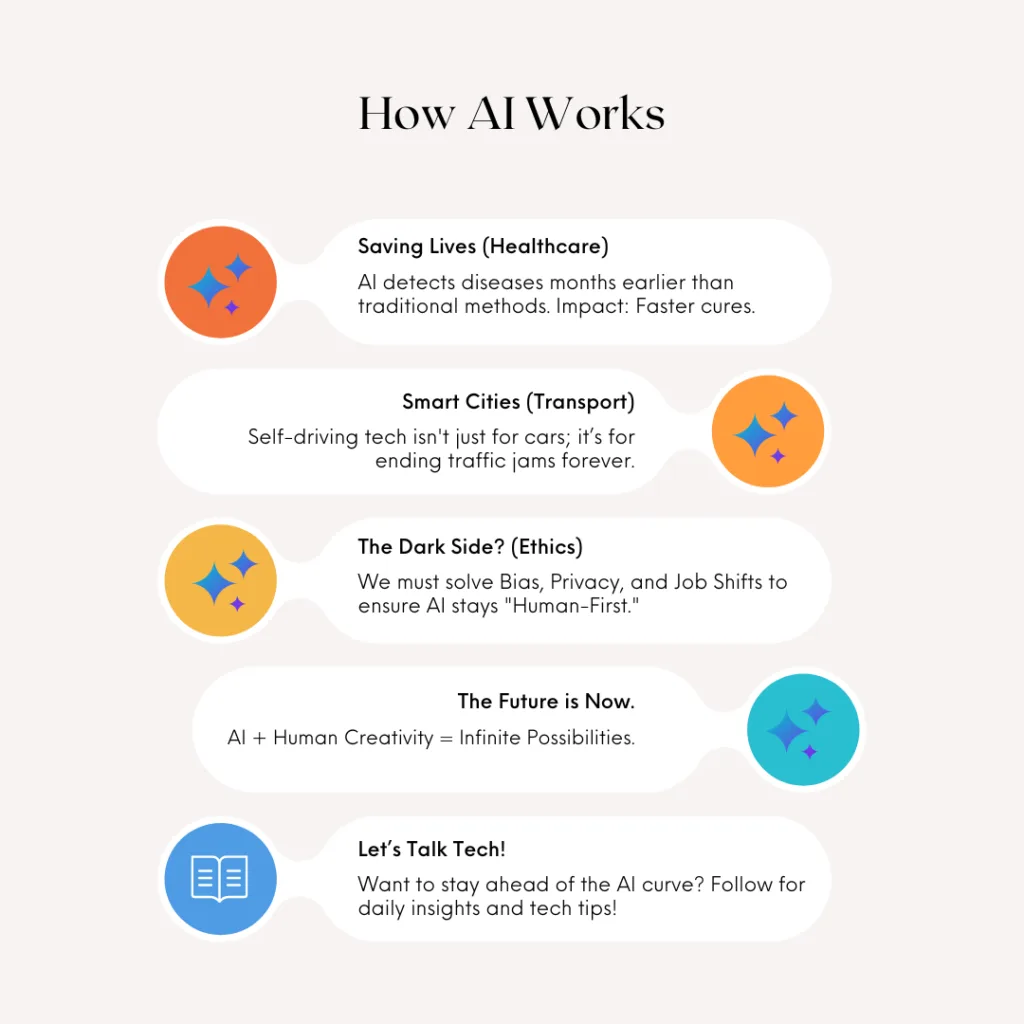
- Healthcare: From analyzing X-rays to discovering new drugs, AI enables early disease detection and creates personalized treatment plans tailored to your DNA.
- Finance: AI powers the “engine” of modern banking through instant fraud detection, algorithmic trading, and automated financial advisors.
- Transportation: Beyond self-driving cars, AI optimizes entire city traffic flows and manages complex global logistics to reduce carbon footprints.
- Customer Service: AI-driven assistants provide 25/7 support, resolving issues instantly and creating hyper-personalized shopping experiences.
- Manufacturing: Smart factories use AI for “predictive maintenance”—fixing machines before they break—and managing supply chains with precision.
The Ethical Frontier: Navigating the Challenges
Great power requires even greater responsibility. As we integrate AI into society, we must address critical hurdles:
- Algorithmic Bias: Ensuring AI doesn’t inherit human prejudices.
- Data Privacy: Protecting the massive amounts of personal info used to train models.
- Workforce Evolution: Managing job shifts as automation takes over repetitive tasks.
- Autonomous Ethics: Deciding how machines should make life-or-death decisions.
The Bottom Line: AI is a tool for human empowerment. By understanding its mechanics and addressing its risks, we can build a future where technology doesn’t just work—it works for everyone.

How Arunangshudas Helps You Navigate the AI Era
In a world where technology moves at lightning speed, Arunangshudas acts as your strategic bridge between complex AI concepts and real-world results. By breaking down the technical “black box” of Machine Learning and NLP into actionable insights, he empowers businesses and creators to stay ahead of the curve. Whether it’s optimizing content for search intelligence or implementing AI-driven marketing strategies, Arunangshudas focuses on responsible and innovative growth. His approach ensures that you aren’t just using AI—you are mastering it to drive efficiency, enhance creativity, and build a future-proof digital presence.
Conclusion: Embracing the AI Revolution
The journey of Artificial Intelligence, from raw data collection to real-world deployment, is fundamentally changing how we live and work. By mastering its core components—like Machine Learning and Computer Vision—and applying them across sectors like healthcare and finance, we unlock unprecedented potential for innovation. However, the true power of AI lies in responsible implementation.
As we move forward, the goal is to balance technological advancement with ethical integrity, ensuring that AI remains a tool that empowers humanity and solves our most complex global challenges. The future isn’t just about smarter machines; it’s about smarter synergy between human creativity and artificial intelligence.
Frequently Asked Questions (FAQs)
1. What is the difference between AI and Machine Learning?
Artificial Intelligence is the broad concept of machines acting “smart,” while Machine Learning is a specific subset of AI. ML is the method that allows machines to learn from data patterns on their own without being manually programmed for every task.
2. How does AI affect data privacy?
AI requires vast amounts of data to learn effectively. This raises privacy concerns regarding how personal information is collected, stored, and used. To protect users, it is crucial to follow data regulations and use ethical AI frameworks that prioritize user anonymity and security.
3. Will AI replace human jobs?
While AI will automate repetitive and manual tasks, it is also creating entirely new job categories in tech, ethics, and data management. The future of work is shifting toward “human-AI collaboration,” where AI handles the data and humans provide the strategy and empathy.
4. Can AI make mistakes?
Yes. AI is only as good as the data it is trained on. If the training data is biased or incomplete, the AI can produce “hallucinations” (incorrect information) or biased outcomes. This is why the Evaluation and Validation stage is so important.
5. How is AI used in everyday life?
You likely use AI every day without realizing it. It powers the facial recognition on your phone, the personalized recommendations on Netflix or Amazon, the voice assistants like Siri or Alexa, and even the spam filters in your email inbox.
