


This decade has made one thing perfectly clear: digital transformation strategies for small businesses are no longer an option—they are a requirement for survival. When people hear the phrase “digital transformation,” they often picture a room full of expensive developers or a massive, costly overhaul of their entire office. But that isn’t the reality. In practice, it simply means rethinking how your business operates, how you talk to your customers, and how you stay competitive in a digital-first world where standards and expectations change overnight.
Whether you’re running a local retail shop, a professional services firm, or a small manufacturing unit, this guide is built for the entrepreneurs and managers who know they need to evolve but aren’t quite sure where to start. You don’t need a massive corporate budget to revolutionize your operations; you just need a clear, actionable roadmap. By focusing on smart, scalable technology, you can start your journey toward digital transformation for small business success without breaking the bank, ensuring your brand stays relevant and resilient in 2026 and beyond.
What Is Small Business Digital Transformation?
This decade has made one thing perfectly clear: digital transformation is no longer a luxury reserved for tech giants—it’s a requirement for survival. When people hear the phrase “digital transformation,” they often picture a room full of expensive developers or a massive overhaul of their entire office. But that isn’t the reality. In practice, it entails completely rethinking how your business operates, engages with customers, and competes in a world where standards are always changing.
For small and medium-sized enterprises (SMEs), digital transformation is the strategic use of technology to radically enhance customer value delivery and business operations. It is more important than simply digitizing paper records or switching to digital tools; it’s about transforming your business model, culture, and customer relationships.
More infomation : How Custom ERP Development Transforms Small and Medium Businesses
Top Digital Transformation Tools for Small Businesses
| Tool | Purpose | Cost | Best For |
|---|---|---|---|
| Shopify | E-commerce platform | $29/month+ | Online retail |
| Google Analytics | Data insights | Free | Any business |
| Zapier | Workflow automation | $19.99/month+ | Process optimization |
| HubSpot CRM | Customer management | Free (basic) | Sales & marketing |
| Canva | Graphic design | Free (premium $12.99/month) | Social media marketing |
Breaking Down the Confusion: Digitization vs. Digitalization
I frequently see small business owners get confused between three terms that sound similar but mean very different things. To start your journey, you must know where you stand:
- Digitization: This is the simplest step—converting analog information into digital format. For example, scanning your paper invoices into PDFs or moving your customer contact book into an Excel sheet. You aren’t changing how you work; you’re just changing the format of your data.
- Digitalization: This is using those digital tools to improve a specific process. If you start sending those PDF invoices via email instead of post, you have digitalized a task. It makes your current way of working faster and cheaper, but the core process remains the same.
- Digital Transformation: This is the “big picture” move. It’s when you reimagine the entire business. Imagine a customer who orders a product on your website; that order automatically updates your inventory, triggers a shipping label, sends a personalized “Thank You” WhatsApp message, and updates your accounting software—all without a human touching a button. That is true transformation.
Why Transformation Is Critical in 2026
Your customers have changed. Whether they are buying a sourdough loaf from a local bakery or a laptop from a global retailer, they expect a seamless digital experience.
- Setting New Standards: Tech-focused startups are entering every niche, setting high expectations for speed and ease of use.
- Doing More with Less: Digital tools allow you to compete with much larger rivals by achieving higher output with fewer resources.
- Data over Intuition: Moving to digital means you stop “guessing” what works and start “knowing” based on actual insights.
Step-by-Step Digital Transformation Strategy for Small Businesses
I’ve witnessed far too many companies purchase flashy new software that ends up gathering digital dust because no one understood why they needed it in the first place. Prior to investing any money in technology, you need a structured approach. This digital transformation strategy for small businesses is designed to generate momentum quickly without overworking your employees or your budget.
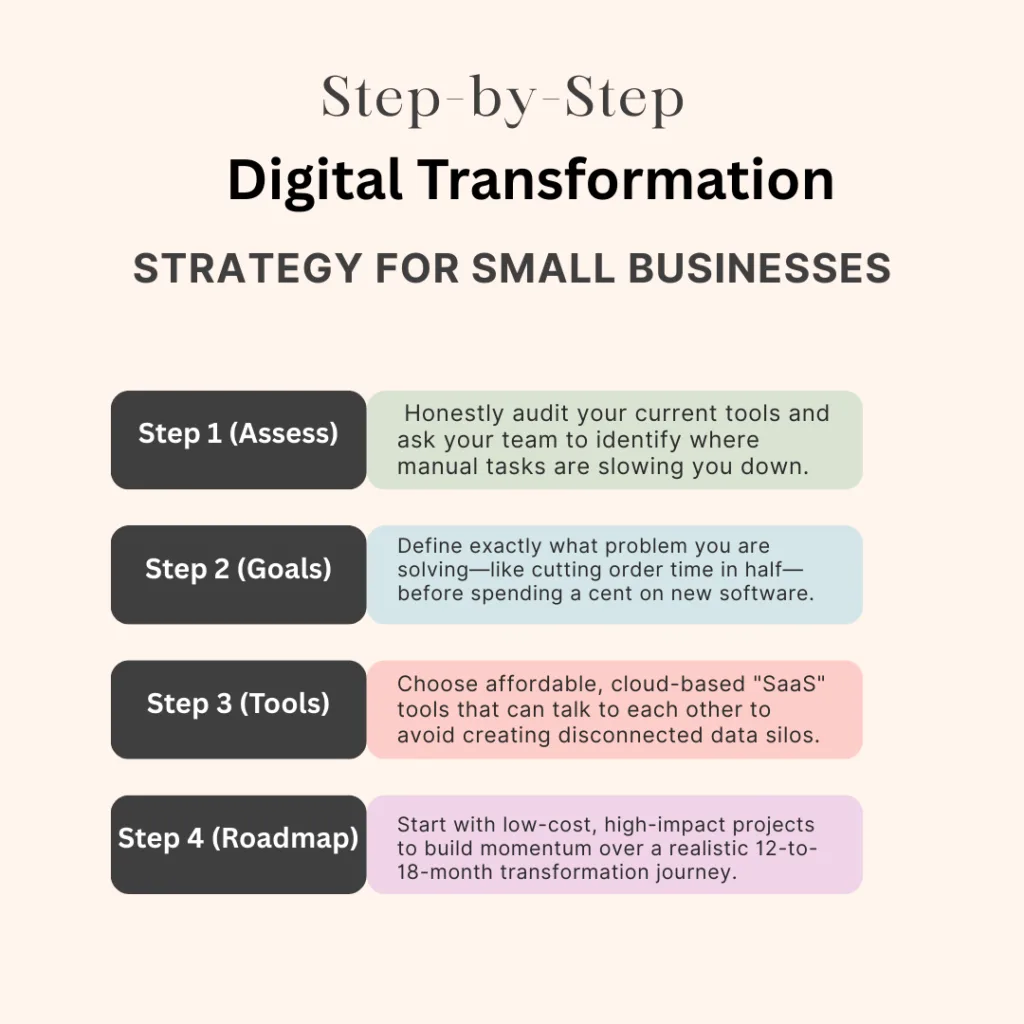
Step 1: Assess Your Digital Maturity
Be honest about your starting point. Audit your procedures and technology. Does your team have the skills to use new tools? Where are the bottlenecks? Involving your entire staff in this evaluation is key—they often see the inefficiencies that management misses.
Step 2: Define Clear Business Goals
I’ve seen too many businesses buy “shiny” software that ends up gathering digital dust. Before spending a cent, ask: “What specific problem are we solving?” Whether it’s halving order processing time or increasing repeat customers by 20%, write it down.
Step 3: Choose the Right Tools (Buy vs. Build)
Small businesses should almost always “buy” rather than “build.” Look for scalable, affordable solutions (SaaS) that can grow with you. I always advise picking tools that talk to each other (interoperability) rather than isolated apps that create data silos.
Step 4: Create a Phased Roadmap
Start with low-cost, high-impact projects. This builds momentum and shows value to team members who might be skeptical. Don’t try to change everything in a week; a 12-to-18-month plan is much more realistic.
Read more blog : Top 5 Healthcare Startups & Digital Health Tech Disruptors
Key Areas of Focus for SMBs
- Operations & Automation: Use AI to handle manual invoicing or tedious data entry.
- Customer Experience (CX): Centralize your data. A simple CRM allows you to talk to customers across social media, email, and WhatsApp seamlessly.
- Finance & Accounting: Cloud-based software like QuickBooks makes financial health visible to everyone, not just the person holding the receipts.
Real-World Examples of Small Business Success
Take Warby Parker, which began as a small eyewear startup and used digital tools to disrupt the industry. By leveraging e-commerce and social media, they offered affordable glasses directly to consumers, bypassing traditional retail markups. Similarly, a small bakery like Crumbl Cookies grew from a single location to a national franchise by mastering Instagram marketing and online ordering.
Local examples abound too. A family-owned hardware store might adopt Square for payments and inventory, while a yoga studio uses Mindbody to manage bookings online. These stories prove that digital transformation isn’t reserved for tech giants—it’s a practical path for any small business willing to adapt.
Overcoming Common Challenges in Digital Transformation
Budget Constraints
Small businesses often worry about costs, but many digital tools offer free tiers or low entry points. Start with free versions of Google Workspace or Mailchimp, then upgrade as revenue grows.
Lack of Expertise
You don’t need to be a tech wizard. Platforms like Coursera or Udemy offer affordable courses on digital marketing and analytics, while many tools provide intuitive tutorials.
Resistance to Change
Employees or owners may resist new systems. Highlight benefits—like time savings with Slack—and phase in changes gradually to ease the transition.
Conclusion: Embracing Digital Transformation for Long-Term Success
Digital transformation strategies for small businesses are not a luxury—they’re a necessity in a world where technology shapes every interaction. From cloud computing’s flexibility to social media’s reach, these strategies empower small businesses to punch above their weight, connecting with customers, streamlining operations, and driving growth. The beauty lies in their accessibility: tools like Shopify, Google Analytics, and Zapier are designed with small budgets and teams in mind, offering scalable solutions that evolve with your business. The data backs this up—businesses that embrace digital tools see faster growth, higher customer satisfaction, and greater resilience, as evidenced by McKinsey and Forbes studies. Yet, success hinges on more than just technology; it requires a mindset shift, a willingness to experiment, and a focus on customer needs. Start small—perhaps with a free CRM or a social media campaign—and build momentum.
The journey may feel daunting, but the rewards are tangible: a bakery going viral on TikTok, a consultant booking clients via Calendly, or a retailer thriving on Etsy. In 2025 and beyond, digital transformation isn’t just about survival—it’s about seizing opportunities to innovate, connect, and grow in ways that were once unimaginable for small businesses. The tools are at your fingertips; the time to act is now.
FAQ: Common Concerns for Small Businesses
Digital transformation too expensive for a small business?
Not anymore. With the rise of SaaS (Software as a Service), you can pay a small monthly fee instead of a massive upfront cost. Most tools now have “starter” tiers specifically for small teams.
Will automation replace my employees?
No. It replaces the “boring” parts of their jobs. By automating data entry or scheduling, your team can focus on what humans do best: strategy, creativity, and building customer relationships.
How do we handle data security?
Modern cloud providers (like Microsoft, Google, or specialized CRM firms) have security measures far more robust than a local server in a back office. Moving to the cloud often improves your security.
