


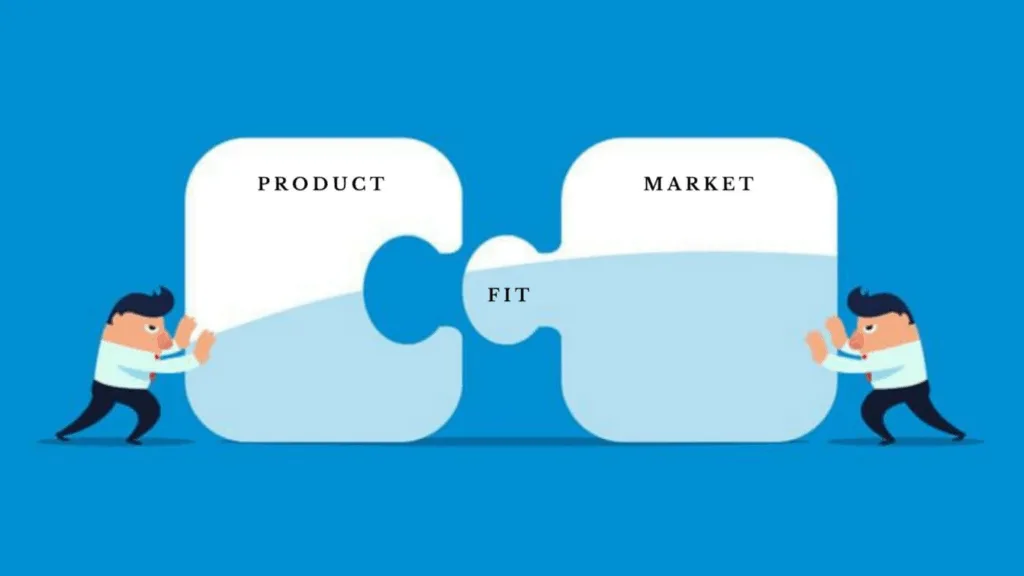
One of the most important milestones in any startup or a business is Finding Product-Market Fit. It is the invisible line between an idea that sounds good and one that works, a product that is loved, used and recommended by the customers. Product-Market Fit is difficult, though, as so many founders quickly discover. It is a continuous process, not a single instance, but a progression of getting to know your users, experimenting, developing your product, and trying to match your products with a real demand.
In this post, we are going to deconstruct what products market fit is, the product market fit meaning, the product fit framework, and some steps we can take to make founders (Small Business owners in particular, Women-Led Startups) more likely to reach this elusive target. We will also understand how to Get Funding for a Startup or why investors are interested in product-market fit and what Indian startup Exit Strategies rely on it.
Now, it is time to go into this guide and discover how to find the right way to Product- Market Fit and create something that is meaningful.
1. Understanding What is Product Market Fit
Then what exactly is the market fit product? In a straightforward terminology, Product-Market Fit implies that you have developed a product that is in high demand in the market. Your product is a practical solution to a real issue of a given group of people not in theory, but in practice. Clients are ready to pay, remain and promote your product.
Differently put, product-market fit is reached when you are sure that you not only use your product, but love it. Customers do not simply purchase it, but give it a dependency, discuss it and believe that it enhances their lives or companies.
Product-market fit, according to Marc Andreessen who coined the phrase, implies that it is in a good market and has a product that can fulfill. It is the golden zone between your idea and implementation and for its validation in the market.
This validation is key in case of an early-stage startup, particularly Women-Led Startups. Before investors, mentors and customers put money, trust or support, it is what they seek.
2. The Product Market Fit Meaning in Today’s Startup World
The product market fit sense has changed over time. In the past, this only implied the availability of a sufficient number of customers or users. Nowadays it is about sustainable demand. Selling once is not the issue, but it is the repeat usage, retention and growth by word of mouth.
Several indicators are used by modern startups to determine the presence of product-market fit:
- High customer retention level.
- Gaining customer lifetime value (CLV)
- Low churn rate
- Favourable user comments and recommendations.
- Growth not through the heavy marketing.
To the Small Business owners and new founders, this meaning is useful in aligning the development of products with the feedback of the customers rather than making assumptions. It makes the startup process that is based more on guesses, rather than on data.
3. Why Product-Market Fit is Hard to Achieve
Most startups die due to poor analysis of the market or exaggerated perception of the product. Product-Market Fit is difficult to achieve since it cannot happen with just innovation but it takes empathy, persistence, and continuous experimentation.
The following are some of the reasons why it is so difficult:
- Unproven demand: A common mistake of most founders is to fall in love with the idea but not the customer problem.
- Premature scaling: Expenditure on advertising without having any idea whether the market wants the product or not.
- Ignoring user feedback: No consideration of user feedback which is branded as gold.
- Ineffective market segmentation: Attempting to reach everybody rather than a niche that is in need of the solution.
In the case of Women-Led Startups and Small Business ventures, these can be even more problematic by the fact that there is lack of resources, mentorship, or funding barriers. However, these could be defeated strategically with the right product fit framework.
4. The Product Market Fit Framework
Having a systematic product market fit framework could assist you in working in a systematic way to achieve success. The following is a simple step by step model that you can use:
Step 1: Identify the Target Market
Start by defining who your customers are.
- What are their pain points?
- What is the issue that you are resolving on their behalf?
- What is their current solution to this?
Stake your niche — it is preferable to have a small niche at the start rather than a weak appeal to many.
Step 2: Build a Minimum Viable Product (MVP)
No one will waste time creating an ideal product. Produce a simple product that offers essential value. You do not intend to roll out the final version, you intend to test assumptions.
Step 3: Validate Through Real Users
Get your product before actual individuals. Take feedback, measure the engagement, and see what is and is not working. Valuation does not mean compliments, but rather constant use.
Step 4: Measure Key Metrics
Use metrics like:
- Retention Rate
- Net Promoter Score (NPS)
- Customer Acquisition Cost (CAC)
- Lifetime Value (LTV)
When your customers are back, referring and being loyal they are almost fit.
Step 5: Refine and Iterate
Use feedback to improve. Kill the features that are not working and bet on what users are loving. Product-market fit is not fixed and it should change with the change of your users and markets.

5. Signals That Product-Market Fit is Achieved
Asking yourself how you can tell whether you have Product-Market Fit? Here are strong signs:
- You are having a hard time meeting demand.
- The customers are also referring to your product.
- Your marketing acquisition costs are reduced.
- You are receiving unsolicited feedback from happy users.
- Shareholders begin to take an interest.
This stage is essential when an individual wishes to have funds to start a business. There is a tendency among investors to support a company that has been able to show product-market fit since it minimizes risk and predicts scalability.
As a matter of fact, product-market fit becomes a reality when makes you drag the product out of you at least when the customers want it more than you need to sell it.
6. Case Studies of Finding Product-Market Fit
Case Study 1: Zomato
Zomato was an online menu delivery company that has grown to be a food delivery giant. The founders knew that the users wanted convenience and not only information. Through turning and testing in actual use, they discovered Product-Market Fit and went massively.
Case Study 2: Nykaa
An ideal case of a Women-Led Startup that has found product-market fit in India. Nykaa has realized that customers desire quality beauty products online with confidence and choice. They perfected what they were offering, established good relationships with suppliers, and conquered e-commerce in the beauty scene.
Case Study 3: Slack
Slack was originally an in-house communication tool in one of the gaming companies. On realizing the utility of the same in other teams they turned around and reached product in a relatively short period, by organic adoption.
These examples demonstrate that the journey is not a straight line most of the time – it is a discovery and learning and adjusting process.
7. Common Mistakes Founders Make While Chasing Product-Market Fit
- Paying attention to vanity metrics: Downloads, likes or a visit to the site does not mean validation.
- Turnover blindness: A bad sign of losing customers faster than getting them.
- Mimicking competition: What others work with might not work with your audience.
- Overbuilding: Coming to the store with too many features that the core product has not been popularized.
The startups that do not make such errors are in a position to experience fit in a shorter and a more sustainable manner.
8. Product-Market Fit and Funding
Product-Market Fit creates access to investors. The more founders can demonstrate demand, the higher is the confidence of investors in committing money to scaling.
To any person seeking to raise money on a start-up, clear signs of traction, such as revenue growth, retention statistics, and user base can make an enormous difference. Investors would like to invest in startups which have a proven product as opposed to merely an idea.
Furthermore, Women-Led Startups are currently receiving more consideration on the part of investors who are focusing more on diversity and innovation. Product may be proven to make their pitch more powerful and find the right backers.
9. Product-Market Fit and Exit Strategies for Indian Startups
After a Product-Market Fit has been reached, the startups can consider Exit Strategies for Indian Startups, including:
- Acquisition: Bigger companies acquire startups that have already shown store penetration.
- Merger: Forming a partnership with some other firm.
- IPO (Initial Public Offering): Releasing yourself into the store when you have a massive customer base.
These exits are almost impossible without product. Not only will it make your business sustainable but it will also be strategically valuable.
10. How Arunangshu Das Guides Us to This
Guidance is important when it comes to knowing and realizing Product-Market Fit. Arunangshu Das is the person to consider in this respect, as a mentor, strategy, and growth enabler to startups.
Using his extensive experience in startup development, Arunangshu Das assists founders in identifying the problem areas of customers, optimizing product concepts, and constructing business models that are scalable. His mentorship fills the innovation and validation gap, assisting an early-stage venture most importantly Women-Led Startup and Small Business proprietor, in attaining quantifiable Product.
His product approach to building an actionable framework enables founders to overcome uncertainty and raise funding, as well as plan Exit Strategies of Indian Startups.
Simply put, Arunangshu Das is not only a consultant but also a mentor who transforms possibility into action and vision into the fact supported by data.

11. Final Thoughts
When the startup has reached Product-Market Fit, that is not the final stage and it becomes the point of growth. When it is reached, it becomes easy to scale, investors begin paying attention and customers turn out to be the biggest marketing agents.
Note, Product does not come overnight. It is an endless learning-testing-refining cycle. To every Small Business or Women-Led Startup that wants to thrive in India within the competitive ecosystem, this process is what should be mastered to guarantee sustained survival.
And when you are finding it hard to define, measure, or attain your Product-Market Fit, you need not hesitate to get professional mentoring. You can be free to pursue store validation and success with a clearer vision and reach it with the help of leaders such as Arunangshu Das.
Your turn is today, then, take the first step, read your users, prove your assumptions, and create something that the store will adore. It is important to note that in the long-run, Product is not about identifying customers only, but about building value that will be sustained.
