


Artificial intelligence is reshaping how hedge funds collect information, evaluate opportunities, manage portfolios, and execute trades. Financial Modeling for Analysts is increasingly being enhanced by Autonomous AI Agents that can process large datasets, identify relationships, and support Financial Research Workflows. Instead of relying entirely on manual analysis, investment teams can use AI-driven systems to accelerate research while maintaining human oversight over critical decisions.
The rise of hedge fund AI is closely connected to advances in quantitative trading systems, autonomous market research, and AI trading bots. These technologies allow funds to monitor market conditions continuously, analyze financial documents, and detect potential opportunities across multiple asset classes. By combining structured and unstructured data, algorithmic trading AI can help investment professionals build faster, more responsive research and trading processes.
What Are AI Agents in Hedge Fund Research?
AI agents are software systems capable of performing multi-step tasks with limited human intervention. In hedge fund research, an agent can collect market information, analyze company filings, compare financial metrics, summarize research reports, and identify potential investment signals.
Unlike conventional software that follows a fixed sequence of commands, AI agents can adapt their workflow according to the information they encounter. This makes them particularly useful for research-intensive investment environments where analysts must continuously process changing data.
Predictive market analytics is one important application. AI agents can examine historical prices, economic indicators, earnings data, news, and alternative datasets to identify patterns that may be relevant to investment decisions. These insights can complement, rather than replace, the judgment of portfolio managers and analysts.
Key Applications of AI Agents in Hedge Funds
1. Automated Market Research
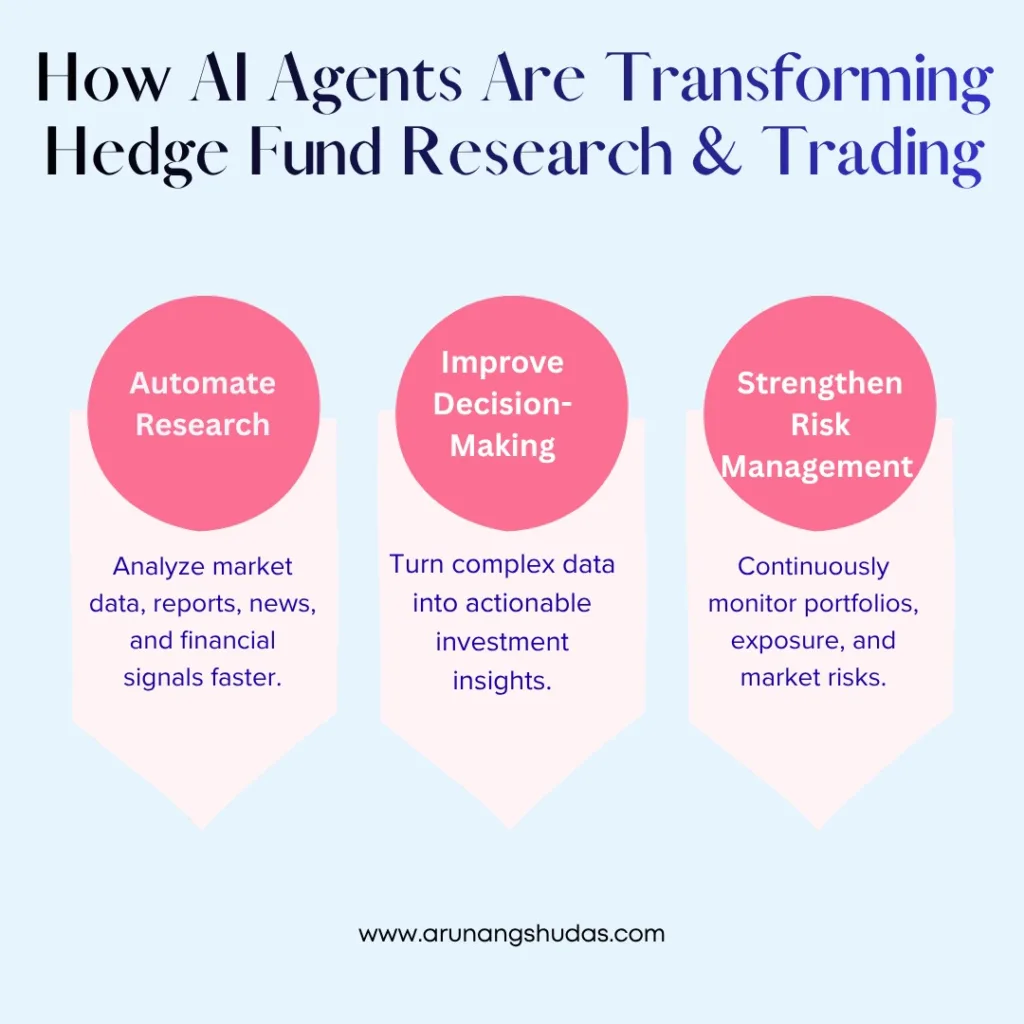
AI agents can continuously scan financial news, company announcements, earnings releases, regulatory filings, and market data. This creates a research environment in which analysts can receive relevant information without manually searching dozens of sources.
Trading intelligence tools can further organize this information by asset, sector, theme, or investment thesis. An agent may identify an important announcement, assess its potential significance, and generate a concise briefing for an analyst.
2. Financial Signal Analysis
Modern hedge funds often analyze thousands of variables to identify potential trading signals. AI agents can support financial signal analysis by comparing historical relationships, market behavior, sentiment indicators, and fundamental data.
Rather than treating every signal equally, an AI system can rank signals according to predefined criteria and present the most relevant findings to researchers.
3. Portfolio and Investment Automation
Investment automation AI can assist with repetitive portfolio-monitoring activities. For example, an agent could monitor exposure, track changes in portfolio companies, identify deviations from predefined risk parameters, and notify an investment team when action may be required.
This automation can reduce operational workloads while allowing professionals to focus on higher-value strategic decisions.
4. AI-Driven Trading Strategies
AI hedge fund strategies can combine machine learning, statistical techniques, alternative data, and automated execution. AI systems may be used to identify patterns in prices, liquidity, volatility, or market sentiment.
However, successful deployment requires rigorous testing. A strategy that performs well on historical data may fail in live markets because of regime changes, transaction costs, liquidity constraints, or overfitting.
AI Agents and Quantitative Trading Systems
AI agents can work alongside quantitative trading systems rather than replacing them. Quantitative systems typically execute rules or models consistently, while AI agents can provide additional research, monitoring, and decision-support capabilities.
For example, an AI agent might analyze thousands of earnings reports and identify companies experiencing unusual changes in margins. A quantitative model could then evaluate those companies against predefined trading factors.
| AI Agent Capability | Hedge Fund Application | Potential Benefit |
| Data collection | Market and company research | Faster information gathering |
| Document analysis | Earnings and regulatory filings | Reduced manual review |
| Pattern detection | Signal generation | Identification of potential opportunities |
| Portfolio monitoring | Exposure and position tracking | Faster risk awareness |
| Workflow automation | Research and reporting | Greater analyst productivity |
The strongest architecture often combines AI reasoning with deterministic quantitative models. This provides flexibility during research while preserving consistency during model execution and trade controls.
Report Analysis and Financial Research
Hedge funds process enormous amounts of written information every day. Report Analysis can include earnings reports, annual reports, analyst research, central-bank communications, industry publications, and regulatory documents.
AI agents can extract relevant information from these documents and transform it into structured research. For example, an agent could compare management commentary across several quarters, identify changes in guidance, and highlight inconsistencies between narrative statements and financial metrics.
This is particularly useful for Fintech Companies developing research platforms for institutional investors. AI-powered systems can make complex financial information easier to search, compare, and monitor.
Risk Management and Financial Risk Monitoring
AI should not be viewed only as a return-generation technology. Risk Management is another major area where intelligent agents can provide value.
A risk-focused AI system can monitor portfolio exposures, volatility, correlations, liquidity, concentration, and other predefined indicators. Financial Risk Monitoring can operate continuously, allowing teams to detect potential problems before they become significant.
| Risk Area | AI Agent Function | Example Output |
| Market risk | Monitor price and volatility changes | Risk alert |
| Concentration risk | Track portfolio exposure | Concentration warning |
| Liquidity risk | Monitor trading conditions | Liquidity notification |
| Model risk | Compare live behavior with expectations | Model-drift alert |
| Operational risk | Monitor workflow anomalies | Exception report |
AI systems should still operate within clearly defined governance frameworks. Human approval, audit trails, access controls, and model validation remain essential when automated systems influence investment activity.
Financial Automation Tools for Hedge Fund Operations
Financial Automation Tools can streamline tasks across investment research, portfolio monitoring, reporting, and operations. AI agents can connect multiple steps into a single workflow instead of requiring analysts to perform each task separately.
For example:
- An agent collects new company filings.
- It identifies material changes.
- It compares the changes with historical information.
- It summarizes the findings.
- It evaluates predefined investment signals.
- It sends the results to the relevant analyst.
- A human investment professional reviews the findings.
This approach demonstrates how AI Systems in Financial Services can augment professional workflows without requiring every decision to be fully automated.
AI and Financial Decision-Making
The objective of AI in hedge funds should not simply be to automate every decision. Effective Financial Decision-Making requires context, judgment, risk awareness, and an understanding of market conditions.
AI agents are particularly valuable when they reduce the time required to move from raw information to actionable research. Portfolio managers can spend less time gathering information and more time challenging assumptions, evaluating scenarios, and deciding whether a position fits the portfolio’s objectives.
The human-in-the-loop model is therefore likely to remain important. AI can generate evidence and recommendations, while experienced professionals remain responsible for interpreting those outputs.
AI Agents in Investment Banking and Wealth Management
Although hedge funds are an important use case, the same technologies are influencing Investment Banking Operations and other financial sectors. AI agents can assist with document review, financial research, due diligence, reporting, and workflow coordination.
Similarly, AI Agents in Wealth Management can support client research, portfolio monitoring, personalization, and financial planning workflows. The exact implementation differs from hedge fund applications because wealth management typically places greater emphasis on client objectives, suitability, communication, and long-term portfolio construction.
The Role of AI Trading Bots
AI trading bots can automate elements of trade execution and market monitoring. They may use predefined rules, machine-learning models, or combinations of statistical and AI techniques.
However, autonomous execution introduces additional risks. A trading bot can react extremely quickly to incorrect data, unexpected market events, or faulty model assumptions. Consequently, institutional deployments generally require position limits, execution controls, monitoring systems, testing environments, and emergency shutdown mechanisms.
| Technology | Primary Role | Human Oversight |
| AI research agent | Research and information synthesis | High |
| Predictive model | Forecasting and signal generation | High |
| Algorithmic trading system | Rule-based execution | Medium to high |
| AI trading bot | Automated trading decisions/execution | Very high |
| Risk agent | Continuous portfolio monitoring | High |
Challenges of Deploying AI Agents
Despite their potential, AI agents introduce several challenges for hedge funds.
Data quality: Poor, incomplete, or delayed data can produce unreliable conclusions.
Hallucinations and incorrect reasoning: Generative AI systems can sometimes produce plausible but inaccurate information, making verification essential.
Model risk: Machine-learning models may perform differently when market conditions change.
Security: Financial systems require strong controls around confidential information, credentials, and trading infrastructure.
Explainability: Investment professionals need to understand why a system generated an important signal or recommendation.
Governance: Firms need clear rules defining what an AI agent can recommend, execute, approve, or change independently.
These challenges make governance as important as technological capability.
The Future of AI in Hedge Fund Research and Trading
The next stage of hedge fund AI is likely to involve interconnected agents rather than isolated tools. A research agent could gather information, another agent could evaluate financial signals, a risk agent could test portfolio implications, and an execution system could handle approved trades.
This ecosystem could create an end-to-end investment workflow in which information moves rapidly from discovery to analysis, validation, risk assessment, and execution.
The competitive advantage, however, will not necessarily belong to firms using the most advanced AI model. It may belong to firms that combine high-quality data, proprietary research, robust quantitative models, strong risk controls, and effective human judgment.
Conclusion
AI agents are becoming an important component of modern hedge fund research and trading. From autonomous research and predictive market analytics to automated monitoring and quantitative execution, these systems can significantly improve the speed and scale of investment workflows.
The most practical approach is not to remove humans from the investment process, but to give analysts and portfolio managers better tools. When carefully governed, AI agents can transform repetitive research tasks, strengthen Financial Risk Monitoring, accelerate analysis, and support more informed investment decisions.
As Fintech Companies continue developing advanced AI infrastructure, hedge funds will have increasing opportunities to integrate intelligent agents into research, trading, operations, and risk management. The firms that benefit most will be those that treat AI as part of a broader investment architecture rather than as a standalone technology.
Frequently Asked Questions
1. How are AI agents used in hedge funds?
AI agents can automate research, analyze financial reports, identify potential signals, monitor portfolios, summarize market developments, and support trading workflows. Their role can range from research assistance to carefully controlled automated execution.
2. Are AI trading bots replacing human traders?
Not necessarily. AI trading bots can automate specific activities, but professional hedge funds still require human oversight for strategy design, risk management, governance, and exceptional market conditions.
3. What are the benefits of AI in hedge fund research?
The major benefits include faster information processing, automated report analysis, continuous market monitoring, scalable financial signal analysis, and reduced time spent on repetitive research tasks.
4. What risks are associated with AI hedge fund strategies?
Key risks include inaccurate data, model overfitting, unexpected market conditions, incorrect AI-generated information, cybersecurity vulnerabilities, insufficient explainability, and uncontrolled automated execution.
5. What is the future of AI agents in financial services?
AI agents are likely to become increasingly integrated into research, trading, portfolio monitoring, investment banking operations, and wealth management. The strongest implementations will combine automation with human oversight, robust quantitative models, and strong governance.
