


Introduction: The Revolution of Customer Experience Through Machine Learning
Machine learning has fundamentally transformed how businesses interact with their customers, creating unprecedented opportunities for personalization, efficiency, and satisfaction. As companies worldwide strive to distinguish themselves in increasingly competitive markets, machine learning technologies have emerged as crucial differentiators that enable organizations to understand, predict, and respond to customer needs with remarkable precision.
This technological revolution isn’t merely changing operational processes—it’s redefining the very essence of customer relationships. By enabling businesses to anticipate needs, solve problems proactively, and deliver highly customized experiences, brands can now resonate with their audience on a deeply personal level.
The integration of these advanced algorithms represents a paradigm shift in management, moving companies away from traditional reactive service models (waiting for a customer to complain) toward predictive engagement frameworks. These frameworks create lasting competitive advantages by optimizing every touchpoint throughout the customer journey. From sophisticated recommendation engines powering e-commerce giants like Amazon to intelligent chatbots providing instant support, machine learning has become the backbone of modern customer experience strategies.
As we explore the multifaceted ways machine learning enhances these experiences, we uncover the mechanisms and strategies that are setting new standards for business performance in the digital age.
Table of contents
- What is machine learning?
- How does machine learning work?
- Why does ML matter in customer service?
- What’s the difference between machine learning and AI?
- What are the 4 types of machine learning?
- Where is machine learning used in customer service?
- Comparison: Traditional vs. Machine Learning Approaches
- Machine learning takeaways for service leaders
- Deep learning, a more advanced form of ML
- Frequently Asked Questions (FAQs)
Machine learning, a subset of artificial intelligence, refers to computer systems that can learn from data, identify patterns, and make decisions with minimal human intervention. In the context of customer experience, these algorithms analyze vast quantities of data—including purchase histories, browsing behaviors, and interaction records—to uncover insights impossible for humans to detect manually.
How does machine learning work?
These powerful algorithms differ from traditional analytics by continuously improving their performance over time. Unlike static software that follows a fixed set of rules, machine learning (ML) models are designed to evolve. As more customer data becomes available—such as purchase histories, browsing behaviors, and interaction records—the models automatically refine their predictions, becoming increasingly accurate and valuable to the business.
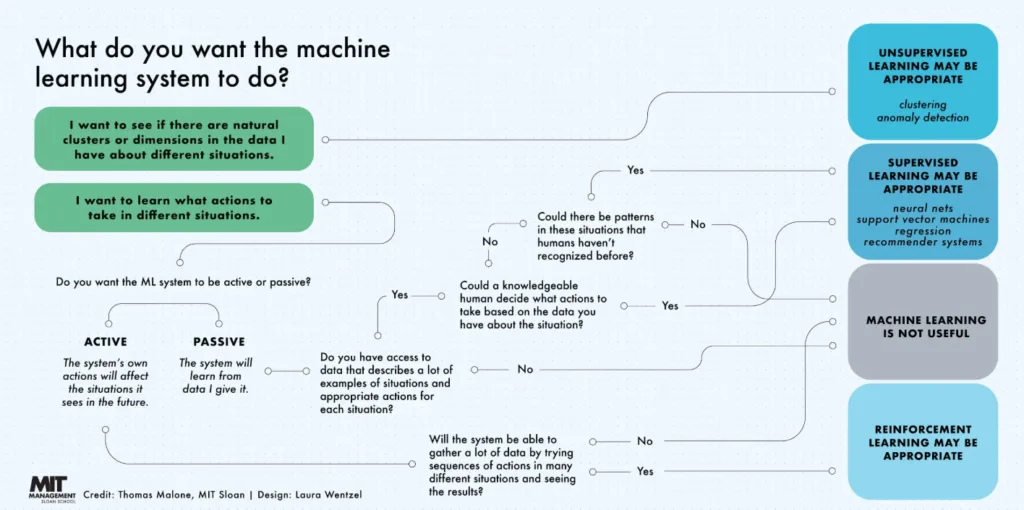
The core mechanism involves several sophisticated layers:
- Dynamic Data Processing: Machine learning algorithms analyze vast quantities of customer data to uncover deep insights that would be impossible for humans to detect manually.
- Multivariate Analysis: According to Google AI Research, advanced implementations can process hundreds of variables simultaneously, identifying complex correlations that drive customer behavior across different segments.
- Continuous Improvement: These systems operate on a feedback loop; as they ingest new data, they automatically adjust their internal logic to better reflect changing market trends or individual customer shifts.
- Processing Unstructured Data: What makes modern ML particularly valuable is its ability to process unstructured inputs—including natural language, images, and voice recordings—converting them into actionable intelligence for customer-facing strategies.
By transforming descriptive data (what happened) into predictive intelligence (what will happen), machine learning empowers companies to optimize every touchpoint throughout the customer journey. Harvard Business Review has documented how this capability enables “predictive personalization,” allowing businesses to anticipate needs before customers themselves are even consciously aware of them.
Why does machine learning matter in customer service?
According to research from MIT Technology Review, companies implementing machine learning for customer experience see up to 10% revenue increases and 15% cost reductions simultaneously. It enables “predictive personalization,” where businesses can anticipate customer needs before customers themselves are consciously aware of them. This transforms passive data collection into active experience management.
What’s the difference between machine learning and AI?
While often used interchangeably, Artificial Intelligence (AI) is the broader concept of machines being able to carry out tasks in a way that we would consider “smart”. Machine Learning (ML) is a specific application or subset of AI based on the idea that giving machines access to data allows them to learn for themselves.
What are the 4 types of machine learning?
- Supervised learning: The model is trained on labeled data, meaning the system is told what the “correct” output should be for specific inputs.
- Unsupervised learning: The system looks for previously undetected patterns in a data set with no pre-existing labels and minimum human supervision.
- Semi-supervised learning: A middle ground that uses a small amount of labeled data and a large amount of unlabeled data during training to improve accuracy.
- Reinforcement learning: The model learns through trial and error, using feedback from its own actions to maximize a “reward.”
- Bonus 5. Self-supervised learning: A recent evolution where the system learns to represent data by using one part of the input to predict another part of the same input.
Where is Machine Learning Used in Customer Service?
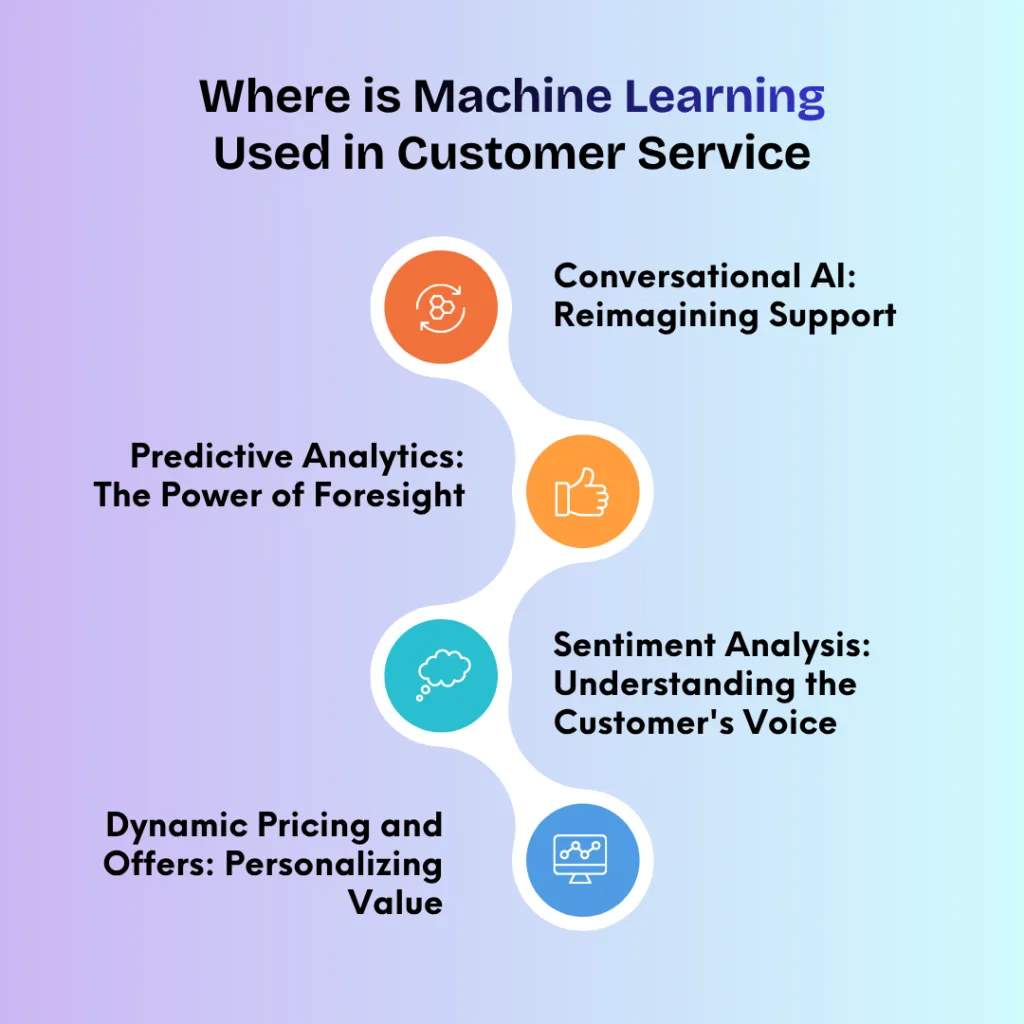
Machine learning has numerous high-impact applications in modern service, moving beyond simple automation to create intelligent, context-aware systems. By processing both structured data (transactions) and unstructured data (emails, voice, and chat), ML identifies correlations that drive satisfaction.
1. Conversational AI: Reimagining Support
The emergence of sophisticated conversational AI has revolutionized support by enabling natural, contextually aware interactions at scale. These systems—ranging from chatbots to virtual assistants—have progressed beyond simple rule-based responses to become capable of understanding intent, sentiment, and context in customer communications.
- Cost Efficiency: Businesses implementing conversational AI can reduce customer service costs by up to 30%.
- Speed of Resolution: Well-implemented AI can resolve customer issues up to 5 times faster than traditional channels.
- Human-AI Synergy: ML-powered tools handle up to 80% of routine inquiries, freeing human teams to focus on complex issues requiring empathy.
2. Predictive Analytics: The Power of Foresight
Machine learning enables predictive analytics that forecast behavior, preferences, and needs with remarkable accuracy. This transforms how businesses understand their customers by moving from retrospective views to future-looking strategies.
- Churn Prevention: Identify early warning indicators—such as changes in browsing patterns or purchase frequency—to reduce churn by up to 25%.
- Satisfaction Scores: Organizations leveraging predictive analytics can improve customer satisfaction scores by up to 25%.
- Proactive Retention: Identifying at-risk customers before they show obvious signs of disengagement allows for proactive retention efforts.
3. Sentiment Analysis: Understanding the Customer’s Voice
Modern sentiment analysis algorithms process thousands of comments across social media, reviews, and support transcripts to identify patterns of satisfaction or dissatisfaction.
- Nuanced Understanding: These systems detect not only explicit opinions but also subtle signals like sarcasm, humor, and frustration with human-like accuracy.
- Faster Response: Companies using sentiment analysis respond to emerging issues 65% faster than those relying on manual monitoring.
- Granular Insight: feedback can be categorized by specific product features or journey stages to prioritize improvements based on emotional impact.
4. Dynamic Pricing and Offers: Personalizing Value
Machine learning has transformed pricing from static models to dynamic, personalized systems that optimize value for both customers and businesses simultaneously.
- Real-time Optimization: Algorithms analyze variables like customer history, current inventory, competitor pricing, and market demand to determine optimal pricing in real-time.
- Higher Conversion: Research shows that personalized promotions driven by ML algorithms deliver 40% higher conversion rates than standard offers.
- Segment Sensitivity: Systems identify price sensitivity patterns across different customer segments to maximize perceived value.
Comparison: Traditional vs. Machine Learning Approaches
| Dimension | Traditional Approach | Machine Learning Approach | Business Impact |
| Personalization | Segment-based with limited variables | Individual-level using hundreds of data points | 35% higher conversion rates |
| Customer Support | Rule-based systems with human escalation | Natural language understanding with context awareness | 30% cost reduction |
| Feedback Analysis | Manual review of limited samples | Automated analysis of all feedback across channels | 65% faster issue identification |
| Pricing Strategy | Static pricing with scheduled promotions | Dynamic, personalized pricing optimized in real-time | 15% revenue increase |
| Churn Prevention | Reactive responses to cancellation attempts | Proactive identification of at-risk customers | 25% reduced churn rate |
Machine learning takeaways for service leaders
- Data Integration is Key: 70% of companies cite data integration as their biggest barrier to effective ML implementation.
- Focus on Ethics: 76% of consumers want transparency about how their data is used in machine learning models.
- Hybrid Approach: Successful organizations recognize that ML should augment rather than replace human judgment.
Deep learning, a more advanced form of ML
Deep Learning is a specialized subfield of machine learning that uses multi-layered artificial neural networks to deliver high accuracy in tasks like object detection and speech recognition. It is inspired by the structure of the human brain and powers the most advanced AI assistants.
Read more blogs : 9 Best Customer Support Software for SaaS Startups
Read more blog :
How AI Chatbots and Virtual Companions Are Changing the Dating Experience
7 Web Hosting Providers With the Best Customer Support
Final Thoughts: The Future of Customer Experience (CX)
The integration of Machine Learning into customer experience strategies represents a fundamental shift in how businesses understand and serve their customers. This technological evolution has moved from a theoretical possibility to a competitive necessity, enabling organizations to deliver hyper-personalization, anticipatory service, and frictionless interactions at an unprecedented scale.
The business benefits of a well-implemented ML strategy are clear: increased customer satisfaction, improved loyalty, enhanced lifetime value, and significant operational efficiencies. Beyond these measurable metrics, machine learning enables organizations to move away from transactional interactions and toward a model of continuous value exchange based on a deep understanding of individual needs.
However, success requires more than just technical expertise; it demands a thoughtful approach to data governance, privacy protection, and organizational change. The most successful leaders recognize that machine learning should augment human judgment, not replace it. By combining algorithmic precision with human creativity and empathy, brands can create prescient customer interactions that define the next generation of market leaders.
In an increasingly personalized business landscape, harnessing these technologies is no longer optional—it is the key to sustained competitive advantage.
Frequently Asked Questions (FAQs)
What types of data are most valuable for machine learning in customer experience?
The most valuable data combines structured information like transaction histories with unstructured data such as email communications and social media posts. Organizations integrating these diverse types see 3x higher accuracy in customer predictions.
How should businesses measure the ROI of machine learning investments?
Effective measurement combines operational metrics like cost savings with customer metrics like Net Promoter Score (NPS) and financial outcomes like revenue growth. ROI often increases exponentially once systems reach critical data thresholds.
What are the most common pitfalls when implementing machine learning?
Common pitfalls include deploying algorithms without clear business objectives, neglecting change management for employees, and having fragmented customer information across disconnected data silos.
