


ResNet Architecture in Deep Learning: The Complete Guide & Evolution
In the rapidly evolving realm of artificial intelligence and machine learning, neural network architectures have undergone a profound transformation. Among these breakthroughs, the Residual Network (ResNet) stands out as a cornerstone, completely reshaping how deep neural networks are trained.
1. The Genesis of ResNet
A Brief History of Deep Learning
From early perceptrons to the modern rise of Convolutional Neural Networks (CNNs) and Recurrent Neural Networks (RNNs), the quest to build deeper, more powerful models has been relentless. Deeper networks theoretically possess a greater capacity to learn complex hierarchical patterns, but historical scaling walls quickly halted early progress.
The Vanishing Gradient Problem
The primary hurdle preventing early engineers from building excessively deep networks was the vanishing gradient problem. As backpropagation sends error signals backward through many layers, gradients shrink exponentially near the input layer. Consequently, earlier layers stop learning, rendering deep architectures stagnant or even less accurate than shallow ones.
The Birth of Residual Learning
In 2015, Kaiming He et al. introduced ResNet in their landmark paper, “Deep Residual Learning for Image Recognition.” Instead of forcing stacked layers to learn an underlying unmasked mapping directly, ResNet introduced skip connections to learn residual mappings, smoothly paving the way for ultra-deep models.
2. Unraveling the Architecture
Anatomy of ResNet
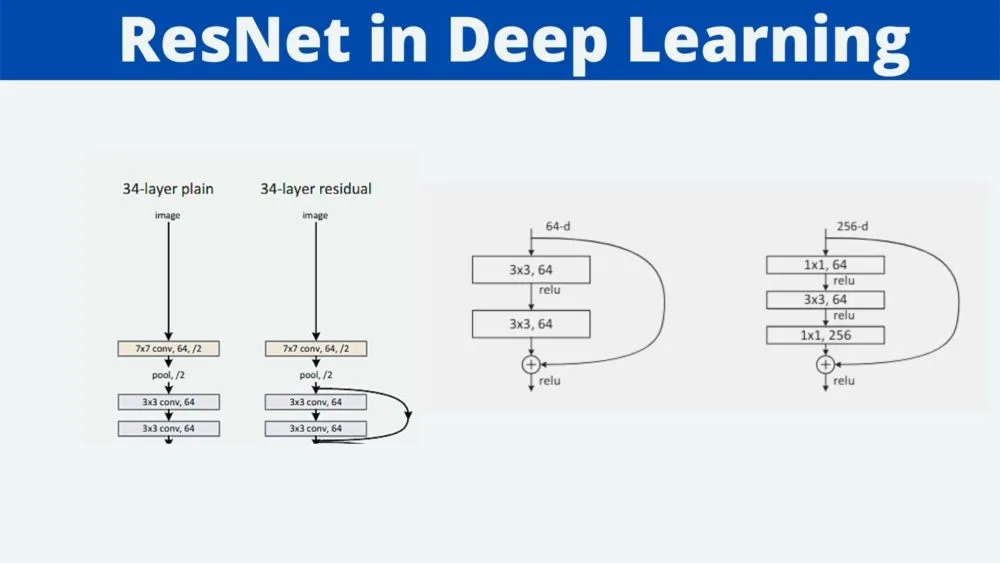
ResNet features deep stacks of residual blocks, coupling standard convolutional layers and batch normalization with direct identity shortcuts. Rather than learning total output mappings, blocks learn the residual difference ($F(x)$) to be added back to the original input ($x$).
Skip Connections
At the core of ResNet are skip connections (or identity shortcuts). These pathways bypass one or more layers, allowing gradients to flow unimpeded backward during backpropagation and completely resolving the vanishing gradient bottleneck.
Residual Blocks
- Basic Blocks: Built with two sequential $3 \times 3$ convolutional layers, batch normalization, and ReLU activations. Designed for shallower variants like ResNet-18 and ResNet-32.
- Bottleneck Blocks: Utilize a $1 \times 1 \rightarrow 3 \times 3 \rightarrow 1 \times 1$ layer design. The initial $1 \times 1$ convolution reduces dimensionality, saving compute parameters before heavy $3 \times 3$ convolutions take place. Essential for deeper networks like ResNet-50, ResNet-101, and ResNet-152.
Read More Blog : Stride in Convolutional Neural Networks
3. Training and Optimization
Training Strategies
Training a stable ResNet relies heavily on Stochastic Gradient Descent (SGD) with momentum, precise learning rate scheduling, and robust data augmentation. Furthermore, utilizing pre-trained weights from massive baseline corpuses like ImageNet allows engineers to leverage transfer learning instantly for downstream domains.
Optimization Mechanics
- Batch Normalization (BN): Normalizes layer inputs across mini-batches, stabilizing learning paths and accelerating convergence speeds.
- Residual Addition: Preserves clean gradient propagation pipelines natively across dozens or hundreds of layers.
4. Applications and Impact
Image Classification
ResNet drastically exceeded human-level error baselines on the ImageNet challenge. Its robust feature extractor design remains a gold-standard benchmark for image recognition pipelines globally.
Object Detection and Segmentation
By serving as a robust feature extractor backbone in object detection frameworks like Faster R-CNN and Mask R-CNN, ResNet empowers precise pixel-level segmentation and real-time bounding box detection across complex videos.
Transfer Learning and Beyond
Beyond computer vision, ResNet backbones serve as foundational transfer learning blocks for diverse industries, including medical imaging (CT/X-ray analysis), remote sensing, and autonomous vehicle sensor processing.
5. Future Directions
Advancements in Architectures
Modern research builds upon ResNet’s structural legacy by blending residual connections with spatial attention mechanisms, graph pathways, and multi-modal transformers.
Explainable AI (XAI)
To combat the “black-box” dilemma, modern development pairs ResNet features with interpretability frameworks like Grad-CAM and saliency maps, visualizing precise image regions that influence model decisions.
Robustness and Generalization
Active research focuses on fortifying models against adversarial input attacks and domain shifts using specialized regularization routines and automated data augmentation.
Read More Blog : How CNN Works : The Beginners Guide 2026
ResNet vs. Alternative CNN Architectures At-a-Glance
| Architecture | Key Innovation | Best Suited For | Typical Parameter Scale |
| ResNet-50 / 101 | Skip Connections / Residual Learning | Universal Computer Vision, Medical Imaging, Transfer Learning | $\sim 25.5\text{M}$ to $44.5\text{M}$ |
| VGG-16 | Uniform $3 \times 3$ Convolution Stacks | Feature Visualization, Style Transfer, Saliency Mapping | $\sim 138\text{M}$ |
| MobileNetV3 | Depthwise Separable Convolutions | Edge AI, Smartphones, Real-time IoT Inferences | $\sim 2.5\text{M}$ to $5.4\text{M}$ |
Conclusion: The Enduring Legacy of ResNet
In summary, ResNet remains a foundational milestone in deep learning history, permanently changing how data scientists scale neural networks. By ingeniously solving the vanishing gradient bottleneck through skip connections and residual learning, ResNet transformed computer vision from a brittle, shallow discipline into a robust, ultra-deep engineering science.
Whether powering real-time autonomous vehicle sensors, precision medical diagnostics, or transfer learning applications across global industries, its architectural DNA continues to influence modern transformer models, multi-modal frameworks, and edge AI innovations. Mastering ResNet is essential for anyone looking to build scalable, high-performance machine learning systems.
Frequently Asked Questions (FAQs)
1. What exact problem does ResNet solve in deep learning?
ResNet primarily solves the vanishing gradient problem. As neural networks grow deeper, backpropagated gradients shrink exponentially until earlier layers stop updating. Skip connections create a clean gradient “highway,” letting models scale past 150+ layers safely.
2. What is the difference between a basic block and a bottleneck block?
A basic block consists of two standard $3 \times 3$ convolutional layers used mainly in shallower models (like ResNet-18/34). A bottleneck block uses a $1 \times 1 \rightarrow 3 \times 3 \times 1 \times 1$ layer setup to compress and expand feature dimensions, drastically lowering computational overhead for deep variants like ResNet-50 and ResNet-101.
3. Can ResNet be used for tasks other than image classification?
Yes. While originally built for image classification, ResNet is widely deployed as a foundational backbone for object detection (Faster R-CNN), instance segmentation (Mask R-CNN), medical anomaly identification, and multi-modal machine learning pipelines.
4. How does transfer learning work with pre-trained ResNet models?
Transfer learning utilizes a ResNet model pre-trained on a massive dataset like ImageNet. Developers freeze the early feature-extraction layers and fine-tune only the final classification head, achieving high production accuracy with as few as 500 to 1,000 domain-specific examples.
5. Why do skip connections improve training performance?
Skip connections allow the network to learn residual functions rather than completely unmasked transformations. If an optimal layer configuration is close to an identity mapping, the network can easily push weights toward zero while letting the input pass through the shortcut uninterrupted.
