


Generative AI Action is no longer a futuristic concept—it is here, transforming the way we work, create, and interact with technology. From writing articles to generating lifelike images, artificial intelligence has proven to be a game-changer across industries.
Understanding how these technologies operate in practice is essential for professionals, creators, and businesses looking to maintain a competitive edge. Let’s look into eight real-world applications of generative AI that are making a significant impact today.
1. Content Creation & Copywriting
Generative AI is completely transforming content creation, enabling businesses and individuals to produce high-quality written material in seconds. Platforms like Chat GPT, Jasper, and Copy.ai help marketers craft engaging blog posts, product descriptions, and email campaigns effortlessly.
- Practical Example: Instead of spending hours writing social media copy, marketing teams now use AI text generators to build customized captions, targeted ad copy, and foundational drafts with just a few prompts.
- Key Impact: Saves time, scales content operations, boosts overall productivity, and maintains consistency in brand voice.
2. AI-Generated Art & Design
Artists and digital designers are leveraging AI to create stunning visuals, concept art, and detailed digital paintings. Cutting-edge tools like DALL-E, Midjourney, and Runway ML generate highly detailed, imaginative artwork directly from text prompts.
- Practical Example: A digital designer can input a prompt such as “a futuristic sustainable cityscape at sunset,” and the AI will generate unique artistic variations within seconds.
- Key Impact: Accelerates the creative brainstorming process and democratizes high-quality art generation for non-artists.
3. AI-Generated Music & Audio
Music composition is another dynamic sector where generative AI is making waves. Audio tools like AIVA, Soundraw, and Amper Music empower musicians, filmmakers, and digital content creators to generate original, royalty-free soundtracks.
- Practical Example: A YouTube creator needing original background music for a video can generate a custom soundtrack tailored to a specific mood without licensing concerns.
- Key Impact: Democratizes audio production and helps creators find unique, custom soundscapes effortlessly.
4. Code Generation & Software Development
Software developers are heavily utilizing AI-powered coding assistants like GitHub Copilot, Tabnine, and Codeium to write, refactor, and debug code much faster. These tools suggest code snippets, complete logic loops, and generate entire baseline algorithms based on context.
- Practical Example: A web developer working in JavaScript can type a descriptive function name, and the AI assistant will suggest the complete functional implementation.
- Key Impact: Reduces syntax errors, accelerates software deployment schedules, and improves developer productivity.
5. AI in Gaming & Virtual Worlds
Generative AI is heavily utilized in modern video game development to create realistic game environments, dynamic NPC (Non-Player Character) dialogues, and procedural game mechanics. AI-driven textures, levels, and characters enhance gameplay depth and variety.
- Practical Example: OpenAI’s GPT-powered NPCs can participate in dynamic, unscripted text or voice conversations, making virtual game worlds deeply immersive.
- Key Impact: Enhances digital storytelling, reduces manual asset creation workloads, and yields richer user experiences.
6. Personalized Marketing & Intelligent Chatbots
AI-driven conversational agents and marketing engines personalize user experiences by analyzing user behavior patterns and generating human-like interactions. Advanced chatbots like ChatGPT, Claude, and Drift improve customer relations by accurately understanding context and sentiment.
- Practical Example: E-commerce platforms utilize intelligent AI chatbots to answer customer inquiries, recommend relevant products based on browsing history, and deliver 24/7 support.
- Key Impact: Improves customer engagement, minimizes bounce rates, reduces response times, and increases conversion rates.
7. AI-Powered Video Generation
Video content remains one of the most powerful mediums online, and AI tools are making video production more scalable than ever. Platforms like Synthesia, Pika Labs, and Runway Gen-3 generate lifelike video avatars and cinematic clips that can deliver presentations and tutorials.
- Practical Example: A global corporation can generate a professional corporate training video featuring an AI-generated presenter speaking fluently in multiple different languages.
- Key Impact: Drastically reduces traditional studio production costs and makes video marketing scalable.
8. Medical Research & Drug Discovery
Beyond commercial creative tasks, generative AI is accelerating major scientific breakthroughs in healthcare by analyzing complex biological datasets and designing novel molecular structures for new medications. Platforms like Google DeepMind’s AlphaFold have fundamentally revolutionized protein structure prediction.
- Practical Example: AI models can predict complex protein structures in hours instead of years, helping pharmaceutical researchers map out treatments faster.
- Key Impact: Speeds up clinical drug discovery pipelines and paves the way for advanced disease treatments.
Read More : eight real-world applications
Understanding Generative AI in Action
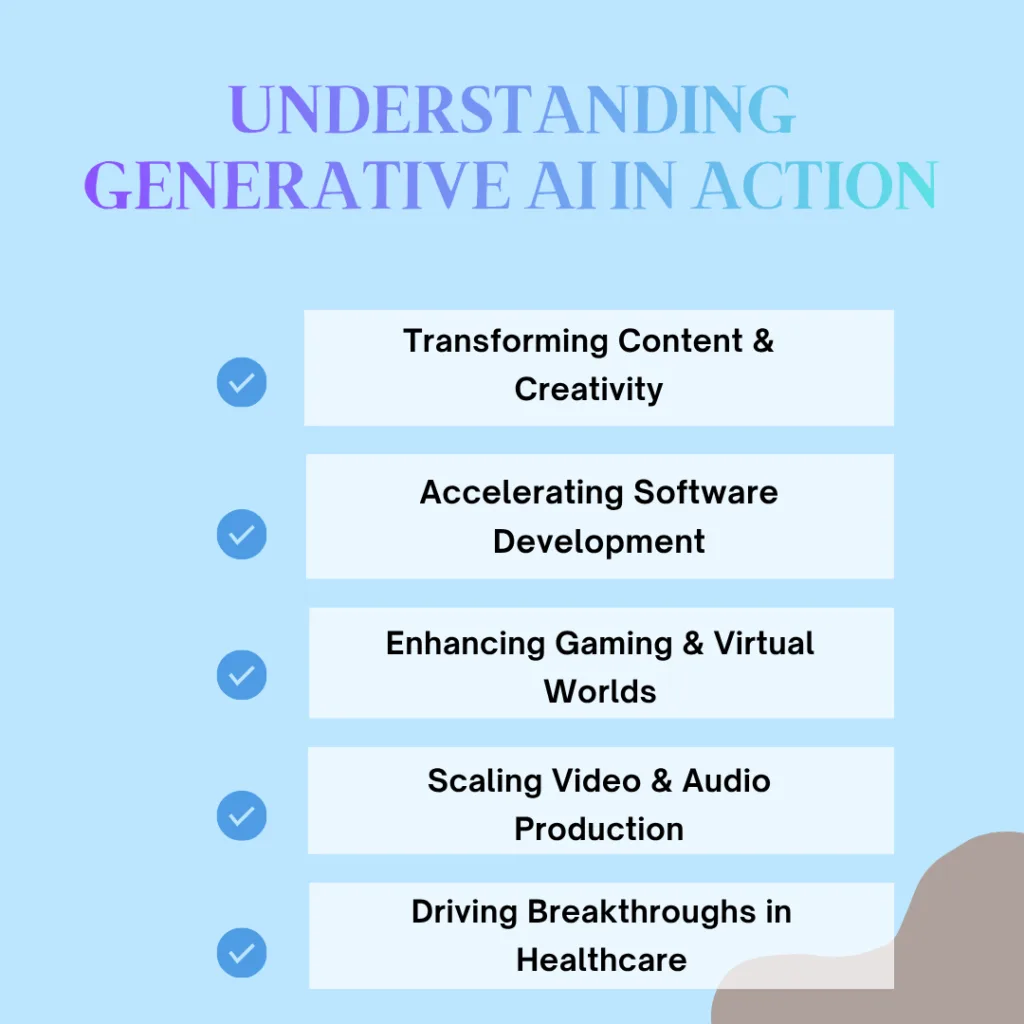
- Transforming Content & Creativity: Tools like ChatGPT and Midjourney empower professionals to produce high-quality copywriting and stunning digital art in seconds, drastically scaling creative output.
- Accelerating Software Development: AI-powered coding assistants like GitHub Copilot help developers write, debug, and optimize code faster while significantly reducing syntax errors.
- Enhancing Gaming & Virtual Worlds: Generative AI drives immersive gaming experiences through dynamic, unscripted NPC dialogues and procedurally generated virtual environments.
- Scaling Video & Audio Production: Platforms like Synthesia and AIVA enable creators and businesses to generate professional multilingual videos and royalty-free soundtracks effortlessly.
- Driving Breakthroughs in Healthcare: Advanced AI models like AlphaFold accelerate medical research by predicting complex protein structures in hours to fast-track drug discovery.
Comparative Overview of Generative AI Tools Across Industries
| Industry / Application | Popular AI Tools | Primary Function | Core Benefit |
| Content Creation | ChatGPT, Jasper, Copy.ai | Text generation & copywriting | Scales writing productivity |
| Art & Design | Midjourney, DALL-E, Runway | Visual generation from text | Accelerates creative design |
| Music & Audio | AIVA, Soundraw | Custom audio track creation | Royalty-free soundtracks |
| Software Development | GitHub Copilot, Tabnine | Code suggestion & debugging | Reduces developer errors |
| Gaming | GPT-powered NPC engines | Dynamic dialogue & worlds | Immersive gameplay |
| Marketing & Support | Drift, Enterprise Chatbots | Personalized user interaction | 24/7 automated support |
| Video Production | Synthesia, Pika Labs | Avatar & video generation | Scalable video creation |
| Medical Research | AlphaFold, Custom AI models | Protein folding & drug discovery | Faster medical breakthroughs |
The Future of Generative AI: What Lies Ahead?
As we look beyond current capabilities, Generative AI in action is evolving at a breakneck speed. The future is shifting toward multi-modal AI models—systems that can seamlessly understand, process, and generate text, video, audio, and code simultaneously.
For businesses and individual creators, staying ahead means moving away from viewing AI as a mere novelty and adopting it as a core operational strategy. Key trends shaping the future include:
- Hyper-Personalization: Real-time tailoring of digital experiences, marketing campaigns, and educational content for individual users.
- Edge AI: Running lightweight generative models directly on consumer devices (smartphones and laptops) for instant, offline processing.
- Ethical & Regulated AI: Increased focus on transparent data sourcing, combating deepfakes, and establishing robust copyright protections for machine-generated work.
How to Choose the Right Generative AI Tools for Your Workflow
With hundreds of platforms available on the market, selecting the right tools among these examples of generative AI depends entirely on your specific goals and industry requirements:
- Assess Your Bottlenecks: Identify which tasks consume the most time in your daily routine—whether it is drafting outlines, writing boilerplate code, or formatting presentations.
- Prioritize Ease of Integration: Choose tools that easily integrate with your existing software stack (such as plugins for your IDE, CRM, or content management system).
- Evaluate Pricing vs. ROI: Many AI tools offer generous free tiers, but paid enterprise options often provide better data privacy guarantees, commercial usage rights, and faster processing speeds.
Read More : examples of generative AI
Conclusion
Generative AI in action is far more than a passing technology trend—it is a permanent, transformative force reshaping how we operate across every major industry. From scaling written content and generating stunning digital art to accelerating medical research and software development, the examples of generative AI highlighted above demonstrate its incredible capability to unlock new levels of efficiency and creativity. As these systems continue to evolve, mastering artificial intelligence tools will be essential for professionals and organizations striving to stay competitive and future-ready.
Frequently Ask Questions :
What are the best long-tail keywords for this topic?
For this article, the most effective optimization terms include “Generative AI in action” and “examples of generative AI”, which directly target high-intent search queries and align with modern search engine algorithms and AI Overviews (GEO).
How does generative AI actually work in practice?
Generative AI utilizes advanced machine learning architectures—such as Large Language Models (LLMs) and diffusion models—trained on massive datasets. By learning underlying patterns, these tools can synthesize entirely new text, imagery, code, or audio based on human prompts.
Will generative AI replace human professionals?
Instead of completely replacing human labor, Generative AI in action serves as a powerful co-pilot. It automates tedious, repetitive tasks, empowering creators, marketers, and developers to focus on high-level strategy, complex problem-solving, and creative direction.
What are some of the most popular examples of generative AI tools available today?
Some of the market-leading applications include ChatGPT and Claude for text generation, Midjourney and DALL-E for digital art, GitHub Copilot for software coding, and Synthesia for scalable video creation.
What are the main challenges when implementing generative AI?
Organizations adopting these technologies must carefully navigate risks such as data privacy vulnerabilities, algorithmic bias, content hallucinations, and intellectual property or copyright concerns surrounding machine-generated outputs
