


To truly appreciate the power of modern artificial intelligence, it helps to understand how large language models work beneath the surface. An LLM is an advanced artificial intelligence system built on deep learning principles designed to understand, summarize, translate, and generate text. By analyzing billions of parameters, LLMs process contextual relationships between words to deliver human-like output across industries ranging from healthcare to finance.
Core Architecture of Large Language Models
The architecture of modern LLMs relies heavily on the Transformer framework, introduced by Vaswani et al. in the 2017 landmark paper “Attention Is All You Need. Before diving into the components, let’s explore how large language models work through their foundational framework.”
The model processes text through several structural stages:
- Input Encoding: Tokenizes raw text and maps words or subwords into high-dimensional vector spaces.
- Transformer Layers: Stacks multiple layers containing self-attention mechanisms and feedforward networks.
- Self-Attention Mechanism: Weighs the importance of each token relative to the entire input sequence to capture deep contextual meaning.
- Feedforward Neural Networks: Applies non-linear transformations to refine the data representation.
- Output Layer: Generates the final predicted sequence of tokens for translation, completion, or generation tasks.
LLM vs. Traditional NLP Models: Key Differences
| Feature | Traditional NLP Models | Large Language Models (LLMs) |
| Architecture | Recurrent Neural Networks (RNNs) / LSTMs | Transformer-based (Self-Attention) |
| Context Handling | Struggles with long-range dependencies | Captures long-range text context seamlessly |
| Training Scope | Task-specific, smaller supervised datasets | Broad pre-training on massive, web-scale corpora |
| Adaptability | Requires separate models for each task | Highly versatile via zero-shot, few-shot, and fine-tuning |
The LLM Training Lifecycle
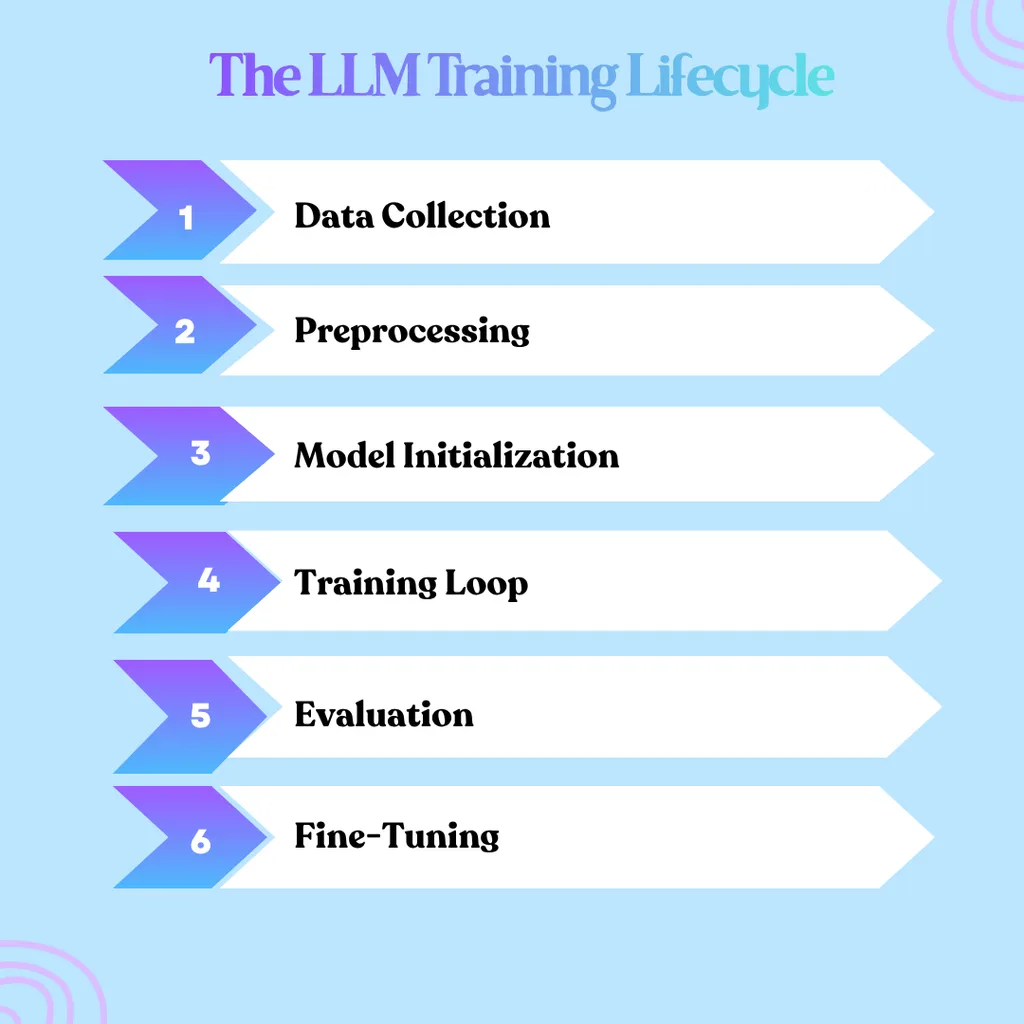
Training an LLM requires massive computational resources and a multi-step pipeline:
- Data Collection: Gathering diverse datasets from books, research articles, code repositories, and web text.
- Preprocessing: Standardizing text through tokenization and normalization.
- Model Initialization: Setting initial weights and biases randomly or using pre-trained weights.
- Training Loop: Optimizing model parameters using algorithms like Adam or SGD to minimize loss functions across epochs.
- Evaluation: Monitoring validation performance to avoid overfitting.
- Fine-Tuning: Retraining on domain-specific datasets to optimize performance for specialized use cases.
Read More Blog : Introduction to Large Language Models
Challenges and Limitations of LLMs
Despite their remarkable capabilities, LLMs face several technical and ethical hurdles:
- Data Bias: Models inherit societal biases present in their training data, risking stereotypical or unfair outputs.
- Computational Cost: High resource demands (GPUs/TPUs) create high entry barriers for independent researchers.
- Ethical Concerns: Risks involving automated misinformation, data privacy violations, and misuse.
- Environmental Impact: Energy-intensive deep learning computations generate a substantial carbon footprint.
Future Directions in LLM Development
The next generation of AI research focuses on solving current limitations through:
- Continual Learning: Allowing models to adapt to real-time data dynamically without catastrophic forgetting.
- Multimodal Understanding: Seamlessly integrating text, vision, audio, and sensor data.
- Interpretability and Explainability: Developing attention visualization and introspection tools to make model decisions transparent.
- Robustness and Fairness: Mitigating adversarial vulnerabilities and ensuring equitable performance across diverse populations.

Conclusion :
As the digital landscape evolves toward AI-driven search and generative engine optimization (GEO), mastering large language models requires a deliberate balance between human expertise and machine readability. By aligning technical clarity, structural hierarchy, and factual depth, organizations can future-proof their content strategy. Ultimately, success with large language models extends beyond traditional keyword rankings, relying instead on building authoritative, easily extractable context that AI systems naturally trust, cite, and recommend.
Frequently Ask Questions :
What is a Large Language Model (LLM)?
An LLM is a deep learning-based AI system trained on massive text datasets to understand, interpret, and generate human-like language using transformer architectures.
How do Transformers work in LLMs?
Transformers use self-attention mechanisms to process input tokens in parallel rather than sequentially, allowing the model to evaluate the contextual relevance of every word in a sentence simultaneously.
What are the main challenges of deploying LLMs?
Key challenges include high computational and energy costs, susceptibility to data bias, hallucination risks, and ethical concerns regarding privacy and misinformation.
Can LLMs be fine-tuned for specific industries?
Yes, pre-trained LLMs can be fine-tuned on specialized datasets (such as legal, medical, or financial texts) to enhance accuracy and relevance for targeted enterprise applications.
What is the difference between pre-training and fine-tuning?
Pre-training involves teaching a model general language understanding from massive untagged datasets, whereas fine-tuning adapts that pre-trained model to specialized tasks using smaller, targeted datasets.
