


Whether you are preparing for your first SEO job or aiming for a senior digital marketing role, understanding the most common SEO interview questions can improve your confidence and help you perform better. Recruiters often evaluate technical SEO knowledge, analytical thinking, content optimization skills, and practical problem-solving abilities. Along with SEO preparation, many companies also ask candidates about related technical topics like AI engineer interview questions, top system design interview questions, and restful api interview questions to assess broader digital and technical awareness.
This guide covers the most frequently asked SEO interview questions for freshers and experienced professionals, practical answers, and interview tips. It also explains how hiring managers assess candidates during technical rounds. If you’re preparing for multiple roles, you may also encounter AI engineer interview questions, top system design interview questions, and restful api interview questions, especially in organizations where SEO teams work closely with developers, AI specialists, and engineering teams.
Why SEO Interview Preparation Matters
Search Engine Optimization is constantly evolving. Employers expect candidates to understand Google’s ranking factors, technical SEO, content optimization, keyword research, analytics, and reporting. Strong preparation helps you answer confidently and demonstrate practical experience rather than theoretical knowledge.
SEO Interview Questions for Freshers
1. What is SEO?
SEO (Search Engine Optimization) is the process of improving a website’s visibility in search engine results pages (SERPs) to increase organic traffic.
2. What are the different types of SEO?
The three primary types include:
- On-page SEO
- Off-page SEO
- Technical SEO
3. What is the difference between organic and paid search?
Organic search results are earned through optimization, while paid search results appear through advertising platforms like Google Ads.
4. What is Keyword Research?
Keyword research identifies the search terms users type into search engines to help create optimized content.
5. What is Search Intent?
Search intent explains why a user performs a search. It can be:
- Informational
- Navigational
- Commercial
- Transactional
Types of SEO
| SEO Type | Main Focus | Popular Tools | Goal |
| On-Page SEO | Content & Keywords | Yoast, RankMath | Better Rankings |
| Off-Page SEO | Backlinks | Ahrefs, Semrush | Authority |
| Technical SEO | Website Performance | Screaming Frog | Crawlability |
| Local SEO | Local Visibility | Google Business Profile | Local Traffic |
SEO Interview Questions for Experienced Professionals
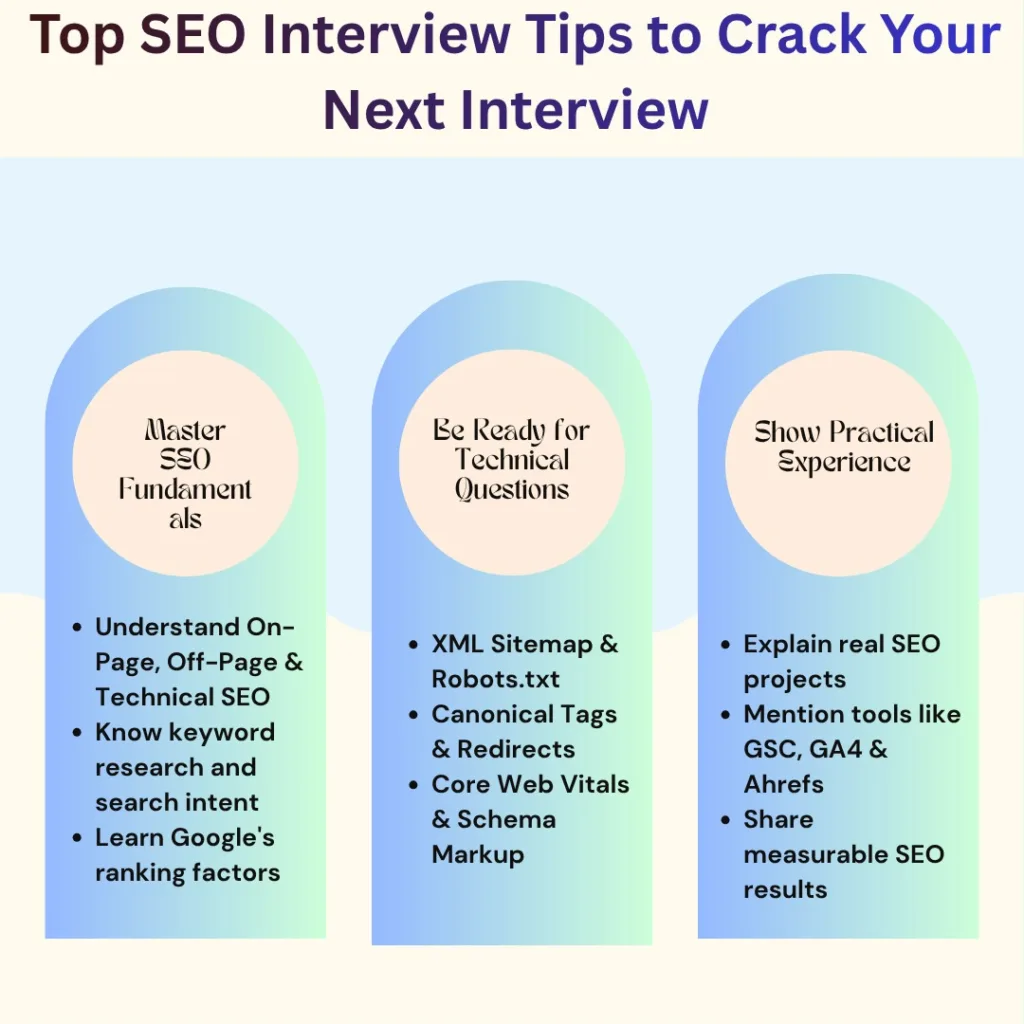
6. How do you perform a technical SEO audit?
A technical SEO audit includes:
- Checking crawl errors
- Website indexing
- Page speed
- Mobile usability
- XML sitemap
- Robots.txt
- Canonical tags
- Redirect chains
- Broken links
7. What are Core Web Vitals?
Core Web Vitals measure user experience using:
- Largest Contentful Paint (LCP)
- Interaction to Next Paint (INP)
- Cumulative Layout Shift (CLS)
8. What is Schema Markup?
Schema Markup is structured data that helps search engines understand webpage content and display rich results.
9. What is Canonical Tag?
A canonical tag tells search engines which version of a page should be indexed to prevent duplicate content issues.
10. What is Crawl Budget?
Crawl budget refers to the number of pages search engine bots crawl on a website during a given period.
Common SEO Tools
| Tool | Primary Use | Best For |
| Google Search Console | Performance Monitoring | Technical SEO |
| Google Analytics 4 | Traffic Analysis | User Behavior |
| Ahrefs | Backlink Analysis | Link Building |
| Semrush | Keyword Research | SEO Campaigns |
| Screaming Frog | Website Crawling | Technical Audits |
Technical SEO Interview Questions
11. What is Robots.txt?
Robots.txt instructs search engine bots which pages should or shouldn’t be crawled.
12. What is XML Sitemap?
An XML sitemap lists important website pages for search engines to crawl and index.
13. What are Redirects?
Common redirect types include:
- 301 Permanent Redirect
- 302 Temporary Redirect
14. What is Mobile-First Indexing?
Google primarily uses the mobile version of a website for indexing and ranking.
15. How do you improve page speed?
Methods include:
- Image optimization
- Browser caching
- Lazy loading
- Minifying CSS and JavaScript
- CDN implementation
- Faster hosting
Important Google Ranking Factors
| Ranking Factor | Importance | SEO Impact |
| Quality Content | High | Improves Rankings |
| Backlinks | High | Builds Authority |
| Core Web Vitals | High | Better UX |
| Mobile Friendliness | High | Mobile Rankings |
| HTTPS | Medium | Security Signal |
| Internal Linking | Medium | Better Crawling |
Advanced SEO Interview Questions
16. How do you recover from a Google algorithm update?
Recovery steps include:
- Identifying affected pages
- Reviewing Google Search Console
- Improving content quality
- Removing spammy backlinks
- Updating outdated pages
- Monitoring ranking improvements
17. How do you measure SEO success?
Common SEO KPIs include:
- Organic Traffic
- Keyword Rankings
- Click-Through Rate
- Conversion Rate
- Bounce Rate
- Impressions
- Indexed Pages
18. What is E-E-A-T?
E-E-A-T stands for:
- Experience
- Expertise
- Authoritativeness
- Trustworthiness
Google uses these principles to evaluate content quality, particularly for topics that require high accuracy and credibility.
19. What is an SEO Audit?
An SEO audit evaluates a website’s overall optimization, identifies technical issues, and recommends improvements.
20. Explain Internal Linking
Internal linking connects related pages within the same website, helping distribute authority and improve navigation.
SEO Metrics Every Candidate Should Know
| Metric | Meaning | Why It Matters |
| Organic Sessions | Visitors from Search | Measures SEO Growth |
| CTR | Click Through Rate | Improves Traffic |
| Bounce Rate | User Engagement | Indicates Content Quality |
| Impressions | Search Visibility | Brand Exposure |
| Domain Authority | Website Strength | Link Profile Indicator |
| Indexed Pages | Search Coverage | Crawl Efficiency |
Search Engine Optimization Interview Questions
Recruiters frequently ask practical search engine optimization interview questions to understand how candidates solve real SEO challenges. These may include website audits, content optimization, backlink strategies, keyword research, technical troubleshooting, and reporting. Practicing search engine optimization questions with real-world examples helps demonstrate both knowledge and hands-on experience during interviews.
SEO Marketing Interview Questions
Many companies include seo marketing interview questions to evaluate how SEO integrates with content marketing, social media, paid advertising, email campaigns, and conversion optimization. Candidates should be prepared to explain how SEO contributes to lead generation, customer acquisition, and long-term business growth.
Questions to Ask an SEO Candidate
If you are hiring, here are some valuable questions to ask an SEO candidate:
- How do you perform keyword research?
- Which SEO tools do you use most often?
- Describe a successful SEO campaign you managed.
- How do you identify technical SEO issues?
- How do you measure SEO success?
- What would you do after a major Google algorithm update?
SEO Interview Questions MozSEO Resources
Many professionals use seo interview questions mozseo resources to practice industry-standard concepts, understand ranking factors, and stay updated with evolving SEO best practices. Combining these resources with hands-on experience provides stronger interview preparation.
SEO Interview Question Tips
Every seo interview question is an opportunity to demonstrate practical knowledge rather than simply defining concepts. Use real project examples, explain your process clearly, mention relevant tools, and support your answers with measurable results whenever possible.

Related Technical Interview Topics
Modern digital marketing professionals often collaborate with developers and engineers. As a result, interviewers may also ask about interview questions on html css, front developer interview questions, full stack interview questions, or even interview questions on machine learning to understand your familiarity with technical workflows and cross-functional collaboration.
FAQs
1. What are the most common SEO interview questions?
Most interviews include questions about on-page SEO, technical SEO, keyword research, backlinks, Google Search Console, Google Analytics, Core Web Vitals, schema markup, and SEO reporting.
2. How should freshers prepare for an SEO interview?
Freshers should learn SEO fundamentals, practice keyword research, understand technical SEO basics, use Google Search Console and Analytics, and prepare answers using practical examples or personal projects.
3. Which SEO tools should I know before an interview?
Candidates should be familiar with Google Search Console, Google Analytics 4, Ahrefs, Semrush, Screaming Frog, PageSpeed Insights, and Google Keyword Planner.
4. Are technical questions asked in SEO interviews?
Yes. Employers frequently ask about indexing, crawling, XML sitemaps, robots.txt, canonical tags, redirects, Core Web Vitals, structured data, and website performance optimization.
5. What makes a strong answer during an SEO interview?
The best answers combine theoretical knowledge with real project experience, explain the approach step by step, mention relevant SEO tools, and include measurable outcomes such as traffic growth, ranking improvements, or increased conversions.
