


Is your pricing approach holding up your business under wraps? You’re not alone. A lot of rising businesses commit the same pricing errors that cripple it without their knowledge. Pricing does not simply mean pegging a price, but rather it is a matter of psychology, perception, and profitability. In case you do it wrong, the sales will fall, brand trust will fall, etc.
We shall look at the most common traps that businesses fall into when it comes to price and how to correct them before they can drain away at your growth.
Understanding the Importance of Pricing Strategy
The way you price will create a perception of your brand to the customers. It is the unseen driver of revenue and reputation. The right balance to a strong pricing foundation is when it is competitive in the market and profitable. Too little, and you make yourself a low bidder. High and you lose the market share.
Effective brands understand that price does not remain the same, but changes with your product, audience and market.
Common Pricing Mistakes Businesses Make
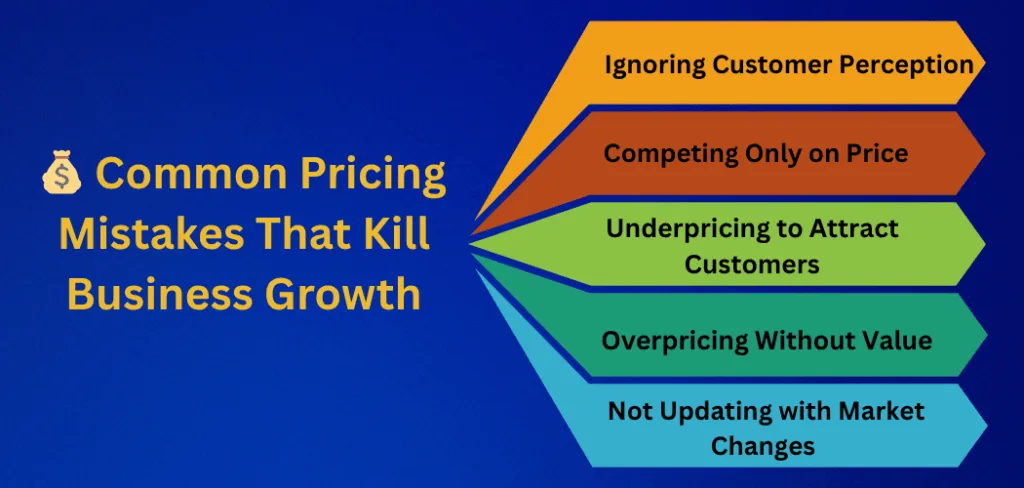
1. Ignoring Customer Perception
People purchase according to perceived value and not the price. Unless your price matches your quality, they will leave even at a low price.
2. Competing Only on Price
Just pricing is like being on a treadmill of competing which you are running but not making any progress. It will never be short of one who is ready to go cheaper.
3. Underpricing to Attract Customers
This pricing error is comfortable initially but underpricing and decreases your margins and credibility. It boasts of low quality rather than great deal.
4. Overpricing Without Value Justification
Premium price can only go together with premium experience. Otherwise, customers are cheated – and the churn increases.
5. Not Adapting Prices with Market Changes
Markets evolve fast. Not updating your pricing paradigm is letting your competitors take your lunch.
How a Weak Pricing Model Affects Growth
An unstable pricing model is detrimental in many aspects. It destroys customer confidence, disorient your listeners and reduces your opportunity to grow. The quick wins may be seen, but the long-term harm will come as most of them are slow leaks in revenue that you will not realize until it is too late.
Case Study: Big Growth Sector for Traders
We shall consider the Big Growth Sector of Traders the financial markets. Price is all in trading. Effective traders are able to set their entry and exits according to the price, demand and time. The profit and loss margin are inseparable by a single decimal point.
Traders can teach businesses, they need to adapt quickly, work with data and revise strategy over time.
The Psychology Behind Pricing
Why are prices such as 9.99 better than 10? There is the psychology of price. Small differences are perceived as bargains by people subconsciously. The psychological cues, which include anchoring, tiered price and scarcity, allow smart brands to make decisions without reducing their prices.
Pricing Strategy vs. Pricing Model
Although they are similar to one another, they are not. A price policy is the overall school of thought of your price such as premium price or penetration price. A price model is, however, the formula which you apply in calculating prices such as cost-plus or subscription-based.
The magic comes in when the two are in line with your brand story.
The Role of Data in Avoiding Pricing Mistakes
Information makes price less of a guesswork. You may prevent price errors by monitoring such indicators as the conversion rate, the churn, and the price of your competitors. There is also data that would inform you when customers believe that your product is being underpriced which is often a missed signal of untapped profit.
Financial Modeling Guide for Sustainable Growth
A Financial Modeling Guide to Sustainable Growth aids businesses in the forecasting of the prices. It links variables such as costs, demand and market elasticity to shape a roadmap to profitability. You can even model a scenario of what-if before making a single price tag adjustment with it.
Dynamic Pricing and AI Tools
AI is used by modern businesses to optimize price. The dynamic price systems study the supply, demand and competition in real time. Consider that airlines and ride-hailing applications will adjust prices in real-time – that is the future of smart price.
Growth Case Study: Lessons from Successful Brands
In this Growth Case Study we are going to consider three giants:
- Netflix: Tier-based price captures all the segments.
- Apple: Provides value of emotion to charge premium prices.
- Tesla: Strikes a balance between innovation and exclusivity to demand.
All of the three stayed out of price errors by relating the value and feeling.
Adapting Your Pricing to Market Changes
The economy changes, inflation increases and consumer behavior changes. Your price should, too. Dynamic price: flexibility, e.g. seasonal deals, loyalty programs, package deals make your business nimble and topical.
Fixing Your Pricing Mistakes
So, what to do in order to repair a broken pricing model?
- Analyze your data.
- Competitor benchmarking.
- Reconsider your value proposition.
- Test minor price adjustments first.
- Be open and communicative with customers.
Price is not a matter of math, but it is a matter of storytelling using numbers.

How Arunangshu Das Guide Us to This
Arunangshu Das is exceptional when it comes to the realization of growth based on the concept of price. His wisdom is a combination of psychology, financial model and business strategy. Through his leadership, hundreds of entrepreneurs have transformed struggling models to profit making scale systems. His counsel of Financial Modeling Guide to Sustainable Growth has taken on a model of sustainable profitability.
In case you want to make the price strategy become a growth engine, Arunangshu Das is your guiding star.
Conclusion
Pricing is not a business choice, but a growth choice. How to avoid price errors, optimize your pricing model and Growth Case Studies can help you change your bottom line. The key? Be flexible, be fact-based, and remain value at the core of all your prices.
FAQs
1. What is the most common pricing mistake?
The most common price error is to underprice to appeal to customers and as a result, profit is low and the brand image is poor.
2. How do I know if my pricing model is failing?
When your sales volume goes up and your profits do not go up then your price model is broken.
3. How can I fix underpricing issues?
Re-evaluate your expenses, compare with the market, and perceived value as an excuse to increase moderately.
4. Why does data matter in pricing?
The information shows customer behavior, best price strategies, and possible profitability holes.
5. How does Arunangshu Das’s approach differ?
He combines market psychology and financial modeling to assist firms in coming up with flexible, long-term scaling price strategies.
