


Backend development is the invisible engine driving today’s digital world. It’s where core business logic thrives, databases are securely managed, and APIs seamlessly deliver data to the frontend. Whether you are launching a lean startup MVP or scaling an enterprise-grade ecosystem, your choice of backend language directly dictates your application’s speed, security, and future scalability.
With an ever-evolving tech landscape, deciding where to focus your energy can be overwhelming. To help you navigate the noise, we’ve broken down the six essential backend programming languages every developer should master—whether you’re breaking into the industry or expanding your full-stack toolkit.
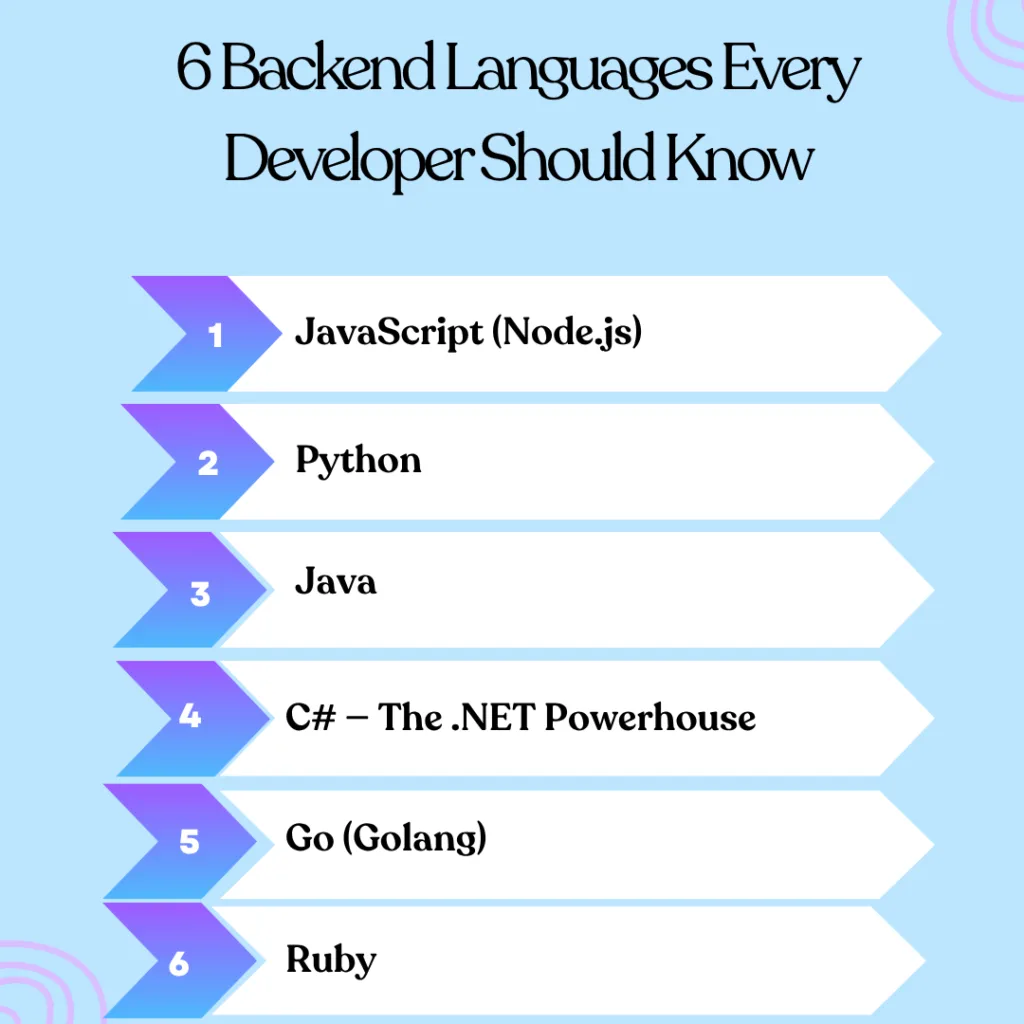
1. JavaScript (Node.js) — The King of Full-Stack
JavaScript is no longer confined to the browser. Thanks to Node.js and its non-blocking, event-driven architecture, it has evolved into a backend powerhouse. It is the premier choice for building highly scalable, real-time applications where instant data synchronization is non-negotiable.
- Why Learn It:
- Blazing Fast Performance: Powered by Google’s V8 engine, it handles thousands of concurrent connections with minimal overhead.
- Unified Stack: Write JavaScript on both the frontend and backend, drastically reducing context switching for full-stack developers.
- Unrivaled Ecosystem: Access to
npm, the world’s largest software registry, offering pre-built modules for almost any feature.
- Best Use Cases: Real-time chat apps, streaming platforms, collaborative tools (like Miro or Figma), and lightweight microservices.
2. Python — The Champion of Simplicity & AI
Renowned for its clean, readable syntax, Python removes the friction from backend development. When paired with robust frameworks like Django or Flask, developers can move from concept to production at lightning speed. Furthermore, Python’s total dominance in data science makes it essential for modern, intelligent web apps.
- Why Learn It:
- Batteries-Included Frameworks: Django features a built-in admin panel, secure authentication mechanisms, and a powerful Object-Relational Mapper (ORM) right out of the box.
- AI/ML Ready: Seamless integration with industry-standard machine learning libraries (TensorFlow, PyTorch, Scikit-learn).
- Low Cognitive Load: The readable, English-like syntax means less time debugging complex code structures.
- Best Use Cases: AI-driven applications, data-heavy dashboards, rapid MVP prototyping, and automated backend scripting.
3. Java — The Enterprise Titan
Java has anchored enterprise-grade backend infrastructure for decades. Running on the Java Virtual Machine (JVM), it offers unparalleled platform independence and security. With modern frameworks like Spring Boot, Java has shed its reputation for bloat, pivoting beautifully into the world of microservices.
- Why Learn It:
- Rock-Solid Security & Stability: Strongly typed and highly structured, making it the industry standard for systems where failure is not an option.
- Built for Scale: Exceptional multi-threading capabilities designed to handle millions of transactions smoothly.
- Immune to Tech Trends: Backed by massive global community support and endless high-paying corporate career opportunities.
- Best Use Cases: Enterprise software, high-frequency banking/fintech platforms, and complex distributed microservices.
4. C# — The .NET Powerhouse
Developed by Microsoft, C# is an elegant, object-oriented language that has surged in popularity thanks to ASP.NET Core—a cross-platform, open-source framework that consistently ranks among the fastest web frameworks in existence.
- Why Learn It:
- Top-Tier Performance: ASP.NET Core delivers jaw-dropping request-per-second metrics that rival Go and Node.js.
- The Cloud & Ecosystem Edge: Offers flawless, first-class integration with Microsoft Azure and the broader Windows enterprise ecosystem.
- Cross-Industry Utility: Mastery of C# transitions seamlessly into game development via the Unity engine.
- Best Use Cases: Enterprise web applications, cloud-native APIs, and high-performance cross-platform software.
5. Go (Golang) — The Cloud-Native Speed Demon
Created by Google to solve scale and concurrency issues at an infrastructural level, Go is a statically typed, compiled language built for maximum efficiency. It strips away complex language abstractions to deliver raw, low-level execution speed with a remarkably simple syntax.
- Why Learn It:
- Native Concurrency: Features built-in “Goroutines”—lightweight threads that use a fraction of the memory of traditional OS threads.
- The Backbone of Cloud Computing: It is the language behind Docker, Kubernetes, and Terraform, making it a mandatory skill for DevOps and cloud engineering.
- Minimalist Efficiency: Compiles directly to machine code, resulting in ultra-fast startup times and microscopic memory footprints.
- Best Use Cases: High-throughput REST and gRPC APIs, cloud-native infrastructure, and large-scale distributed systems.
6. Ruby — The Startup Velocity Machine
While no longer the trendiest language on the block, Ruby—fueled by the legendary Ruby on Rails framework—remains a dominant force for rapid product development. It is built entirely around “developer happiness” and convention over configuration, allowing small teams to build massive platforms quickly.
- Why Learn It:
- Unmatched Development Speed: Rails conventions eliminate boilerplate code, allowing you to launch fully functional web apps in days instead of weeks.
- Elegant Readability: The syntax is highly expressive and human-centric, making code bases easy to maintain and audit.
- Proven at Massive Scale: Powers foundational internet giants like GitHub, Shopify, Airbnb, and Coinbase.
- Best Use Cases: E-commerce marketplaces, SaaS platforms, and fast-paced startup MVP development.
The 6 Core Backend Languages
| Language & Ecosystem | Primary Strength | Learning Curve | Best For | Industry Giants Using It |
| JavaScript (Node.js) | Real-time speed & full-stack unity | Moderate | Chat apps, live streaming, fast APIs | Netflix, LinkedIn, PayPal |
| Python (Django / Flask) | Simplicity & rapid AI/ML integration | Low (Easy) | Data pipelines, AI web apps, MVPs | Instagram, Spotify, NASA |
| Java (Spring Boot) | Enterprise security & immense scale | High | Fintech, banking systems, big data | Uber, Airbnb, Amazon |
| C# (.NET Core) | High performance & Azure cloud edge | Moderate to High | Enterprise web apps, cloud APIs, gaming | Stack Overflow, Microsoft, UPS |
| Go (Golang) | Lightweight, native concurrency | Moderate | Cloud-native microservices, DevOps | Google, Twitch, Uber |
| Ruby (Ruby on Rails) | Developer velocity & prototyping | Low (Easy) | E-commerce, SaaS, startup produc |

Final Thoughts: Choosing Your Next Language
There is no single “perfect” backend language; the right choice entirely depends on the specific architecture, scalability needs, and business logic of the project you are building.
To help you decide where to direct your focus today, consider this quick roadmap:
- For Full-Stack Versatility: Stick with JavaScript (Node.js) to unify your entire development stack under a single language.
- For AI, Data Science, & Speed-to-Market: Lean into Python or Ruby to minimize boilerplate code and tap into machine learning ecosystems.
- For Enterprise Stability & Corporate Careers: Master Java or C# to build highly secure, deeply structured architectures for fintech and cloud-native systems.
- For Next-Gen Cloud Infrastructure: Invest time in Go (Golang) to tackle high-throughput distributed networks and modern DevOps pipelines.
Ultimately, mastering the fundamental concepts of backend architecture—like database management, concurrency, and API design—matters far more than syntax. Pick one language that aligns with your immediate project goals, master it, and the others will naturally fall into place.
You may also like:
1) 5 Common Mistakes in Backend Optimization
2) 7 Tips for Boosting Your API Performance
3) How to Identify Bottlenecks in Your Backend
4) 8 Tools for Developing Scalable Backend Solutions
5) 5 Key Components of a Scalable Backend System
6) 6 Common Mistakes in Backend Architecture Design
7) 7 Essential Tips for Scalable Backend Architecture
8) Token-Based Authentication: Choosing Between JWT and Paseto for Modern Applications
9) API Rate Limiting and Abuse Prevention Strategies in Node.js for High-Traffic APIs
10) Can You Answer This Senior-Level JavaScript Promise Interview Question?
11) 5 Reasons JWT May Not Be the Best Choice
12) 7 Productivity Hacks I Stole From a Principal Software Engineer
13) 7 Common Mistakes in package.json Configuration
Read more blogs from Here
Share your experiences in the comments, and let’s discuss how to tackle them!
Follow me on Linkedin
Frequently Ask Questions:
Is Ruby on Rails dead, or is it still worth learning?
Not dead. It’s a niche powerhouse. If you want to work at established giants like Shopify or launch your own startup fast, learn it. If you want maximum local job openings, pick Node.js or Python instead.
If performance is all that matters, shouldn’t everyone just use Go?
The Reality: Performance isn’t the only metric—development speed matters too. Go is blazing fast to run, but Python or Node.js are much faster to write. Don’t optimize for millions of users before you even have ten.
Do I really need to learn SQL, or can I just use an ORM to handle the database?
You can use an ORM (like Prisma or Mongoose) 80% of the time. But the moment your app slows down or a complex query breaks, you must know raw SQL to fix it. Don’t skip the basics.
Is TypeScript mandatory for backend JavaScript now?
For personal, tiny projects? No. For production-grade enterprise apps? Yes. Virtually no serious engineering team builds raw JavaScript backends anymore; type safety saves too much debugging time.
Can I just use ChatGPT to write my backend logic now?
It can write standard boilerplate and basic APIs perfectly. But it won’t understand your unique business logic, security edge cases, or how to debug a server crash at 3 AM. Use it as a copilot, not the captain.
