


The financial services industry is undergoing a major transformation as organizations increasingly adopt multi-agent AI technologies to improve efficiency, decision-making, and customer experiences. Unlike traditional AI solutions that operate independently, modern AI ecosystems consist of multiple intelligent agents working together through collaborative AI workflows to solve complex financial challenges. These systems are reshaping how banks, investment firms, insurance providers, and fintech companies operate in today’s data-driven environment.
One of the key drivers behind this shift is the growing adoption of AI Agents for Private Equity. Investment firms are leveraging intelligent agents to analyze large datasets, evaluate investment opportunities, and automate due diligence processes. As a result, financial professionals can make faster and more informed decisions while reducing manual workloads. The integration of enterprise finance AI is helping organizations achieve greater operational agility and competitive advantages.
At the same time, Financial Research Workflows are being enhanced through intelligent AI collaboration. Multiple AI agents can simultaneously gather market data, assess risk factors, monitor economic indicators, and generate insights for analysts. This evolution has led to the emergence of autonomous financial systems that can perform sophisticated tasks with minimal human intervention.
Understanding Multi-Agent AI Systems
A multi-agent AI system consists of several autonomous agents designed to perform specific functions while communicating and collaborating with one another. These agents operate within coordinated environments supported by AI orchestration platforms, enabling seamless information exchange and task management.
Key Components of Multi-Agent AI
| Component | Function |
| AI Agents | Execute specialized financial tasks |
| Communication Layer | Enables data exchange between agents |
| Decision Engine | Coordinates actions and recommendations |
| Analytics Module | Processes financial insights |
| Monitoring System | Tracks performance and compliance |
By leveraging distributed AI agents, financial institutions can divide complex processes into smaller, manageable tasks that improve overall system performance.
Why Financial Institutions Are Adopting Multi-Agent AI
The demand for intelligent automation continues to grow as Financial Institutions Are Investing heavily in AI-driven transformation initiatives. Organizations recognize that traditional automation tools often struggle with dynamic financial environments.
Benefits of Multi-Agent AI in Finance
| Benefit | Impact |
| Faster Decision-Making | Reduced response times |
| Enhanced Accuracy | Improved forecasting and analysis |
| Cost Optimization | Lower operational expenses |
| Scalability | Supports growing business needs |
| Compliance Monitoring | Reduces regulatory risks |
Through intelligent automation networks, financial firms can automate repetitive processes while maintaining high levels of accuracy and compliance.
Multi-Agent AI Applications in Financial Services
1. Wealth Management
One of the most promising applications of AI Agents in Wealth Management is personalized investment advisory services. Different agents can monitor market trends, evaluate client portfolios, and recommend investment strategies in real time.
Wealth Management Agent Roles
| AI Agent | Responsibility |
| Market Agent | Tracks market conditions |
| Portfolio Agent | Evaluates asset allocation |
| Risk Agent | Monitors risk exposure |
| Client Agent | Analyzes customer preferences |
| Compliance Agent | Ensures regulatory adherence |
These specialized agents work together through collaborative AI workflows to deliver customized wealth management solutions.
2. Financial Modeling and Forecasting
Financial professionals increasingly rely on AI-powered tools for Financial Modeling for Analysts. Multiple agents can process historical data, identify trends, and generate predictive models more efficiently than traditional methods.
AI-Powered Financial Modeling Process
| Stage | AI Contribution |
| Data Collection | Automated aggregation |
| Data Cleaning | Error detection and correction |
| Model Development | Predictive analytics |
| Risk Assessment | Scenario simulations |
| Reporting | Automated report generation |
By integrating finance workflow AI, organizations can significantly reduce the time required for complex financial analysis.
3. Fraud Detection and Risk Management
Modern fraud prevention systems rely heavily on distributed AI agents that continuously monitor transactions and identify suspicious activities. Each agent specializes in detecting specific patterns or anomalies, creating a comprehensive defense mechanism.
Fraud Detection Workflow
| Agent Type | Function |
| Transaction Agent | Monitors payments |
| Behavioral Agent | Tracks user activity |
| Risk Agent | Calculates risk scores |
| Alert Agent | Issues warnings |
| Investigation Agent | Supports compliance teams |
These systems contribute to more robust AI-powered operations across financial institutions.
The Role of AI Orchestration Platforms
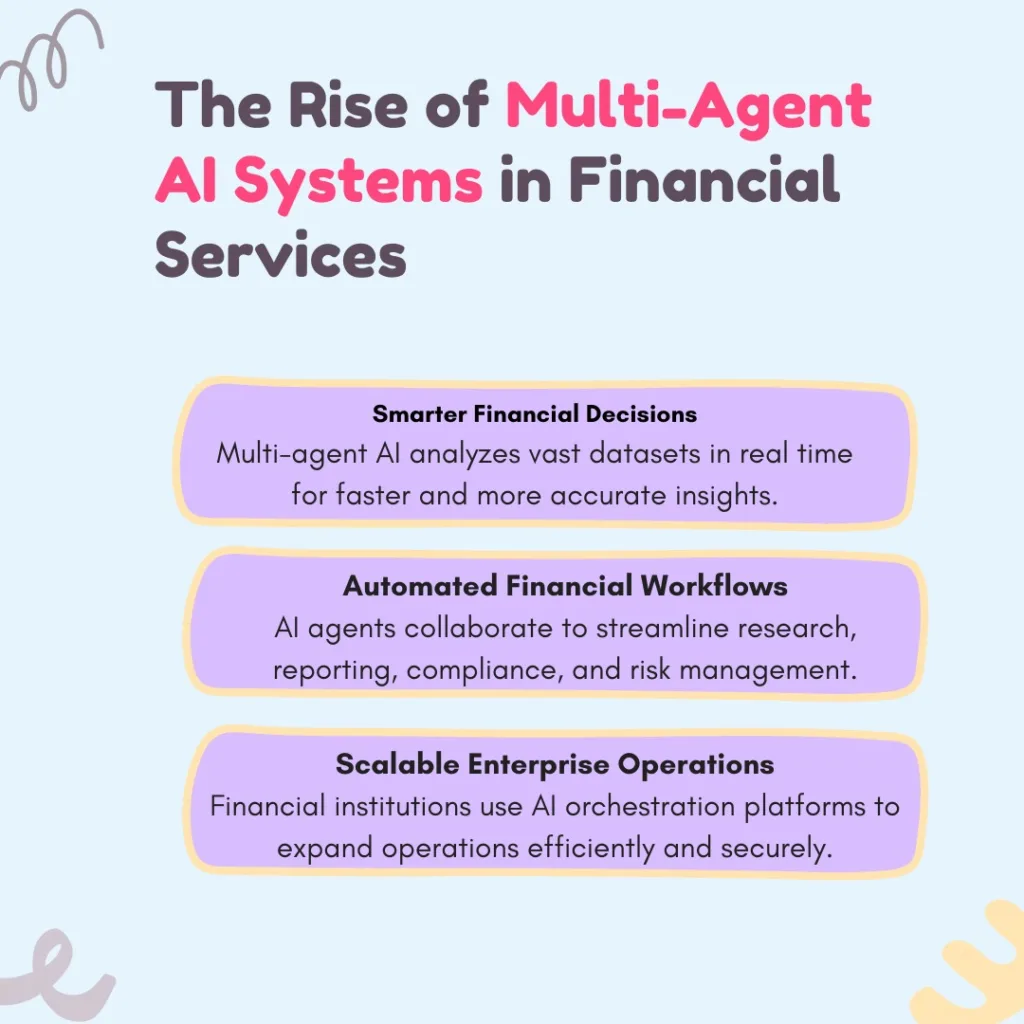
As financial ecosystems become increasingly complex, AI orchestration platforms play a critical role in coordinating agent interactions. These platforms ensure efficient communication, workload balancing, and governance across AI networks.
Features of AI Orchestration Platforms
| Feature | Business Value |
| Workflow Coordination | Improved efficiency |
| Agent Monitoring | Greater transparency |
| Resource Allocation | Optimized performance |
| Security Controls | Enhanced protection |
| Compliance Management | Regulatory support |
These capabilities enable organizations to build highly scalable AI systems capable of supporting enterprise-level financial operations.
Enterprise Finance AI and Operational Transformation
The rise of enterprise finance AI is transforming back-office functions such as accounting, auditing, treasury management, and regulatory reporting. Through AI-powered operations, organizations can streamline processes and reduce operational bottlenecks.
For example, AI agents can automatically reconcile transactions, generate financial statements, identify anomalies, and prepare compliance reports. This level of automation creates more efficient finance workflow AI environments that support business growth.
Intelligent Automation Networks in Banking
Banks are increasingly deploying intelligent automation networks to improve customer service and operational resilience. These systems integrate chatbots, virtual assistants, risk assessment tools, and transaction monitoring agents into unified ecosystems.
The result is faster service delivery, improved customer satisfaction, and stronger risk management capabilities. Such implementations demonstrate how autonomous financial systems are becoming essential components of modern banking infrastructure.
Future Trends in Multi-Agent AI for Financial Services
Several trends are expected to shape the future of multi-agent AI in financial services:
- Increased adoption of autonomous decision-making systems.
- Greater integration of AI agents across departments.
- Enhanced regulatory compliance automation.
- Expansion of predictive analytics capabilities.
- Wider deployment of scalable AI systems across global financial organizations.
As Financial Institutions Are Investing more resources into AI innovation, the role of distributed AI agents and AI orchestration platforms will continue to expand.

Conclusion
The rise of multi-agent AI is redefining the future of financial services. Through collaborative AI workflows, organizations can automate complex processes, improve decision-making, and enhance customer experiences. From AI Agents in Wealth Management to Financial Modeling for Analysts, these technologies are creating smarter and more efficient financial ecosystems. As Financial Institutions Are Investing heavily in innovation, the adoption of enterprise finance AI, autonomous financial systems, intelligent automation networks, finance workflow AI, AI-powered operations, AI orchestration platforms, distributed AI agents, and scalable AI systems will continue to accelerate, driving the next generation of financial transformation.
FAQs
1. What is multi-agent AI in financial services?
Multi-agent AI refers to a system where multiple intelligent agents collaborate to perform financial tasks such as risk analysis, investment management, fraud detection, and reporting.
2. How do collaborative AI workflows benefit financial institutions?
Collaborative AI workflows improve efficiency, accuracy, and scalability by allowing multiple AI agents to work together on complex financial processes.
3. What are AI Agents in Wealth Management?
AI Agents in Wealth Management are specialized AI systems that analyze market trends, client preferences, portfolio performance, and risk factors to provide investment recommendations.
4. Why are Financial Institutions Are Investing in multi-agent AI?
Financial Institutions Are Investing in AI because it helps reduce costs, improve compliance, enhance customer experiences, and increase operational efficiency.
5. What role do AI orchestration platforms play?
AI orchestration platforms coordinate communication, task allocation, monitoring, and governance among multiple AI agents to ensure seamless operations.
