


Preparing for a Generative AI interview requires more than understanding how large language models work. Candidates may face LLM interview questions, AI engineering interview scenarios, and practical questions about large language models, AI model questions, and generative AI concepts. AI engineers are also expected to understand API development, SQL joins, React components, and Python coding problems because modern AI applications often connect models with software systems and data platforms.
A strong preparation strategy should cover model architecture, prompt engineering, retrieval-augmented generation, evaluation, deployment, and production monitoring. Alongside predictive modeling, candidates may encounter questions relevant to data analysts, and an AWS cloud interview. This broader technical foundation helps AI engineers understand how generative AI systems move from experimentation to production.
1. What Is Generative AI?
Generative AI refers to artificial intelligence systems that can create new content based on patterns learned from training data. Depending on the model, generated content can include text, images, audio, video, code, or structured data.
Unlike traditional machine learning systems that are commonly designed to classify or predict an outcome, generative models learn patterns that allow them to produce new outputs. Large language models such as GPT-based systems are examples of generative AI models designed primarily for language-related tasks.
Key Generative AI Concepts
Some important concepts candidates should understand include:
- Foundation models
- Large language models
- Transformers
- Tokenization
- Embeddings
- Prompt engineering
- Fine-tuning
- Retrieval-augmented generation
- Model evaluation
- Inference
- Guardrails
- Hallucination reduction
2. What Are Large Language Models?
Large language models are neural networks trained on large volumes of text and other data to understand and generate language. Most modern LLMs use transformer-based architectures.
During inference, an LLM processes an input sequence and predicts appropriate subsequent tokens. The model can then generate a response one token at a time.
Important LLM components include:
- Tokenization
- Embedding layers
- Transformer layers
- Attention mechanisms
- Feed-forward networks
- Output probability distributions
3. What Is a Transformer Architecture?
A transformer is a neural network architecture that uses attention mechanisms to process relationships between tokens.
The self-attention mechanism allows the model to determine which tokens are important when processing another token. This makes transformers particularly effective for language-related tasks.
A simplified transformer workflow is:
Input Text → Tokenization → Embeddings → Attention Layers → Feed-Forward Layers → Output
Transformers have become the foundation of many modern language models because they can process relationships between words and tokens efficiently.
4. What Is Self-Attention?
Self-attention allows a model to determine how much importance each token should give to other tokens in the same sequence.
For example, in the sentence:
“The engineer deployed the model because it performed well.”
The model needs to understand that “it” refers to the model. Attention mechanisms help capture such relationships.
The core components of attention are:
- Query
- Key
- Value
The attention calculation is commonly represented as:
Attention(Q, K, V) = softmax(QKᵀ / √dₖ)V
5. What Is Prompt Engineering?
Prompt engineering involves designing input instructions that guide a generative AI model toward the desired output.
Effective prompts can specify:
- Role
- Context
- Task
- Constraints
- Output format
- Examples
- Evaluation criteria
For instance, instead of asking:
“Summarize this.”
An AI engineer might use:
“Summarize the following technical document in five bullet points. Focus on architecture, limitations, implementation requirements, and security considerations.”
The second prompt provides clearer instructions and constraints.
6. What Is Retrieval-Augmented Generation?
Retrieval-Augmented Generation, or RAG, combines information retrieval with generative AI.
A typical RAG system works as follows:
User Query → Embedding → Vector Search → Relevant Documents → Prompt Construction → LLM → Response
RAG can help applications use external or organization-specific information without requiring the entire knowledge base to be encoded directly into model parameters.
Common components include:
- Document loaders
- Text splitters
- Embedding models
- Vector databases
- Retrieval systems
- Prompt templates
- LLMs
- Evaluation systems
7. What Is Fine-Tuning?
Fine-tuning involves taking a pretrained model and training it further on a task-specific dataset.
It can be useful when an organization needs a model to follow particular patterns, styles, or task requirements.
Fine-tuning should not automatically be considered a replacement for RAG. RAG is generally useful when the application needs access to changing external information, while fine-tuning can help modify model behavior or task performance.
8. What Is the Difference Between RAG and Fine-Tuning?
| Feature | RAG | Fine-Tuning |
| Main purpose | Provide external context | Adapt model behavior |
| Knowledge updates | Easier to update documents | Requires additional training |
| Data source | External knowledge base | Training dataset |
| Infrastructure | Retrieval + model | Training + model |
| Common use | Enterprise knowledge assistants | Specialized model behavior |
The appropriate approach depends on the application requirements, data characteristics, model capabilities, and operational constraints.
9. What Are Hallucinations in Generative AI?
A hallucination occurs when a model produces information that appears plausible but is unsupported, incorrect, or fabricated.
Common causes include:
- Insufficient context
- Ambiguous prompts
- Weak retrieval
- Training-data limitations
- Model uncertainty
- Incorrect assumptions
- Poor grounding
AI engineers can reduce hallucinations using techniques such as RAG, structured outputs, source attribution, validation rules, tool calling, and human review for high-impact applications.
10. How Do You Evaluate a Generative AI Application?
Evaluation should consider both model quality and application-level performance.
Important metrics may include:
- Accuracy
- Relevance
- Faithfulness
- Context precision
- Context recall
- Response latency
- Token usage
- Cost per request
- Safety violations
- User satisfaction
For production systems, evaluation should include representative test datasets and continuous monitoring rather than relying only on a few manually tested prompts.
11. What Is Temperature in an LLM?
Temperature controls the randomness of token selection during generation.
A lower temperature generally produces more predictable outputs, while a higher temperature can produce more varied responses.
| Temperature Setting | Typical Behavior | Suitable Use |
| Low | More deterministic | Structured answers |
| Medium | Balanced variation | General assistants |
| High | More creative variation | Brainstorming |
| Very high | Highly variable | Experimental generation |
The optimal setting depends on the model and application.
12. What Is Tokenization?
Tokenization converts text into smaller units called tokens.
A token may represent:
- A complete word
- Part of a word
- Punctuation
- A special symbol
For example, a long technical word may be divided into several tokens depending on the tokenizer.
Tokenization matters because model context windows and inference costs are generally measured using tokens.
13. What Is an Embedding?
An embedding represents information as a numerical vector. Text embeddings can capture semantic relationships between pieces of text.
For example, sentences with similar meanings can have vectors that are relatively close in an embedding space.
Embeddings are commonly used for:
- Semantic search
- RAG
- Document clustering
- Recommendation systems
- Similarity detection
- Classification
14. How Does an AI Engineer Build a Production-Ready GenAI Application?
A production system generally requires much more than selecting an LLM.
A typical architecture can include:
Frontend → API Layer → Application Logic → Retrieval/Tools → LLM → Validation → Response
The engineering process may include:
- Define the business problem.
- Select an appropriate model.
- Design prompts and system instructions.
- Build data pipelines.
- Add retrieval or tools where required.
- Develop APIs.
- Containerize the application.
- Deploy infrastructure.
- Monitor quality and performance.
- Continuously evaluate and improve the system.
15. How Are APIs Used in Generative AI Applications?
APIs connect applications with AI models, databases, tools, and business systems.
For example, an AI assistant may expose an API endpoint that accepts a user request, retrieves relevant information, calls an LLM, validates the output, and returns a structured response.
Good API design should consider:
- Authentication
- Authorization
- Input validation
- Rate limiting
- Error handling
- Logging
- Versioning
- Response schemas
16. How Can SQL Support Generative AI Applications?
SQL is useful when AI applications need to work with structured business data.
An AI system might translate a natural-language request into a database query, execute it under controlled permissions, and convert the resulting data into a readable response.
AI engineers should understand concepts such as:
- SELECT statements
- WHERE clauses
- GROUP BY
- Aggregations
- Subqueries
- Indexing
- SQL joins
- Transactions
For AI-generated SQL, security controls are particularly important because unrestricted query execution can expose sensitive information or create unwanted database operations.
17. What Role Does Python Play in Generative AI?
Python is widely used for AI development because of its machine learning ecosystem and extensive libraries.
AI engineers may use Python for:
- Data processing
- Model integration
- API development
- Prompt pipelines
- Evaluation
- RAG applications
- Model serving
- Automation
During interviews, candidates may also receive Python coding problems involving lists, dictionaries, strings, APIs, algorithms, data processing, and object-oriented programming.
18. How Do Docker and Kubernetes Help Deploy AI Applications?
Docker containers package applications and their dependencies into portable environments.
Kubernetes pods provide a deployment unit for containerized applications within a Kubernetes cluster.
A simplified deployment process is:
Application → Docker Image → Container Registry → Kubernetes Deployment → Kubernetes Pods → Service
AI applications can use this infrastructure for scalable model APIs, inference services, background workers, and supporting components.
19. Why Are Git Commands Important for AI Engineers?
AI engineering involves collaborative software development, so version control is essential.
Common Git commands include:
| Git Command | Purpose |
| git clone | Copies a repository |
| git status | Shows working-tree status |
| git add | Stages changes |
| git commit | Records changes |
| git pull | Retrieves and integrates changes |
| git push | Sends commits to a remote repository |
| git branch | Manages branches |
| git merge | Combines branches |
AI projects may also use Git to track application code, configuration, evaluation scripts, prompt templates, and infrastructure definitions.
20. What Should You Know for an AWS Cloud Interview Focused on AI?
For an AWS cloud interview, an AI engineer may need to understand how cloud services support application hosting, storage, databases, networking, monitoring, and model workloads.
Relevant concepts can include:
- Compute services
- Object storage
- Managed databases
- IAM
- Virtual networks
- Containers
- Serverless services
- Monitoring
- Autoscaling
- Managed machine learning services
The exact AWS services depend on the architecture and organization’s technology stack.
21. How Does Generative AI Differ From Predictive Modeling?
Generative AI and predictive modeling have different primary objectives.
| Area | Generative AI | Predictive Modeling |
| Primary goal | Generate new content | Predict an outcome |
| Typical output | Text, image, code, audio | Class or numerical value |
| Common models | LLMs, diffusion models | Regression, trees, neural networks |
| Example | Generate a product description | Predict customer churn |
| Evaluation | Quality, relevance, faithfulness | Accuracy, precision, recall, RMSE |
Both approaches can be used together in larger AI systems.
22. How Should AI Engineers Handle Security?
Security should be considered throughout the AI application’s lifecycle.
Important areas include:
- Prompt injection
- Sensitive-data exposure
- Insecure tool access
- Excessive permissions
- Data poisoning
- Model misuse
- Authentication
- Authorization
- Logging
- Output validation
These topics can overlap with areas discussed in a security analyst interview, particularly when AI systems connect to enterprise applications and sensitive data.
23. How Can React Be Used in Generative AI Applications?
React components can provide the frontend interface for AI applications.
For example, a React-based AI assistant may contain components for:
- Chat messages
- Prompt input
- File uploads
- Streaming responses
- Citations
- Tool results
- Feedback buttons
- Conversation history
The frontend typically communicates with the backend through APIs rather than directly exposing sensitive model credentials.
24. How Do DevOps Tools Support Generative AI?
Modern AI applications require continuous development, testing, deployment, and monitoring.
Common DevOps tools can support:
- Source control
- CI/CD
- Containerization
- Infrastructure automation
- Deployment
- Monitoring
- Logging
- Security scanning
A mature AI engineering workflow can combine application development with automated testing and deployment pipelines.
25. What Are Common Challenges in Generative AI Projects?
| Challenge | Example | Possible Approach |
| Hallucination | Incorrect factual response | RAG and validation |
| Latency | Slow generation | Caching and model optimization |
| Cost | High token usage | Prompt optimization |
| Security | Prompt injection | Guardrails and access controls |
| Data quality | Poor retrieval | Better chunking and indexing |
| Evaluation | Difficult quality measurement | Automated human evaluation |
The correct solution depends on the specific application’s requirements and risk profile.
Generative AI Interview Questions: Quick Preparation Table
| Question Area | What to Prepare |
| LLMs | Transformers, attention, tokens, context windows |
| RAG | Embeddings, vector databases, retrieval |
| Prompt Engineering | System prompts, few-shot prompting, structured outputs |
| Fine-Tuning | Training data, adaptation, evaluation |
| Deployment | APIs, Docker, Kubernetes, cloud |
| Programming | Python, SQL, API development |
| Frontend | React components and API integration |
| DevOps | Git, CI/CD, containers, monitoring |
| Security | Prompt injection, permissions, data protection |
| Evaluation | Accuracy, relevance, faithfulness, latency, cost |
Conclusion
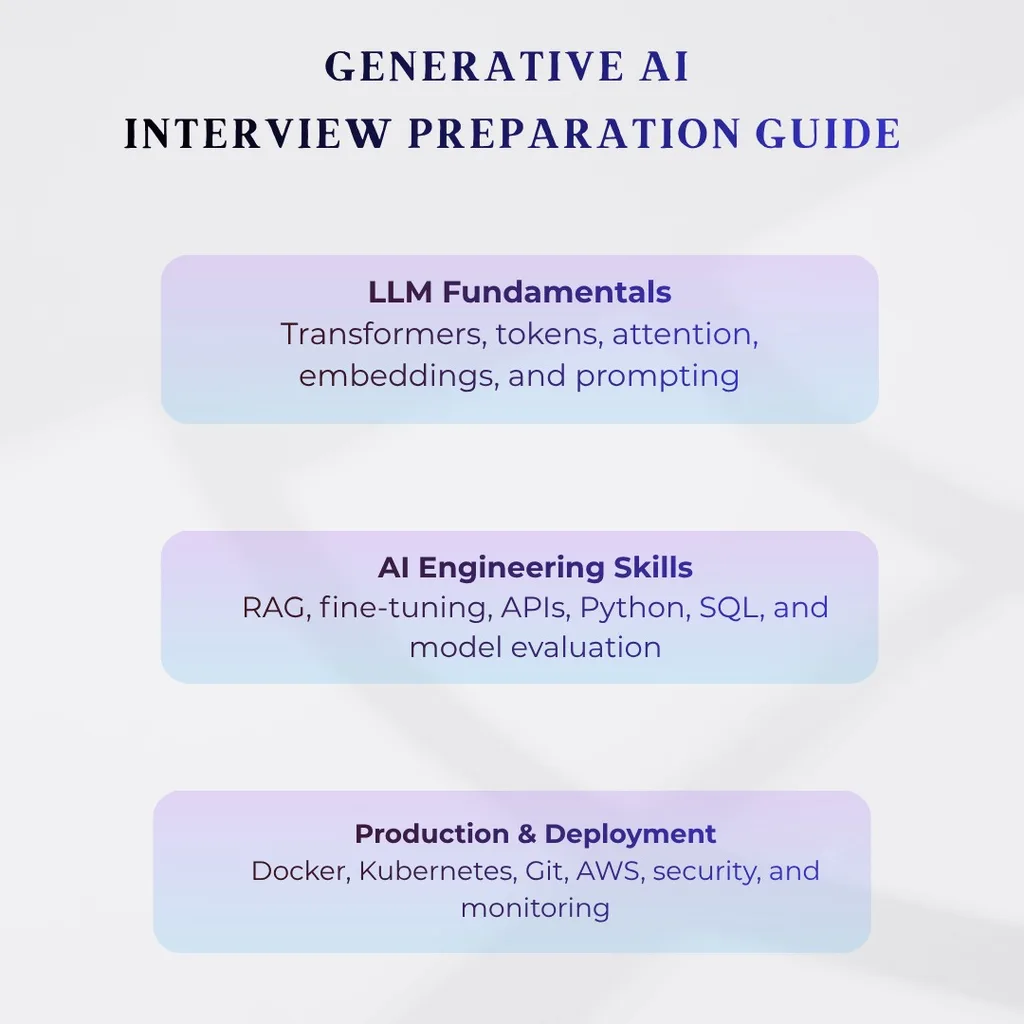
Generative AI interviews can cover both AI fundamentals and practical software engineering. Candidates should be comfortable explaining large language models, attention, embeddings, RAG, fine-tuning, prompt engineering, evaluation, and hallucination mitigation while also understanding Python, APIs, databases, Git, containers, Kubernetes, cloud infrastructure, frontend integration, and security.
For AI engineers, the strongest preparation comes from understanding how these technologies work together in a complete production system—not just memorizing individual interview answers.
Frequently Asked Questions
1. Is Python required for a Generative AI Engineer?
Python is highly useful because many AI and machine learning frameworks, data-processing libraries, evaluation tools, and model APIs support Python. However, the exact programming requirements vary by role.
2. What should I study first for a Generative AI interview?
Start with transformer architecture, LLM fundamentals, prompt engineering, embeddings, RAG, fine-tuning, model evaluation, and Python. Then move into APIs, databases, deployment, cloud, and security.
3. Is RAG better than fine-tuning?
RAG and fine-tuning solve different problems. RAG is useful when an application needs information from an external knowledge base, while fine-tuning is used to adapt model behavior to particular tasks or datasets. The appropriate choice depends on the application.
4. Do AI engineers need to know Docker and Kubernetes?
Many production AI engineering roles benefit from knowledge of Docker and Kubernetes because AI services are frequently deployed as containerized applications. However, requirements vary between organizations and roles.
5. What are the most important GenAI interview topics for experienced candidates?
Experienced candidates should be prepared to discuss LLM architecture, RAG, prompt engineering, model evaluation, fine-tuning, inference optimization, AI application architecture, APIs, databases, cloud deployment, security, observability, and production troubleshooting.
