


Preparing for a cloud engineering role requires more than memorizing services. Candidates should understand how AWS services work together, how to troubleshoot infrastructure, and how to make practical architecture decisions. This guide covers interview questions on front developer interview questions, and interview questions on machine learning alongside essential AWS topics to help candidates prepare for technical discussions.
For candidates preparing across multiple technology stacks, these interview questions on HTML CSS and full stack interview questions can provide useful background before moving into cloud-focused discussions. The guide also connects AWS concepts with development, databases, and application deployment so that preparation is relevant for modern cloud engineering positions.
What Is AWS and Why Is It Important for Cloud Engineers?
Amazon Web Services (AWS) is a cloud computing platform that provides infrastructure and managed services for computing, storage, databases, networking, security, analytics, machine learning, and application development.
A strong candidate should understand not only individual AWS services but also how they fit into a complete application architecture. Interviewers commonly test practical knowledge through scenario-based questions involving scalability, availability, security, cost optimization, and disaster recovery.
1. What Is Amazon EC2?
Amazon Elastic Compute Cloud (EC2) provides resizable virtual servers in the AWS cloud. Engineers can select an instance type, operating system, storage configuration, networking settings, and security controls according to application requirements.
EC2 is commonly used for web servers, APIs, backend applications, development environments, and workloads that require direct control over the operating system.
Key EC2 concepts
- AMIs
- Instance types
- Security groups
- Key pairs
- Elastic IP addresses
- EBS volumes
- Auto Scaling
- Availability Zones
2. What Are EC2 Instance Types?
EC2 offers different instance families optimized for specific workloads.
| Instance Family | Primary Use | Example Workload |
| General Purpose | Balanced compute and memory | Web applications |
| Compute Optimized | High CPU performance | Batch processing |
| Memory Optimized | Large memory requirements | In-memory databases |
| Storage Optimized | High local storage performance | Data processing |
| Accelerated Computing | GPU/accelerator workloads | Machine learning |
Choosing an instance type depends on CPU, memory, network throughput, storage performance, and workload characteristics.
3. What Are Security Groups in AWS?
A security group acts as a virtual firewall for EC2 instances. It controls inbound and outbound traffic using rules based on protocols, ports, and IP addresses or security-group references. Similar to how React interview questions assess how developers handle application-level security and data flow, AWS interviews often evaluate how well candidates understand network security and access control.
Security groups are stateful, meaning that response traffic is automatically allowed when the corresponding request is permitted.
For example, an application server might allow:
- HTTP on port 80
- HTTPS on port 443
- SSH on port 22 only from an administrator’s trusted IP
4. What Is Amazon S3?
Amazon Simple Storage Service (S3) is an object storage service designed to store and retrieve large amounts of data.
Typical use cases include:
- Backup storage
- Static website assets
- Application files
- Data lakes
- Log archives
- Media storage
S3 stores objects inside buckets, and each object has a key that identifies its location within the bucket.
5. What Are S3 Storage Classes?
S3 provides multiple storage classes designed for different access patterns and cost requirements.
| Storage Class | Typical Use |
| S3 Standard | Frequently accessed data |
| S3 Intelligent-Tiering | Data with changing access patterns |
| S3 Standard-IA | Infrequently accessed data |
| S3 One Zone-IA | Infrequently accessed, recreatable data |
| S3 Glacier Instant Retrieval | Archive data requiring quick retrieval |
| S3 Glacier Flexible Retrieval | Long-term archival |
| S3 Glacier Deep Archive | Lowest-cost long-term archive |
An engineer should select a storage class based on access frequency, retrieval requirements, durability needs, and cost.
6. What Is AWS Lambda?
AWS Lambda is a serverless compute service that runs code in response to events without requiring developers to manage servers.
Lambda can be triggered by services such as:
- Amazon S3
- Amazon API Gateway
- Amazon EventBridge
- Amazon SQS
- Amazon SNS
- Amazon DynamoDB
For example, uploading an image to S3 could trigger a Lambda function that processes or resizes the image automatically.
7. How Does AWS Lambda Work?
A Lambda function executes when an event invokes it. AWS manages the underlying infrastructure, including server provisioning and scaling.
The general workflow is:
Event → Lambda Function → Processing → Response/Action
Lambda is particularly useful for event-driven applications, APIs, automation, scheduled jobs, and lightweight backend processing.
However, candidates should understand limitations such as execution duration, concurrency, memory allocation, and cold-start considerations.
8. What Is Amazon VPC?
Amazon Virtual Private Cloud (VPC) allows organizations to create an isolated virtual network within AWS.
A VPC can contain:
- Public and private subnets
- Route tables
- Internet gateways
- NAT gateways
- Network ACLs
- Security groups
- VPC endpoints
A common architecture places public-facing resources in public subnets while databases and internal services remain in private subnets.
9. What Is the Difference Between a Public and Private Subnet?
A public subnet has a route to an Internet Gateway, allowing resources with appropriate public addressing and security rules to communicate with the internet.
A private subnet does not have a direct route to an Internet Gateway. Resources in private subnets can use a NAT Gateway for outbound internet access when required.
For example:
Internet → Load Balancer → Application Servers → Database
The load balancer can be public, while application servers and databases can remain private.
10. What Is Amazon RDS?
Amazon Relational Database Service (RDS) is a managed relational database service that simplifies database deployment, maintenance, backups, patching, and scaling.
Supported database engines include options such as:
- PostgreSQL
- MySQL
- MariaDB
- Oracle
- SQL Server
RDS can provide Multi-AZ deployments, automated backups, read replicas, and monitoring capabilities.
Candidates working across application stacks may also encounter database concepts such as SQL joins during technical interviews, especially when discussing backend applications connected to AWS-hosted databases.
11. What Is Amazon DynamoDB?
DynamoDB is a fully managed NoSQL database service designed for high-performance applications.
It provides:
- Low-latency access
- Automatic scaling capabilities
- Flexible data models
- High availability
- Serverless operation
DynamoDB is suitable for workloads where predictable, fast key-value or document access is more appropriate than a traditional relational database.
12. What Is Amazon CloudFront?
Amazon CloudFront is a content delivery network (CDN) that distributes content through globally distributed edge locations.
It can improve application performance by caching content closer to users.
Typical CloudFront use cases include:
- Website acceleration
- Video delivery
- API acceleration
- Static asset delivery
- S3 content distribution
CloudFront can also integrate with AWS security services and origin servers.
13. What Is an Elastic Load Balancer?
Elastic Load Balancing distributes incoming traffic across multiple targets such as EC2 instances, containers, and IP addresses.
Common load balancer types include:
- Application Load Balancer
- Network Load Balancer
- Gateway Load Balancer
Load balancing improves availability and can help applications handle increasing traffic.
14. What Is Auto Scaling in AWS?
Amazon EC2 Auto Scaling automatically adjusts the number of EC2 instances according to defined policies and conditions. Similar to how a Python technical interview may assess automation and application scalability concepts, AWS interviews often evaluate how engineers can design infrastructure that responds efficiently to changing workloads.
For example:
Low traffic → Fewer instances
High traffic → More instances
Auto Scaling helps maintain application availability while avoiding unnecessary infrastructure costs.
15. What Is IAM?
AWS Identity and Access Management (IAM) controls authentication and authorization for AWS resources.
IAM includes:
- Users
- Groups
- Roles
- Policies
- Permissions
A strong security practice is to follow the principle of least privilege, granting only the permissions required for a specific task.
AWS Services Cloud Engineers Should Know
| AWS Service | Category | Common Purpose |
| EC2 | Compute | Virtual servers |
| S3 | Storage | Object storage |
| Lambda | Serverless | Event-driven applications |
| RDS | Database | Managed relational databases |
| DynamoDB | Database | NoSQL applications |
| VPC | Networking | Isolated cloud network |
| CloudFront | CDN | Content delivery |
| IAM | Security | Access management |
| CloudWatch | Monitoring | Metrics and logs |
| Route 53 | DNS | Domain and traffic routing |
16. What Is AWS CloudWatch?
Amazon CloudWatch is a monitoring and observability service used to collect metrics, logs, and events from AWS resources and applications.
Cloud engineers can use CloudWatch to monitor:
- EC2 CPU utilization
- Application logs
- Lambda execution metrics
- API performance
- System health
- Custom application metrics
CloudWatch alarms can also trigger actions when predefined thresholds are reached.
17. What Is Amazon Route 53?
Amazon Route 53 is a highly available and scalable DNS service.
It can perform:
- Domain registration
- DNS resolution
- Health checks
- Traffic routing
Routing policies include simple, weighted, latency-based, failover, and geolocation-based approaches.
18. What Is AWS CloudFormation?
AWS CloudFormation is an Infrastructure as Code service that allows engineers to define AWS resources through templates.
Instead of manually creating infrastructure, teams can define resources such as:
- VPCs
- EC2 instances
- IAM roles
- S3 buckets
- RDS databases
- Load balancers
Infrastructure can then be created and managed consistently across environments.
19. What Is the Difference Between High Availability and Fault Tolerance?
High availability focuses on keeping applications operational with minimal downtime.
Fault tolerance means the system can continue operating even when a component fails. Similar to how asp net core interview questions may assess application reliability and deployment concepts, AWS interviews often evaluate how engineers design systems that remain resilient during infrastructure failures.
For example, deploying application servers across multiple Availability Zones improves availability because the application can continue operating if one Availability Zone experiences an issue.
20. What Is AWS Well-Architected Framework?
The AWS Well-Architected Framework provides principles for evaluating cloud workloads across important architectural areas.
Its pillars include:
- Operational Excellence
- Security
- Reliability
- Performance Efficiency
- Cost Optimization
- Sustainability
Understanding these principles is particularly useful for an AWS architecture interview, where candidates may need to explain why they selected specific services and architectural patterns.
AWS Architecture Interview Scenario
Question
You need to design a highly available web application on AWS. How would you approach it?
Answer
A possible architecture could include:
Route 53 → CloudFront → Application Load Balancer → EC2 Auto Scaling → RDS Multi-AZ
Supporting services could include:
- S3 for static assets
- IAM for access control
- CloudWatch for monitoring
- VPC for network isolation
- AWS WAF for application-layer protection
The application servers should ideally be distributed across multiple Availability Zones to reduce the impact of infrastructure failures.
21. How Is AWS Different From Traditional Data Centers?
Traditional data centers require organizations to purchase and maintain physical infrastructure. AWS provides on-demand cloud infrastructure and managed services.
Key differences include:
| Factor | Traditional Data Center | AWS |
| Infrastructure | Physical hardware | Cloud resources |
| Scaling | Usually slower | Rapidly scalable |
| Maintenance | Customer-managed | Varies by service |
| Deployment | Hardware provisioning | API/console based |
| Cost Model | Capital expenditure | Primarily usage-based |
| Availability | Designed by organization | Multiple AZs/regions available |
Cloud engineers should understand these differences when discussing migration strategies.
22. How Do You Secure an AWS Environment?
AWS security should be implemented across multiple layers.
Important practices include:
- Use IAM roles and least-privilege policies
- Enable MFA for sensitive accounts
- Avoid unnecessary public access
- Encrypt sensitive data
- Protect APIs and applications
- Monitor logs and security events
- Regularly review permissions
- Segment networks using VPC architecture
- Keep systems patched
Security should be considered during architecture design rather than added after deployment.
23. How Do You Optimize AWS Costs?
Cost optimization starts with understanding resource usage.
Some common approaches include:
- Right-sizing EC2 instances
- Removing unused resources
- Using appropriate S3 storage classes
- Applying lifecycle policies
- Using Auto Scaling
- Monitoring resource utilization
- Selecting appropriate purchasing options
- Reviewing data transfer costs
The best approach depends on workload requirements rather than simply choosing the lowest-cost service.
24. AWS Interview Preparation Across Technology Stacks
Cloud engineering interviews increasingly involve knowledge that crosses development and infrastructure boundaries. Candidates may encounter Node.js backend interview topics when discussing APIs deployed on EC2, containers, or serverless infrastructure.
Similarly, React interview questions may appear when a frontend application is hosted through S3 and CloudFront. A Python technical interview can involve Lambda functions, automation scripts, data processing, or AWS SDK usage.
Candidates working with Microsoft technologies may also encounter asp net core interview questions when discussing APIs deployed to AWS. Developers preparing for C# roles can review c sharp interview questions and answers, while Java-focused candidates may encounter core java questions asked in interview during broader software engineering interviews.
These cross-functional topics matter because modern cloud engineers often collaborate closely with application developers, DevOps teams, database engineers, and security teams.
25. What Is the Difference Between EC2, Lambda, and Containers?
| Feature | EC2 | Lambda | Containers |
| Server Management | Customer-managed | AWS-managed | Depends on platform |
| Scaling | Auto Scaling | Automatic | Configurable |
| Control | High | Lower | High |
| Best For | Custom workloads | Event-driven tasks | Portable applications |
| Billing | Instance/resource usage | Invocation and duration | Resource usage |
The appropriate option depends on application architecture, operational requirements, workload patterns, and team expertise.
26. What Is the Difference Between AWS Regions and Availability Zones?
An AWS Region is a geographical area containing multiple isolated Availability Zones.
An Availability Zone consists of one or more discrete data centers with independent infrastructure.
Deploying workloads across multiple Availability Zones can improve resilience within a Region.
For disaster recovery, organizations may also use multiple AWS Regions depending on their recovery requirements.
27. What Is AWS Elastic Beanstalk?
AWS Elastic Beanstalk is a platform service that simplifies application deployment while AWS manages much of the underlying infrastructure.
It can provision and manage components such as:
- EC2 instances
- Load balancing
- Auto Scaling
- Application health monitoring
It is useful when developers want a simpler deployment experience without manually configuring every infrastructure component.
28. What Is Amazon EBS?
Amazon Elastic Block Store (EBS) provides persistent block storage for EC2 instances.
EBS volumes can be used for:
- Operating system disks
- Application storage
- Database storage
- Persistent workloads
Unlike temporary instance storage, appropriately configured EBS volumes can persist independently of the lifecycle of an EC2 instance.
29. What Is the Shared Responsibility Model?
The AWS Shared Responsibility Model divides security responsibilities between AWS and the customer.
AWS is responsible for security of the cloud, including the underlying infrastructure.
Customers are responsible for security in the cloud, depending on the services they use. This can include areas such as:
- Data protection
- IAM configuration
- Operating system patching on customer-managed instances
- Network configuration
- Application security
The exact division varies by AWS service.
30. How Should You Approach an AWS Cloud Interview?
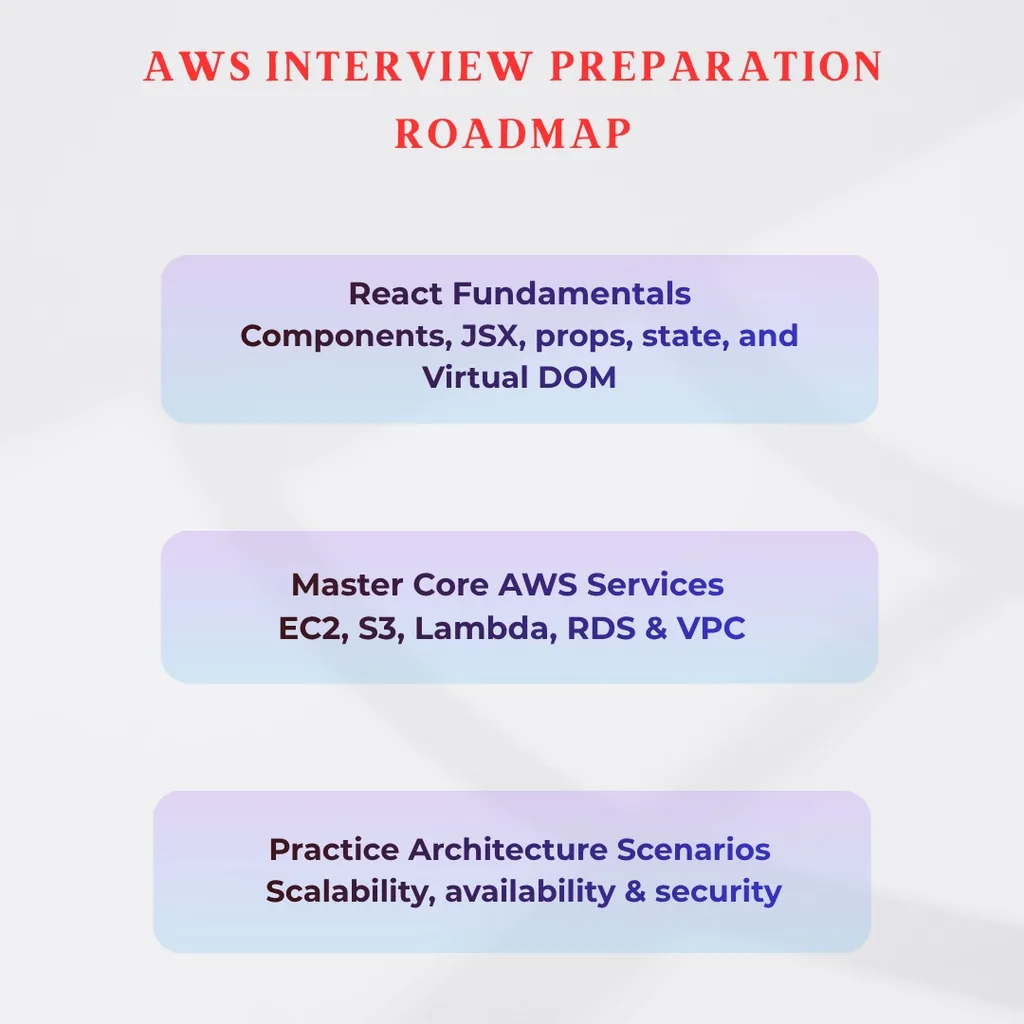
A strong AWS cloud interview preparation strategy should focus on concepts rather than memorizing definitions.
Prepare across these areas:
Compute
Understand EC2, Lambda, Auto Scaling, containers, and deployment options.
Storage
Know S3, EBS, storage classes, lifecycle policies, and backup strategies.
Networking
Review VPCs, subnets, route tables, Internet Gateways, NAT Gateways, security groups, and load balancers.
Databases
Understand RDS, DynamoDB, replication, backups, and database availability.
Security
Study IAM, encryption, least privilege, logging, monitoring, and network security.
Architecture
Practice designing scalable, secure, highly available applications.
Quick AWS Interview Revision Table
| Topic | Key Point to Remember |
| EC2 | Virtual compute instances |
| S3 | Object storage |
| Lambda | Serverless event-driven compute |
| VPC | Isolated AWS network |
| RDS | Managed relational database |
| DynamoDB | Managed NoSQL database |
| IAM | Identity and access management |
| CloudWatch | Monitoring and observability |
| CloudFront | Global content delivery |
| Route 53 | DNS and traffic routing |
| CloudFormation | Infrastructure as Code |
| ELB | Traffic distribution |
Final Thoughts
Preparing for AWS Interview Questions and Answers for Cloud Engineers requires a combination of service knowledge, architecture understanding, troubleshooting ability, and real-world decision-making. Focus on understanding why a service is used, not just what it does.
Along with AWS fundamentals, candidates should strengthen their knowledge of networking, databases, security, Linux, DevOps, and application development. This broader preparation can help when interviewers move from direct EC2 interview questions or S3 interview questions into scenario-based architecture discussions.
Whether the discussion involves AWS Lambda questions, infrastructure security, scalability, or an AWS architecture interview, the strongest answers usually connect the technology choice to business requirements such as availability, performance, security, scalability, and cost.
Frequently Asked Questions
1. What is the difference between EC2 and Lambda?
EC2 provides virtual servers where the customer manages the operating environment, while Lambda runs code without requiring the customer to manage servers. Lambda is particularly suitable for event-driven workloads.
2. Why is S3 commonly used in cloud architectures?
S3 provides scalable object storage and is useful for backups, static assets, logs, media, archives, and data-lake workloads.
3. How can you make an AWS application highly available?
Deploy critical components across multiple Availability Zones, use load balancing, configure Auto Scaling, and select appropriate database and storage redundancy options.
4. What is the purpose of IAM?
IAM controls access to AWS resources through identities, roles, policies, and permissions. Least-privilege access is a core security principle.
5. How can AWS infrastructure costs be reduced?
Monitor resource usage, right-size instances, remove unused resources, use storage lifecycle policies, configure Auto Scaling, and select suitable purchasing and storage options based on workload requirements.
