


Preparing for a DevOps interview can be challenging, especially when the discussion covers Kubernetes interview questions, containerization, cloud infrastructure, networking, deployments, and troubleshooting. This guide covers commonly asked Kubernetes questions and answers to help DevOps professionals prepare for technical interviews with practical concepts and examples.
Along with Kubernetes, modern interviews may also include java developer interview questions, core java questions asked in interview, interview questions on html css, and full stack interview questions, particularly when the role involves application development, CI/CD, microservices, or cloud-native environments.
What Are Kubernetes?
Kubernetes is an open-source container orchestration platform designed to automate the deployment, scaling, management, and networking of containerized applications. It helps DevOps teams manage applications across clusters of physical or virtual machines.
Kubernetes is particularly useful when an organization needs to run multiple containers reliably across different environments. Instead of manually starting, stopping, and monitoring containers, Kubernetes automates many operational tasks.
Key Kubernetes Components
| Component | Purpose | Example |
| Pod | Smallest deployable Kubernetes unit | Runs one or more containers |
| Node | Machine that runs workloads | Virtual or physical server |
| Cluster | Collection of nodes | Production Kubernetes environment |
| Service | Provides stable network access | Exposes an application |
| Deployment | Manages application replicas | Maintains desired pod count |
| ConfigMap | Stores configuration data | Application environment settings |
| Secret | Stores sensitive information | Passwords and tokens |
1. What Is Kubernetes Architecture?
Kubernetes architecture consists primarily of a control plane and worker nodes. The control plane manages the overall state of the cluster, while worker nodes run application workloads.
Important control-plane components include the API server, scheduler, controller manager, and etc. Worker nodes typically contain components such as kubelet and kube-proxy along with a container runtime.
Understanding Kubernetes architecture is important because interviewers often ask candidates to explain how a request moves from the Kubernetes API to an application running inside a pod. In broader technical interviews, candidates may also encounter database-related topics such as SQL joins, especially when DevOps roles involve application development, databases, and backend systems.
2. What Are Kubernetes Pods?
Kubernetes pods are the smallest deployable units in Kubernetes. A pod can contain one or more containers that share networking and storage resources.
For example, an application container and a supporting sidecar container can run inside the same pod when they need to communicate closely.
Pods are generally considered ephemeral. If a pod fails, Kubernetes can create another pod to maintain the desired state.
3. What Are Kubernetes Services?
Kubernetes services provide a stable network endpoint for accessing a group of pods. Because pod IP addresses can change when pods are recreated, directly connecting to pod IPs is unreliable.
A Service uses label selectors to identify the appropriate pods and can expose applications internally or externally depending on its type.
Common Service types include:
- ClusterIP
- NodePort
- LoadBalancer
- ExternalName
4. What Is a Kubernetes Deployment?
A Kubernetes deployment manages a set of replicated pods and allows teams to define the desired state of an application.
For example, you can specify that an application should always have three replicas running. If one pod fails, the Deployment works with Kubernetes controllers to create a replacement.
Deployments also support rolling updates, making them useful for releasing new versions without immediately stopping all existing application instances.
5. Why Is Kubernetes Used for Container Orchestration?
Container orchestration becomes increasingly important as applications grow from a few containers to hundreds or thousands of workloads.
Kubernetes provides capabilities such as:
- Automated scheduling
- Self-healing
- Horizontal scaling
- Service discovery
- Load balancing
- Rolling updates
- Rollbacks
- Configuration management
- Secret management
This makes Kubernetes a common platform for managing cloud-native and microservices-based applications.
6. What Is the Difference Between a Pod and a Container?
A container is an isolated application process, whereas a pod is a Kubernetes abstraction that can contain one or more containers.
| Feature | Container | Pod |
| Definition | Application runtime unit | Kubernetes deployment unit |
| Networking | Has container networking | Containers share pod network |
| Lifecycle | Managed by container runtime | Managed by Kubernetes |
| Storage | Can use mounted volumes | Containers can share volumes |
| Typical usage | Runs application code | Groups closely related containers |
7. What Is a Kubernetes Namespace?
A namespace logically separates resources within a Kubernetes cluster. Organizations commonly use namespaces to separate development, testing, staging, and production workloads.
For example:
kubectl get pods -n productionThis command lists pods within the production namespace.
Namespaces can also be combined with resource quotas and access-control policies to provide better organizational and operational boundaries. In broader technical interviews, candidates may also encounter React interview questions, particularly when the role involves both DevOps and application development.
8. What is kubectl?
kubectl is the command-line interface used to interact with Kubernetes clusters.
Some frequently used commands are:
kubectl get pods

kubectl get nodes

kubectl describe pod <pod-name>

kubectl logs <pod-name>

kubectl apply -f deployment.yaml

kubectl delete pod <pod-name>
During Docker interview questions and Kubernetes interviews, candidates may also be asked to explain the difference between Docker’s container management capabilities and Kubernetes’ orchestration capabilities.
9. What Is the Difference Between Kubernetes and Docker?
Docker is primarily a containerization platform and tooling ecosystem, while Kubernetes is designed for orchestrating containerized workloads across clusters.
Docker can build and run containers, whereas Kubernetes can schedule workloads, maintain replicas, provide service discovery, perform rolling updates, and recover failed workloads.
Modern Kubernetes environments can use container runtimes that comply with the Kubernetes Container Runtime Interface rather than relying exclusively on Docker Engine.
10. How Does Kubernetes Perform Self-Healing?
Kubernetes continuously compares the current cluster state with the desired state defined by resources such as Deployments.
If a pod managed by a Deployment crashes, Kubernetes can create a replacement. Similarly, if a container fails, the kubelet can restart it according to its restart policy.
This self-healing behavior reduces the amount of manual intervention required from DevOps teams.
11. What Is a ReplicaSet?
A ReplicaSet ensures that a specified number of pod replicas are running at any given time.
For example, if a ReplicaSet specifies three replicas and one pod becomes unavailable, Kubernetes attempts to create another pod.
In practice, Deployments are generally preferred over managing ReplicaSets directly because Deployments provide additional release-management capabilities.
12. What Is a ConfigMap?
A ConfigMap stores non-sensitive configuration information separately from application container images.
For example, application settings such as:
APP_ENV=production

LOG_LEVEL=info

API_TIMEOUT=30
can be stored in a ConfigMap and injected into containers as environment variables or mounted files.
Sensitive information should generally be handled using Kubernetes Secrets or an appropriate external secret-management solution.
13. What Is a Kubernetes Secret?
A Kubernetes Secret is designed to hold sensitive information such as credentials, tokens, and certificates.
Example:
apiVersion: v1

kind: Secret

metadata:

  name: database-secret

type: Opaque
However, candidates should understand that simply storing a value in a Kubernetes Secret does not automatically provide the same security guarantees as a dedicated external secret-management system.
14. What Is a Kubernetes Ingress?
Ingress provides HTTP and HTTPS routing into services within a Kubernetes cluster. It can route requests based on hostnames or URL paths.
For example:
example.com/api    → API Service

example.com/shop   → Shop Service

example.com/admin  → Admin Service
An Ingress requires an Ingress controller to actually implement the routing behavior.
15. What Are Liveness and Readiness Probes?
Kubernetes health probes help determine whether an application is functioning correctly.
| Probe | Purpose | Typical Result |
| Liveness probe | Determines whether container should be restarted | Failed check can trigger restart |
| Readiness probe | Determines whether pod should receive traffic | Failed check removes pod from service endpoints |
| Startup probe | Gives slow-starting applications time to initialize | Delays other probe checks |
These probes are especially useful for production microservices.
16. What Is Horizontal Pod Autoscaling?
Horizontal Pod Autoscaler, or HPA, automatically adjusts the number of pod replicas based on metrics such as CPU utilization or other supported metrics.
For example, an application may run with two replicas during normal traffic and scale to ten replicas during periods of high demand. Autoscaling is an important Kubernetes capability for applications with unpredictable workloads. In DevOps roles involving automation and scripting, candidates may also face Python technical interview questions covering scripting, automation, data structures, and application logic.
17. What Is the Difference Between StatefulSet and Deployment?
A Deployment is generally used for stateless applications, while StatefulSet is designed for workloads that require stable identities and persistent storage associations.
Examples of StatefulSet use cases include certain database and distributed-system workloads.
A StatefulSet provides characteristics such as:
- Stable pod identities
- Ordered deployment and scaling
- Persistent volume association
- Stable network identities
18. How Does Kubernetes Scheduling Work?
The Kubernetes scheduler determines which node should run a newly created pod.
It evaluates factors such as:
- Resource requests and limits
- Node availability
- Affinity and anti-affinity rules
- Taints and tolerations
- Scheduling constraints
The scheduler then assigns the pod to an appropriate node.
19. What Are Resource Requests and Limits?
Resource requests specify the amount of CPU and memory a container is expected to require. Limits specify the maximum amount it can consume.
For example:
resources:

  requests:

    cpu: "250m"

    memory: "256Mi"

  limits:

    cpu: "500m"

    memory: "512Mi"
Correctly configuring these values helps Kubernetes schedule workloads effectively and prevents individual applications from consuming disproportionate resources.
20. How Does Kubernetes Help in Cloud Environments?
Kubernetes is widely used with cloud platforms because it provides a consistent orchestration layer for containerized workloads.
For example, an AWS cloud interview may include questions about Kubernetes clusters, load balancers, IAM, networking, storage, autoscaling, and managed Kubernetes services.
DevOps professionals should understand how Kubernetes integrates with cloud-native infrastructure rather than treating Kubernetes as an isolated technology.
Kubernetes Interview Questions: Scenario-Based Questions
Technical interviews often move beyond definitions and ask candidates to troubleshoot real-world scenarios.
Scenario 1: A Pod Is Stuck in Pending State
Check:
kubectl get pods

kubectl describe pod <pod-name>
Possible causes include insufficient CPU or memory, scheduling constraints, unavailable nodes, taints, or persistent-volume issues.
Scenario 2: A Pod Is in CrashLoopBackOff
Start by examining the logs:
kubectl logs <pod-name>Then inspect the pod:
kubectl describe pod <pod-name>Possible causes include application crashes, incorrect configuration, missing environment variables, failed health checks, or dependency failures.
Scenario 3: Application Is Running but Cannot Be Accessed
Check the following:
- Pod status
- Service configuration
- Service selectors
- Endpoint availability
- Ingress configuration
- Network policies
- Application listening port
This type of troubleshooting question tests whether a candidate understands the relationship between pods, Services, networking, and external traffic.
Kubernetes and Other Technical Interview Topics
DevOps professionals may encounter broader software-development questions during technical interviews. For example, candidates working with Node.js may face Node.js backend interview topics involving asynchronous programming, event loops, APIs, middleware, and database integration.
Similarly, database-focused roles may include SQL joins questions covering INNER JOIN, LEFT JOIN, RIGHT JOIN, FULL OUTER JOIN, and self joins.
Frontend-focused positions may include React interview questions related to components, hooks, state management, props, rendering, and performance optimization.
For Python-oriented DevOps roles, a Python technical interview may cover data structures, functions, exception handling, modules, automation scripts, and object-oriented programming.
Microsoft-stack positions may include asp net core interview questions involving middleware, dependency injection, routing, configuration, authentication, and Web API development.
Candidates targeting C# roles should also prepare c sharp interview questions and answers covering classes, interfaces, inheritance, delegates, LINQ, async programming, and exception handling.
For Java-focused positions, a Java Backend Developer interview can combine Java fundamentals, REST APIs, databases, microservices, and cloud deployment.
Candidates working with Spring-based applications should also prepare java spring boot interview questions covering dependency injection, Spring Boot starters, REST controllers, configuration, Actuator, security, and database integration.
Final Thoughts
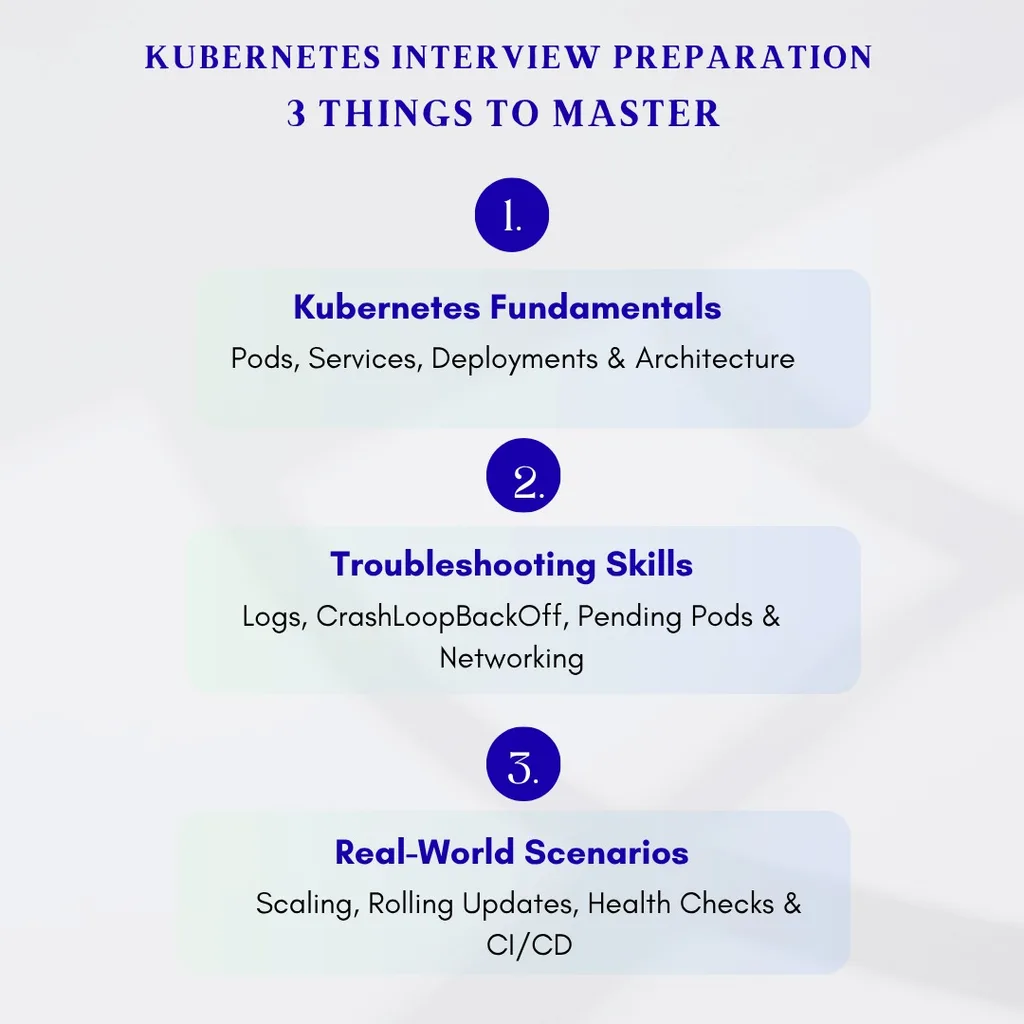
Strong preparation for Kubernetes interview questions requires more than memorizing definitions. DevOps professionals should understand how Kubernetes components interact and be able to troubleshoot common production scenarios.
Focus on Kubernetes architecture, pods, Services, Deployments, networking, storage, security, scaling, monitoring, and CI/CD integration. At the same time, be prepared for adjacent technical topics because modern DevOps interviews often cross into cloud platforms, programming, databases, and application development.
A combination of conceptual knowledge and hands-on practice will help candidates confidently handle both fundamental and scenario-based Kubernetes interview questions.
Frequently Asked Questions
1. Is Kubernetes difficult to learn for DevOps professionals?
Kubernetes has a significant learning curve because it combines containers, networking, storage, security, scheduling, and distributed systems. However, learning pods, Deployments, Services, ConfigMaps, Secrets, and basic troubleshooting provides a strong foundation.
2. What topics should I prepare for an interview?
Focus on Kubernetes architecture, pods, Deployments, Services, namespaces, ConfigMaps, Secrets, Ingress, probes, autoscaling, storage, networking, scheduling, and troubleshooting.
3. Are Kubernetes commands asked in DevOps interviews?
Yes. Interviewers commonly ask candidates to demonstrate commands such as kubectl get, kubectl describe, kubectl logs, kubectl exec, kubectl apply, and kubectl rollout.
4. Is Kubernetes better than Docker?
They serve different primary purposes. Docker provides containerization tools, while Kubernetes provides orchestration capabilities for managing containerized applications across clusters. They are not direct substitutes in every context.
5. How can I prepare for Kubernetes interviews?
Build hands-on experience. Create a small Kubernetes cluster, deploy an application, expose it through a Service, configure health probes, scale it, inspect logs, perform a rolling update, and troubleshoot intentionally broken deployments. This practical experience makes it much easier to answer scenario-based questions.
