


The demand for skilled Java backend developers continues to rise as enterprises, startups, and global technology companies rely on Java to build scalable, secure, and high-performance applications. Whether you’re preparing for your first technical interview or targeting a senior position at an MNC, mastering the right concepts can significantly improve your chances of success.
This comprehensive guide covers the most important Java Backend Developer Interview Questions for MNC Jobs, including core java questions asked in interview, java developer interview questions, java spring boot interview questions, system design, REST APIs, databases, multithreading, microservices, and coding challenges.
Why MNCs Prefer Java Backend Developers
Java remains one of the most trusted programming languages for enterprise software development because of its:
- Platform independence
- Strong ecosystem
- Scalability
- Security
- Rich frameworks like Spring Boot
- Excellent cloud integration
Most multinational companies assess candidates on programming fundamentals, backend architecture, database optimization, APIs, system design, and problem-solving skills.
Core Java Questions Asked in Interview
Freshers and experienced professionals are always expected to have strong Java fundamentals. Most java developer interview questions begin with Core Java concepts before moving to advanced topics.
Interviewers often test:
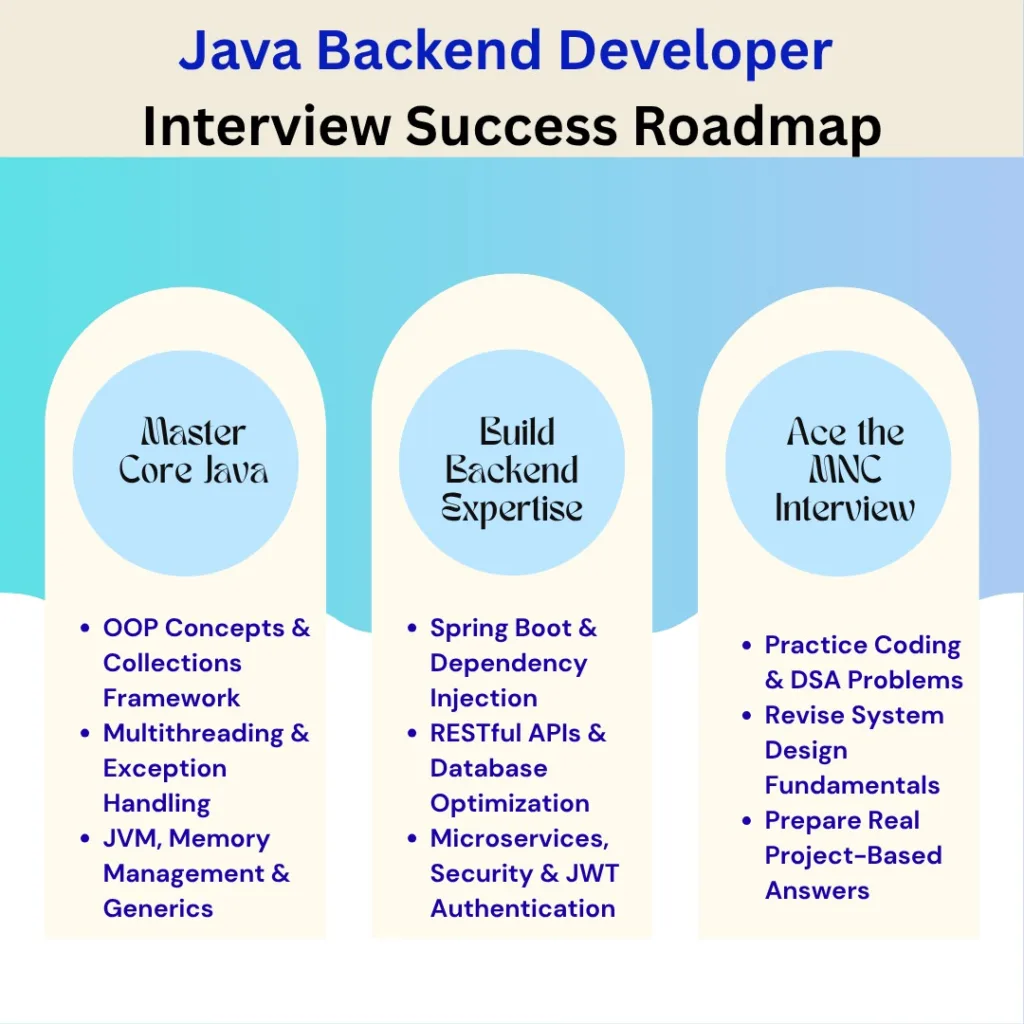
- OOP concepts
- Collections Framework
- Exception Handling
- Multithreading
- JVM
- Memory Management
- Generics
- Streams API
Java Spring Boot Interview Questions
Modern enterprise applications heavily rely on Spring Boot. Therefore, almost every backend interview includes multiple java spring boot interview questions covering REST APIs, dependency injection, microservices, and Spring Security.
Candidates should also understand deployment, configuration management, and cloud-native application development.
Java Backend Interview Preparation Roadmap
| Experience Level | Main Focus | Difficulty |
| Fresher | Core Java, OOP, Collections | Easy |
| 1–3 Years | Spring Boot, REST APIs, SQL | Medium |
| 3–6 Years | Microservices, Kafka, Security | Medium-High |
| 6+ Years | System Design, Scalability, Architecture | Advanced |
1. Explain the Four Pillars of OOP.
Answer
The four pillars are:
- Encapsulation
- Inheritance
- Polymorphism
- Abstraction
These principles make applications modular, reusable, and maintainable.
2. Difference Between JDK, JRE, and JVM
| JDK | JRE | JVM |
| Development Kit | Runtime Environment | Executes Bytecode |
| Includes Compiler | Includes Libraries | Memory Management |
| Used by Developers | Used by Users | Platform Specific |
3. What is the Java Collections Framework?
Answer
The Collections Framework provides data structures such as:
- List
- Set
- Queue
- Map
Common implementations include:
- ArrayList
- LinkedList
- HashMap
- TreeMap
- HashSet
4. Difference Between ArrayList and LinkedList
| ArrayList | LinkedList |
| Faster random access | Faster insertion/deletion |
| Dynamic Array | Doubly Linked List |
| More memory efficient | Higher memory usage |
| Better for searching | Better for frequent modifications |
5. What is HashMap?
HashMap stores key-value pairs using hashing.
Features:
- Allows one null key
- Multiple null values
- Average O(1) lookup
- Not synchronized
6. Explain HashMap Internal Working.
HashMap uses:
- Hash Function
- Buckets
- Linked List
- Tree Nodes (Java 8+)
Collision handling occurs using linked lists or balanced trees.
7. Difference Between HashMap and ConcurrentHashMap
ConcurrentHashMap supports concurrent operations with better thread safety compared to synchronized HashMap implementations.
8. What is Exception Handling?
Java provides:
- try
- catch
- finally
- throw
- throws
Exception handling improves application reliability.
9. Checked vs Unchecked Exceptions
Checked exceptions are verified during compilation.
Unchecked exceptions occur during runtime.
Examples:
Checked:
- IOException
Unchecked:
- NullPointerException
10. What is Multithreading?
Multithreading allows multiple threads to execute simultaneously for improved performance.
Common interview topics include:
- Thread lifecycle
- Synchronization
- Deadlock
- ExecutorService
11. Explain Synchronization.
Synchronization prevents multiple threads from modifying shared resources simultaneously.
12. What is Executor Framework?
ExecutorService manages thread pools efficiently.
Advantages:
- Better performance
- Resource optimization
- Easy task scheduling
Frequently Asked Spring Boot Topics
| Topic | Importance | Interview Frequency |
| Dependency Injection | High | Very High |
| Spring Beans | High | High |
| Spring Security | High | High |
| REST Controllers | Very High | Very High |
| Profiles | Medium | High |
| Validation | High | High |
| JPA | Very High | Very High |
| Transactions | High | High |
13. What is Dependency Injection?
Dependency Injection reduces tight coupling between classes by letting the Spring container manage object creation.
14. What is Spring Boot Auto Configuration?
Spring Boot automatically configures dependencies based on project libraries, reducing manual configuration.
15. Explain Spring Bean Scope.
Bean scopes include:
- Singleton
- Prototype
- Request
- Session
Singleton is the default scope.
16. Difference Between @Component, @Service and @Repository
These annotations define different layers:
- Component → Generic Bean
- Service → Business Logic
- Repository → Database Layer
17. What is REST API?
REST APIs allow communication between applications using HTTP methods.
Methods include:
- GET
- POST
- PUT
- DELETE
- PATCH
These are among the most common restful api interview questions in backend interviews.
18. Explain HTTP Status Codes.
Examples:
- 200 OK
- 201 Created
- 400 Bad Request
- 401 Unauthorized
- 404 Not Found
- 500 Internal Server Error
19. Difference Between PUT and PATCH
PUT updates the complete resource.
PATCH updates only selected fields.
20. Explain JWT Authentication.
JWT contains:
- Header
- Payload
- Signature
It enables stateless authentication.
Database Interview Questions
| Question | Expected Answer |
| Indexing | Improves query speed |
| ACID | Database properties |
| Normalization | Removes redundancy |
| Joins | Combine multiple tables |
| Transactions | Maintain consistency |
| Locks | Prevent conflicts |
21. What is Normalization?
Normalization organizes database tables to reduce redundancy.
Forms include:
- 1NF
- 2NF
- 3NF
- BCNF
22. Difference Between INNER JOIN and LEFT JOIN
INNER JOIN returns matching records.
LEFT JOIN returns all records from the left table.
23. What are ACID Properties?
- Atomicity
- Consistency
- Isolation
- Durability
24. Explain Microservices.
Microservices divide applications into independently deployable services.
Benefits:
- Scalability
- Fault Isolation
- Independent Deployment
25. What is an API Gateway?
An API Gateway manages authentication, routing, rate limiting, and monitoring for multiple microservices.
26. What is Circuit Breaker Pattern?
It prevents cascading failures by stopping repeated requests to failing services.
27. Explain Docker.
Docker packages applications and dependencies into lightweight containers.
28. Explain Kubernetes.
Kubernetes automates deployment, scaling, and management of containerized applications.
29. What is Kafka?
Apache Kafka is a distributed event streaming platform used for high-throughput messaging.
30. Explain Redis.
Redis is an in-memory cache used for reducing database load and improving response times.
31. Coding Question
Reverse a String without using built-in methods.
Solution
String str="Interview";

char[] arr=str.toCharArray();

for(int i=arr.length-1;i>=0;i--)

{

    System.out.print(arr[i]);

}
This is one of the most common coding interview questions with solutions asked during Java interviews.
32. Coding Question
Find duplicate elements in an array using HashSet.
HashSet<Integer> set=new HashSet<>();

for(int num:arr)

{

   if(!set.add(num))

   {

      System.out.println(num);

   }

}
33. Explain Time Complexity.
Interviewers frequently ask interview questions for data structures and algorithms to evaluate problem-solving ability.
Common complexities:
O(1)

O(log n)

O(n)

O(n log n)

O(n²)
MNC Interview Rounds
| Round | Topics Covered |
| Online Assessment | DSA, Coding |
| Technical Round 1 | Core Java |
| Technical Round 2 | Spring Boot, APIs |
| Technical Round 3 | System Design |
| HR Round | Communication, Culture Fit |
Tips to Crack Java Backend Interviews
- Master Core Java fundamentals.
- Practice Spring Boot projects.
- Build RESTful APIs.
- Revise SQL queries daily.
- Practice DSA on coding platforms.
- Learn system design basics.
- Understand microservices architecture.
- Practice Java coding every day.
- Review previous MNC interview experiences.
- Improve communication and debugging skills.

Conclusion
Preparing for Java Backend Developer Interview Questions for MNC Jobs requires a balanced understanding of Core Java, Spring Boot, REST APIs, databases, microservices, multithreading, cloud technologies, and system design. Along with technical expertise, practicing coding challenges and explaining real-world project experience confidently will help you stand out. Regularly revising the concepts covered in this guide will improve your readiness for interviews at leading multinational companies and increase your chances of securing your desired Java backend developer role.
Frequently Asked Questions (FAQs)
1. Which Java topics are most important for MNC interviews?
Focus on Core Java, Collections, Multithreading, Exception Handling, Spring Boot, REST APIs, SQL, Microservices, and System Design.
2. Are Spring Boot questions mandatory in Java backend interviews?
Yes. Most companies expect candidates to understand Spring Boot, dependency injection, REST services, JPA, validation, security, and microservices.
3. Do MNCs ask coding questions during Java backend interviews?
Yes. Coding rounds commonly include arrays, strings, linked lists, trees, recursion, hashing, dynamic programming, and algorithm optimization.
4. How should experienced Java developers prepare?
Experienced professionals should revise architecture, scalability, concurrency, JVM internals, cloud deployment, caching, messaging systems, and system design alongside practical project discussions.
5. How many interview rounds are there for Java backend developer roles?
Most MNCs conduct four to six rounds, including an online coding assessment, one or more technical interviews, a system design round (for experienced candidates), and an HR or managerial discussion.
