


Java remains one of the most popular programming languages for enterprise applications, Android development, backend systems, and cloud-based software. Whether you are a fresher or an experienced professional, preparing the right java interview questions can significantly improve your chances of landing your dream job. This guide covers the most important Core Java concepts, frequently asked interview questions, and practical answers to help you prepare effectively. It also serves as a valuable resource for software engineering interview questions.
If you’re preparing for entry-level or experienced roles, mastering associate software engineer interview questions will help you understand object-oriented programming, exception handling, collections, multithreading, and JVM concepts. Alongside Core Java, many companies also include senior developer interview questions and basic technical interview questions to evaluate your coding skills and problem-solving abilities.
Why Core Java Is Important for Interviews
Core Java forms the foundation of many enterprise applications. Before learning frameworks like Spring Boot or Hibernate, recruiters expect candidates to understand Java fundamentals thoroughly.
Benefits of mastering Core Java include:
- Strong object-oriented programming knowledge
- Better coding practices
- Easier understanding of advanced frameworks
- Higher interview confidence
- Improved debugging skills
Core Java Interview Topics You Should Cover
Before attending any technical interview, prepare these topics:
- Java Basics
- OOP Concepts
- Constructors
- Strings
- Arrays
- Collections Framework
- Exception Handling
- Multithreading
- JVM & JDK
- Garbage Collection
- File Handling
- Java 8 Features
These topics frequently appear in java language interview questions asked by software companies.
Core Java Topics vs Difficulty Level
| Topic | Difficulty | Interview Frequency |
| Java Basics | Easy | Very High |
| OOP Concepts | Easy | Very High |
| Collections | Medium | Very High |
| Exception Handling | Medium | High |
| Multithreading | Hard | High |
| JVM & Memory | Hard | High |
| Java 8 Features | Medium | Very High |
Top Core Java Interview Questions and Answers
1. What is Java?
Java is an object-oriented, platform-independent programming language developed by Sun Microsystems (now Oracle). It follows the principle:
Write Once, Run Anywhere (WORA)
This is among the most common java interview questions and answers for beginners.
2. What are the features of Java?
Major features include:
- Platform Independent
- Object-Oriented
- Secure
- Robust
- Multithreaded
- Distributed
- High Performance
- Portable
3. Explain JVM, JRE, and JDK.
| Component | Purpose |
| JVM | Executes Java bytecode |
| JRE | JVM + Libraries |
| JDK | JRE + Development Tools |
This is one of the most frequently asked core java questions asked in interview.
4. What is Object-Oriented Programming?
OOP is a programming methodology based on objects.
Its four pillars are:
- Encapsulation
- Inheritance
- Polymorphism
- Abstraction
5. Difference between == and equals()?
| == | equals() |
| Compares references | Compares object values |
| Works with primitives | Mostly used with objects |
| Faster | More flexible |
6. What is Constructor?
A constructor initializes an object.
Types:
- Default Constructor
- Parameterized Constructor
7. Difference between Method Overloading and Overriding
Method Overloading
- Same method name
- Different parameters
- Compile-time polymorphism
Method Overriding
- Same method
- Same parameters
- Runtime polymorphism
8. What is Encapsulation?
Encapsulation means wrapping variables and methods into one class while restricting direct access using private variables.
9. What is Abstraction?
Abstraction hides implementation details and only exposes required functionality.
Achieved using:
- Abstract Class
- Interface
10. What is Inheritance?
Inheritance allows one class to inherit properties from another.
Example:
- Parent Class
- Child Class
11. What is Polymorphism?
Polymorphism means “many forms.”
Types:
- Compile-Time
- Runtime
12. What is String Pool?
String Pool is a special memory area inside the heap where Java stores string literals.
13. Difference between String, StringBuilder, and StringBuffer
| Feature | String | StringBuilder | StringBuffer |
| Mutable | No | Yes | Yes |
| Thread Safe | No | No | Yes |
| Performance | Slow | Fast | Medium |
14. What is Exception Handling?
Exception handling prevents program termination when runtime errors occur.
Keywords:
- try
- catch
- finally
- throw
- throws
15. Checked vs Unchecked Exceptions
Checked Exceptions
- Compile-time
- IOException
Unchecked Exceptions
- Runtime
- NullPointerException
16. What is Collection Framework?
Collection Framework provides classes and interfaces to store data.
Popular interfaces:
- List
- Set
- Queue
- Map
These topics are commonly included in java developer interview questions.
17. Difference between ArrayList and LinkedList
| ArrayList | LinkedList |
| Faster retrieval | Faster insertion |
| Uses dynamic array | Uses doubly linked list |
| Less memory | More memory |
18. What is HashMap?
HashMap stores key-value pairs.
Characteristics:
- Allows one null key
- Multiple null values
- Not synchronized
19. What is Multithreading?
Multithreading executes multiple tasks simultaneously to improve performance.
Common methods:
start()

run()

join()
20. What is Garbage Collection?
Garbage Collection automatically removes unused objects from memory.
Garbage collector is managed by JVM.
Most Asked Core Java Interview Questions
| Question | Experience Level |
| OOP Concepts | Fresher |
| JVM | Fresher |
| Collections | 1-3 Years |
| Exception Handling | Fresher |
| Multithreading | Experienced |
| Java 8 Streams | Experienced |
| Memory Management | Experienced |
Java 8 Interview Questions
Common Java 8 topics include:
- Lambda Expressions
- Stream API
- Functional Interfaces
- Method References
- Optional Class
- Default Methods
These are commonly seen in java software engineer interview questions.
Coding Questions Asked in Java Interviews
Interviewers often ask coding-based questions such as:
- Reverse a String
- Find Duplicate Elements
- Fibonacci Series
- Palindrome Program
- Prime Number
- Factorial
- Remove Duplicates
- Bubble Sort
- Binary Search
These practical exercises also align with coding interview questions with solutions.
Core Java vs Advanced Java
| Core Java | Advanced Java |
| OOP | JDBC |
| Collections | Servlet |
| Exception Handling | JSP |
| Multithreading | Spring |
| File Handling | Hibernate |
| JVM | REST API |
Tips to Crack Core Java Interviews
Follow these preparation tips:
- Practice coding every day.
- Revise OOP concepts.
- Understand JVM architecture.
- Solve Java coding problems.
- Learn Java 8 features.
- Build small Java projects.
- Practice mock interviews.
Common Mistakes Candidates Make
Avoid these mistakes:
- Memorizing without understanding
- Ignoring Collections Framework
- Weak coding practice
- Poor understanding of multithreading
- Not revising exception handling
Related Technical Interview Topics
Many companies combine Java with other technologies during hiring. You may also encounter:
- wordpress interview questions
- wp interview questions
- seo interview question
- seo marketing interview questions
- interview questions on html css
- front developer interview questions
- full stack interview questions
- full stack developer interview questions
- backend questions for interview
Preparing these topics alongside Java can improve your overall interview readiness.
Advanced Technical Skills Worth Learning
As software development evolves, interviewers increasingly assess knowledge beyond Core Java. Consider preparing:
- interview questions on machine learning
- ai engineer interview questions
- top system design interview questions
- restful api interview questions
- interview questions for data structures and algorithms
These skills are particularly valuable for experienced developers and product-based company interviews.
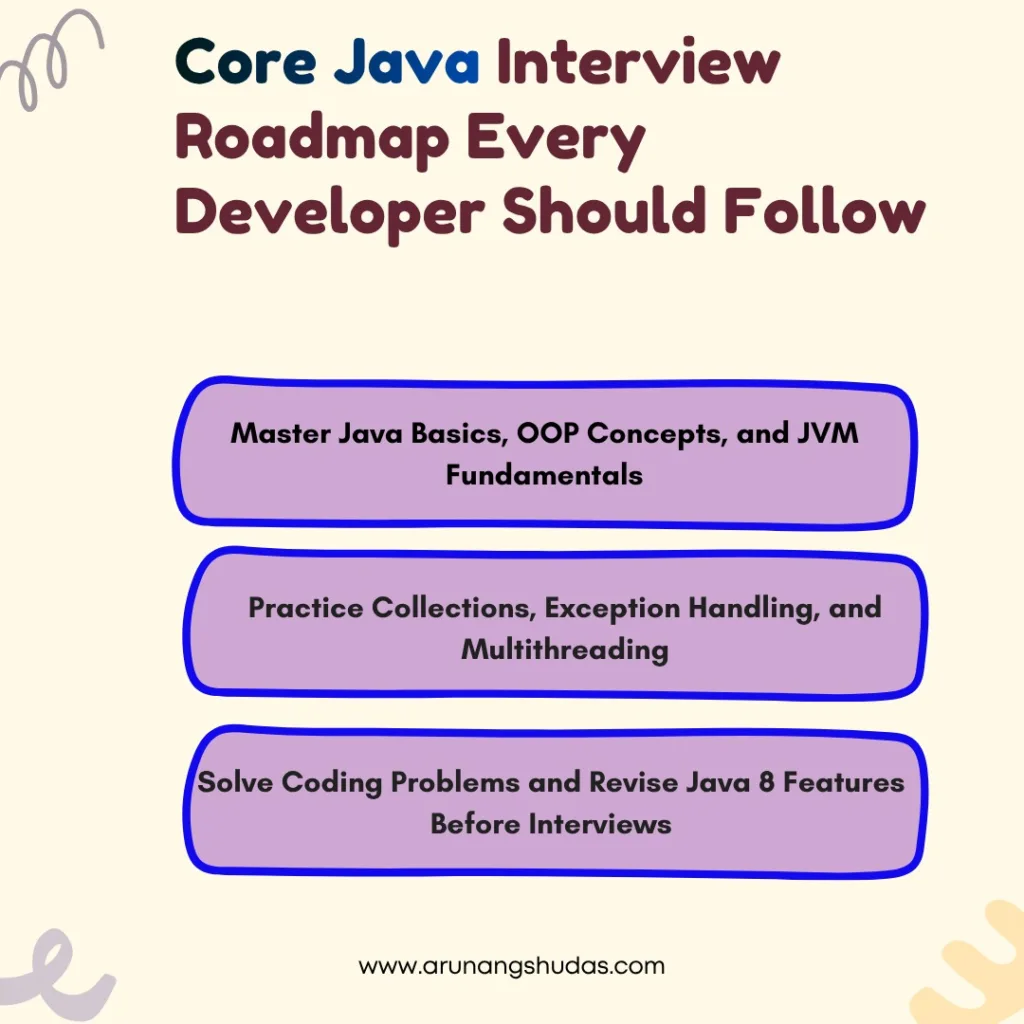
Interview Preparation Roadmap
| Week | Topics |
| Week 1 | Java Basics, OOP |
| Week 2 | Strings, Arrays, Collections |
| Week 3 | Exception Handling, File Handling |
| Week 4 | Multithreading, JVM, Java 8 |
| Week 5 | Coding Practice, Mock Interviews |
Conclusion
Preparing for Core Java interviews requires more than memorizing definitions. Focus on understanding concepts, writing clean code, and practicing real-world problems. By mastering the topics covered in this guide, you’ll be well-prepared for java interview questions, java language interview questions, java interview questions and answers, core java questions asked in interview, java interview questions, java software engineer interview questions, and java developer interview questions. Combine your Core Java knowledge with coding practice, system design fundamentals, and related technical domains to confidently tackle interviews across startups, product companies, and enterprise organizations.
Frequently Asked Questions (FAQs)
1. What are the most common Core Java interview questions?
The most common questions cover OOP concepts, JVM, JDK vs JRE, Collections Framework, Exception Handling, Multithreading, String handling, and Java 8 features.
2. How should freshers prepare for Core Java interviews?
Freshers should focus on Java basics, object-oriented programming, collections, exception handling, simple coding problems, and mock interviews to build confidence.
3. Are coding questions asked in Java interviews?
Yes. Interviewers frequently ask candidates to solve coding problems such as reversing a string, checking palindromes, finding duplicates, sorting arrays, and implementing basic algorithms.
4. Is Core Java enough for software engineer interviews?
Core Java is essential, but many companies also expect knowledge of SQL, REST APIs, data structures, algorithms, system design basics, and frameworks like Spring Boot for higher-level roles.
5. Which Java topics should experienced developers revise before an interview?
Experienced developers should revise multithreading, concurrency, JVM internals, memory management, Collections Framework, Java 8 Streams, design patterns, REST APIs, and performance optimization techniques.
