

Traditional Automation has transformed the way marketers manage repetitive tasks, while Digital Marketing Workflows have made it easier to coordinate campaigns, customer interactions, and content operations. However, many businesses are now moving beyond rule-based systems toward AI-powered solutions that can understand context, make decisions, and take action. The ability to Automate Content Marketing at Scale is one example of how AI is changing modern marketing operations. Instead of simply responding to predefined commands, intelligent systems can analyze information, determine the next best action, and execute multiple steps with minimal human intervention.
As brands handle increasingly complex customer journeys, the limitations of conventional automation and basic chat interfaces are becoming clearer. Businesses want to Automate Content Marketing at Scale, personalize experiences, and respond to changing customer behavior without adding more manual processes. This is where AI agents are gaining importance. Unlike traditional tools that perform a fixed task, AI agents can connect different applications, interpret data, coordinate workflows, and continuously adjust their actions according to marketing objectives.
AI Agents vs Chatbots: Understanding the Difference
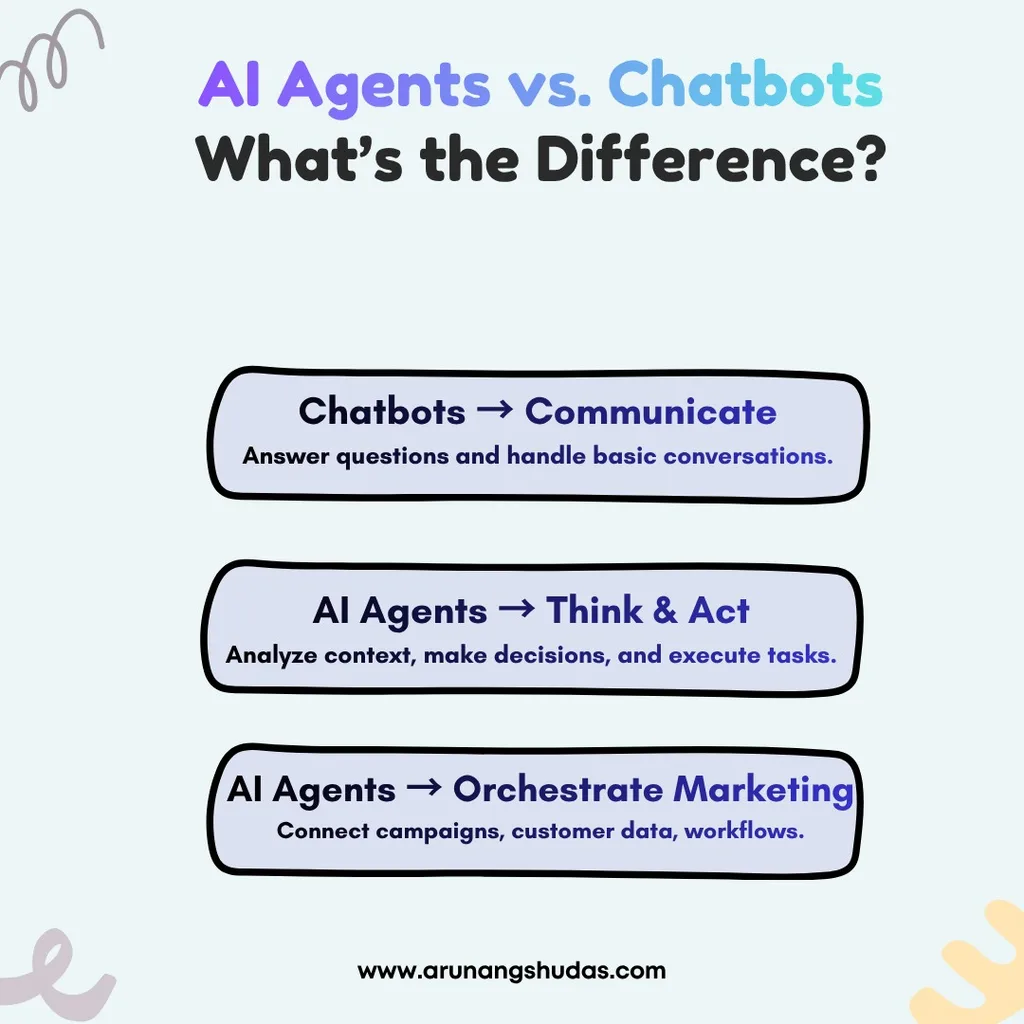
The debate around AI agents vs chatbots is not simply about choosing one technology over another. Chatbots are primarily designed to communicate with users, answer questions, and guide conversations. AI agents go further by combining reasoning, planning, data analysis, and task execution.
For example, a chatbot may answer a prospect’s question about pricing. An AI agent could identify that prospect as a high-intent lead, update the CRM, recommend relevant content, notify a sales representative, schedule a follow-up, and continue nurturing the lead based on future interactions.
| Feature | Traditional Chatbots | AI Agents |
| Primary function | Conversation and responses | Goal-oriented action |
| Decision-making | Rule-based or limited | Context-aware |
| Workflow execution | Usually limited | Can coordinate multiple tasks |
| Personalization | Basic to moderate | Highly contextual |
| Integrations | Selected systems | Multiple connected systems |
| Autonomy | Low | High |
| Marketing applications | FAQs, basic support | Campaigns, lead nurturing, optimization, analysis |
This shift is creating a new generation of intelligent marketing systems that can operate across multiple channels instead of remaining confined to a website chat window.
From Conversational AI to Autonomous Marketing Workflows
Conversational marketing AI has already improved how brands communicate with prospects and customers. But the next stage is about connecting conversations to actions. An AI agent can interpret what a customer says and determine what should happen next.
Consider a visitor who asks about a product, downloads a guide, and returns several days later. Rather than treating each interaction independently, an AI agent can connect these signals and build a more complete picture of customer intent.
This enables autonomous workflows in which AI can:
- Identify customer intent
- Segment audiences dynamically
- Trigger personalized campaigns
- Update customer records
- Recommend relevant content
- Route qualified leads to sales teams
- Monitor campaign performance
- Generate follow-up communications
- Escalate complex issues to human teams
The result is marketing that becomes more responsive without requiring marketers to manually manage every individual interaction.
Why Enterprise Marketing Needs More Than Chatbots
Large organizations operate across numerous channels, markets, products, and customer segments. A chatbot can support one part of this ecosystem, but enterprise customer automation requires coordination across the entire marketing infrastructure.
AI agents can connect CRM platforms, analytics systems, advertising platforms, content libraries, customer support tools, and marketing automation software. This creates a more unified operating environment.
| Marketing Challenge | Chatbot Approach | AI-Agent Approach |
| Lead qualification | Ask predefined questions | Analyze intent and behavioral signals |
| Customer support | Answer common queries | Resolve, route, and follow up |
| Campaign management | Provide information | Coordinate campaign tasks |
| Content operations | Recommend content | Create, adapt, distribute, and monitor content |
| Customer data | Retrieve information | Interpret and act on multiple data points |
| Reporting | Present metrics | Identify patterns and suggest actions |
For enterprise teams, this means AI becomes an operational layer rather than simply another customer-facing interface.
AI Engagement Platforms Are Changing Customer Interactions
Modern AI engagement platforms are designed to help organizations manage interactions across multiple touchpoints. Instead of relying on isolated systems, businesses can use AI to connect customer behavior, marketing activity, and business objectives.
This is especially useful for brands operating across email, websites, social media, paid advertising, messaging platforms, and customer service channels.
With digital interaction AI, marketers can understand not only what customers are saying but also what their behavior may indicate. A customer who repeatedly visits product pages, interacts with advertisements, and opens comparison emails may represent a different opportunity than someone who only reads a blog post.
AI agents can combine these signals and initiate appropriate actions.
Marketing Productivity Goes Beyond Saving Time
Many marketing productivity tools focus on helping marketers complete individual tasks faster. AI agents can change the nature of productivity by managing sequences of related tasks.
For example, a marketer launching a campaign may traditionally need to:
- Research the audience.
- Develop campaign messaging.
- Create content.
- Adapt content for different channels.
- Set up campaigns.
- Monitor results.
- Analyze performance.
- Make optimization decisions.
An agentic system can help coordinate much of this process. Humans can remain responsible for strategy, creative direction, approvals, and governance while AI handles repetitive execution and analysis.
This makes AI particularly valuable for teams that need to increase output without proportionally increasing headcount.
AI-Driven Support Systems Can Connect Marketing and Customer Service
Marketing and customer support have historically operated as separate functions. AI-driven support systems can help bridge this gap by connecting customer conversations with marketing and customer experience data.
For example, when a customer reports a problem, the system can recognize the customer’s history and prevent irrelevant promotional messaging from being sent during the support process. Once the issue is resolved, the customer can potentially re-enter an appropriate engagement journey.
This creates a more contextual experience and reduces the disconnect between acquisition, conversion, and retention.
Workflow Orchestration Is the Real Advantage
The biggest difference between basic AI tools and AI agents is often workflow orchestration marketing.
Rather than simply generating an output, an AI agent can coordinate a series of actions toward a defined objective.
| Use Case | Agentic Workflow |
| New lead | Identify → qualify → enrich → segment → nurture → notify sales |
| Content campaign | Research → create → repurpose → distribute → measure |
| Customer issue | Detect → classify → resolve → escalate if needed → follow up |
| Ad optimization | Monitor → analyze → identify weak performance → recommend changes |
| Brand monitoring | Track mentions → classify sentiment → identify risks → alert team |
This orchestration capability allows marketing teams to think in terms of outcomes rather than individual tasks.
Content Repurposing Becomes More Scalable
One of the most practical applications of AI agents is Content Repurposing. Instead of manually transforming a long-form article into social posts, newsletters, video scripts, advertisements, and sales materials, marketers can create an agent workflow that coordinates these activities.
An agent can identify important themes in a source asset, adapt the messaging for different audiences, and prepare content for multiple channels while maintaining consistent brand guidelines.
Human review remains important, particularly for brand voice, factual accuracy, and sensitive communications. But the time spent on repetitive adaptation can be dramatically reduced.
AI Can Help Marketers Identify Consumer Trends Earlier
Marketing success often depends on recognizing changes before competitors do. AI agents can continuously monitor customer behavior, search patterns, social conversations, campaign results, and other signals to help marketers Consumer Trends Earlier.
Instead of waiting for a quarterly report, marketing teams can receive ongoing insights about emerging topics, changing preferences, or shifts in customer sentiment.
The advantage is not simply speed. It is the ability to connect multiple signals that might appear insignificant when viewed separately.
Marketing Automation Becomes More Adaptive
Traditional marketing automation generally follows predefined rules. Modern AI systems can make Marketing Automation more adaptive.
For instance:
Traditional approach:
“If a user downloads an ebook, send email A.”
Agentic approach:
“Evaluate the user’s engagement, company profile, previous interactions, content interests, and current intent. Select the appropriate next action.”
The second model allows campaigns to respond to context rather than forcing every customer through the same sequence.
Conversion Rate Optimization Can Become Continuous
Conversion Rate Optimization traditionally involves analyzing landing pages, testing messaging, and reviewing conversion data at scheduled intervals. AI agents can support a more continuous optimization process.
They can monitor:
- Landing-page engagement
- Conversion patterns
- Audience segments
- Campaign traffic
- Content performance
- Customer behavior
- Funnel drop-off points
The agent can then identify anomalies or opportunities and recommend experiments. With appropriate safeguards and approvals, some organizations may also automate selected optimization actions.
Influencer Marketing Campaigns Can Benefit From Agentic Intelligence
Managing Influencer Marketing Campaigns involves discovering creators, analyzing audiences, monitoring content, tracking engagement, and evaluating campaign performance.
AI agents can coordinate these activities by helping teams:
- Identify relevant creators
- Compare audience characteristics
- Monitor campaign mentions
- Track engagement signals
- Organize creator communication
- Summarize campaign results
- Detect potential brand-safety issues
This allows marketing teams to focus more on partnerships and strategy while AI handles information-heavy operational tasks.
Lead Nurturing Becomes More Contextual
Effective Lead Nurturing requires understanding when a prospect is ready for the next stage of the buying journey. AI agents can analyze interactions across email, website behavior, content engagement, and CRM records to help determine the appropriate next step.
Rather than sending every prospect the same sequence, an agent can recommend different journeys based on intent and behavior.
This is particularly useful for complex sales cycles where prospects may interact with a company for weeks or months before becoming customers.
AI Agents and B2B Marketing Strategies
Modern B2B Marketing Strategies often involve multiple stakeholders, long buying cycles, detailed research, and substantial amounts of customer data.
AI agents can support these processes by helping marketers coordinate account research, content personalization, lead scoring, campaign execution, and sales handoffs.
| B2B Marketing Area | Potential AI-Agent Contribution |
| Account research | Summarize companies, industries, and relevant signals |
| Lead scoring | Combine behavioral and firmographic information |
| Personalization | Adapt messaging to account context |
| Sales alignment | Trigger notifications and summarize prospect activity |
| Content strategy | Identify content gaps and audience interests |
| Campaign analysis | Connect performance across channels |
The key advantage is coordination. Instead of adding another standalone marketing tool, organizations can use AI agents to connect existing systems and processes.
Brand Monitoring Can Become Proactive
Brand Monitoring traditionally involves tracking mentions across social media, news, reviews, and other channels. AI agents can add interpretation to this process.
Rather than simply reporting that a brand was mentioned, an agent can categorize the mention, assess its relevance, identify emerging themes, and determine whether human attention may be required.
For example, a sudden increase in negative customer discussions could trigger an internal alert before the issue becomes a larger reputation problem.
Paid Advertising Campaign Performance Gets More Actionable
Marketers already have access to large volumes of advertising data. The challenge is turning that information into useful decisions.
AI agents can monitor Paid Advertising Campaign Performance across campaigns, audiences, creatives, and channels. They can identify unusual changes, summarize likely causes, and recommend areas for investigation.
The important distinction is that an agent should not blindly change campaigns. Strong governance can require human approval for significant budget changes or strategic decisions.
Customer Journey Optimization With AI Agents
The modern customer journey is rarely linear. People may discover a brand through social media, research through search engines, watch videos, visit a website, interact with customer support, and return through an advertisement.
Customer Journey Optimization therefore requires connecting these fragmented experiences.
AI agents can help marketers understand these interactions and coordinate the next best action across channels.
The goal is not to automate every customer interaction. It is to make interactions more relevant, timely, and connected.
The Future: Humans + AI Agents
AI agents are unlikely to eliminate the need for marketers. Instead, they can shift marketers away from repetitive operational work toward higher-value activities such as strategy, creative direction, positioning, experimentation, and relationship building.
The most effective model is likely to be collaborative:
Human: Defines goals, strategy, brand standards, boundaries, and approvals.
AI agent: Researches, analyzes, coordinates, executes repetitive tasks, and monitors outcomes.
Human: Reviews important decisions and improves the strategy.
This creates a marketing organization that can operate faster without sacrificing human judgment.
Why AI Agents Matter More Than Chatbots
Chatbots remain valuable. They can answer questions, provide support, collect information, and facilitate conversations. But modern marketing increasingly requires more than conversation.
The competitive advantage comes from systems that can understand, decide, act, coordinate, and learn from outcomes.
AI agents matter because they can transform marketing from a collection of disconnected automated tasks into a connected, goal-oriented system. They can help businesses scale content, improve customer engagement, optimize campaigns, accelerate lead nurturing, and respond to changing market conditions.
In other words, chatbots communicate, while AI agents can help execute the work behind the conversation.
Frequently Asked Questions
1. What is the main difference between AI agents and chatbots?
Chatbots primarily focus on conversations and predefined responses. AI agents can reason about objectives, coordinate multiple tasks, use connected systems, and take actions based on context.
2. Are AI agents replacing marketing automation?
Not necessarily. AI agents are better viewed as an evolution of marketing automation. They can make automated workflows more adaptive by interpreting data and choosing actions instead of relying exclusively on fixed rules.
3. Can AI agents improve marketing productivity?
Yes. AI agents can automate repetitive research, content operations, reporting, lead management, campaign monitoring, and workflow coordination, allowing marketers to focus more on strategy and creative decision-making.
4. Are AI agents useful for B2B marketing?
Yes. They can support account research, lead qualification, personalization, lead nurturing, campaign coordination, sales handoffs, and performance analysis, making them particularly useful for complex B2B buying journeys.
5. Will human marketers still be necessary?
Absolutely. AI agents can handle execution and analysis, but humans remain essential for strategic decisions, creative direction, brand judgment, ethical considerations, approvals, and understanding business context.
