


Consumer behavior is changing faster than traditional research cycles can keep up. Consumer trend How AI Agents Help Brands Predict Consumer Trends Earlier
Consumer behavior is changing faster than traditional research cycles can keep up. Consumer trend forecasting powered by predictive marketing AI enables brands to identify emerging preferences, purchase signals, and audience shifts before they become obvious in mainstream data. At the same time, Automate Content Marketing at Scale strategies can help businesses respond to those signals faster, while Traditional Automation continues to handle repetitive, rules-based marketing activities.
Modern audience intelligence systems can analyze large volumes of customer interactions, search behavior, social conversations, reviews, and engagement data. Combined with AI Agents for SEO, brands can identify changing search intent and content opportunities, while Digital Marketing Workflows can automatically move insights from research into campaigns, content, and customer engagement.
Why Earlier Trend Prediction Matters
A trend often begins as a small behavioral signal. A few customers start searching for a product category, social conversations shift, or engagement with a particular topic rises unexpectedly. By the time traditional reports identify the pattern, competitors may already be responding.
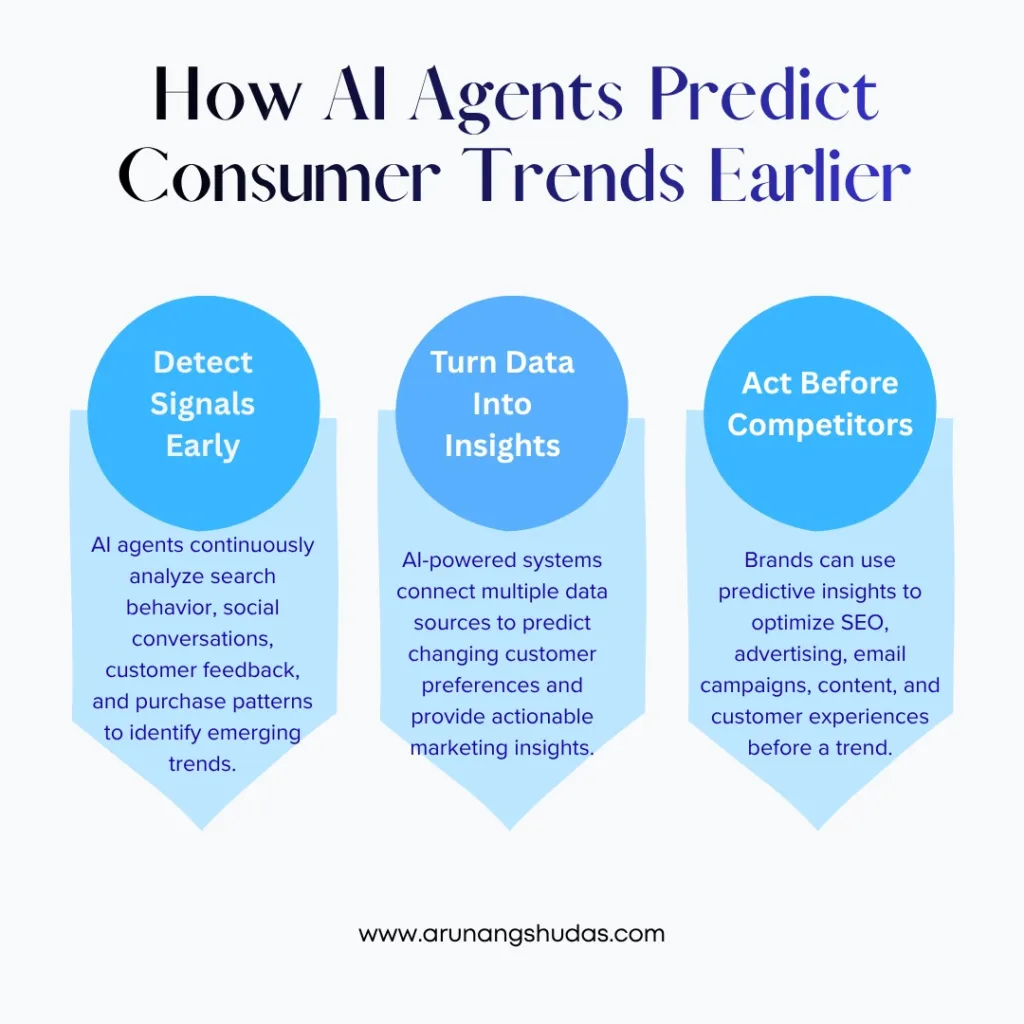
AI agents continuously process these signals and connect information across multiple sources. Instead of waiting for a monthly or quarterly research report, marketers can receive ongoing intelligence about what audiences are discussing, searching for, and purchasing.
This makes market research automation especially valuable for brands operating in fast-moving industries. AI systems can compare historical behavior with current activity and identify unusual changes that deserve attention.
Traditional Research vs. AI-Powered Trend Prediction
| Factor | Traditional Approach | AI Agent Approach |
| Data collection | Periodic | Continuous |
| Analysis | Manual and scheduled | Automated and ongoing |
| Signal detection | Often reactive | Proactive |
| Data sources | Limited datasets | Multiple digital sources |
| Decision speed | Days or weeks | Minutes or hours |
1. AI Agents Detect Behavioral Signals Earlier
One of the biggest advantages of AI agents is their ability to recognize patterns across seemingly unrelated datasets. AI behavior analysis can examine browsing activity, product searches, purchases, content engagement, customer feedback, and social interactions.
For example, if customers begin searching for sustainable packaging, engaging with environmentally focused content, and purchasing reusable products, an AI system can connect those signals. This provides marketers with an early indication that sustainability may be becoming a stronger purchase consideration.
Trend detection AI can then classify the emerging pattern, compare it with historical trends, and estimate whether the change is temporary or likely to grow.
Signals AI Agents Can Monitor
| Signal | What It Can Reveal | Marketing Opportunity |
| Search behavior | Emerging interests | SEO and content creation |
| Social conversations | New topics and attitudes | Social campaigns |
| Product searches | Purchase intent | Product promotion |
| Reviews | Changing customer expectations | Product improvements |
| Website behavior | Shifts in engagement | Conversion optimization |
2. They Turn Customer Data Into Actionable Insights
Collecting data is not enough. Brands need to understand what that data means and what action should follow.
Customer insights automation helps transform raw customer information into usable recommendations. An AI agent can identify audience segments, summarize emerging preferences, flag changes in demand, and suggest appropriate marketing responses.
This strengthens predictive analytics marketing by allowing businesses to move from reporting what happened to anticipating what may happen next.
For example, an AI agent might detect that a specific customer segment is increasingly interested in premium products. Instead of simply reporting the trend, it could recommend targeted messaging, personalized product recommendations, or adjustments to paid campaigns.
3. AI Agents Combine Multiple Trend Sources
Consumer trends rarely emerge from a single channel. A strong prediction may require information from search engines, social platforms, websites, reviews, sales data, and advertising performance.
Digital trend monitoring gives brands a continuous view of these signals. AI agents can combine this information and identify relationships that would be difficult for teams to detect manually.
This is particularly valuable for enterprise market intelligence, where organizations may have millions of customer interactions spread across multiple markets and business units.
How AI Agents Connect Trend Signals
| Data Source | AI Analysis | Possible Insight |
| Search data | Query and intent analysis | Rising consumer interest |
| Social media | Sentiment and topic analysis | Emerging conversations |
| CRM data | Customer behavior analysis | Changing segment preferences |
| Advertising data | Performance pattern analysis | Messaging opportunities |
| Reviews | Theme extraction | Product expectations |
4. They Improve Marketing Decisions
Trend prediction becomes valuable when insights influence actual marketing decisions.
AI-powered intelligence can support Marketing Automation by determining which audiences should receive particular messages and when. It can also contribute to Conversion Rate Optimization by identifying changing customer expectations and recommending improvements to landing pages, offers, and calls to action.
For brands running Influencer Marketing Campaigns, AI agents can identify growing topics, audience interests, and creator conversations that align with emerging demand.
Similarly, Automated Email Marketing can use behavioral signals to personalize campaigns around topics that customers are becoming more interested in.
Marketing Activities Improved by Predictive AI
| Marketing Area | How AI Agents Help |
| Marketing Automation | Triggers actions from emerging signals |
| Conversion Rate Optimization | Identifies changing conversion patterns |
| Influencer Marketing Campaigns | Finds relevant emerging conversations |
| Automated Email Marketing | Personalizes content around customer interests |
| Paid Advertising Campaign Performance | Detects shifts in audience response |
5. They Help B2B Brands Anticipate Market Changes
Trend prediction is not limited to consumer brands. B2B organizations can use AI agents to identify changes in industry priorities, buyer behavior, competitor positioning, and demand.
B2B Marketing Strategies can become more proactive when AI systems continuously analyze industry publications, customer conversations, search patterns, website activity, and account-level engagement.
For example, if businesses in a particular sector suddenly increase searches for a specific technology, AI agents can flag the development. A B2B marketing team can then create relevant content, adjust campaign messaging, or prioritize accounts showing similar behavior.
6. AI Agents Strengthen Brand Monitoring
Brands also need to understand how their reputation and positioning change as consumer expectations evolve.
Brand Monitoring powered by AI can track mentions, sentiment, recurring topics, competitor comparisons, and emerging concerns. Instead of manually reviewing thousands of mentions, marketing teams can focus on the signals most likely to affect brand perception.
AI agents can also identify sudden increases in negative sentiment or unexpected conversations before they become major reputation issues.
7. Predictive Intelligence Improves the Customer Journey
Understanding trends earlier allows brands to adjust experiences before customers begin leaving.
Customer Journey Optimization uses behavioral insights to identify friction points across discovery, consideration, purchase, and retention. AI agents can detect where customer expectations are changing and recommend adjustments to messaging, product recommendations, website experiences, or follow-up communications.
For instance, if customers increasingly compare products based on a new feature, brands can surface that feature earlier in the journey rather than waiting for conversion rates to decline.
The Role of AI Agents in Predictive Marketing
The key difference between conventional analytics and AI-agent-driven marketing is the ability to move continuously from observation to interpretation to action.
An AI agent can:
- Collect signals from multiple sources.
- Detecting unusual behavioral changes.
- Compare current activity with historical patterns.
- Identify potential emerging trends.
- Estimate which signals are likely to become meaningful.
- Recommend marketing actions.
- Trigger approved workflows.
- Monitor the results and refine future predictions.
This creates a continuous feedback loop rather than a one-time research exercise.
How Brands Can Build an AI-Powered Trend Forecasting System
Businesses do not necessarily need to replace their entire marketing technology stack. AI agents can be introduced gradually around existing data and workflows.
A practical approach is to begin with high-value signals such as search trends, customer feedback, CRM activity, website behavior, social conversations, and campaign performance. Once the system consistently identifies useful patterns, organizations can connect those insights to automated marketing workflows.
The most effective systems also include human oversight. AI should identify opportunities and make recommendations, while marketers retain control over strategic decisions, brand positioning, budgets, and sensitive customer interactions.
Final Thoughts
AI agents are changing how brands understand what customers may want next. Instead of relying solely on historical reports, businesses can use continuous behavioral signals to recognize emerging demand earlier and respond faster.
The real advantage is not simply better prediction. It is the ability to connect prediction with execution. When AI-powered intelligence feeds content, advertising, SEO, email, customer experience, and sales strategies, brands can move from reactive marketing toward proactive decision-making.
In competitive markets, identifying a trend a few weeks or months earlier can create a meaningful advantage. AI agents give marketing teams the infrastructure to spot those signals, understand their significance, and act before the opportunity becomes obvious to everyone else.
Frequently Asked Questions
1. How do AI agents predict consumer trends?
AI agents analyze large volumes of behavioral data, including searches, purchases, social conversations, reviews, website interactions, and campaign performance. They identify patterns, compare them with historical behavior, and highlight signals that could indicate an emerging trend.
2. What is the difference between AI trend forecasting and traditional market research?
Traditional market research is often conducted periodically and can involve significant manual analysis. AI trend forecasting can continuously monitor multiple data sources, detect changes in real time, and provide ongoing recommendations to marketing teams.
3. Can small businesses use AI agents for trend prediction?
Yes. Small businesses can start with focused use cases such as monitoring search behavior, customer reviews, website engagement, social conversations, or advertising performance. The system can become more sophisticated as the business collects more data.
4. How can AI trend prediction improve marketing ROI?
Earlier trend detection can help brands allocate budgets toward growing customer interests, improve targeting, personalize messaging, optimize campaigns, and reduce spending on strategies that are losing relevance.
5. Will AI agents replace marketing teams?
AI agents are better viewed as decision-support and automation systems rather than replacements for marketers. They can handle large-scale data analysis and repetitive tasks, while marketing professionals provide strategy, creativity, judgment, brand expertise, and oversight.
