


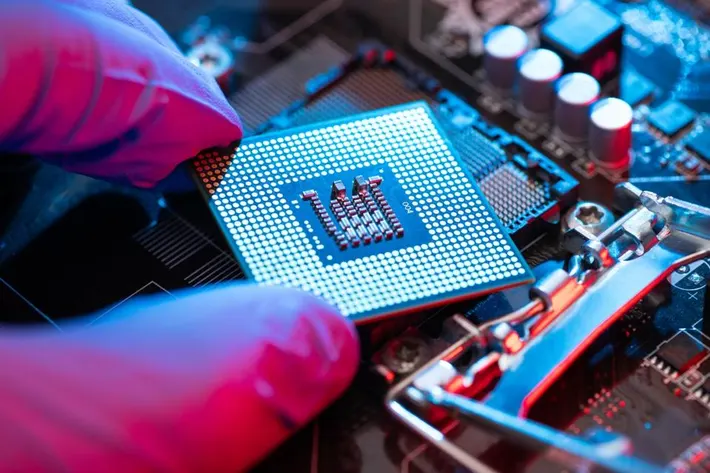
The AI hardware boom is transforming the global technology and semiconductor industries at an unprecedented pace. As artificial intelligence continues to power breakthroughs in everything from chatbots and autonomous vehicles to medical research and industrial automation, the demand for high-performance GPUs, specialized chips, and custom processors has skyrocketed.
Unlike traditional computing, AI workloads require massive parallel processing power and energy-efficient designs to train and run complex machine learning models. This has triggered a race among hardware makers like NVIDIA, AMD, and Intel, as well as cloud giants developing in-house silicon, to create faster and more capable solutions.
For investors, this surge isn’t just a tech trend—it’s a market opportunity. AI-focused hardware companies are seeing soaring valuations, driving stock market interest and reshaping supply chains.
The AI hardware boom is more than a shift in computing; it’s a global economic force redefining performance standards, manufacturing strategies, and long-term investment priorities.
What’s Driving the AI Hardware Boom?

The AI hardware boom is fueled by the explosive growth of artificial intelligence applications that require massive computing power. Training large language models, powering recommendation engines, and enabling computer vision systems all demand hardware that can process enormous datasets quickly and efficiently. Traditional CPUs can’t handle these workloads alone, pushing demand for GPUs, AI accelerators, and custom silicon designed specifically for parallel processing.
Another key driver is the race among tech giants to build faster, more energy-efficient solutions. Companies like NVIDIA, AMD, and Intel are developing new architectures to handle increasingly complex AI models, while cloud providers such as Google, Amazon, and Microsoft are investing in in-house chips to optimize performance and reduce costs.
Rising enterprise adoption of AI across industries—from finance and healthcare to automotive and robotics—is also accelerating hardware demand. Governments are supporting domestic semiconductor production to secure supply chains, adding more momentum to the sector. In short, the AI hardware boom is not just about technological progress—it’s about meeting global demand for faster insights, smarter automation, and a competitive edge.
Key Players in the AI GPU and Chip Market
The AI GPU and chip market is dominated by a few major players driving innovation and setting industry standards. NVIDIA remains the clear leader, with its CUDA ecosystem and data center–focused GPUs powering everything from generative AI models to autonomous vehicles.
AMD has gained traction with its competitive GPU lineup and new AI accelerators designed to challenge NVIDIA’s dominance, while Intel continues to expand its AI portfolio with Gaudi AI accelerators and advancements in CPU–GPU integration.
Tech giants such as Google, Amazon, and Microsoft are also designing custom chips—like Google’s Tensor Processing Units (TPUs) and AWS Inferentia—to optimize AI workloads in their massive cloud infrastructures. Meanwhile, startups like Cerebras, Graphcore, and SambaNova are pushing the boundaries of AI hardware with specialized architectures focused on ultra-high performance and efficiency.
These companies are not just racing to deliver faster chips; they’re building entire ecosystems of software, frameworks, and partnerships to lock in enterprise customers. As competition intensifies, the AI GPU and chip market is expected to grow rapidly, attracting both institutional investors and venture capital.
Market Trends in AI Hardware Investment
These trends collectively highlight how AI hardware has shifted from a niche segment to a core driver of global technology investment.
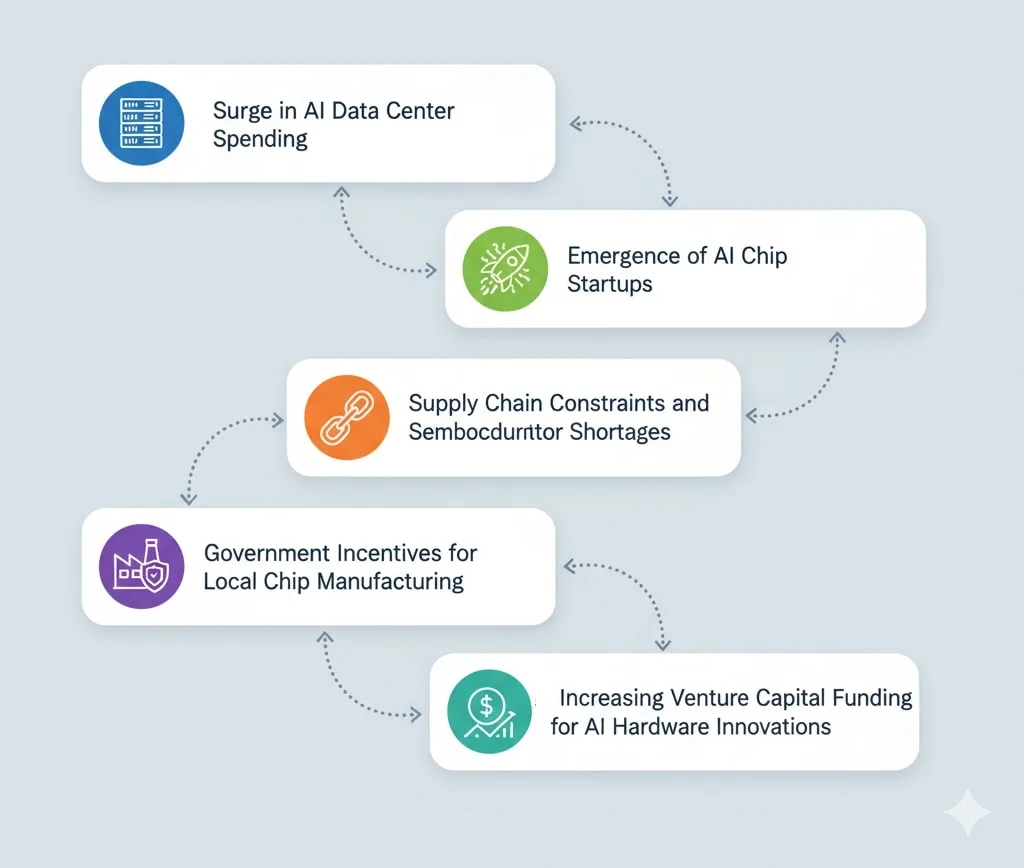
- Surge in AI data center spending – Hyperscalers and cloud providers are massively upgrading their infrastructure to handle AI workloads, leading to record investments in GPU clusters and high-performance computing systems.
- Emergence of AI chip startups – Innovative startups like Cerebras, Graphcore, and Tenstorrent are disrupting the traditional semiconductor landscape with purpose-built AI accelerators.
- Supply chain constraints and semiconductor shortages – Ongoing bottlenecks in advanced chip manufacturing are driving up costs and delaying production timelines, putting pressure on both established companies and newcomers.
- Government incentives for local chip manufacturing – Countries are investing billions to secure semiconductor independence, with initiatives such as the U.S. CHIPS Act and similar programs in Europe and Asia supporting domestic production.
- Increasing venture capital funding for AI hardware innovations – Investors are pouring capital into next-generation chip designs, photonic computing, and quantum-ready hardware to gain early exposure to the booming AI hardware sector.
How AI Hardware Is Powering Next-Gen Applications
Advancements in AI hardware are directly fueling a wave of next-generation applications that were once computationally impossible. High-performance GPUs and custom AI chips are enabling real-time language translation, autonomous driving, fraud detection, and large-scale generative AI models like chatbots and image creators.
These specialized processors handle massive datasets and complex algorithms far faster than traditional CPUs, unlocking new capabilities in industries from finance to healthcare.
In autonomous vehicles, AI accelerators process data from cameras, LiDAR, and radar sensors in milliseconds, allowing cars to make split-second decisions. In biotech, powerful AI chips are accelerating protein folding simulations, helping researchers develop drugs more quickly. Even entertainment is transforming, with advanced GPUs enabling hyper-realistic graphics and real-time rendering for gaming and VR.
As computing demands grow, AI hardware isn’t just about speed—it’s about efficiency and scalability. Optimized chips reduce energy use, shrink data center footprints, and make AI accessible to smaller enterprises, driving innovation far beyond Big Tech.
Challenges and Future Outlook of the AI Hardware Boom

While the AI hardware boom is reshaping industries, it comes with significant challenges. Semiconductor supply chain disruptions have led to component shortages, delaying production and increasing costs for manufacturers. High development expenses, combined with the need for constant innovation, make it difficult for smaller players to compete against giants like NVIDIA, AMD, and Intel.
Energy consumption is another critical issue, as large-scale GPU clusters powering AI models draw enormous power, raising both costs and sustainability concerns.
Looking ahead, the future of AI hardware will be shaped by breakthroughs in chip design, improved manufacturing processes, and increased global investment. Governments are incentivizing domestic production through initiatives like the U.S.
CHIPS Act and similar programs in Europe and Asia, aiming to reduce dependence on foreign supply chains. Emerging technologies such as neuromorphic computing, photonic processors, and quantum accelerators promise to push performance even further while improving efficiency.
Despite the hurdles, AI hardware demand shows no signs of slowing. As next-gen applications proliferate, the race to build faster, smarter, and greener chips will define the next decade of technological growth.

