


Generative AI is no longer a distant concept discussed only in tech conferences; it is a present-day reality. From revolutionizing content creation and coding to reshaping how we visualize data and compose music, this technology is silently—and sometimes quite loudly—transforming our digital landscape.
Whether you’ve used an AI assistant to draft a professional email, generate a high-quality image, or outline a video script, you have already experienced Generative AI examples in action. In this guide, we will break down how this technology is being applied across industries, providing clear, real-world use cases that demonstrate its tangible impact on our daily lives.
What Is Generative AI?
Generative AI is the name of artificial intelligence systems that are capable of generating content instead of merely interpreting or categorizing data. This material may be text, pictures, videos, audio, coded material, or even synthetics. Generative Artificial intelligence, in contrast to traditional AI, adheres to strict rules, but learns patterns and structures after analyzing huge collections of data and proceeds to produce original outputs according to that learning.
Imagine an assistant who is super-creative having read millions of books, viewed billions of images, and watched countless videos after which he or she uses that experience to generate something new in a few seconds.
Why Generative AI Is Gaining Massive Attention
Generative has forced its way to the forefront so fast due to its time-saving abilities, its ability to enhance creativity and output without compromising quality. Businesses enjoy it as it saves on costs. It is favorite amongst creators as it eliminates creative blocks. And it is the favorite of marketers as it accelerates the production process and at the same time makes things personal.
Simply put, generative AI does not appear to be a machine, rather a partner.
How Generative AI Works: Behind the Scenes
You don’t need a computer science degree to understand the mechanics of Generative AI. At its core, the technology is built on two pillars: pattern recognition and predictive modeling.
1. The Power of Machine Learning Models
Generative AI utilizes sophisticated architectures to “understand” and create data. While these sound complex, they are essentially the “engines” that drive the output:
- Transformers: The brains behind text tools, designed to understand the relationship between words in a sentence.
- Diffusion Models: The technology powering image generators, which starts with “digital noise” and refines it into a clear picture.
- Generative Adversarial Networks (GANs): Two AI models “competing” against each other—one creates, the other critiques—until the result is indistinguishable from reality.
Think of it as “Autocomplete on Steroids.” When you provide a prompt, the model makes a highly calculated “best guess” based on its training. It isn’t just predicting the next word; it’s predicting the next concept.
2. Training Data: The Foundation of Quality
The quality of an AI’s output is directly tied to its training data. By analyzing massive datasets—billions of pages of text or millions of images—the AI learns how “pixels,” “notes,” or “words” typically fit together.
Human Input Matters: This is why two people using the same tool can get vastly different results. The AI adapts to the specific context and nuance of your prompt, making it a highly versatile partner for any scenario.
Pattern Perception, Not Plagiarism: AI doesn’t “copy and paste” existing content. Instead, it perceives the underlying patterns (like the brushstrokes of a painter or the syntax of a coder) and replicates those rules to create something entirely new.
Key Industries Transformed by Generative AI
The impact of Generative AI extends far beyond the tech sector. Today, it is being integrated into the core operations of diverse industries, from streamlining clinical workflows to revolutionizing retail experiences. Its “secret power” lies in its incredible versatility—it adapts to solve specific, complex problems across various domains.
1. Healthcare
AI is transforming patient care by generating accurate medical reports, assisting in drug discovery, and summarizing patient histories. This allows healthcare professionals to spend less time on paperwork and more time on life-saving treatments.
2. Education
In the classroom, Generative AI acts as a personalized tutor. It can generate custom lesson plans, simplify complex topics for students, and provide instant feedback on assignments, making quality education more accessible.
3. Finance
Financial institutions leverage AI for automated risk assessment, fraud detection, and generating detailed market analysis reports. It helps analysts process vast amounts of data to predict trends with higher precision.
4. Media & Entertainment
From scriptwriting to deep-learning-based visual effects, AI is the new engine for creativity. It enables creators to produce high-fidelity content at a fraction of the traditional cost and time.
5. E-commerce & Retail
AI reshapes the shopping journey through personalized product recommendations, AI-driven virtual try-ons, and the generation of thousands of unique product descriptions tailored to different customer segments.
Generative AI Examples Across Different Domains
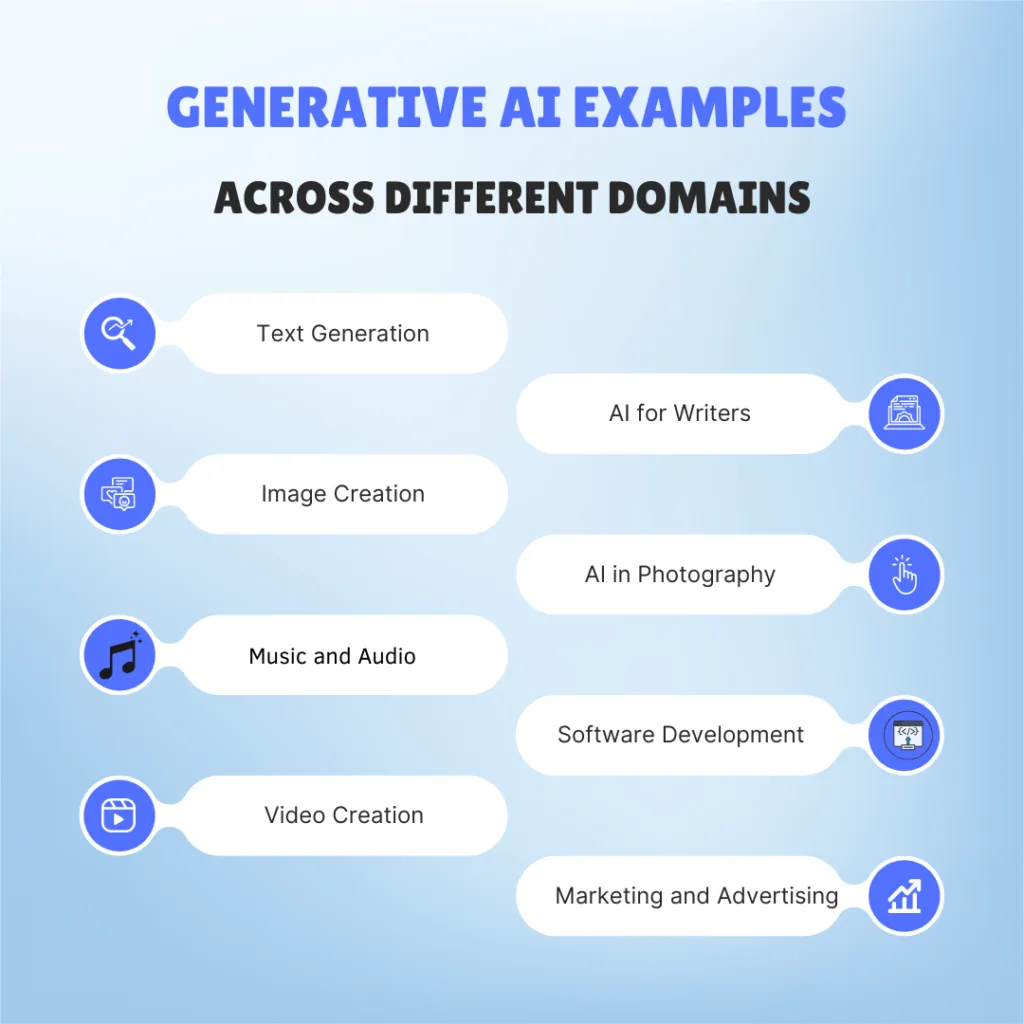
At this point, we shall move to the most crucial section, which is some real, practical Examples of Generative Ai in industries.
1. Text Generation: Redefining Content Creation
Text generation is the most accessible and widespread application of GenAI. Large Language Models (LLMs) are now essential for drafting everything from high-level technical documentation to punchy social media captions.
- Real-World Example: Instead of spending hours on a 1,000-word article outline, a marketer can use AI to generate a structured draft in minutes.
- The Benefit: Beyond speed, it ensures a consistent brand voice across multiple platforms, allowing businesses to scale their communication without losing quality.
2. Generative AI for Writers: The Ultimate Brainstorming Partner
For authors and copywriters, AI isn’t a replacement—it’s a creative collaborator. It excels at ideation, rewriting, and summarizing complex topics.
Read more blog : Generative AI for Writers: Tools That Help Write Blogs, Books, and Scripts
The “Calculator” Analogy: Using AI for writing isn’t “cheating”; it’s working smarter. It handles the repetitive heavy lifting, allowing writers to focus on high-level storytelling and strategy.
3. Image Creation: From Text to Visual Reality
Generative AI allows anyone to turn a simple text prompt into a professional-grade visual. Whether you need a “futuristic city at sunset” or a “minimalist logo concept,” AI delivers in seconds.
- Who it’s for: Designers and social media managers use these tools to bypass expensive photoshoots and generic stock photos, creating unique assets tailored to their specific brand aesthetic.
4. AI in Photography: The 24/7 Virtual Editor
In the world of photography, Generative AI acts as an automated darkroom. It goes beyond simple filters to intelligently improve image quality.
- Capabilities: AI can automatically remove complex backgrounds, upscale low-resolution shots (generative fill), and fix lighting or focus issues.
- Impact: It provides professional-level retouching at a fraction of the traditional time and cost.
5. Video Creation: High Production on a Startup Budget
Video production used to require a full crew and a massive budget. Now, Generative AI can produce scripts, visuals, voiceovers, and animations from a single prompt.
- Revolutionizing Content: Small businesses and startups are now using AI to create high-conversion social media reels and explainer videos, leveling the playing field with global brands.
6. Music and Audio: Where Imagination Meets Automation
Generative AI is transforming the auditory landscape by creating custom background tracks, realistic voiceovers, and unique sound effects.
- Use Case: Podcasters and YouTubers use AI-generated audio to maintain high production values while drastically lowering licensing costs and production timelines.
7. Software Development: The Smart Coding Assistant
For developers, AI is a context-aware assistant capable of writing code snippets, debugging errors, and generating documentation.
- Efficiency: It helps beginners learn syntax faster and allows senior engineers to automate “boilerplate” code, shifting their focus to architecture and complex problem-solving.
8. Marketing and Advertising: Personalization at Scale
Creativity is the lifeblood of marketing, and Generative AI acts as a force multiplier. From ad copy to landing pages, AI allows marketers to test hundreds of variations simultaneously.
The Competitive Edge: AI is particularly transformative for A/B testing. It allows for hyper-personalization, ensuring the right message reaches the right audience at the exact moment they are ready to engage.
The Strategic Benefits of Generative AI
Generative AI is more than just a convenience; it’s a catalyst for innovation. By integrating these tools, businesses and creators can unlock potential that was previously hindered by manual constraints.
1. Creativity at Scale
Traditionally, high-quality creative work was limited by the “hours in a day.” Generative AI removes this bottleneck, allowing brands to produce high-volume, high-quality content—from personalized marketing assets to diverse design variations—without exhausting their creative teams.
2. Efficiency: Saving Time and Capital
By delegating repetitive, data-heavy tasks to AI, humans are freed to focus on high-level strategy.
- Lower Operational Costs: Automating drafts, code snippets, and basic video editing reduces the need for massive production budgets.
- Accelerated Workflows: Tasks that once took weeks can now be condensed into hours, allowing for faster go-to-market strategies.
Navigating the Limitations & Ethics
While the advantages are transformative, Generative AI is not a “set it and forget it” solution. Responsible implementation requires human oversight.
1. Bias and Data Integrity
AI models are a mirror of their training data. If the data contains historical biases, the AI will likely replicate them.
- The Fix: Ethical usage requires rigorous human-in-the-loop oversight to ensure outputs are fair, accurate, and inclusive.
2. The Landscape of Copyright and Originality
As AI-generated content becomes mainstream, the legal world is still catching up.
Transparency is Key: To maintain brand trust, it is vital to be transparent about AI usage and ensure that the “originality” of the final product is enhanced by human creativity, not just replaced by an algorithm.
Intellectual Property: Ownership and copyright laws are currently evolving.
Generative AI in the Business & Startup Ecosystem
The business world is witnessing a shift in adoption speed that is historically unprecedented. For startups and established enterprises alike, Generative AI has moved from an “experimental luxury” to a “core operational necessity.”
1. Productivity Through Intelligent Automation
AI doesn’t just automate tasks; it enhances the output of entire departments.
- Customer Experience: AI-driven support bots handle complex queries with human-like nuance.
- Knowledge Management: Internal documentation and research that used to take weeks can now be indexed and summarized in seconds.
2. Securing a Competitive Advantage
In today’s market, speed is the ultimate currency. Companies leveraging GenAI can:
- Rapidly Prototype: Test and iterate on product ideas in a fraction of the time.
- Market Adaptability: Pivot content and marketing strategies instantly based on real-time data trends, staying steps ahead of less agile competitors.
Future Trends: What’s Next for GenAI?
The horizon of Artificial Intelligence is moving from “text-based” to “action-based” systems.
- The Rise of Multimodal AI: Future systems won’t just handle one type of data. They will seamlessly blend text, images, audio, and video into a single, cohesive workflow (e.g., an AI that reads a document and automatically generates a matching video presentation).
- Human-AI Symbiosis: We are moving away from “replacement” and toward collaboration. AI will act as a “co-pilot,” handling the data-heavy lifting while humans provide the strategic direction and emotional intelligence.
How to Choose the Right Generative AI Tool
With thousands of tools hitting the market, selection can be overwhelming. Focus on these two pillars:
1. Use Case Alignment
Don’t buy into the hype; buy into the solution.
- Identify your primary bottleneck—is it writing, UI/UX design, video production, or software development?
- Select “Best-of-Breed” tools (like GPT-4 for text or Midjourney for visuals) that are specifically engineered for your niche.
2. Seamless Integration
The best tool is the one your team actually uses.
Scalability: Ensure the tool has a manageable learning curve so your team can see an immediate ROI without months of training.
Low Friction: Look for tools with robust APIs or native integrations (like Slack, Google Workspace, or GitHub).
How Arunangshudas Guides Practical Use of Generative Artificial intelligence
Arunangshudas focuses on simplifying generative Artificial intelligence adoption by connecting real-world use cases with practical workflows. His approach highlights using generative Artificial intelligence tools for writing, visual creation, video production, and productivity without overcomplicating the technology. By emphasizing hands-on implementation, ethical usage, and efficiency-driven outcomes, Arunangshudas helps creators, marketers, and businesses apply generative Artificial intelligence examples in daily work to improve speed, creativity, and consistency while maintaining human control over final outputs.
Conclusion
Generation Artificial intelligence is transforming the manner in which we produce, interact and innovate. Generative Artificial intelligence Examples also include writing and photography, video production and software development, which proves that this technology is not a craze, but rather a revolution. When applied in a considerate way, generative AI can become a huge asset, enhancing human creativity instead of eliminating it.
Artificial intelligence is not the future of Artificial intelligence vs. human beings. It’s humans with Artificial intelligence.
Frequently Asked Questions (FAQs)
1. What is the best example of generative Artificial intelligence?
The most widely used examples today are Large Language Models (LLMs) like ChatGPT for text generation and Diffusion Model like Midjourney or DALL-E for AI image creation. These tools are the most accessible entry points for both individuals and businesses.
2. Is Generative AI safe for business use?
Yes, provided it is used responsibly. Businesses should implement clear ethical guidelines, ensure data privacy (avoiding the input of sensitive company data into public models), and always maintain human oversight to verify the accuracy of AI-generated outputs.
3. Can Generative AI replace human creativity?
No. Generative AI is a collaborator, not a replacement. While it excels at automating routine tasks and generating raw ideas, it lacks the emotional intelligence, cultural nuance, and strategic intent that only a human creator can provide.
4. How does Generative AI benefit content creators?
AI acts as a force multiplier for creators by accelerating the brainstorming, drafting, and editing phases. It allows creators to produce high-quality scripts, visuals, and blog posts faster, shifting their focus from manual execution to high-level storytelling.
5. Which industries are seeing the most impact from Generative AI?
While almost every sector is evolving, the most significant transformations are occurring in Marketing & Advertising, Software Development, Healthcare, E-commerce, and Media Production. These industries benefit most from AI’s ability to personalize content and automate complex data patterns.
