


In the high-stakes world of algorithmic trading, your choice of data architecture isn’t just a technical detail—it’s a competitive advantage. When execution happens in microseconds, your trading database must handle massive ingestion, complex backtesting, and real-time analytics without breaking a sweat.
As we move through 2026, the landscape for the best time series databases has evolved. While established players remain strong, the criteria for a “top” system now include AI-readiness and seamless horizontal scaling.
Why a Time-Series Database (TSDB) is Essential for Trading
Traditional relational databases struggle with the “velocity” of modern markets. A dedicated time series database is engineered to handle:
- High Ingestion Rates: Capturing millions of ticks per second during peak volatility.
- Efficient Compression: Reducing storage costs for decades of historical market data.
- Temporal Querying: Built-in functions for time-weighting, “as-of” joins, and moving averages.
Best Time Series Databases for Trading Systems
1. TimescaleDB: The SQL Powerhouse
If your team is already fluent in the PostgreSQL ecosystem, TimescaleDB is often the best database for trading systems that require relational integrity alongside time-series performance.
- Why it’s a leader: It is essentially “PostgreSQL made for time-series.” You get ACID compliance, complex JOINs, and a massive library of extensions without learning a new language.
- Key Features:
- Hypertables: Automatically partitions data into manageable chunks (chunks) for faster vacuuming and indexing.
- Continuous Aggregations: Pre-computes OHLC (Open-High-Low-Close) bars or moving averages in the background.
- Tiered Storage: Moves older data to cheaper object storage (like S3) automatically to save on costs.
- Best Use Case: Strategy development where you need to JOIN market data with metadata like company fundamentals or sentiment scores.
2. InfluxDB: The Real-Time Specialist
InfluxDB consistently sits high in time series database rankings for developers who need a purpose-built, “sensor-first” approach to market data.
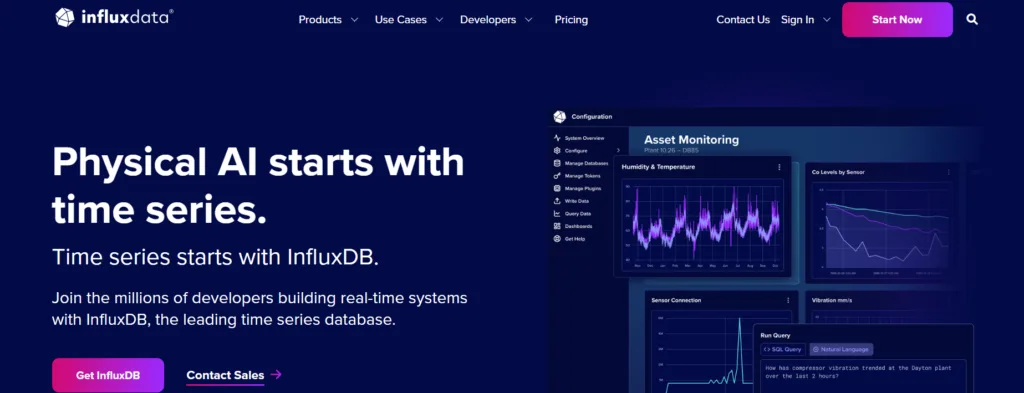
- Why it’s a leader: Its storage engine is optimized for high-frequency “hot” data. The latest versions have significantly improved the ability to handle high-cardinality data, such as tracking thousands of individual option strikes or crypto pairs.
- Key Features:
- Native Compression: Achieves industry-leading compression ratios for timestamped floats.
- Flux & InfluxQL: Specialized languages designed for mathematical transformations over specific time windows.
- Ecosystem: Integrates natively with Telegraf for data collection and Grafana for real-time visualization.
- Best Use Case: High-frequency monitoring, real-time risk management, and sub-second alerting systems.
3. ClickHouse: The Analytical Speed Demon
While technically a columnar OLAP database, ClickHouse has become a favorite for quantitative researchers handling petabytes of data. It is widely considered the best database for time series data when it comes to raw query speed.
- Why it’s a leader: It can process billions of rows in milliseconds by using a columnar storage format, making it perfect for “deep” historical analysis.
- Key Features:
- Vectorized Execution: Uses modern CPU instructions to process data in parallel for blazing-fast results.
- Data Skipping Indices: Allows the engine to “jump” over irrelevant data during massive scans.
- Linear Scalability: Easily scales across clusters to handle global market feeds.
- Best Use Case: Large-scale backtesting, market microstructure research, and computing complex order flow imbalances.
Comparison: Top Time Series Databases at a Glance
| Feature | TimescaleDB | InfluxDB | ClickHouse |
| Primary Strength | SQL Compatibility | Real-time Ingestion | Analytical Speed |
| Query Language | Full SQL | Flux / InfluxQL | SQL (Dialect) |
| Scalability | Vertical (Mostly) | Cloud Native | Horizontal Cluster |
| Ideal Data Type | Relational + Time | Metrics / Ticks | Massive History |
| Learning Curve | Low (SQL-based) | Moderate | Moderate to High |
Read more blog: The Impact of Database Architecture on Trading Success
Choosing the Best Time Series DB for Your Strategy
Selecting the best timeseries db depends entirely on your specific trading architecture:
- Go with TimescaleDB if you need a “do-it-all” trading database that lives inside your existing PostgreSQL infrastructure and requires transactional safety.
- Go with InfluxDB if your focus is on real-time stream processing and you need a managed cloud solution that “just works” for high-frequency metrics.
- Go with ClickHouse if you are a quant-heavy firm running complex statistical models over years of tick-by-tick historical data.
The Bottom Line: Future-Proofing Your Data Stack
In the high-speed arena of algorithmic trading, your data infrastructure is the engine under the hood. You can have the most sophisticated Alpha strategy in the world, but if your trading database can’t ingest ticks or retrieve historical bars fast enough, slippage will eat your profits.
As we look toward the rest of 2026, the trend is moving toward “hybrid” architectures. Many top-tier firms no longer rely on just one system; they might use InfluxDB for high-frequency “hot” data ingestion and ClickHouse as a massive data lake for long-term quantitative research.
Choosing from the best time series databases isn’t just about picking the fastest one on a benchmark—it’s about which one fits your team’s workflow and your strategy’s specific latency requirements. Whether you prioritize the familiar SQL power of TimescaleDB or the raw analytical speed of a columnar store, the goal remains the same: transforming raw market noise into actionable signals as close to real-time as possible.
Don’t let legacy database limitations be the bottleneck for your trading success. Start small, benchmark with your own tick data, and pick the architecture that scales with your ambitions.
Frequently Ask Questions:
What makes TimescaleDB suitable for financial market data?
TimescaleDB combines the reliability of PostgreSQL with the performance of a time-series database. It supports high write throughput, SQL compatibility, and continuous aggregations, making it ideal for storing historical price data, running complex financial queries, and performing backtesting.
Is InfluxDB good for real-time trading analytics?
Yes, InfluxDB is built specifically for real-time time-series data processing. It offers high ingestion rates, low-latency writes, and efficient data compression, making it suitable for processing tick data, monitoring trading algorithms, and detecting anomalies in financial markets.
When should you choose ClickHouse for trading systems?
ClickHouse is best used when dealing with massive historical datasets and complex analytical queries. Its columnar storage and fast query performance allow traders and researchers to analyze billions of rows of market data quickly, which is especially useful for quantitative research and large-scale backtesting.
Why are time-series databases important for algorithmic trading?
Time-series databases are designed to efficiently store and process timestamped data. In algorithmic trading, markets generate huge volumes of real-time data, such as price movements and tick data. TSDBs help traders quickly analyze historical and real-time data, enabling faster decision-making and improved trading strategies.
Follow me on Linkedin
