


When it comes to modern web development, the smooth integration between the backend and frontend is what makes an application function seamlessly. A well-integrated system ensures data consistency, performance efficiency, and a better user experience.
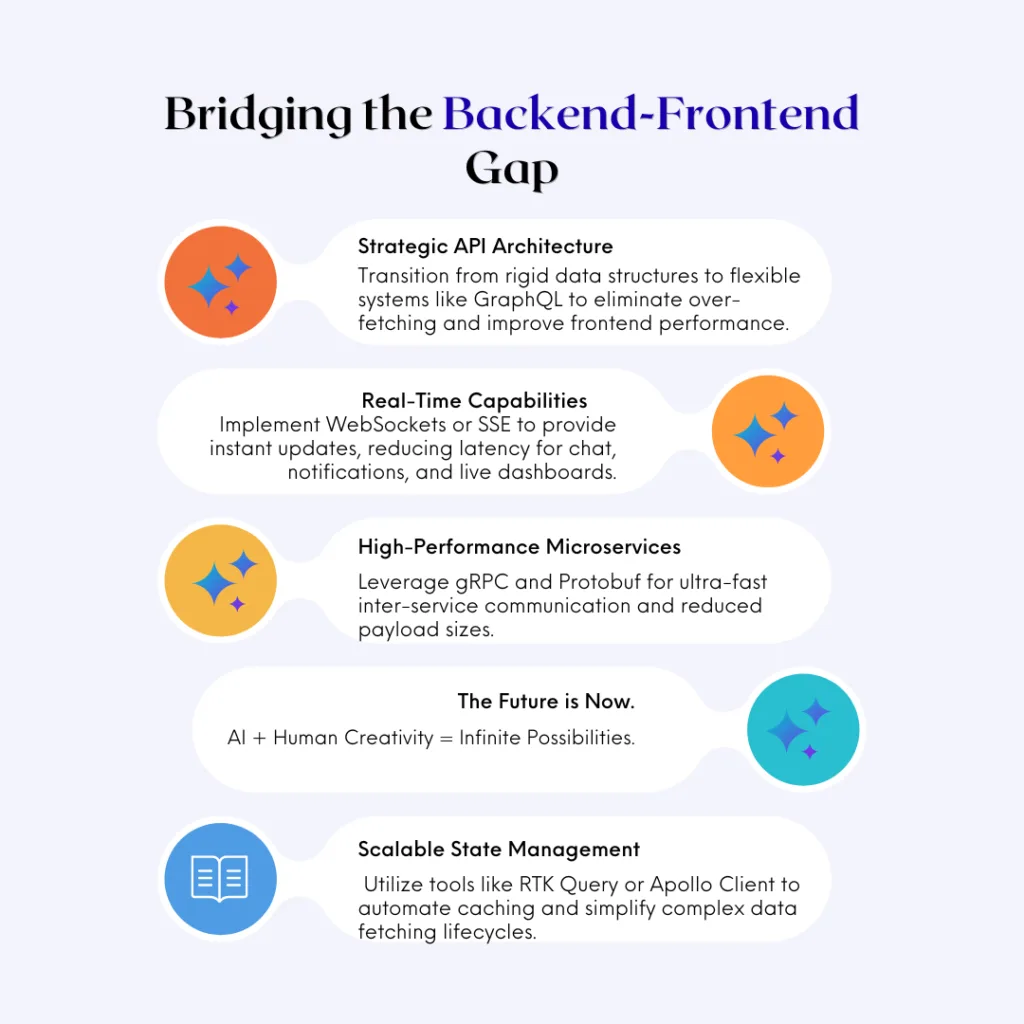
But here’s the challenge—how do you pick the right technology to bridge the gap between the frontend and backend? Should you go for GraphQL or REST APIs? What about WebSockets for real-time communication?
I. Traditional & Modern API Architectures
1. REST APIs (Representational State Transfer)
- Best for: Standard web services, public APIs, and CRUD-based applications.
- The 2026 Context: While older, REST remains the “universal language” of the web due to its stateless nature and ease of caching.
- Pros: Highly cacheable, universally compatible, and easy to secure.
- Cons: Prone to over-fetching (getting more data than needed) or under-fetching (requiring multiple calls).
Read more blog : REST API Authentication Methods
2. GraphQL
- Best for: Complex data structures and frontend-driven development.
- The 2026 Context: Essential for mobile apps where bandwidth is a premium; it allows the client to dictate the shape of the response.
- Pros: Single endpoint for all queries; strongly typed schema via Introspection.
- Cons: Complexity in implementing server-side caching and potential for N+1 query issues.
3. gRPC (Google Remote Procedure Call)
- Best for: High-performance microservices and polyglot environments.
- The 2026 Context: Uses Protocol Buffers (Protobuf) for binary serialization, making it significantly faster than JSON-based REST.
- Pros: Strict typing, low latency, and built-in support for streaming.
- Cons: Requires a proxy (like Envoy) for browser-based communication.
II. Real-Time & Event-Driven Communication
4. WebSockets
- Best for: Full-duplex, bidirectional communication (Chat, Gaming, Live Dashboards).
- Pros: Extremely low overhead after the initial handshake; real-time updates.
- Cons: Persistent connections consume server memory; requires robust scaling strategies (e.g., Redis Pub/Sub).
5. Server-Sent Events (SSE)
- Best for: One-way real-time streams (Live news feeds, Stock tickers, AI text-streaming).
- The 2026 Context: In the era of Generative AI, SSE is the standard for streaming LLM responses to the UI word-by-word.
- Pros: Automatic reconnection; lighter on server resources than WebSockets.
- Cons: Unidirectional (Server to Client only).
6. MQTT (Message Queuing Telemetry Transport)
- Best for: IoT, edge computing, and low-bandwidth environments.
- Pros: “Publish/Subscribe” model; ultra-lightweight headers (2 bytes).
- Cons: Not natively built for standard web browser interactions without a bridge.
III. Integrated Data Fetching & State Management
7. Next.js API Routes (Route Handlers)
- Best for: Full-stack React applications and Serverless architectures.
- Pros: Zero-config setup; seamless integration with Server Components.
- Cons: Can lead to “monolithic” tendencies within a frontend repository.
8. Firebase (Firestore & Realtime Database)
- Best for: MVP development and serverless “Backend-as-a-Service” (BaaS).
- Pros: Instant synchronization; built-in Auth and Security Rules.
- Cons: High costs at massive scale and limited complex querying compared to SQL.
9. Apollo Client (GraphQL State Management)
- Best for: Enterprise-level React/Angular apps using GraphQL.
- Pros: Sophisticated Normalized Caching and declarative data fetching.
- Cons: Substantial bundle size; may be overkill for simple apps.
10. Redux Toolkit (RTK) Query
- Cons: Strictly tied to the Redux state management pattern.
- Best for: Managing cached API state in complex React ecosystems.
- Pros: Eliminates boilerplate; provides “hooks” for every API lifecycle (loading, error, success).
Comparison Matrix: Which Protocol Should You Choose?
| Protocol | Data Format | Communication | Latency | Complexity |
| REST | JSON/XML | Pull (Request/Response) | Medium | Low |
| GraphQL | JSON | Pull (Flexible) | Medium | High |
| gRPC | Protobuf | Bidirectional Streaming | Ultra-Low | High |
| WebSockets | Binary/Text | Bidirectional (Real-time) | Low | Medium |
| SSE | Text | Server-to-Client | Low |
Final Thoughts
Choosing the right technology for backend-frontend integration depends on your application’s needs.
- Need a standard, easy-to-use API? → Go with REST.
- Want efficient data fetching? → GraphQL is your friend.
- Building real-time apps? → Try WebSockets or SSE.
- Working with IoT devices? → MQTT is your best bet.
- Using React + GraphQL? → Apollo Client will make your life easier.
Each of these technologies serves a specific purpose, and in many cases, a hybrid approach works best.
You may also like:
1) 5 Common Mistakes in Backend Optimization
2) 7 Tips for Boosting Your API Performance
3) How to Identify Bottlenecks in Your Backend
4) 8 Tools for Developing Scalable Backend Solutions
5) 5 Key Components of a Scalable Backend System
6) 6 Common Mistakes in Backend Architecture Design
7) 7 Essential Tips for Scalable Backend Architecture
8) Token-Based Authentication: Choosing Between JWT and Paseto for Modern Applications
9) API Rate Limiting and Abuse Prevention Strategies in Node.js for High-Traffic APIs
10) Can You Answer This Senior-Level JavaScript Promise Interview Question?
11) 5 Reasons JWT May Not Be the Best Choice
12) 7 Productivity Hacks I Stole From a Principal Software Engineer
13) 7 Common Mistakes in package.json Configuration
Read more blogs from Here
Share your experiences in the comments, and let’s discuss how to tackle them!
Follow me on Linkedin
How Arunangshudas Can Help You
Building a robust integration between your backend and frontend is the technical foundation of a high-converting digital product. At Arunangshudas, we help you navigate these architectural choices to ensure your stack is not just functional, but scalable. We specialize in optimizing full-stack performance—ensuring your API response times are lightning-fast and your user experience is seamless.
Whether you are migrating from a legacy REST system to GraphQL or building a real-time IoT platform with MQTT, Arunangshudas provides the strategic technical oversight to turn your code into a growth engine. Let’s build a system that scales as fast as your ambition.
Frequently Asked Questions: Frontend-Backend Integration
1. Which API protocol is best for Generative AI streaming?
Server-Sent Events (SSE) is currently the industry standard for streaming AI responses (like LLM-generated text). Unlike REST, which waits for the entire response to be ready, SSE allows the server to push fragments of data to the frontend as they are generated, providing a much smoother user experience.
2. Should I use GraphQL or REST for a new project in 2026?
It depends on your data complexity. Choose REST if your application is straightforward, relies heavily on caching, or requires a public-facing API. Choose GraphQL if your frontend needs to aggregate data from multiple sources in a single request or if you want to eliminate “over-fetching” to improve mobile performance.
3. Is gRPC a viable replacement for REST in web development?
For internal microservices, yes—gRPC is significantly faster and more efficient. However, for direct frontend-to-backend communication in a browser, REST or GraphQL are still preferred. To use gRPC in a browser, you must implement a “gRPC-Web” proxy, which adds a layer of architectural complexity.
4. When should I choose WebSockets over Server-Sent Events (SSE)?
Choose WebSockets when you need true bidirectional, “full-duplex” communication where both the client and server send data frequently (e.g., a multiplayer game or a collaborative whiteboarding tool). Choose SSE if you only need the server to push updates to the client (e.g., a notification bell or a live scoreboard), as it is easier to implement and lighter on resources.
5. How does Next.js API Routes simplify the integration process?
Next.js API Routes (Route Handlers) allow you to build a Full-Stack application within a single repository. It eliminates the need for CORS (Cross-Origin Resource Sharing) configuration and allows the frontend to fetch data from the same server that serves the UI. This is ideal for SEO-focused sites and rapid prototyping.
