


Startups that are bootstrapped are the core of innovation, they are passionate, gritty, and capital constrained. When it comes to the rush to expand, however, the truth is that several founders take a wrong turn when making financial decisions only to realize later on they have squandered their resources. Both the Bootstrap and Seek Funding are planning to raise money? To survive and thrive, it is important to understand these financial traps.
We will reveal all the typical financial pitfalls in most bootstrapped startups, how to prevent them, and how to make wiser financial choices with the help of such an expert as Arunangshu Das.
The best financial pitfalls that tend to sink bootstrapped startups can be broken down and how to avoid them, so let’s explain.
Understanding Bootstrapping and Its Challenges
Bootstrapping is the act of financing your business out of personal savings, reinvested earnings or small amounts of money without involving investors or debts.
Although this keeps you in control, as well, it produces high pressure. Lack of capital will result in problems of spending sprees or neglecting financial plans. The key challenge? Preserving the cash flow and developing a viable business model.
The Importance of Financial Discipline
What can distinguish successful bootstrappers and those who fail early is discipline. Each financial choice has to count. Keep a simple principle:
“Track every rupee. Measure every outcome.”
Even the startups that would seem profitable without financial discipline might end up drained.
Mistake 1: Lack of Clear Budgeting
It is surprising to learn how many startups are initiated without a budget. Founders can be quick to think that they can manage as they go but this is very soon proven wrong.
Why It’s Dangerous
In the absence of a budget, one can not know:
- The amount of money you can comfortably spend.
- When to expect shortfalls
- Point of reduction of unnecessary costs.
Smart Fix
Prepare an expense tracker in a monthly format with the help of such applications as Zoho Books, QuickBooks, or even Google Sheets. Review spending trends, update weekly.
| Expense Type | Ideal % of Total Budget | Notes |
| Product Development | 30% | Focus on MVP |
| Marketing | 20% | Test low-cost channels |
| Salaries | 25% | Keep team lean |
| Operations | 15% | Rent, utilities, tools |
| Emergency Fund | 10% | Essential for risk cover |
Mistake 2: Ignoring Cash Flow Management
Profitable businesses fail as a result of cash flow problems even in the profitable business. Most founders do not anticipate the time it takes revenue to flow in – and spend prior to payment.
Example
A business starting with invoicing its customers on 30 days terms would likely have no cash after 20 days without controlling its costs.
Quick Fix
- Keep a cash reserve that includes no less than a 3 months cover of expenses.
- Promote quick paying clients.
- Instantiate automatic notifications of overdue payments.
Remember: before profits, cash flow is survival.
Mistake 3: Misjudging Market Demand
Most founders are infatuated with their idea and do not go through the right validation. Developing a product that is not needed is a quick means to lose money.
Avoid This
- Concept-test with small pilot tests.
- Before scaling, use customer feedback.
- You should not spend a lot of money before you discover a good product-market fit.
Mistake 4: Overvaluing or Undervaluing Your Startup
One of the biggest causes of failure in start ups when it comes to making the decision to Bootstrap or Seek Funding is the issue of valuation being misunderstood.
The Truth About Startup Valuation in India
It is not all about potential, but performance, scalability and financial data. Valued startups have future difficulties in attracting later investors and undervalued ones surrender excessively early equity.
| Stage | Typical Valuation (India) | Key Criteria |
| Idea Stage | ₹50L–₹1Cr | Founders & concept strength |
| Early Traction | ₹1Cr–₹5Cr | MVP & user growth |
| Growth Stage | ₹5Cr–₹25Cr | Revenue consistency |
| Expansion | ₹25Cr+ | Strong profit margins |
Get a realistic valuation before pitching or reinvesting.
Mistake 5: Mixing Personal and Business Finances
This is one of the errors made by solopreneurs. Personal and business expenses should be kept separate since the combination of the two causes confusion and lack of tracking during taxation.
Fix: Open a separate business account from day one. Pay yourself a fixed salary to maintain transparency.
Mistake 6: Spending Too Much on Non-Essentials
New office equipment, costly programs or logo redesign can seem thrilling – but will hardly enhance your bottom line.
Rather, invest in growth stimulating areas such as customer acquisition or retention tools.
Mistake 7: Hiring Too Fast, Too Soon
Early recruiting is another budget killer. Bootstrapped founders will tendency create huge teams with unproven workflows.
Alternative Approach
- Begin with freelancers or interns.
- Automate repetitive tasks.
- Recruit when the workload is guaranteed to be greater than the capacity.
Mistake 8: No Emergency Fund
It takes only one default or deceleration in the markets, with no safety net, to put you out of business.
Rule of Thumb: Never spend less than 10-15 percent of revenue collected as contingent reserve.
Mistake 9: Not Tracking ROI on Marketing
Most of the startups invest in advertisements without thinking – hoping that one will come true. However, in marketing every rupee has to deliver tangible results.
How to Fix
- Track ROI by campaign.
- Apply tools such as Google Analytics, Meta Ads Manager or HubSpot.
- Elaborate stop campaigns that are not converting.
Mistake 10: Ignoring Professional Financial Advice
DIY finance can be effective in the beginning but as your company expands, it is important to hire professional assistance. Compliance, tax and cash flow can be straightened with the help of chartered accountants, CFO consultants, or business coaches.
How to Stop Burning Cash and Build Sustainable Growth
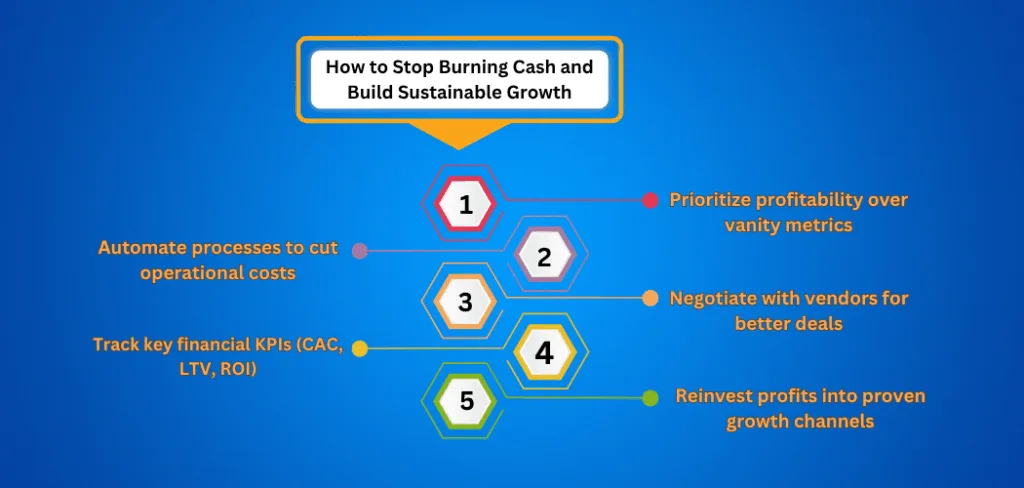
In order to Stop Burning Cash consider these 5 principles:
- Focus more on profitability than vanity measures.
- Automation of processes in order to save on manual expenses.
- Bargain with suppliers on improved prices.
- Keep track of such KPIs as CAC (Customer Acquisition Cost) and LTV (Lifetime Value).
- Put back profits into established growth areas.
These can be used regularly to create a reliable and scalable business base.
How Arunangshu Das Guides Founders Through These Mistakes
Arunangshu Das assists startups in changing their financial strategy, as it aims at working on strategy, valuation and optimization of growth.
He provides customized work to assist founders:
- Establish long term financial plans.
- Assess the option of Bootstrapping or raising Funds.
- Get right Startup Valuation in India
- Get tips on how to Stop Burning Cash.
In case you are having difficulties with financial planning or pricing, the advice he provides can assist you in creating a tough and investor-ready business model.
Conclusion
Bootstrapping may be an effective means of expansion – wisely done. These financial errors can be avoided, and with that, you will always remain lean, profitable, and ready to achieve long-term success.
It is worth remembering: It is not about growing fast, but growing right.
FAQs
1. What’s the biggest financial mistake startups make?
Lack of proper management of cash flow. Great ideas do not succeed even with no liquidity.
2. How can I manage startup finances with limited experience?
Basic accounting tools and outsourcing the services of a part-time financial consultant.
3. Should I bootstrap or seek funding early on?
When you have the ability to maintain initial operations and demonstrate traction, bootstrap initially; and raise funds to scale.
4. How do I determine my startup’s valuation in India?
Strictly based on revenue, growth rate, market size and founder experience, not assumptions.
5. How can Arunangshu Das help startups financially?
He provides entrepreneurs with customized financial plans, valuation techniques and savvy funding strategies.
