


The Ultimate Guide to Essential SaaS Tools for Startups (2026 Strategy) Startups leverage scalable Software as a Service (SaaS) tools to optimize operations across communication, project management, sales, marketing, customer support, analytics, finance, and human resources. Top 10 SaaS Tools Adopting an agile and integrated SaaS tech stack allows lean teams to reduce operational friction, automate repetitive workflows, and accelerate sustainable growth.
What Are SaaS Tools for Startups?

SaaS tools are cloud-hosted software solutions delivered over the internet via subscription models, removing the need for local installations or complex hardware setups. For early-stage startups, they offer unmatched flexibility, affordable pricing tiers, and seamless scalability.
Early-stage companies typically rely on SaaS ecosystems to:
- Collaborate remotely across distributed or hybrid team environments.
- Automate repetitive tasks like data entry, billing, and email nurturing.
- Track sales pipelines and monitor customer relationship health.
- Analyze performance data to drive evidence-based decisions.
- Manage corporate finances and HR administration with full compliance.
Why Are SaaS Tools Important for Startups?
Operating with limited budgets and tight headcounts requires maximum operational leverage. Strategic SaaS adoption provides key advantages:
- Rapid Deployment: Stand up enterprise-grade infrastructure in minutes instead of months.
- Reduced Capital Expenditure: Lower upfront costs through predictable pay-as-you-go subscription models.
- Automated Security & Maintenance: Vendors handle system patches, backups, and data encryption.
- Frictionless Integration: Modern APIs allow tools to sync seamlessly, eliminating data silos.
Essential SaaS Stack Categories for Startups
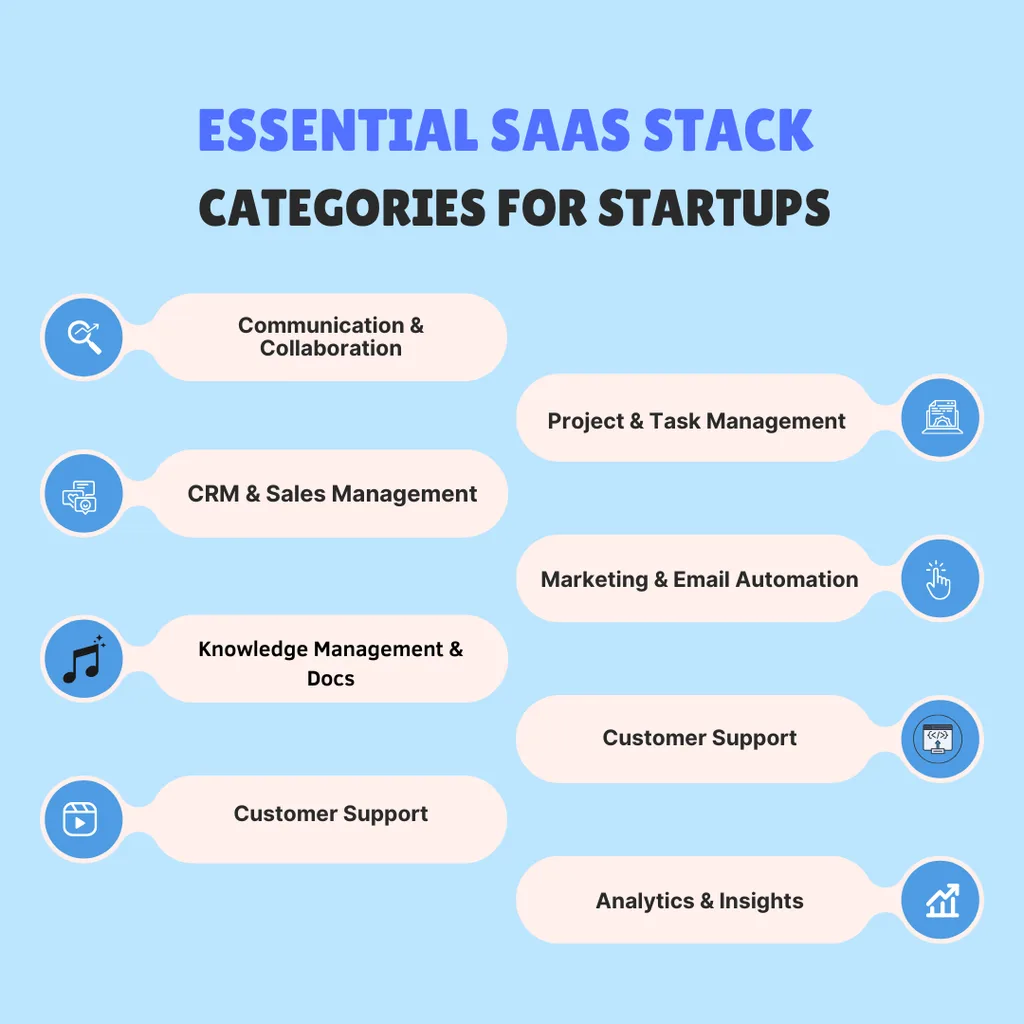
1. Communication & Collaboration
- Slack: Centralizes team communication through organized channels, direct messaging, and robust third-party app integrations.
2. Project & Task Management
- Asana / ProofHub: Empowers teams to map project timelines, assign deliverables, share files, and monitor accountability visually.
3. CRM & Sales Management
- HubSpot CRM: Offers intuitive pipeline management, lead scoring, and automated outreach to optimize conversion cycles.
4. Marketing & Email Automation
- Mailchimp / EngageBay: Streamlines targeted multi-channel email campaigns, subscriber segmentation, and customer journey automation.
5. Knowledge Management & Docs
- Google Workspace / Bit.ai: Facilitates real-time document co-authoring, secure cloud storage, and structured internal wikis.
6. Customer Support
- Zendesk: Centralizes customer queries through multi-channel ticketing systems, live chat widgets, and self-service help centers.
7. Analytics & Insights
- Google Analytics (GA4): Tracks user acquisition channels, behavioral metrics, and conversion paths to fine-tune digital growth strategies.
8. Finance, HR & Security
- QuickBooks Online & Gusto: Simplifies bookkeeping, automated payroll runs, and tax compliance, backed by 1Password for enterprise-grade credential security.
Comparison of Essential Startup SaaS Stack Options
| Category | Recommended Tool | Core Value Proposition | Best Suited For |
| Communication | Slack | Centralized messaging & app ecosystem | Remote & hybrid teams |
| Project Tracking | Asana | Visual task boards & milestone tracking | Cross-functional alignment |
| CRM / Sales | HubSpot | Pipeline tracking & contact management | Lead generation & conversion |
| Analytics | Google Analytics 4 | User behavior & traffic tracking | Data-driven marketing decisions |
| Accounting | QuickBooks Online | Expense tracking & tax compliance | Financial visibility & reporting |
How to Choose the Right SaaS Tools
To avoid tool bloat and subscription fatigue, founders should evaluate software through a disciplined framework:
- Prioritize Core Needs First: Secure foundational tools (communication, project management, CRM) before expanding into niche software.
- Leverage Free Tiers: Utilize freemium models or trial versions to test product-market fit and user adoption before committing budget.
- Verify Native Integrations: Ensure tools connect effortlessly via APIs to prevent data fragmentation.
- Audit for Feature Overlap: Regularly prune redundant applications to trim overhead expenses.

Conclusion: Future-Proofing Your Startup with the Right SaaS Strategy
Building a resilient company requires more than just a great product—it demands an agile, efficient operational engine. By strategically investing in the right mix of communication, project management, CRM, analytics, and financial SaaS tools, early-stage founders can eliminate administrative friction and redirect their energy toward sustainable growth.
Frequently Asked Questions (FAQ)
Q1: What are the most critical SaaS tools for early-stage startups?
A: The foundational layer includes communication platforms (Slack), project management software (Asana), CRM systems (HubSpot), analytics suites (Google Analytics), and accounting software (QuickBooks).
Q2: Why should startups prioritize SaaS over legacy on-premise software?
A: SaaS solutions eliminate heavy upfront infrastructure costs, require zero local maintenance, feature automatic security updates, and scale dynamically as headcount grows.
Q3: How many SaaS applications should a growing startup maintain?
A: Most early-stage teams operate efficiently with 6 to 10 core tools that cover essential domains without creating workflow friction or subscription redundancy.
Q4: Are free SaaS tiers viable for launching a new business?
A: Yes. Leading platforms like HubSpot CRM, Slack, Mailchimp, and Google Analytics offer robust free tiers that easily support early-stage operational requirements.
Q5: How can startups prevent SaaS subscription waste?
A: Conduct quarterly software audits to track user license utilization, eliminate duplicate features, and consolidate tools into multi-functional platforms wherever possible.
