


Education is a dynamic subject, it has always been changing according to the needs of the society. The education sector is today being overwhelmed by Artificial Intelligence (AI) that is providing personalized education through AI solutions that can be adapted to the unique learning style of each student. Whether it is through the Internet or in the classroom, AI is transforming how teachers deliver lessons and students study, and in the process, it has made education more interactive, efficient and tailored than ever.
What is AI in Education?
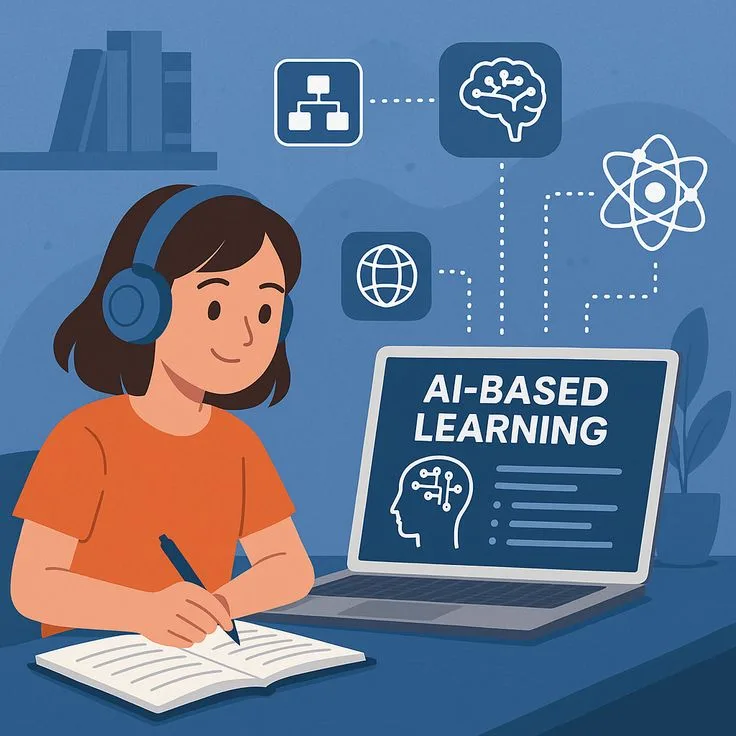
In the field of education, AI can be described as the application of machine learning models, data analytics, and intelligent systems in an attempt to improve the teaching and learning process. AI-based education, compared to the conventional educational methods, recognizes strengths, weaknesses, and learning preferences of each student and guarantees that they have a personalized learning experience. Think of being able to have your own tutor who reads your mind better than anyone could, this is what AI is trying to do on a larger scale.
Also Read:- AI in CRM: How Salesforce, HubSpot, and Others are Using AI
The Role of AI in Online Learning Platforms
The use of AI in online learning systems has transformed the experiences of students who receive knowledge. Through observation of activity and development, AI suggests content, changes the difficulty level, and even anticipates weaknesses on the part of students. Such platforms as Coursera, the Khan Academy or BYJU are taking the lead by using AI to give learners the most appropriate and interesting content.
Personalized Education with AI
Every student is different. There are those who understand things almost instantly and those who have to be practiced on. This is solved by personalized education through AI which involves tailoring lessons, quizzes, and courses according to the student. AI tracks the progress, detects the learning gaps, and recommends the resources on that basis. This will not leave behind any student and all will learn at their own pace.
Adaptive Learning Using AI
The wizard of the smart learning platforms is adaptive learning with the help of AI. Algorithms constantly evaluate performance and modify the curriculum on a real-time basis. In case a student is good in math but bad at grammar, the AI solution will suggest more grammar work and maintain the level of math challenges at a comfortable level, which will make the learning experience truly personalized.
AI Tools for Teachers and Students
Several hundreds of AI tools are currently at the disposal of teachers. Tutoring systems that can be powered by AI can guide students in real time and automated grading and feedback will save teachers hours that would otherwise be spent on manual grading. Intelligent chatbots, predictive analytics, and similar tools allow teachers to forecast learning bottlenecks, and intelligent chatbots respond to student questions in real-time. Even students can use interactive AI applications to practice, test and even career advice.
AI in Classroom Management
In addition to academics, AI is automating management. AI dashboards offer educators with useful data in terms of attendance tracking or lesson planning. Teachers are able to concentrate on teaching and not paperwork and the schools are able to maximize resource allocation. Consider a classroom in which AI can be used to track the progress of students and propose intervention before issues occur- efficiency and innovation cut across.
The Future of AI in Schools
The future of AI in schools is very promising. The AI integration will make the classroom more interactive, and learning will not be limited by the school hours. Smart systems will facilitate life-long learning to ensure that the students get skills that are applicable to fast evolving industries. AI will not be used to set teachers out of the job – it will undoubtedly strengthen them, offering instruments to become more creative and engaging.
Benefits of AI in Education
- Better Learning Results: AI can accommodate every student with higher understanding and memory.
- Greater Student Taking in: Gamified AI models make learning entertaining and inspiring.
- Data-Driven Decision Making: Schools can be able to make informed choices based on real-time analytics, to maximize curriculum and teaching approaches.
Challenges and Ethical Considerations
Although AI has a lot to offer, it has challenges:
- Data Protection: The data on students that is sensitive should be secured.
- Bias in AI: AI algorithms should be trained with a wide range of data so that they are not biased.
- Striking a Balance between Technology and Human Interaction: Human interaction will be critical in learning; AI would support, rather than substitute, teachers.
AI Is Transforming Indian Healthcare and Its Educational Implications
India is already having an AI Is Transforming Indian Healthcare. AI proves its ability to transform the world via predictive diagnostics to individualized treatment. This can be used as an example in educational institutions, where AI can be used to deliver data-driven and personalized experiences in learning. Accuracy, adaptation and personalization, the lessons I have acquired in health care, fit perfectly in classrooms.
Skyrocket Online Sales Through AI in Education
AI does not only make learning better, but it also enhances business. Skyrocket online sales in EdTech through AI to comprehend user behavior, suggest courses, and streamline subscription schemes. Different course suggestions and price recommendations will be highly engaging and appealing to students, as well as profitable to both students and platforms, which is why AI is a win-win solution.
Case Studies
- BYJU: AI is applied to personalized lessons plans and adaptive assessments.
- Khan Academy: It uses AI to suggest exercises and change the level of difficulty.
- Coursera: Uses predictive analytics to enhance the completion of courses.
These instances demonstrate the efficiency with which AI is changing the field of education and producing quantifiable results both to the students and the educators.
How Arunangshu Das Guides Us to This
Arunangshu Das has played a significant role in advising institutions of learning to embrace the power of AI.Das concentrates on practical adoption of AI in the classroom using work-shops, strategic information, and practical training. His strategy is the integration of technology and pedagogy whereby AI-based solutions among teachers and students are utilized in an effective manner to improve their engagement and learning processes.
Conclusion
AI in education is not only a fashion, it is a revolution. Individualized learning, adjustable systems, and smart devices are changing the nature of the classroom such that each student has an education that meets their unique needs. Though challenges may be present, the benefits are hard to ignore, namely, improved outcomes, engagement, and efficiency. Studying AI now is a way to prepare the students of tomorrow to become smarter and more connected.
1. How does AI personalize education for students?
AI learns the learning habits, performance, and preferences to develop a lesson plan that is unique to individual students.
2. Can AI replace teachers in the classroom?
No, AI does not replace teachers because it performs repetitive duties and offers insights, which gives the teacher the option to deal with engagement and creativity.
3. What are some examples of AI tools for education?
Smart tutoring systems, intelligent learning systems, digital grading programs, and AI chatbots.
4. Is AI safe for student data?
Yes, provided institutions follow strict data privacy protocols and use secure platforms.
5. How can schools start implementing AI?
Begin with pilot programs in the online platform, educate teachers on AI tools and slowly introduce AI to the curriculum.
