


Introduction: The New Operational Paradigm
Companies are entering a new phase when substituting human teams with AI is not only a technological breakthrough, but also a financial one. As the cost of labor increases, coordination issues arise and bottlenecks in productivity, businesses turn to agentic AI systems not due to its futuristic nature, but rather, because it is more economical. With the guidance of Google Cloud on Google Vertex AI agents and Google Gemini orchestration, this change is motivated by the evident cost-benefit results.
Human groups need wages, training, benefits, and levels of management. Instead, AI agents are based on low cost computers, standard logic, and 24/7 availability. This changes the point of reference since organizations view independent business operations as the most significant strength of the future.
In this article, the author is going to examine the economic framework of substituting teams with agents, the processes that the agents are going to destroy, as well as the structures that they will transform, and the ability of AI native companies functioning in the 10 years to come.
What Are AI Agents? (Google Cloud–Aligned Definition)
AI agents are also autonomous, goal-oriented systems that can perform a multi-step workflow without human input. According to Google, they are systems that have memory, orchestration, tool-calling, and workflow logic to accomplish tasks on their own.
In contrast to the traditional AI chatbots, which only respond to the queries, the workflow engines are AI agents in business. They schedule work, call APIs, get, and solve problems, and all that, having controlled subtasks as a digital employee.
To differentiate clearly:
LLM Chatbots
Such systems are answer engines. They react, help, and give information but are in need of constant human prompts.
Agentic Systems
These are AI workflow automation engines. They comprehend objectives, implement multi-plan actions, act with instruments and finish jobs independently. They do not wait on people, they behave like laborers.
Driven by the abilities outlined in Google AI Agents documentation such as memory, contextual reasoning, tool-calling and orchestrated workflows, agents become complete participants within an organization.
Why Businesses Are Moving Toward Agents Over Human Teams
Firms are moving to agents on economic, operations and strategic grounds. Human labor is expensive, intermittent and time-bound. Agents work based on usage computation and provide stable performance with any workload.
Enterprise AI agent platforms are adopted by organizations due to their desire:
- Lower operational expenses
- No overtime, no fatigue
- 24/7 availability
- Instant scalability
- Zero coordination overhead
- Regular decision making devoid of human error
There is increasing business need for predictable economics which explains why the global demand of AI driven workflow automation is increasing. Agents are able to scale the work immediately, minimize reliance upon hiring cycles, and avoid delays based on human bandwidth constraints.
The Economics Behind Replacing Teams
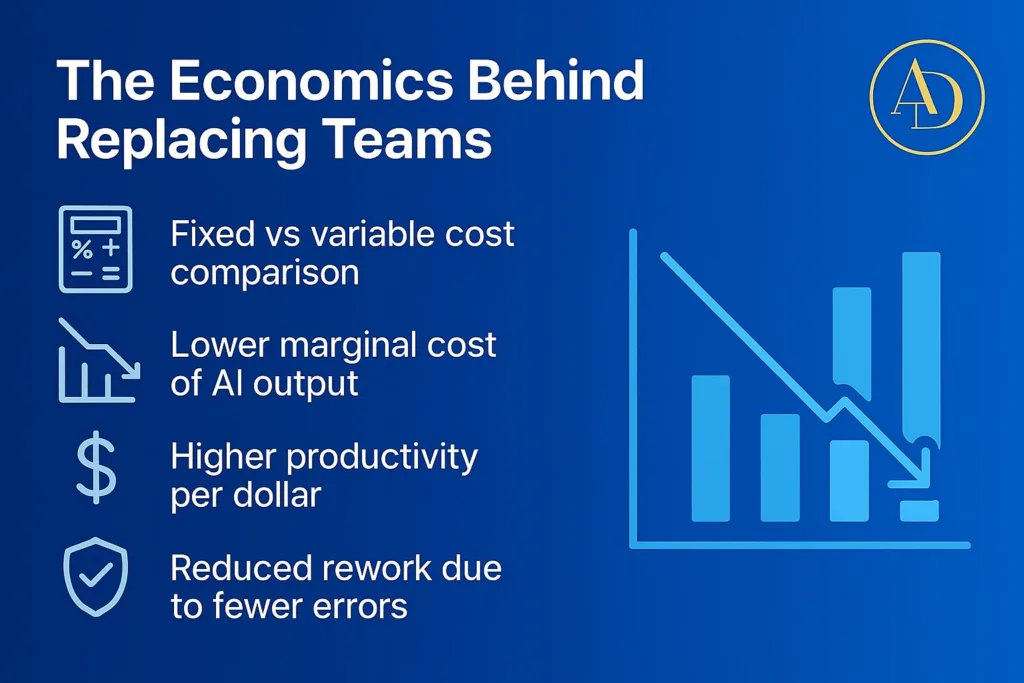
The change of human teams to agents is based on objective financial calculations. The following is a decomposition of this transformation economic model.
Fixed Costs vs Variable Costs
In the case of human teams, salaries, benefits, recruitment, onboarding, and training are fixed costs that can never be avoided. Businesses have to incur these costs even when the business is not performing very well.
AI agents flip the equation. Variable expenses are compute usage, API calls to Google Gemini orchestration, cloud hosting, and light oversight. You only pay when agents work. This is just the right fit of autonomous agents to workflow since companies are no longer required to make a full-time payroll commitment.
Human OPEX (operating expenses) are not affordable whereas AI agents rearrange the cost structures to usage-based CAPEX + variable compute.
Marginal Cost of Output
Human teams have a higher marginal cost of output since:
- Increased labor needs more manpower
- The larger the staff, the larger the management
- Overhead is high with more management
AI agents scale differently. New tasks only need incremental compute that gets cheaper with time as a result of optimizing cloud infrastructure. Consequently, marginal cost decreases with increase in the volume of work.
Productivity per Dollar
Human productivity has leveled off. Above eight hours, the quality is compromised. There is no fatigue, problem of context switching or cognitive overload among agents. They produce regular production, and the ratio of productivity to dollars is much improved.
In agent-first Economic models, the productivity is directly related to the computer it has- companies can purchase productivity in the same way that they purchase electricity.
Error Rates and Rework Costs
Cases of duplicated work, client dissatisfaction, and rework cost are caused by human errors.
Logic embodied within agentic AI systems gives the system consistency in decision-making. The reliability advantage, i.e. the ability of agents to follow deterministic paths, is also pointed out in the performance benchmarks of agent workflows provided by Google; it minimizes rework and eliminates the operational waste by an enormous margin.
The outcome is low cost, more accurate and predictable quality of operations.
The Team Structures That AI Agents Replace
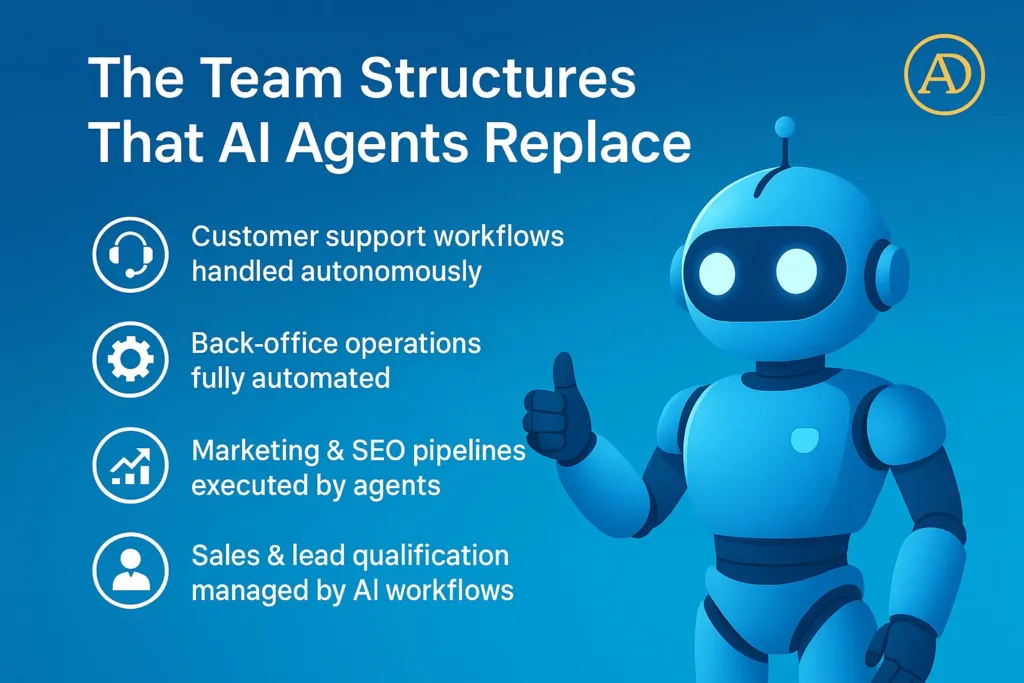
Companies already have interdepartmental agents. The following are the most frequently used team structures, which are currently being replaced by agents.
Customer Support Teams
AI agents are capable of handling the classification of tickets, answering the customers, updating CRMs, common cases, and transferring only the most unusual cases to humans. These support processes are suitable to independent business processes since they necessitate stability and quickness.
Operations & Back-Office Tasks
Back-office departments waste hours on allotment, allegation, reporting, consenting, and workflow harmonies. In the case of AI in back office automation, agents deal with:
- Daily reconciliation
- Timesheet processing
- Inventory updates
- Compliance checks
- Structured reporting
They will dissolve the labor intensive procedures that used to occupy more than one employee.
Marketing & SEO Teams
Orchestration-first agents are now doing AI-based pipelines of content, including research, clustering, writing, editing, scheduling, analytics. An SEO work which would have taken 5 persons can be done by one multi-agent system.
Tasks include:
- Keyword research
- Content planning
- Writing
- Internal linking
- Publishing
- Analytics reporting
This brings a new era of AI agents for business marketing operations.
Sales & Lead Qualification
AI agents prospect, score leads, follow-ups, CRM data and pipeline management. These processes would be well aligned to what agents are capable of achieving since they rely on repeatable processes.
The Agent-Based Company: A New Organizational Economic Model
Organizations are shifting towards agent-based structures and dropping the people-based structure.
The “Zero-Seat SaaS” Concept
Businesses will not pay on a per-user-license basis; instead, they will pay on a per-workflow basis by AI agents. This move minimizes the SaaS expenses but upsurges its automation area.
Agent Orchestrators as the New Managers
Companies make orchestrators, Agents, which control other agents using Google Gemini orchestration. They organize, remember, enforce workflow, and make sure that the flow of work is accurate.
This develops a digital hierarchy in which software runs software.
Human Roles That Survive
People are still needed in areas where they are expected to act as overseers, enforcers, originators, and strategists and judges. Human beings oversee autonomous business processes and train systems rather than doing repetitive tasks to manage edge cases.
Cost Modeling Framework for AI Agent Deployment
Organizations require a cost Economic modeling framework to address critical decisions, as it is required to compare the cost of human teams to agent-based working processes.
Inputs for Cost Modeling
Cost inputs include:
- Compute usage
- Calls to Google Gemini orchestration using API
- Use of memory and context windows
- Integration engineering
- Observation, railings, and documentation
These are costs that are quantifiable and foreseeable.
Outputs for ROI Calculation
Companies evaluate:
- Cost per task
- Tasks per hour
- Throughput improvements
- Workforce savings
- Time-to-value
These indicators can be used to determine the actual value of moving to enterprise AI agent platforms.
Sample ROI Formula
A simple ROI Economic model is:
ROI = (Total Human Team Cost -Total AI Agent Operating Cost)/Total AI Agent Operating Cost.
This will enable firms to estimate a savings at the yearly level and decide whether to expand agent systems or not.
Barriers to Full Replacement
Nevertheless, despite such enormous advantages, companies continue to struggle:
- Legacy system integrations
- Hallucination risks
- Precision issues in unstructured performance
- Compliance and security issues
- Human-in-the-loop requirements
These issues are related to Google Responsible AI and enterprise safety.
Case-Style Examples (Generalized)
Some economic examples that do not have brands are provided below to explain the difference in costs.
1. 10-Person Support Team → AI Workflow Agents
A 350k a year support team can be substituted with computer + engineering agents of 70k a year. Throughput is accelerated 3 times and compliance with SLA also leaps significantly.
2. 5-Person SEO/Content Team → Multi-Agent Pipeline
A group that is spending 220k per year is switched to an automated content-pipe that costs about 45k. Production of 40 articles monthly is boosted to a constant of 200.
3. 3-Person Back-Office Team → Automated Reporting Agents
A back-office team of 120k/year is replaced with agents of about 25k/year. The agents reconcile daily, generate compliance logs, and operational reporting without being fatigued.
Future Outlook: The AI-Native Company
AI native companies will become the next generation organizations. Their processes will begin by having agents, not humans, as the actual implementers of the processes.
These organizations will be dependent on:
- Memory-driven agents
- Organized multi-agent teams
- Scalable compute
- Real-time automation of workflow
- Human beings as executives, not workers
This future is not hypothetical and it is already happening as businesses are incorporating the agent architecture and cloud-native AI infrastructure offered by Google.
Conclusion
Artificial intelligence agents are changing the economic model of work. They help businesses to maximize operations and divert human creativity to strategic areas by decreasing the cost of human labor, removing inefficiencies in coordination and providing scalable workflows.
It is not to put human beings out of business, but to transform the way operation Economic models are developed in such a way that humans concentrate on strategy but agents execute at scale. Businesses that embrace the use of agentic AI systems, workflow automation using AI, workflow autonomous agents, and Google Vertex AI agents will run quicker, less costly and efficiently compared to the traditional organizations.
FAQs
1. How do AI agents differ from ChatGPT?
ChatGPT is an answer engine whereas agents perform workflows independently.
2. Which business teams can be replaced first?
Customer support, back-office, content teams and sales qualification.
3. Are AI agents expensive to run?
No, API calls and computer calculations are much less expensive than human wages.
4. Will humans still be needed?
Yes- strategy, oversight, and exception handling.
5. Is this shift happening already?
Yes, large organizations are re-organizing to AI-first structures.
