


Introduction: The Death of the “Seat” and the Rise of the Agent
SaaS businesses have flourished over the last two decades and they are based on the tools that assist humans to work faster. CRM systems, project management systems, or automation tools all these systems were assisting humans, but people did the job. In the present-day context, there is a colossal change in progress. The future of AI-based SaaS applications is no longer the assistive side of allowing people to perform tasks, but the letting autonomy of software perform tasks on their own.
The discontinuous change of the human operable software into Agent-as-a-Service (AaaS) is the termination of the seat-based model of pricing and the emergence of outcome-based automation. Companies are moving into a period where companies no longer buy software access; instead, they purchase work done with the help of AI agents to do business, AI workers and auto workflow services.
The paper examines the reasons behind the growing success of AaaS as the primary model, the approach in which AI task automation tools are transforming industries, and the actions founders must take to be ready to go to the new era of agent-first SaaS.
What Is Agent-as-a-Service (AaaS)?
They are Agent-as-a-Service providers, which launch digital workers that accomplish tasks one end-to-end, much further than can be achieved with current chatbots or intelligent assistants. These agents do not give advice or information; they are performers and they bring quantifiable results.
Evolution of the Model
The following table compares and contrasts the development of SaaS into AaaS:
| Stage | User Role | System Capability | Example Tools |
| SaaS | Human operates the tool | Software only helps, it does not help | CRMs, PM tools |
| AIaaS | Human builds workflows | Intelligence is offered by models | LLM APIs, AI models |
| AaaS | Human sets the goal | Agents perform duties independently | AI agent platforms |
Agency is the major distinguishing factor. Using autonomous software, a business can initiate workflows which write code, update databases, email, call APIs, and repeat until the task is done. This makes AaaS the new workflow automation with AI backbone to substitute manual digital operations.
The Economic Shift: From “Seats” to “Outcomes”
Pricing by seat would collapse in the case that AI agents become better than the human workers. When a single agent can work as much as 10 people then there is no need of paying 10 seats in the business.
This brings in outcome-based SaaS models, in which customers will only pay based on the actual work being done.
Examples of Outcome-Based Metrics
The way AaaS companies value it is as follows:
| Business Function | Outcome Metric | Example Output |
| Support | Ticket resolution | Closed cases |
| Sales | Meetings booked | Qualified appointments |
| Engineering | Code generated | PRs, bug fixes |
| Finance | Invoices processed | Reconciled statements |
Outcome-based pricing concentrates motivation and depicts the actual worth of AI automation examples This model will prevail because businesses will be more concerned with the efficiency and not the number of users.
Why AaaS Is Winning: The Value Proposition
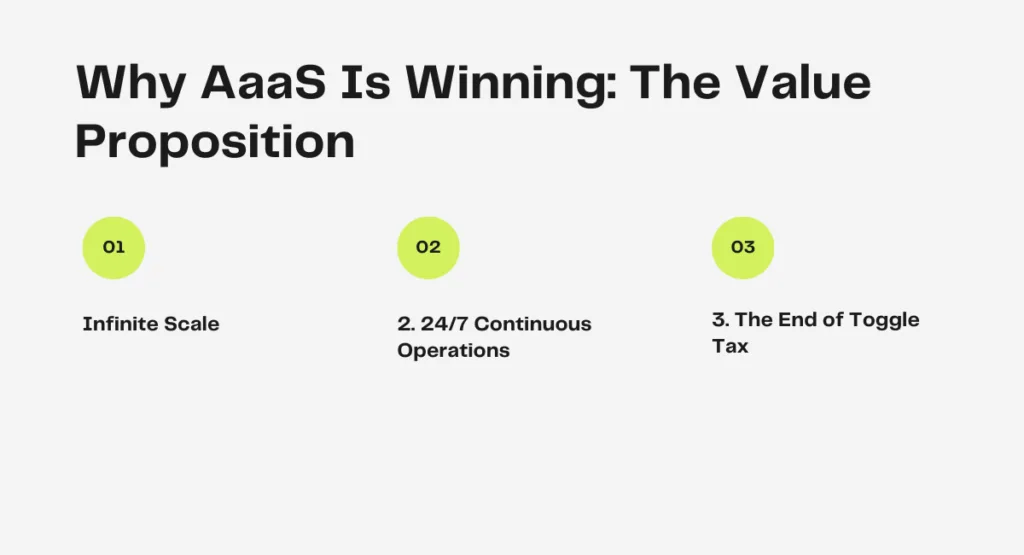
Infinite Scale
Work loads are increased or decreased in real time with scalable AI. They do not need onboarding, training or management like humans. Without restraints in their operations, businesses are able to implement millions of tasks at once.
24/7 Continuous Operations
The AI digital workers are 24/7, with regular precision. They do not create delays because of time zone, business schedule or exhaustion of employees.
The End of Toggle Tax
Man wastes hours in between switching applications. This is completely removed by agent-to-agent, frictionless layers of automation that increase the speed of output.
Real-World Use Cases: Who Is Using AI Agents?
The deployment of AI agents is being applied to all the key business functions and has developed a novel ecosystem of AI to business.
Sales & Marketing
The agents are doing independent research as SDRs, lead research, outreach, nurturing and meeting scheduling. They use recycled content, evaluate performance and do campaigns independently in the field of marketing.
Customer Support
This is where the gap between when to use AI agents instead of chatbots becomes clear.
- Chatbots reply.
- Agents resolve.
An AI support authenticates identity, issues refunds, records CRM, closes tickets, etc.–no human involvement.
Engineering & Coding
Social networks such as Devin give a clue of what can be achieved. Inspect repositories, debug bugs and keep codebases. Developers do not do everything, but oversee.
Operations & Back Office
Auto optimization punctuations become optimal targets of automation:
- Document classification
- Invoice processing
- Compliance tasks
- Data migration
- Contract validation
This makes operations a digital working 24/7 force.
Read more blogs : Top 15 SaaS Platforms to Automate Your Entire Workflow
The “Build vs. Buy” Decision in the AaaS Era
For SaaS Founders
The startup of the next generation will not construct copilots, it will construct Ai-First Departments that are operated by autonomous software. Founders are forced to move away with tool-building systems towards outcome-delivering systems. The next generation SaaS stack will be an AI agent stack for startups instead of a dashboard.
For Enterprises
Admission of AaaS necessitates fresh data, effectively integrated APIs, and elaborate workflow charting. Business organizations need to design sandbox systems to run in a safe environment prior to providing them with complete access to systems.
This necessitates businesses to redraw operations in a way that is no longer a human workflow but an agent workflow.
Challenges & Risks
AaaS is potent but it needs to be put in place in a responsible way.
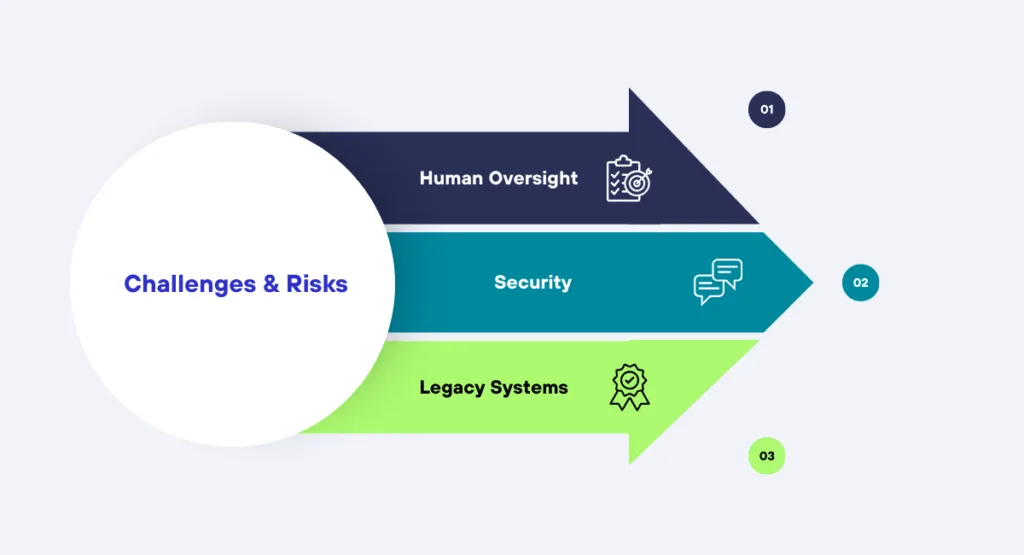
Human Oversight
Although there is autonomy, the environment has to be supervised, particularly when it is complicated or sensitive. The correct amount of human-in-the-loop monitoring needs to be determined by businesses.
Security
Providing agents with internal access exposes the risks to:
- Prompt injection
- Unauthorized actions
- Misinterpreted instructions
It is necessary to achieve secure API governance.
Legacy Systems
A large number of conventional systems do not have modern APIs. The complete autonomous workflow automation will be limited until infrastructure is updated.
Conclusion: The “Service-as-a-Software” Economy
We are even moving into a period where software will not help people- it does the work on its own. Enterprise transformation will come to a rise in the next decade as a result of the emergence of Agent-as-a-Service.
Agents will be employed in the future companies rather than more software seats.
The entities that embrace AI decision making autonomous systems, and outcome-based automation will spearhead the second digital transformation.
FAQs
1. How is Agent-as-a-Service different from typical AI chatbots?
Chatbots answer questions. AaaS agents perform end to end tasks, iterate steps and provide results.
2. Why is seat-based SaaS pricing becoming outdated?
AI also limits human users and consequently the seat-pricing is not in accordance with value.
3. What businesses benefit most from AaaS?
Businesses that have high numbers of support, financial, sales, and operation repetitive tasks experience immediate ROI.
4. What is needed to adopt AI agents successfully?
Pure data, current APIs, workflow transparency, and sand box testing.
5. Will agents replace employees?
Robots do not take away human beings, but monotonous work. Man changes to strategy, creativeness and control.
