


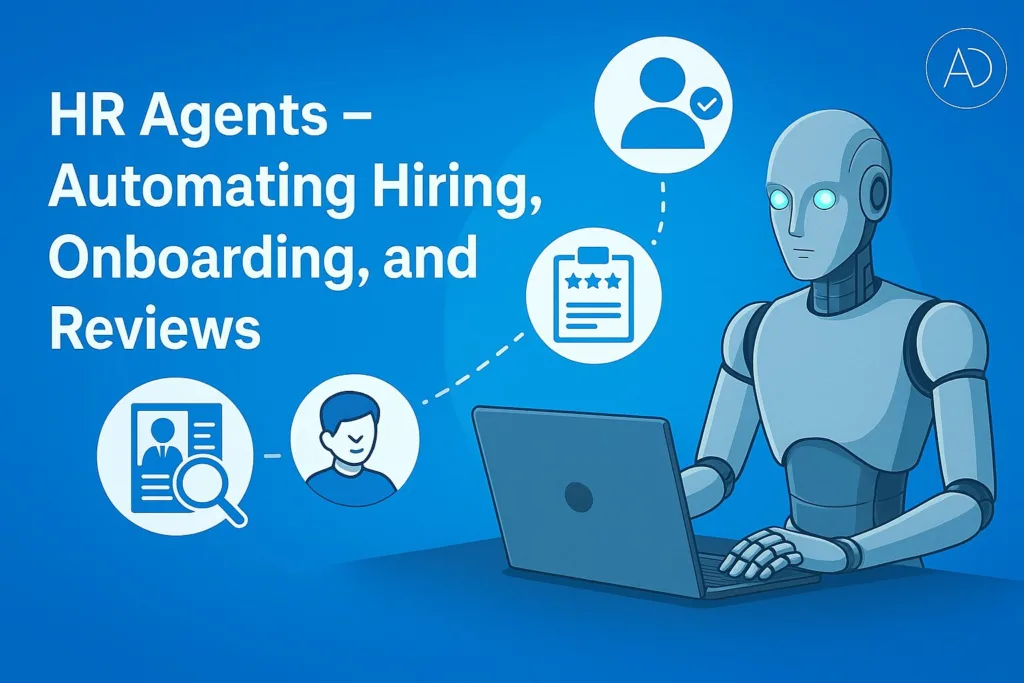
Introduction: Why HR Automation Now Matters
The biggest bottleneck that growing companies are currently dealing with is manual Human Resources processes which slow down productivity, increase cost of operations and frustrate employees with protracted waiting periods. The monotony of traditional HR is seen in sorting resumes, tracking down onboarding paperwork, or putting together performance review reports, all of which drag the whole organization down. It is in this area that the HR automation tools, in particular, the HR agents are coming in as a change agent.
HR agents are not some chatbots or mere assistants. They are independent workflow owners that operate on AI agent architecture, and which are meant to perform end-to-end tasks without the direct human control. They favor reasoning, planning, memory and execution hence are best suited to Human Resources digital transformation programs at scale.
Much of the current agentic transformation is informed by innovations that are featured in the documents of Google Cloud on autonomous agents and detailed integrations found in Gmail, drive, Calendar, Sheets, enterprise HR systems, among others. With these integrations, Human Resources agents can automate the whole employee journey, starting with hiring and onboarding and going on to performance reviews.
There are three spheres that HR agents can be most beneficial in as organizations are in the future of Human Resources automation: hiring, onboarding, and reviews.
What Are HR Agents? From Tools to Autonomous Workflows
The classic HR software is more of a dashboard: you press it, it works. However, the Human Resources agents work in a different manner. They are not reactive, but proactive workflow owners, which are able to reason about tasks, remember, adhere to rules and act within interrelated systems.
These agents have the capability of LLM-based Human Resources services that enable them to comprehend the policies, create documents, evaluate applicants fit, initiate workflows and constantly learn contextual preferences. This degree of autonomy can be achieved because of the latest AI agent architecture that allows them to decompose the tasks, access the information and perform stepwise workflows.
Integrations are also a source of their power. The HR agents are linked to ATS systems, HRMS data bases, internal APIs, Gmail, Drive, Calendar, Sheets, and authentication layers. This allows them to pull and push information in the organization without the intervention of human beings.
Consequently, HR departments use much less time micromanaging routine duties. Rather, they lead strategy and the agents make the Human Resources workflow automation process seamlessly and perfectly.
How HR Agents Transform Hiring
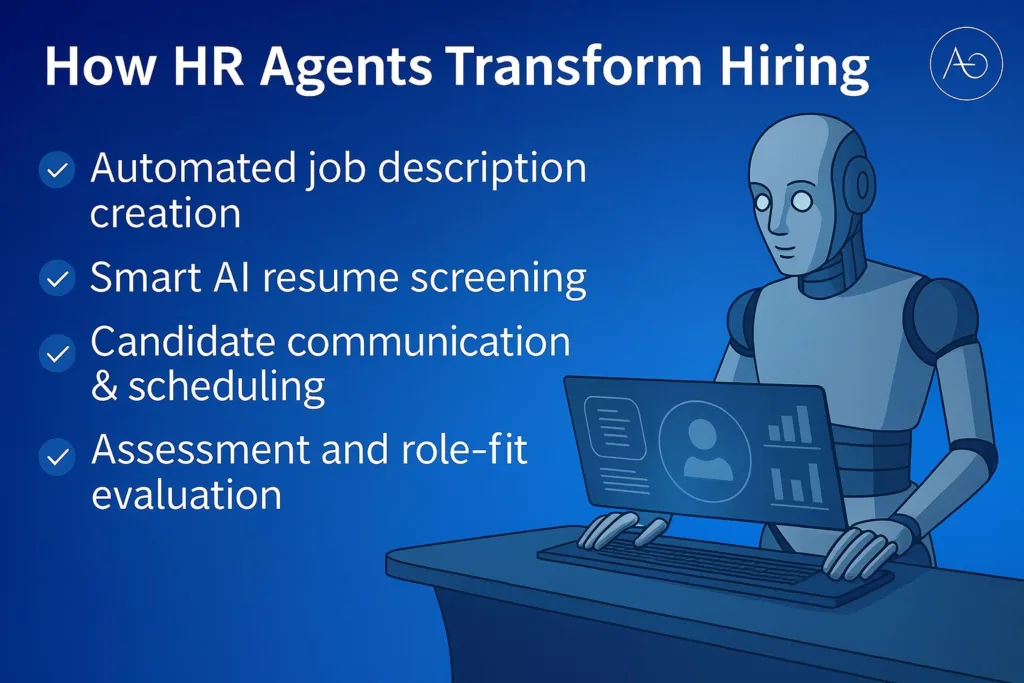
The most time consuming Human Resources activity is hiring and companies tend to lose the best employees because of incompetence in the hiring process. Automation of the funnel opens new horizons of HR operational efficiency as HR agents unlock new levels of efficiency.
Automated Job Description Creation
Templates, past role requirements, and skills taxonomies are used by Human Resources agents to construct structured job descriptions. These are prepared in the Google Docs or Google sheets and are uniform and equitable in relation to department requirements. The stored memory and current standards on the market help the agent to verify competencies, responsibilities, and KPIs.
Resume Screening & Shortlisting
This is where Human Resources agents shine. They undertake sophisticated AI resume scanning, parsing models, skill extraction patterns and ranking logic. With the ATS automation pipelines, the agent matches the candidates with the job requirements and will automatically forward the shortlisted profiles to the hiring manager.
Candidate Communication & Scheduling
Email communication is managed using the Gmail integrations, whereby the Human Resources agents confirm interest, share information, and arrange interviews. They are synchronized with Google Calendar to find out availability in teams, invite to meetings, and send reminders – decrease the level of no-shows.
Assessment & Role-Fit Evaluation
Agents are linked to evaluation platforms to rank submissions, measure matches in skills, and produce summaries. Such reports allow the hiring managers to make decisions quicker. Internal datasets are also another benefit of LLM-based HR agents as the agent can compare the candidate to past successful recruitments.
HR Agents for Onboarding: From Offer Letter to First Week
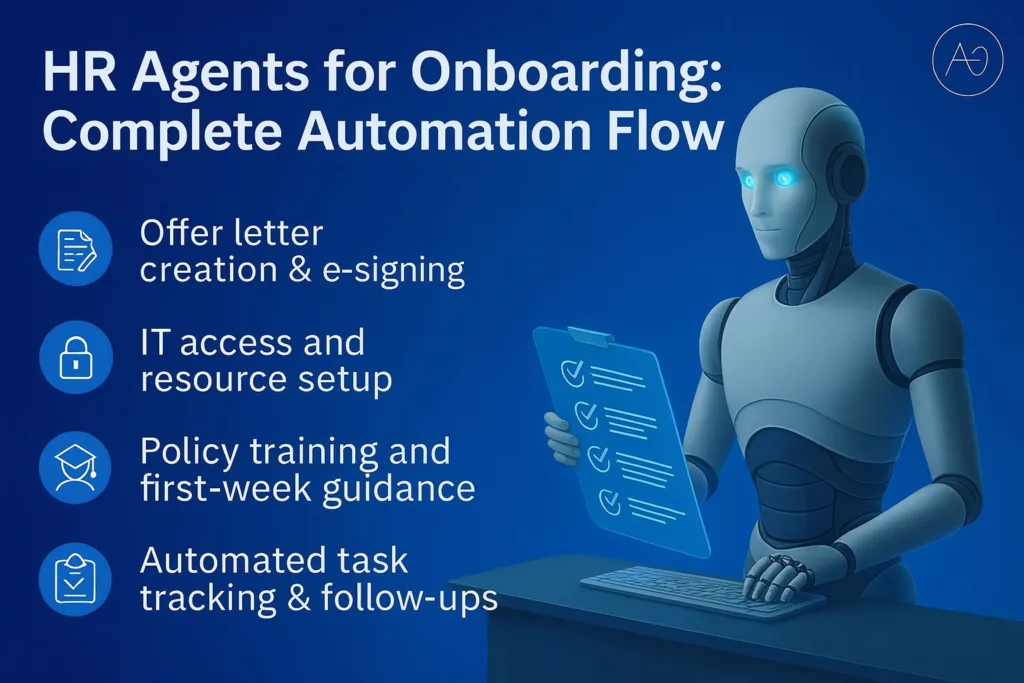
Onboarding may involve various departments and it may get out of control easily. Human Resources agents plan the workflow of the onboarding process to the end and make it less frictional and complaint-free.
Offer Letter Creation & E-Signing
HR agents create and send offer letters to the candidates and track the signature using integrated templates that enable automatic drafting and personalization of the offer letters. This is a narrow automation that enhances the conversion rates and enables a level of compliance.
IT Access Setup & Resource Allocation
HR agents inform IT teams, initiate account creation processes, allocate tools, grant accesses and update internal databases. With the help of the automation of the Human Resources processes, the agents can make sure that all new staff members receive the necessary resources on the first day.
Policy Training & First-Week Guidance
Onboarding is provided by agents who post and policy documents are uploaded to Drive, and information is provided to employees through a conversational interface. This will enable the agent to respond to questions immediately, and it will be an AI onboarding agent.
Task Tracking & Follow-Ups
The agent checks on the documents submitted, training completed, and tasks pending at all times. It alerts and amplifies delays where necessary- developing a coherent and uninterrupted onboarding experience.
HR Agents for Performance Reviews: Continuous & Data-Driven
The inability of most companies to handle performance reviews is based on the fact that the company does not have collected data and proper evaluation procedures. The whole cycle is automated and standardized by Human Resources agents.
Review Cycle Setup
Agents generate templates, alert the employees, open review cycles and handle deadlines. They make sure that they are in line with the organizational KPIs and that teams have version consistency.
Performance Data Collection
Agents are automatically collecting KPIs through integrations with such tools as Sheets, attendance systems, project platforms, and HRMS. This does away with manual data entry and enhances accuracy.
Feedback Summary & Reporting
Human Resources agents synthesize information, discern trends and summaries. This enables AI review assistants, which aid managers in making well-informed decisions, as well as resorting to less bias.
Follow-Up Action Tracking
Agents follow development plans, deadlines and progress after reviews. Nudges can be automated and are empowering to employees and lead to a decrease in Human Resources workload.
Real Benefits: Efficiency, Consistency, and Cost Reduction
Human Resources agents offer approximate enhancements in Human Resources functions. Organizations have shorter recruitment times, less operational strain, less manual mistakes, and greater satisfaction with employees. The existing research on automation and the resources provided by Google Workspace claim that automating HR workflows would considerably decrease the costs of the workflow without affecting the operational consistency.
With repetitive tasks being managed by agents, Human Resources teams will have time to work on culture-building, strategy, and organizational development, which are real indicators of AI native companies that are going to embrace the future of Human Resources automation.
HR Agent Architecture: How It Works Behind the Scenes
The real effectiveness of Human Resources agents is under the water.
LLM Reasoning and Decision Layers
Advanced AI agents work logic uses reasoning, interpretation of policies and contextual decision-making to execute tasks authentically by the agents.
Workflow Orchestration Engines
Sequences, approvals, multi-step processes, and API interactions are managed by systems such as Google Cloud Workflows. This guarantees scalability.
Integrations with ATS, HRMS, Gmail, Drive, Calendar, Sheets
Such systems serve as the data foundation. The APIs are used by agents to retrieve data, perform operations, and maintain statuses as well as interact with employees in real time.
Memory and State Tracking
Contextual data are stored in agents and thus they recall preferences, tasks in progress and past interactions.
Role-Based Access & Compliance Controls
Every action is subject to the requirements of compliance of an enterprise grade, which impose the standard of Human Resources AI compliance and AI data privacy regulations.
Implementation Guide: How Businesses Can Deploy Human Resources Agents
Implementation of Human Resources agents does not need such a huge change. A phased approach works best.
Start with One Workflow
The majority of firms start with the resume screening or scheduling of interviews. This produces quick wins and creates trust.
Connect HRMS + Google Workspace Data
This assimilation is necessary. It provides the agent with the setting that it requires in order to do things properly.
Set Guardrails, Approval Hierarchies, and Audit Trails
These safety measures enable human beings to be in control as the agent does the execution.
Test with a Small Internal Group
The first test serves to check whether workflows proceed correctly and edge cases are detected as early as possible.
Scale to Hiring + Onboarding + Reviews
The agent can then be extended throughout the lifecycle of the employees to become the backbone of Human Resources workflow automation once established.
Challenges & Ethical Considerations
Organizations need to be responsible towards Human Resources agents despite the enormous advantages.
Bias Detection and Fairness
The models should be followed to avoid the discriminatory results of the screening or assessments.
Data Privacy and Secure Handling of Human Resources Data
There should be tight privacy measures to sensitive employee data to ensure trust.
Compliance with Labor Laws
In order to avoid legal problems, workflows have to correspond to the regional labor law requirements.
Transparent Workflows and Audit Logs
Audit trails make the executives accountable, particularly in automating decisions.
Conclusion: Human Resources Agents as the New Foundation of People Operations
One of the significant changes in the management of people operations in organizations is the Human Resources agents. Through automating their hiring, onboarding and performance reviews, organizations get faster processes, more accurate and a smoother experience with the employees. In a world where HR automation is embraced by organizations, HR processes automation is adopted, and AI native companies become a trend, HR agents will turn into the building block of the contemporary HR infrastructure, i.e., by generating consistency, cost reduction, and defining the future of HR automation.
FAQs
1. What exactly do HR agents automate?
They automate the process of hiring staff and onboarding, preparing documents, scheduling, performance reviewing, and cross-team communications.
2. Are HR agents safe to use for sensitive data?
Yes, when roles are assigned properly, data are encrypted, and AI data privacy protection is ensured, then the HR agents are very secretive.
3. Will HR agents replace HR teams?
No, They complement the HR teams by managing monotonous activities to enable human beings to concentrate on strategy, culture and employee development.
4. How soon can companies deploy HR agents?
The companies begin within a few weeks by automating a single workflow after which they continue to scale to complete automation.
5. Do HR agents help reduce bias?
Yes, with fairness procedures, surveillance and open audits.
