


Introduction: Why Operations Agents Matter Now
The modern Ops team is engaged in a struggle on many fronts, including maintaining infrastructure, managing deployments, responding to incidents, monitoring performance; and orchestrating cross system workflows. The workload becomes immense as there is an increasing rate in the distributed systems. The result? Increased response times, increased cost of operation and never ending race to maintain a healthy system.
This is where AI-based Operations Agent come in and the concept of efficiency is redefined. These intelligent modules perform operations, identify anomalies, handle incidents, and provide remedial action – without human intervention.
This change has been confirmed even in large-scale cloud providers such as Google. Google Cloud agent orchestration, as well as the Google Cloud Operations Suite, can show how agentic automation has become a new norm in the industry.
Operations Agent are replacing the role of conventional DevOps and IT teams by hampering down noise of tickets to make autonomous IT operations possible.
What Are Operations Agents?
Operations Agents are independent AI-based agent, which perform operational functions within distributed systems. As opposed to simple scripts or cron jobs, they are policy and intent-driven, trigger-driven, and API-driven, capable of complex adaptive behavior.
They do not simply respond to queries, as is the case with classic chat assistants. Instead, they take actual steps in the form of restarting services, scaling servers, inspecting logs, fixing incidents, and organizing cross-system processes.
Google Cloud documentation documents how automation of multi-system can be orchestrated by workflows and event triggers. This is precisely in line with the operations of the Agent of Operations in contemporary IT ecosystems.
Such agent are a move to an Agentic AI system which is a decision-making system that evolves, performs work, and enhances operational stability.
Traditional DevOps vs. AI-Driven Autonomous Ops
| Feature | Traditional DevOps / SRE | AI-Powered Operations Agents |
| Response Time | Minutes to Hours (Human-dependent) | Seconds (Instant detection & action) |
| Workflow Logic | Static, linear “If-Then” scripts | Adaptive, non-linear reasoning |
| Monitoring | Reactive alerts (Passive) | Proactive anomaly detection (Active) |
| Incident Handling | Manual triage and remediation | Autonomous self-healing protocols |
| Scalability | Limited by team size and burnout | Elastic; handles thousands of nodes |
Core Capabilities of Operations Agents
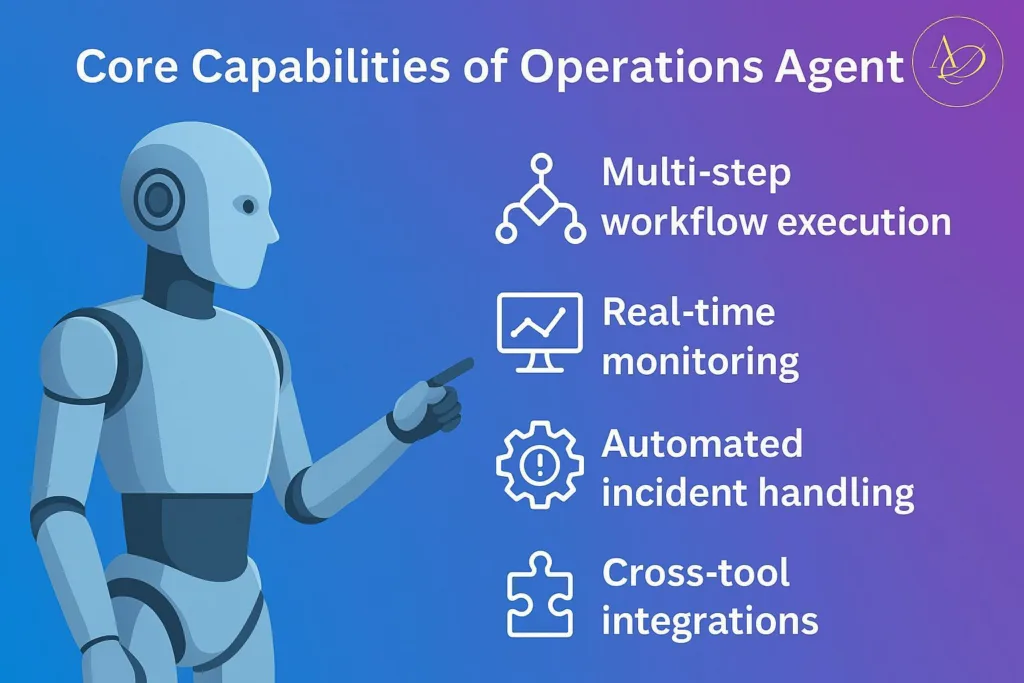
Multi-Step Workflow Execution
Operations Agents do not merely automate the individual tasks but complete, multi-step workflows. This puts them way in advance of the traditional workflow automation tools, which generally work with the static or linear processes only.
For example, an agent could:
- Provision a new server
- Configure network rules
- Test system integrity
- Deploy services
- Document the activity in surveillance systems.
This forms end-to-end automation which would have otherwise involved several engineers or DevOps experts.
Real-Time System Monitoring
Logs, metrics, health checks and performance indicators are monitored by agents at all times. They take advantage of similar capabilities as Google Cloud Operations Suite, such as log-based metrics and alerting.
This real time insight supports:
- Operations anomaly detection
- Early incident prevention
- Performance stability
Agents of Operations in essence act as an autonomous APM (Application Performance Monitoring) system, with added-context and quicker responses.
Automated Incident Handling
Instead of waiting for humans to diagnose a problem, Operations Agents instantly:
- Create tickets
- Correlate root causes
- Run triage workflows
- Apply remediation steps
This is the future of automated incident response and significantly smaller Mean Time To Repair (MTTR).
Cross-Tool Integration
Operations Agents integrate easily with: because they are APIs-powered and event-driven.
- Cloud infrastructure
- CI/CD pipelines
- CRMs
- Databases
- Internal IT systems
This renders them powerful DevOps automation, which connects the gap among various platforms.
How Operations Agents Work
Policy and Workflow Definitions
It all begins with concisely-defined workflows, triggers, intents, and policies. Similar to Google Cloud Workflow Orchestration, an operations agent adheres to a defined logic according to which actions are supposed to take place and at what time.
Sensors and Observability Inputs
The data collected by agents is logged, metric, uptime, and alert feed. It is this continuous observability that allows them to know the real-time status of the system.
Improved observability means improved decision-making -making tools such as Google Cloud Monitoring are a savior.
Decision-Making Layer
The smartness of the Operations Agents is based on a hybrid model that is the combination of:
- Conceptual reasoning based on contextual comprehension (LLM)
- The deterministic safety is evaluated through rule-based evaluation
This provides intelligent, secure, and dependable automation.
Action Execution Layer
When a decision has been formed actions are implemented through:
- API calls
- System commands
- Workflow automation sequences
This forms a consistent base of event-based automation of clouds and on-prem systems.
Key Use Cases of Operations Agents
Infrastructure Automation
Agents manage provisioning of servers, service restarts, auto-scaling and scheduling of maintenance. They minimize physical labor and make infrastructure healthy.
Application Monitoring
The Operations Agents observe:
- Latency
- Uptime
- Error rates
- Throughput
They are similar to next-generation application performance monitoring systems.
Security & Compliance Automation
Operations Agents are constantly monitoring:
- Access anomalies
- Policy violations
- Vulnerability gaps
They guard compliance frameworks, as well as, autogatable guardrails.
Data Pipeline Reliability
In the modern data-driven business the agents observe:
- ETL failures
- Queue backlogs
- Processing errors
- Data freshness issues
This enhances the reliability of the data and aids analytics processes.
Key Benefits of Operations Agents
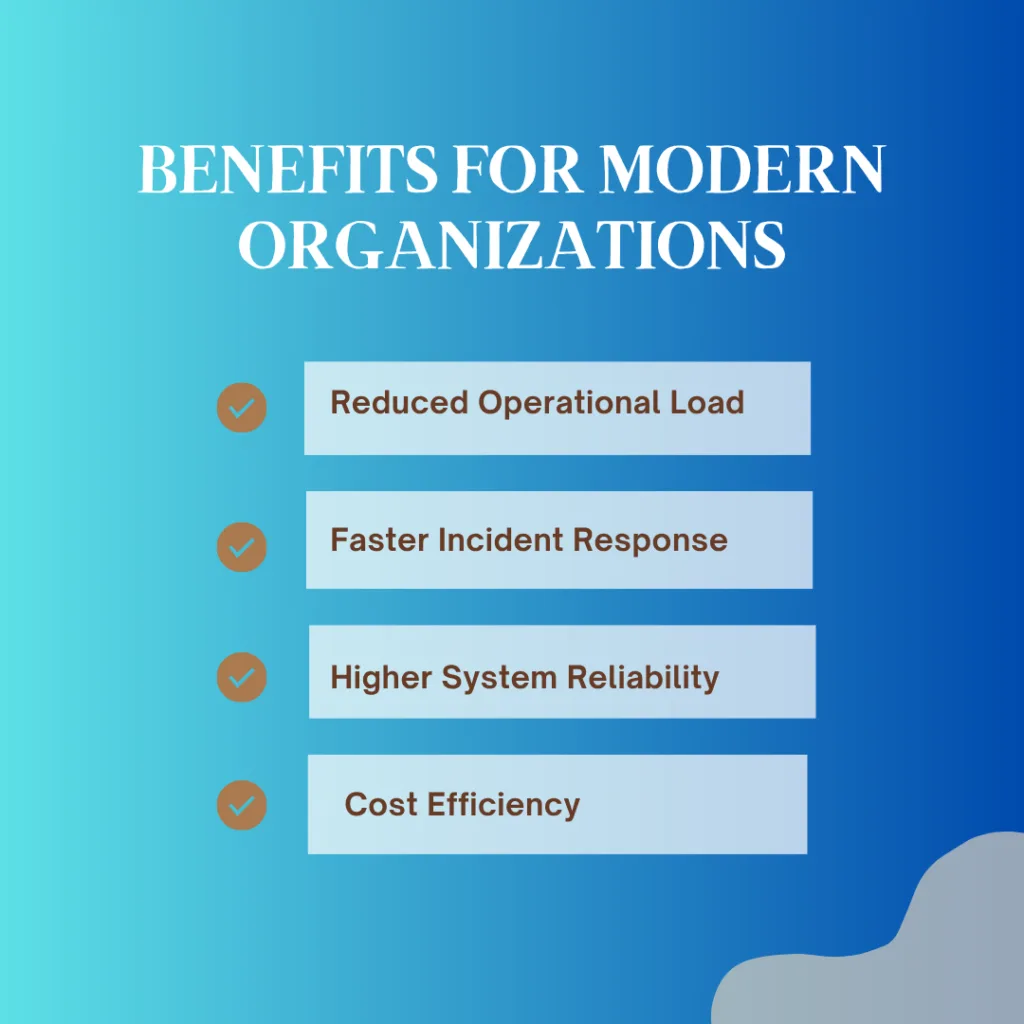
Reduced Operational Load
Teams no longer waste time on repetitive tasks. Ops agents become your Digital workers AI taking over routine processes so your team can focus on innovation.
Faster Incident Response (Improved MTTR)
The agents are 24/7 and act instantly so that the incident is solved before it spirals out to a significant outage.
Higher System Reliability
Proactive monitoring and autonomous actions enable the uptime of the system to go up and enhance user experience and business continuity.
Cost Efficiency
The reduced number of manual work, outages, and predictable operations also lowers the total cost of operations.
Challenges and Limitations
Incorrect Actions Due to Poor Policy Logic
When workflows are not defined correctly, there is a possibility of agents taking wrong actions. There must be clear reasoning, regulated triggers, and protection.
Dependency on Observability Quality
Agents are very dependent on proper logs and metrics. Substandard instrumentation results in blind spots and latitude.
Data Security Concerns
Guardrails based on IAM, least-privilege access, and audit logs are paramount. Care should be taken to have service accounts set in such a way that they do not allow unauthorized behavior.
The Future of Operations Automation
The future is moving toward predictive and self-healing systems. With advances in AI agent tools Operations Agents will soon:
- Predict failures before they happen
- Self-tune infrastructure
- Coordinate multi-agent systems
- Manage entire IT environments autonomously
Cloud platforms such as Google Cloud are further driving breakthroughs in agentic automation in getting us nearer to a fully autonomous world of operations.
Conclusion
The role of the Operations Agents is redefining the manner in which contemporary infrastructure, applications and systems are operated. They offer uninterrupted surveillance, smart automation, quick reaction to incidences, and forecasts. They can be used to assist a company to scale much faster, run more securely, and significantly decrease the overhead costs of operations by integrating workflow automation, observability, and AI-driven decision-making.
Days of manual working are over. The days of smart, autonomous and interactive operations agents of AI are upon us.
Frequently Asked Questions (FAQs)
1. What exactly is an “Operations Agent” in a cloud environment?
An Operations Agent is a specialized AI module designed to monitor and manage system health. Unlike a simple monitoring tool, it can “think” and “act”—meaning if a server fails, the agent doesn’t just send an email; it restarts the service, clears the cache, and logs the incident automatically.
2. How do these agents integrate with existing tools like Google Cloud?
These agents leverage APIs and event triggers. They connect directly into suites like the Google Cloud Operations Suite, pulling real-time data from logs and metrics to make informed decisions and execute workflows through Google Cloud’s orchestration layer.
3. Will AI Operations Agents replace DevOps engineers?
No. They replace the “toil”—the repetitive, boring tasks like manual log checking and basic troubleshooting. This allows DevOps engineers to focus on higher-level architecture, security strategy, and innovation, effectively acting as “managers” of these AI digital workers.
4. What is MTTR and how do agents improve it?
MTTR stands for Mean Time To Repair. Traditionally, this involves a human seeing an alert, investigating it, and fixing it. An Operations Agent reduces MTTR by performing the investigation and the fix in real-time, often resolving the issue before a human would have even opened the alert email.
5. Are there risks to giving AI agents control over my infrastructure?
The primary risk is “hallucination” or incorrect policy logic. This is why we implement guardrails:
Least-Privilege IAM: Giving the agent only the specific permissions it needs.
Sandbox Testing: Testing the agent’s logic in a non-production environment first.
Human-in-the-loop: Requiring human approval for high-risk actions (like deleting a database).
