


Introduction: The Generative Awakening
ChatGPT transformed the world in a very short time. But all of a sudden, millions of individuals got to know how it felt to have quick thinking on their fingertips: refined emails, research summaries, business thoughts, even debug assistance. The emergence of this world increased productivity marked a new digital age what some people refer to as the generative awakening.
It marked the initial encounter between the general audience and generative AI and it was the magic to many. However, as people started to utilize it on a deeper level, they realized there was a limitation to it: however intelligent it may be, it still required instructions.
The Limitation of LLMs
However strong, LLMs are reactive. They are required to have new cues in each step. ChatGPT can compose an email, and it will not automatically send you. ChatGPT will not be able to update your CRM, schedule a meeting, or enrich your prospects. We are all trapped in the manual copy paste economy where we dictate and we execute the tasks manually.
This is what the generative AI hype hit its limit.
Agentic AI Is the Real Leap
The next stage of evolution is Agentic AI systems – self-correcting, self-governing, action taking software beings that do not simply provide answers to questions; they accomplish tasks.
While ChatGPT talks, AI agents work.
They are capable of multi-step workflows, application integration, automatic triggering, attempt retries and continuous operation. This is the real transition to productivity-assistants into the form of autonomous AI systems.
This is the automation jump that all founders, business, and enterprises have been expecting.
Generative AI vs Autonomous Agents: The Core Difference
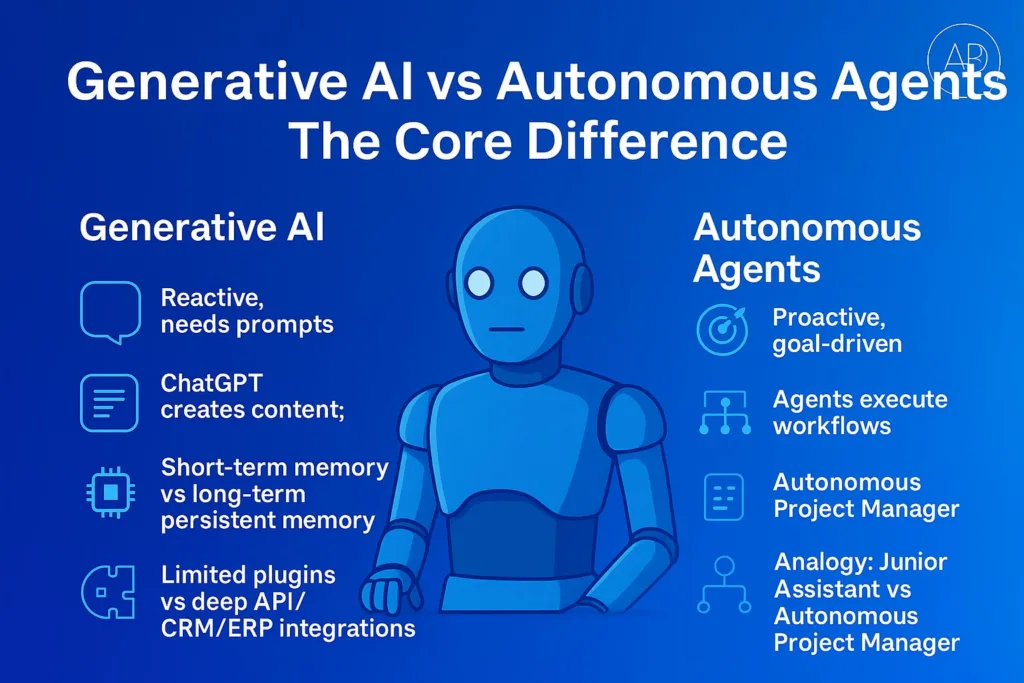
Appreciating this change is impossible without a clear contrast of ChatGPT-like systems (generative) and autonomous agents (agentic). This is the difference that anyone who is developing towards the future of automation must take into account.
What Traditional Generative AI (ChatGPT / LLMs) Does
ChatGPT is an example of a generative AI model that is conversation-based. It excels at:
- Content creation
- Summaries
- Brainstorming
- Natural language reasoning
However, its workflow stops with text or structured responses. It is incapable of discharging end-to-end tasks unless directed manually.
What Autonomous AI Agents Do Differently
AI agents execute tasks without continuous supervision.
They can:
- Plan multi-step workflows
- Integrate with API, CRM, ERP, tools
- Instantly activate workflows
- Use long-term memory
- Modify behavior when things go wrong
This is the AI agent orchestration, the possibility to execute processes in the continuum and autonomously
Simple Analogy to Explain the Shift
Consider generative AI a smart junior assistant.
You ask → it answers.
But agentic AI will be similar to an independent project manager.
You provide it with an objective → it devises the workings out → it carries out all of it then reports back to you.
One-Line Difference Between ChatGPT and AI Agents
ChatGPT answers questions; AI Agents achieve objectives.
This is the fundamental change of generative AI vs agentic AI.
Core Architecture: How AI Agents Work
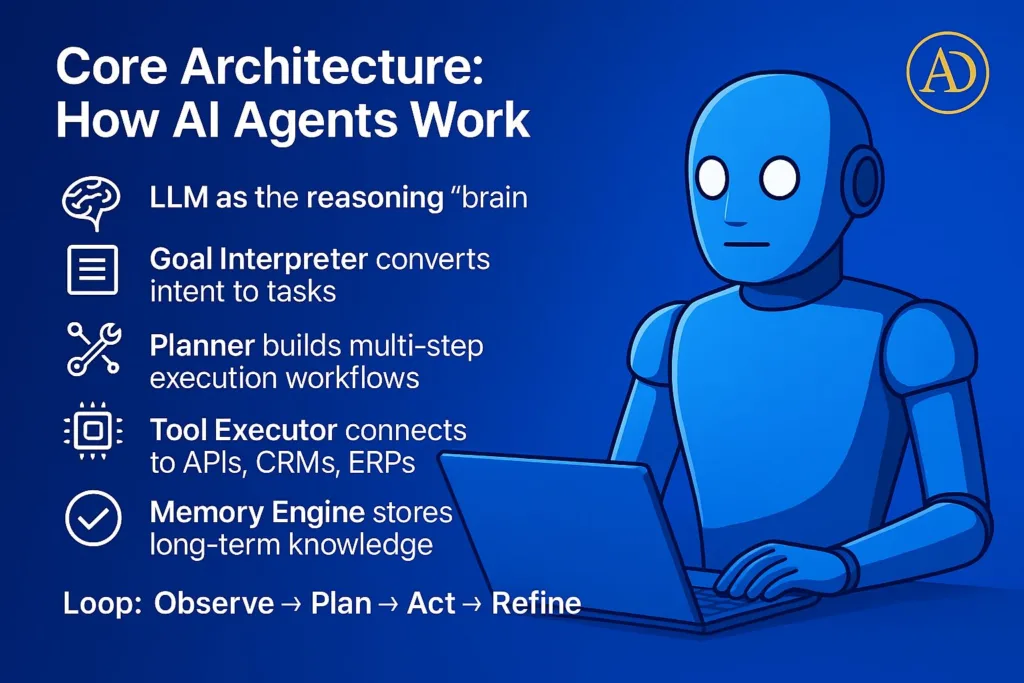
LLM as the Brain
Any autonomous AI system continues to use an LLM. It is an engine of reasoning which:
- Understands instructions
- Breaks tasks down
- Makes decisions
- Interprets results
That is why agentic systems are sometimes called the LLM-based agents – the brain is still the LLM, and the rest is action and autonomy.
Essential Components of a Modern Agent
The current AI agent architecture includes a number of components that collaborate with each other.
Goal Interpreter
The agent deciphers imprecise human instructions:
Identify qualified leads and send follow-ups.
It transforms this into machine-friendly tasks.
Planner
The planner develops an action chain.
Search → Filter → Draft →Send → Update CRM > Schedule reminders.
Tool Executor
This is the action layer.
Agents connect with:
- APIs
- CRMs
- ERPs
- Databases
- Email systems
- Cloud tools
This is where the chatbots vs AI agents come out. Chatbots reply; agents act.
Memory Engine
Agents have: unlike the short-term memory of ChatGPT,
- Persistent memory
- Historical logs
- Task outcomes
- Client preferences
The consistency between days, weeks, months is made possible by this memory.
Evaluator/Refiner
Agents monitor their output:
Is the task correct? Should I try again? Any adjustments required on parameters?
This self-check layer is essential in the reliable operation in self-generated surroundings.
The Autonomous Loop: Observe → Plan → Act → Refine
This is the beat of Agentic AI systems.
- Observe – take input or scan the environment
- Plan – derive steps with the use of LLM reason
- Act – execute via tools
- Refine – correct errors, re-try, or refine
That is the way how the Autonomous AI systems work.
The True Automation Leap: End-to-End Workflow
Beyond RPA: Adaptive Automation
Modern RPA (Robotic Process Automation) has fixed scripts. When anything is modified, layout, data type, API RPA collapses.
AI agents learn, conceive, rationalize and change in real time.
This makes them powerful for:
- unstructured workflows
- dynamic environments
- real-time problem-solving
This means AI workflow automation.
Automated Triggers & AI Agent Orchestration
Agents do not wait until people give them instructions.
They respond to:
- webhooks
- scheduled triggers
- system events
- incoming data
This automation of AI agents enables hands-off automation at team levels.
Self-Correction and Reliability
When something fails, agents:
- retry
- re-plan
- request additional data
- choose alternative methods
This enables them to be exponentially more dependable than scripted systems.
Real Business Use Cases: AI Agents Examples
This is where theory collides with practice- how AI agents examples are being applied by businesses.
Sales & Marketing Agents
An agent can autonomously:
- qualify leads
- enrich CRM data
- draft outreach
- personalize messages
- schedule follow-ups
This changes the way AI automation of small business and startups receives growth.
Finance & Compliance Agents
An AI agent can:
- read invoices
- match purchase orders to them
- flag discrepancies
- update ERP systems
- produce reconciliation reports
This is hundreds of man hours saved
Customer Service Autoresolution Agents
Agentic systems:
- monitor logs
- identify recurring issues
- trigger refunds or updates
- notify customers
- escalate only complex cases
This forms proactive customer service and not a reactive support
IT & DevOps Incident Response Agents
An agent can:
- detect errors
- diagnose root causes
- generate a fix
- test in staging
- notify engineering
This ensures that downtime is minimized.
Table: AI Agents Use Cases and Impact
| Industry | Agent Task | Outcome |
| Sales & Marketing | Lead qualification + CRM automation | Increased conversion + accelerated outreach |
| Finance | Invoice matching + ERP updates | Reduced manual errors |
| Customer support | Auto-resolution workflows | Faster response times |
| IT/DevOps | Monitoring of incidents automatically | Lower downtime |
| Startups | Multi-tool automation | Scaling without hiring |
These applications explain why companies around the globe are abandoning chatbots in favor of AI task automation applications driven by agentic systems.
Technical Architecture: The Agent Stack
Technology Enablers (LLMs, Function Calling, Frameworks)
Agentic systems rely on:
- highly powerful LLMs (GPT-4 series, Gemini)
- advanced function calling
- such frameworks as LangChain, CrewAI
These are capable of integrating well into the real world.
The Full Stack of an Agentic AI System
The full AI agent system entails:
- LLM
- Vector database (memory)
- Tool integration layer
- Event triggers
- Logs + observability
- Execution engine
This system makes dumb reasoning engines into complete autonomous beings.
Multi-Agent Collaboration Explained
Several special agents may work together:
- Research agent
- Writer agent
- Reviewer agent
- Executor agent
They discuss, assign work and organize teamwork on their own. This can be referred to as AI agent taxonomy– the classification of functions among several agents.
Challenges and the Path Forward
Governance & Security Requirements
As agents have full access to real systems (read-write), they need:
- RBAC
- audit trails
- permissions control
- identity management
In the absence of this, scaling to large scale is not safe.
Trust, Explainability & Debugging
Agents must provide:
- transparent logs
- traceable decisions
- interpretable reasoning
This will foster confidence particularly in business contexts.
New Human Role in Autonomous AI Systems
Man becomes not a task doer but:
- supervisors
- strategists
- reviewers
- exception handlers
Humans now lead workflows as opposed to implementing them.
Conclusion: The Age of the Autonomous Enterprise
We have left behind us the world where AI assists us in thinking to the one where AI assists us in doing. The next significant technological development is the transition of the conversational intelligence of ChatGPT to the autonomy and action orientation of AI agents.
Where generative AI was more productive, agentic AI is going to re-architect whole companies.
Companies that implement Autonomous AI systems today will be able to surpass the competition by several folds. The future is of those who use agents to streamline work processes, workforce reduction, and scale.
We are now entering the era of independent business.
FAQs
1. What is the biggest difference in generative AI vs agentic AI?
Generative AI provides responses to questions. The agentic AI is goal-oriented, and it is accomplished by independent action and multi-actions.
2. How do AI agents work in real businesses?
Agents combine with tools, CRM, ERP, APIs, and automate the end-to-end processes without regular oversight.
3. Are chatbots similar to AI agents?
No. Chatbots do not answer. Agents are task performers, decision-makers and self-governing.
4. Can small businesses use agentic AI?
Absolutely, One of the most rapidly developing use cases is AI automation of small businesses since the agents lower the number of required employees.
5. What industries benefit the most?
The greatest impact is derived on sales, marketing, finance, support, IT, and startups using AI task automation tools.
