


Deep Learning Regression:
Regression is one of the most important ML concepts on which DL relies while solving problems that demand output in continuous values. Unlike other models of learning that aim at making classifications of certain labels, Regression is centered on numerical values. This article offers an understanding of Regression in deep learning, some of the most common uses of the algorithm, and various important approaches that can assist you in harnessing the power of the algorithm successfully.
Read more blog : Top 5 Essential Tools for Deep Learning Beginners
Top 5 Essential Deep Learning Tools You Might Not Know
What does Regression mean in Deep Learning?
1. Capturing Complex Dependencies
In a traditional model, you might predict house prices based solely on “Square Footage.” In Deep Learning, the model can ingest hundreds of features—location coordinates, local economic indices, historical price trends, and even image data from the property—simultaneously.
The “Deep” part of the network uses Activation Functions (like ReLU or Sigmoid) to twist and bend the mathematical space, allowing the model to learn dependencies that aren’t obvious to the human eye.
2. The Mechanics of the “Continuous Target”
Unlike classification, where the output is a discrete “Class A” or “Class B,” the output layer in a regression neural network usually has one single node with a linear activation function. This allows the network to output any real number—from $0.001$ to $1,000,000$—without forcing it into a predefined category.
3. The Role of the Objective Function (Loss)
The “brain” of the regression model learns by making mistakes and correcting them. This correction is guided by the Loss Function:
- Mean Squared Error (MSE): $MSE = \frac{1}{n} \sum (y_{actual} – y_{pred})^2$. This is the gold standard for regression. Because it squares the error, it punishes large mistakes very heavily, forcing the model to be extremely precise.
- Mean Absolute Error (MAE): $MAE = \frac{1}{n} \sum |y_{actual} – y_{pred}|$. This is used when your data has “outliers” (random, extreme values). It is more forgiving of large gaps than MSE.
4. Why it Matters for Practical Use
Because deep neural networks can encode non-linear patterns, they are beneficial for:
- Human Behavior: Predicting the “Lifetime Value” (LTV) of a customer in an app.
- Dynamic Systems: Predicting the remaining useful life (RUL) of a jet engine.
- Fluid Dynamics: Estimating pressure changes in a pipeline.
Key Applications of Regression in Neural Networks
- Time Series & Financial Forecasting: Predicting future trends based on historical data. This includes stock market prices, weather patterns, and consumer demand forecasting.
- Real Estate Valuation: Estimating property prices by analyzing variables such as location, square footage, and current market trends.
- Energy Management: Forecasting power grid demand to optimize energy utilization and reduce waste in smart cities.
- Autonomous Vehicles: Self-driving cars rely on regression for speed prediction, distance estimation between vehicles, and trajectory planning.
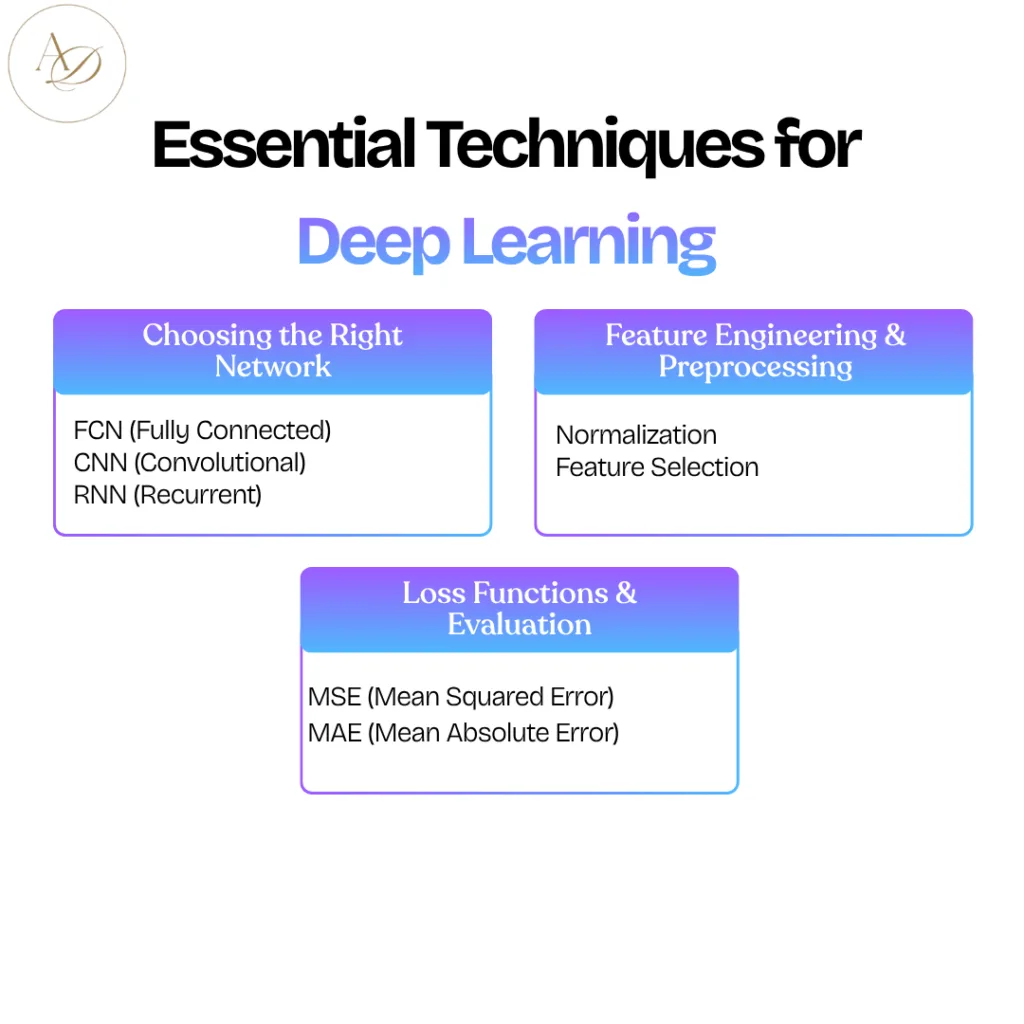
Essential Techniques for Deep Learning Regression
To build a successful regression model, you must choose the right architecture and optimization strategy:
1. Choosing the Right Network
- FCNs (Fully Connected Networks): Best for structured, tabular data.
- CNNs (Convolutional Neural Networks): Used for spatial data, such as predicting pixel intensities or depth in images.
- RNNs (Recurrent Neural Networks): The gold standard for sequential data like time-series forecasting.
2. Feature Engineering & Preprocessing
- Normalization: Scaling input data to a consistent range (e.g., 0 to 1) to ensure the neural network converges faster.
- Feature Selection: Removing “noise” by identifying only the most impactful variables.
3. Loss Functions & Evaluation
The choice of loss function defines how your model learns:
- MSE (Mean Squared Error): Penalizes larger errors more heavily.
- MAE (Mean Absolute Error): More robust to outliers in your data.
- R-Squared ($R^2$): A metric used to evaluate how well the model explains the variance in the dataset.
Regression Metrics & Architecture
| Component | Type | Best Use Case |
| Architecture | RNN / LSTM | Time-series and stock prediction. |
| Architecture | FCN (Dense) | Tabular business data (e.g., house prices). |
| Loss Function | MSE | When you want to minimize large outliers. |
| Loss Function | MAE | When your data has many “noisy” outliers. |
| Metric | $R^2$ Score | To see how “accurate” the model is overall. |
Issues in Regression using Deep Learning Regression
While deep Learning Regression excels in handling complex datasets, there are notable challenges:
- Overfitting: High-complexity neural networks may lead to overfitting within the training data.
- Data Requirements: Deep learning models have a high demand for labeled data to feed into training cases.
- Interpretability: Deep networks involved in regression models could be harder to interpret than general models.

Regression Approaches in Deep Learning Regression
- Start Simple: Always start simple before going up from there in complexity.
- Experiment with Architectures: Experiment with different neural networks to which your data best adjusts.
- Use Cross-Validation: Test the model on other data splits as well.
- Monitor Training: When training the model, use the validation loss instead of the training loss to minimize overfitting.
- Iterate and Improve: Adjust the model constantly according to results and evaluations received.
How Arunangshudas Helps You Master Deep Learning
Transitioning from basic data analysis to advanced Deep Learning can be a steep learning curve. Arunangshudas specializes in simplifying these technical complexities into actionable business strategies.
By working with Arunangshudas, you gain:
- Architectural Guidance: Identifying whether an FCN, CNN, or RNN is right for your specific data challenge.
- Optimization Strategies: Implementing fine-tuning and regularization to ensure your models are both accurate and scalable.
Whether you are looking to predict market trends or optimize industrial processes, Arunangshudas provides the expertise to turn raw data into a competitive advantage.

Conclusion
Regression in deep learning has incredible opportunities for application in various industries to solve sophisticated tasks. This article thus provides a glimpse of how its application, techniques, and difficulties can be managed to enable accurate prediction and enhanced business decision-making. From modeling requirements for future work to analyzing data and even applying and tuning data systems, Regression in deep learning is a key skill that works like a key that opens the door to greater possibilities in machine learning and the greater field.
For More Information Contact us.
Frequently Asked Questions (FAQs)
1. What is the main difference between Regression and Classification?
Classification predicts a “label” (e.g., Is this an apple or an orange?), whereas Regression predicts a “quantity” or “number” (e.g., How much does this apple weigh?).
2. Why use Deep Learning for regression instead of Linear Regression?
Standard Linear Regression works for simple relationships. Deep Learning uses multiple layers to find “non-linear” patterns, making it much more accurate for complex, real-world data.
3. What is “Overfitting” in regression?
Overfitting happens when a model becomes too complex and “memorizes” the training data instead of learning it. This results in great training scores but poor performance on new, real-world data.
4. How do I improve my regression model’s accuracy?
Focus on Feature Scaling (Normalization) and use Regularization techniques like Dropout or L1/L2 penalties to prevent the model from overcomplicating the patterns.
5. Which loss function should I use?
If you want to be very strict with large errors, use MSE. If your dataset has many random “freak” values (outliers) that you don’t want to skew the model, use MAE.
