


Introduction to Tool Calling for Modern AI Agents
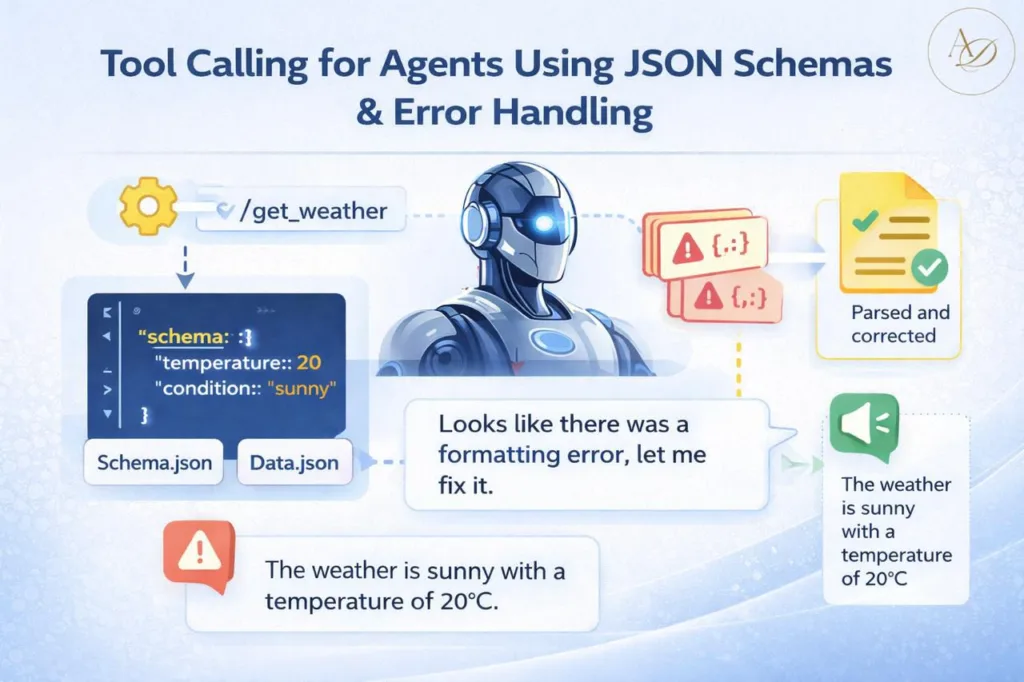
AI agents no longer represent chatbots that respond to text. The current-day autonomous AI agents are supposed to think, make decisions, and take actions. It is that acting part wherein calling of agents plays the actual game-changer. Suppose an AI agent is a smart employee. Thinking is fantastic, yet when one cannot access databases, APIs, calculators, CRMs, it will be trapped in theory.
That gap is filled by tool calling bridges. It enables the LLMs to query real-life systems with formalized inputs and outputs, frequently driven by JSON schema invocation. Combined with sound error handling, agents are reliable, scalable, and enterprise ready.
This tutorial goes into details on calling, reasons behind the use of a JSON schema and how handling errors properly turn weak agents into full-scale systems.
What Is Tool Calling for AI Agents?
1. Definition of Tool Calling for Agents
Tool calling by agents is the capability of an AI agent to call external, like APIs, databases, scripts, or internal services, by producing structured rather than plain text requests. These requests are designed in predefined structures in order to allow machines to understand and execute them reliably.
Simply stated, rather than telling you that he believes the answer to be so-and-so, the agent tells you to call this with these specified parameters. Through that change, real automation is open.
2. Why Tool Calling Is Critical for Agent-Based Systems
AI agents are smart assistants that do not have any hands. They become operatives. This matters particularly to the Executive Agents, Operations Agents as well as the Marketing Agents and any system with a requirement of an Internal AI Agent Stack to operate on the cross-departmental basis.
Calling enables:
- Real-time data access
- Performing of actions (emails, updates, transactions)
- Problem solving with real world consequences
3. Prompt-Only Agents vs Tool-Enabled Agents
Prompt-only agents are purely text generation agents. The use of leads to the integration of reasoning and execution by the agent. The contrast is between reading a recipe and cooking the food. Production environments have agents that are enabled win every time.
How Tool Calling Works in LLM Agents
1. Tool Registration and Discovery
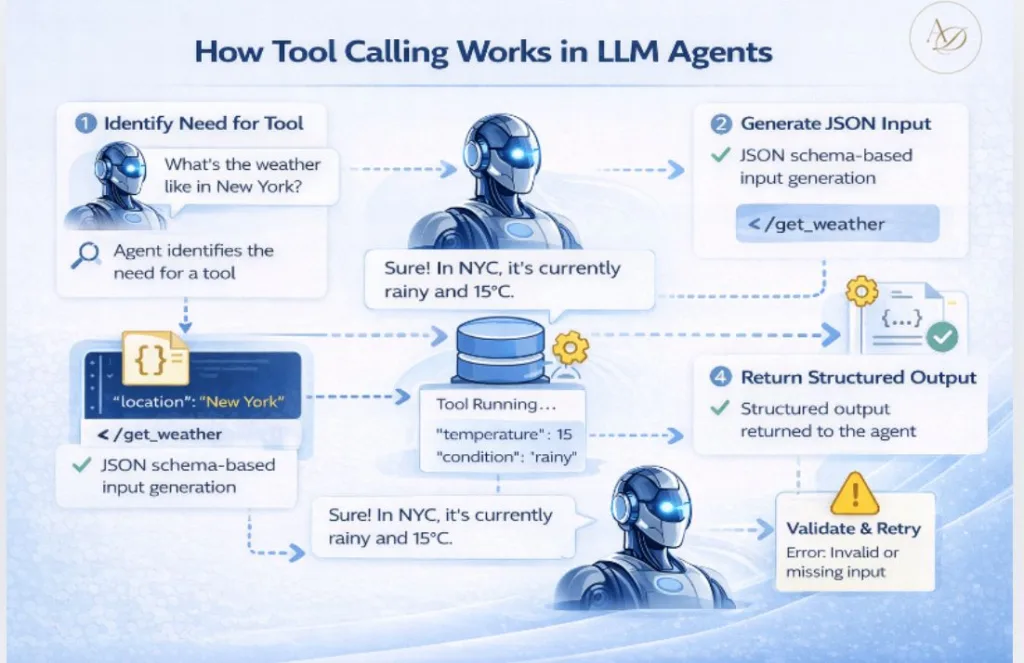
At least, a should be registered before it can be used by an agent. It involves labeling the name of the description, and anticipated inputs with JSONschemas. These are in turn exposed to the agent by their LLM APIs during inference.
2. Input and Output Flow in Tool Calling
The current is not complicated, but mighty:
- The agent receives a task
- It decides a tool is needed
- It generates a structured JSON request
- The system executes
- The response is returned to the agent
This structured loop forms the backbone of AI agent workflows.
3. Why JSON Schema Tool Calling Matters
The use of JSON schema makes the output of the agent predictable, machine-readable, and valid. The absence of schemas makes execution in the form of guesswork- and guesswork does not scale.
Role of JSON Schemas in Tool Calling for Agents
1. What Is a JSON Schema?
A JSON schema is a definition of the structure and data types as well as the rules of a JSON data. In the case of AI agents it serves as a contract: “This is precisely how it is necessary to speak.
2. Required vs Optional Fields
Field requirements make sure that important information is never lacking. Fields are flexible in optional fields. Striking a balance between the two helps to avoid failures but allows the schemas to be used.
3. Enforcing Structured Outputs in AI Agents
Agents are compelled to act by their schemas. They eliminate hallucinated parameters and provide structured data to agents, which makes downstream processing dependable.
Designing Tool Functions with JSON Schema
1. Naming Conventions for AI Agent Tools
The names of the must be descriptive, action-focused and consistent. Counting Naming enables less confusion when calling the LLM.
2. Defining Parameters and Data Types
Both parameters need to have a type which is of a type, such as string, number, or even a Boolean, and a validation rule. This forms the basis of parameter validation.
3. Handling Enums, Arrays, and Nested Objects
Enums restrict values. Arrays support lists. Complex data is possible in nested objects. Apply them well–complexity must be used to clear, not to struggle.
Common JSON Schema Mistakes in Tool Calling for AI Agents
1. Missing Required Fields
The most frequent ontological mismatch is forgetting. Agents go silent or give non-useful results.
2. Incorrect Data Types
When a tool requires an input to be a number and it receives a string, it will stop running. This is early detected during schema validation.
3. Overly Complex Schemas
Complicated schemas disorient agents. Less complex schemas enhance accuracy and lessen agent executions failure.
What Is Error Handling in Tool Calling for Agents?
1. Why AI Agents Fail During Execution
Failure occurs because of invalid input, API outage, schema error, or failure of an unexpected response. At these instances, error handling with AI agents is ready.
2. Types of Errors in Tool Calling
The mistakes may be made prior to execution, during execution or after execution. They all require a different approach in handling.
3. Impact of Poor Error Handling
Mishandling of errors results in endless programs, failed processes, and untrustworthy autonomous artificial intelligences.
Types of Tool Calling Errors in AI Agents
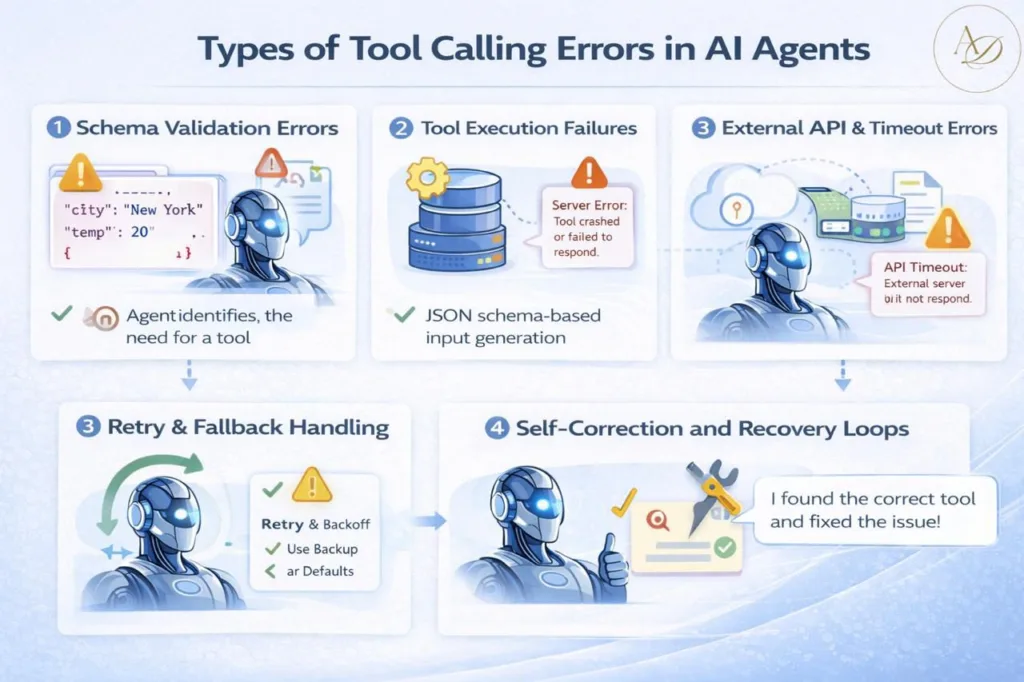
1. Schema Validation Errors
These happen when there are inconsistencies in inputs with the schema. Bad requests are prevented at validation layers.
2. Tool Execution Failures
The runtime errors occur within. They should be identified and repaired by the agents.
3. External API and Timeout Errors
APIs fail. Networks lag. This is a fact that agents have to anticipate.
Implementing JSON Schema Validation for Agent Tool Calls
1. Pre-Tool Validation
Authenticate inputs prior to actual implementation to avoid unnecessary invocations.
2. Post-Tool Response Validation
Check output validation is used to ensure that provide us with useful data.
3. Fallback Handling for Invalid Outputs
Fallback logic enables the agents to re-try, repair or alternate.
Error Handling Strategies for Calling in Agentic Workflows
1. Retry Logic with Limits
Retries are useful, however, bounds ensure no infinite loops.
2. Tool Fallback Strategies
Should one of the fail there can be another to replace it. This is a dignified decay.
3. Human-in-the-Loop Recovery
Some failures need humans. Intelligent agents understand where it is necessary to seek assistance.
Using Retry, Repair & Self-Correction in Tool Calling Agents
1. Self-Healing AI Agents
Intelligent artificial intelligence is able to correct its own mistakes through feedback.
2. Prompt-Based Repair Strategies
Agents may be instigated to restart or fix up invalid outputs.
3. Automatic Tool Re-Invocation
Can be re-invoked safely once they have been repaired.
Logging & Monitoring Tool Calls for AI Agents
1. What to Log
Log entails, log results, errors, retries, and times.
2. Tracking Failures and Retries
Measures indicate ineffective areas of agent operations.
3. Debugging Agent Behavior
Logs transform obscure issues to resolvable ones.
Security Considerations in Tool Calling for Agents
1. Preventing Malformed Inputs
Systems are safeguarded against strict input validation.
2. Limiting Tool Access
The agents must access what they require.
3. Protecting APIs and Credentials
Always keep secrets under wraps within prompts or schemas.
Real-World Use Cases of Calling with JSON Schema & Error Handling
1. AI Customer Support Agents
Tool calling is used by the AI customer support agent to retrieve the tickets, update CRMs, and troubleshoot.
2. Data Processing and Automation
Agents coordinate the processing of data pipelines, check inputs and manage failures independently.
3. Multi-Step Agent Workflows
Complex workflows are based on the collaboration of several tools, retries, and validations.
| Use Case | Tools Used | Error Handling Focus |
| Support Automation | CRM, Ticket APIs | Validation & retries |
| Marketing Agents | Analytics, Ads APIs | Fallback |
| Operations Agents | Internal systems | Human-in-loop |
Tool Calling vs Function Calling in AI Agents
1. Conceptual Differences
Function calling is a subset. Tool calling is broader and more flexible.
2. When to Use Calling
Use tool calling when workflows span systems and require resilience.
3. The Future of Agent
Tool orchestration will define next-gen agentic AI.
Best Practices Checklist for Calling with JSON Schema & Error Handling
The presence of strong schema, clear validation, simple designs, robust logging and smart recovery strategies form the basis of reliable AI agent software since they can be combined to provide minimized uncertainty and avoid failures at each execution phase. Clear, well-defined schemas result in the consistent generation of structured and predictable output by agents, and clear validation helps detect errors early, before they are passed on to software or external systems.
The ease of use of schemas due to simple drawing aids in accuracy enhancement as well as in minimizing the error in execution. Strong logging gives insight into agent behavior and allows it to be easier to track issues, learn more about failures, and overall workflow improvements over time. Lastly, intelligent recovery mechanisms-like retries, fallbacks and self-correction loops enable agents to deal with errors in a graceful manner as opposed to breaking down, which leads to resilient, scalable and real-world usable AI systems.
Future of Calling for Agents
The future is standardized schemas, smarter self-healing agents and on a large scale orchestration. Enterprises Requiring an Internal AI Agent Stack will have an intensive use of structured LLM software calling and robust error handling.
Conclusion
The modern agentic systems are based on the software calling of agents. It will make the AI agents operational powerhouses when combined with the AI agent in the form of the JSON schema and a careful error-management approach to AI agents. With Executive Agents or Operations Agents and even Marketing Agents, software calling is now a necessity rather than an option.
FAQs
1. What is a tool calling for agents?
Tool calling allows AI agents to invoke external using structured data instead of plain text.
2. Why is JSON schema important for AI agents?
It enforces structure, validation, and reliability in calls.
3. How does error handling improve AI agents?
It prevents failures, enables recovery, and ensures stability.
4. Are tool calling and function calling the same?
No, Function calling is limited, while calling supports broader workflows.
5. Who should use calling agents?
Any team building scalable, autonomous AI systems.
