


Why Executives Are Drowning in Data
The current executives are not short of data. They are victims of excessive amounts of it. Dashboards pile up. Weekly, daily, even hourly, are reports communicated. One system is the sale, another finance, the operations another, and the marketing one exists in spreadsheets, never quite in touch with the real world. Such is the contemporary leadership dilemma: greater exposure, less transparency.
The real issue isn’t access. It’s an interpretation. This is not another chart that most leaders need. They must understand what, why and next. Classical instruments had never been constructed to that end. They were created to display information rather than to reflect upon it. That is where executive analytics, decision intelligence and a new category of executive agents come in.
What Is an Executive Agent?
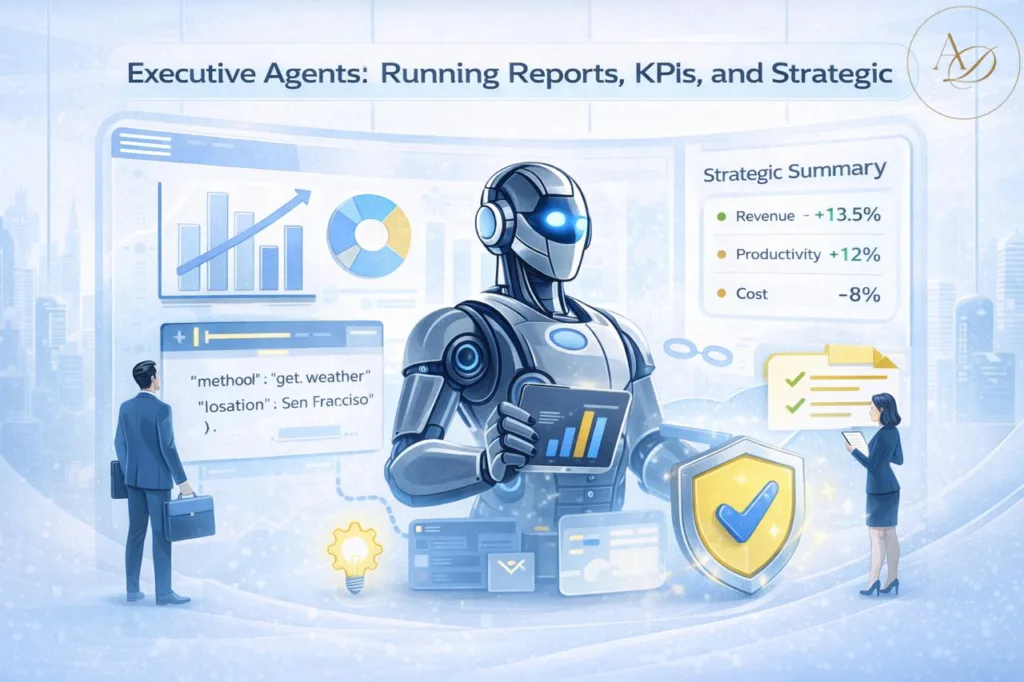
An executive agent is an independent, objective structure, which tracks the performance levels of the business, reads signs within the organization, and reports its findings in a manner that the leaders can actually act on. Consider it not more as software but a digital chief of staff.
In contrast to fixed tools, executive agents constantly monitors the activities in sales, finance, operations, HR and marketing. They relate the dots between numbers and strategy and convert raw figures into context-based explanations. This is not just analytics. It is leadership intelligence based on executive AI agents.
Why “Agent” Matters More Than “AI Tool”
The term agent here is carrying on his part no less than due burden. Most AI tools are reactive. You ask, they answer. The executive agents are aggressive. They observe, recollect, think and take action.
The first difference is autonomy. An agent does not get a query and realize that the customer churn is rising or the cost is skyrocketing in a particular region. Memory is the second. Executive agents have recollection of the history, past judgments and seasonal history. Reasoning is the third. They do not simply flag irregularities, they describe them business wise. That is why nowadays many leaders make reference to these systems as an AI chief of staff instead of any other analytics tool.
Executive Agents vs Traditional BI and Dashboards
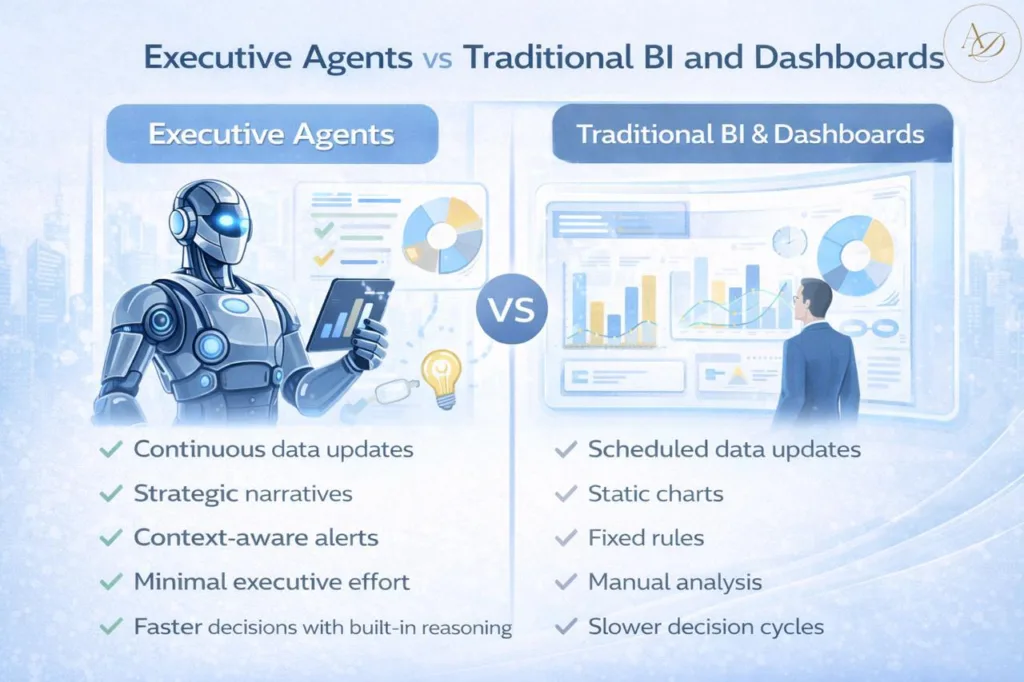
Conventional BI dashboards can get visualized well. They are horrible interpreters. They narrate what has happened, not how and why of what has been done. The role of executives is to connect charts (mentally), filter noise, and make conclusions in a time-pressured situation.
This model is inverted by executive agents. Agents do not require leaders to search to find insights but emerge on their own. They read trends, underscore risks, and report findings as executive ready stories. This is the process of automating the business intelligence to real executive decision systems.
Key Differences That Matter to Leadership
| Capability | BI Dashboards | Executive Agents |
| Data Updates | Scheduled | Continuous |
| Insight Type | Descriptive | Strategic |
| Alerts | Static rules | Context-aware |
| Output | Charts | Executive narratives |
| Effort Required | High | Minimal |
The most important thing in this situation is cognitive load. Dashboards are attention grabbers. By refining, prioritizing, and clarifying what is really important, executive agents also pay attention to leaders.
Running Reports Without Analysts or Manual Work
Reporting has always been cumbersome, paper-based and costly. Analysts extract information in CRMs, ERPs, financial systems, and operations systems and waste hours of their time making slides that become outdated as soon as they are shared.
This whole workflow is automated by executive agents. They read data continuously, test it and create narrative reports, which describe performance using plain language. This is the point where automated business reports and AI-generated reports are no longer a buzzword, but a pragmatic reality.
As an illustration, a CEO can be provided with a one-page summary of the revenue variance, margin pressure, and emerging risks, in real-time, as opposed to a 30-slide deck.
Types of Reports Executive Agents Handle Best
Executive agents do a great job in reports that are based on synthesis, rather than numbers. The contextual explanation in terms of pricing, pipeline quality, and churn is an advantage of revenue performance reports. Bottlenecks are noted prior to getting into a crisis through operational reports. Risk summaries bring out compliance, cash flow, or supply chains issues.
These agents perform better than the old-fashioned automation tools of reporting that merely sum up data without analyzing it because the agents are aware of the relationship between metrics.
KPI Monitoring in Real Time (Not End of Month)
A majority of the organizations continue to review KPIs every month. When the problems arise, it is too late. This is altered by executive agents who will observe KPIs over a prolonged period and identify meaningful changes whenever they occur.
This is contextual real time KPI monitoring. Rather than raising alarm at each change, the agents concentrate on those changes that are important. They know about usual volatility and only spike up when it is shown by the patterns that there is real danger or opportunity.
From Lagging Reviews to Live Business Signals
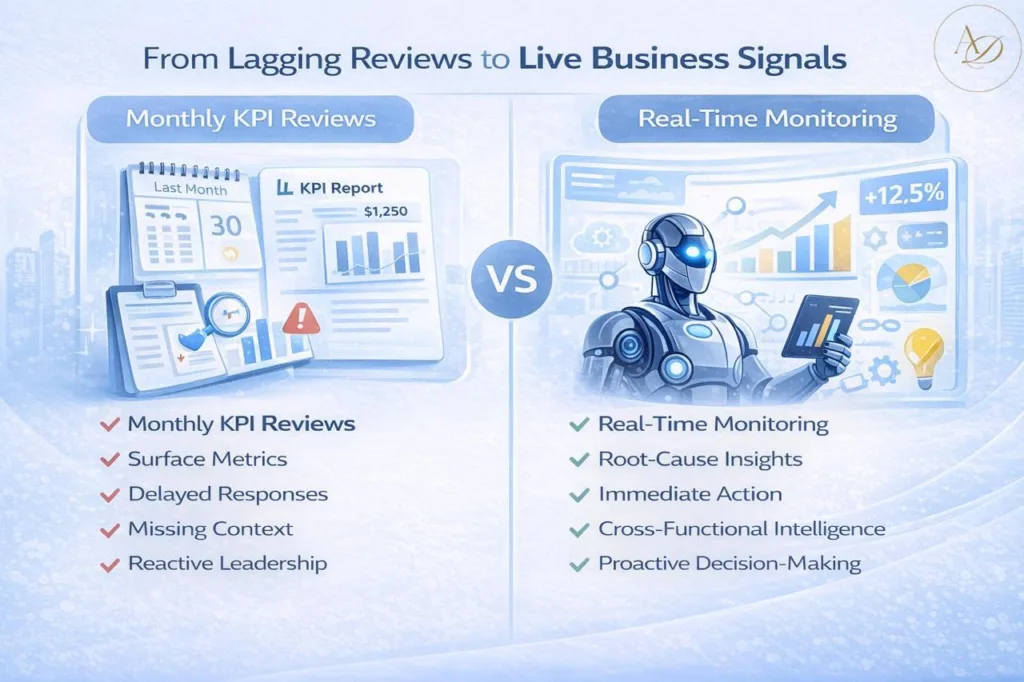
| KPI Review | Traditional Approach | With Executive Agents |
| Review Cycle | Monthly | Real-time |
| Insight Depth | Surface-level | Root-cause |
| Response Speed | Slow | Immediate |
| Context | Missing | Built-in |
This change is what makes the KPIs live business signals as opposed to historical scorecards. Leaders shift to being reactive to being proactive.
Strategic Summaries – Turning Metrics Into Decisions
The only time the data can be useful is when it triggers action. Executive agents are experts in the strategic summaries of AI, linking metrics to the purposes, risks, and actions ahead.
They do not write down numbers, but spell out implications. A downward shift in the conversion rates is not only reported but it is associated with altering the campaign, the shifts in the audience or operational limitation. This is automation of business insights that is meant to be used in decision-making and not reporting.
What Makes a Summary “Executive-Grade”
A summary of the executive level is terse, to the point, and precise. It respects attention. It avoids jargon. Above all, it provides insights in the context of decisions. What changed? Why? What are the options?
Executive agents are not educated to speak like data scientists but like senior advisors. This is the reason why leaders depend on them as executive decision support systems and not analytics tools.
Asking Business Questions in Plain English
Dashboards need to be trained. Executive agents need to be discussed. Leaders are able to pose queries in a simple English language and get situational responses based on actual data.
This is the analytics of natural language and conversational BI at work. No filters. No SQL. Only reasonable questions and answers.
Examples of Executive-Level Questions
A CEO could inquire as to why there was a decrease in revenue within a particular region. A CFO could be inquiring about such a rapid increase of cash burn. A COO may desire to be aware of delays in fulfillment. The answers to these questions are provided by executive agents by reasoning across systems, as opposed to extracting isolated metrics. It is at this point that AI business Q&A is a competitive edge.
One Executive Agent Across All Departments
Majority of decisions fail due to the presence of data silos. Sales maximizes growth, finance efficiency, operations stability. These views are amalgamated by the executive agents into one layer of intelligence.
When bringing systems together across the departments, agents offer cross-functional analytics, which are reality-based, rather than departmental accounts, which are false. Enterprise AI agent platforms and coherent business intelligence are based on this single approach.
Why Cross-Functional Context Changes Decisions
A marketing campaign may seem like a success on its own but on combining it with finance data, it may indicate a decrease in margins. These connections are brought up by the executive agents. This avoids making decisions that are subject to biased facts- which is a major failure mode in leadership teams.
Real-World Executive Agent Use Cases
A growing number of leadership teams combine executive agents with operational agents such as an ai customer support agent to create feedback loops between strategy and execution. When customer escalations rise, the executive agent immediately reflects the impact on churn, revenue forecasts, and staffing needs—closing the gap between customer experience and boardroom decisions.
| Role | What the Agent Delivers |
| CEO | Weekly strategic summary |
| CFO | Cash flow & burn alerts |
| COO | Operational risk signals |
| CMO | Pipeline & ROI insights |
| CHRO | Workforce trends |
These executive AI applications indicate that AI in leadership teams and agentic automation enhance alignment and quickness throughout the organization.
How Executive Agents Work (High-Level Architecture)
On the high level, there are three layers of executive agents. Information is fed into data connectors by enterprise systems. A logic engine processes signals based on goals and memory. The communication layer provides insights in a form of summaries, alerts or conversations.
It is a modern AI agent architecture which is a scaleable and reliable part of the enterprise AI stack.
Security, Governance, and Executive Trust
Trust is non-negotiable. Executive agents should be compliant, auditable and privacy level to enterprise standards. Role based access enables leaders to view only what they are supposed to view. The use of data and decisions are recorded in audit logs. This is the aspect that makes agents feasible on the executive level; it is the focus on AI governance, enterprise AI security, and data compliance automation.
Executive Agents vs Hiring More Analysts
The employment of analysts brings in capacity, but not scaling. Executive agents provide timely, uninterrupted insights throughout the organization.
| Factor | Human Analysts | Executive Agents |
| Cost | High, recurring | Lower at scale |
| Speed | Delayed | Instant |
| Coverage | Limited | Organization-wide |
| Consistency | Variable | High |
This comparison brings out the reason why AI vs analysts is emerging as a strategic debate on ROI not head count.
Implementation Roadmap for Organizations
The effective adoption occurs in stages. Companies tend to begin with automated reporting, then go on to KPI intelligence and lastly allow strategic suggestions. Such incremental strategy helps mitigate risk and develop trust, and the adoption of executive AI and the implementation of agent AI become sustainable.
The Future of Executive Work
Executive agents are evolving from insight generators into proactive strategic partners. They will soon simulate scenarios, recommend actions, and coordinate agentic workflows across teams. Combined with custom AI agents and even AI customer support agent systems, they represent a shift toward autonomous decision ecosystems.
Conclusion – Executive Agents as the Digital Chief of Staff
Executive agents are in the middle of decisions and data. They eliminate noise, surface clarity, and fasten action on leadership. They are fast turning into the digital chief of staff that every executive team requires in a world defined by speed and alignment as the defining success.
FAQs
1. Are executive agents replacing dashboards entirely?
No, Dashboards remain visible, however, executive agents add interpretation and action over them.
2. How accurate are executive agents compared to analysts?
They are also more repetitive as they use the same reasoning over and over again.
3. Can executive agents work with existing tools?
Yes, They are meant to inter-operate with CRMs, ERPs, finance and operations systems.
4. Are executive agents secure for enterprise use?
The contemporary platforms are more concerned with role-based access, encryption, and compliance.
5. What’s the first step to adopting executive agents?
Begin with automated reporting to establish trust and proceed to KPIs and strategy.
