


The Cost of Slow Customer Support
This is a reality check that most businesses always come to realise later on, customer does not wait. Studies on the matter constantly indicate that almost three-quarters of abandon a brand with a single bad customer experience. A single slow reaction, a single misunderstood handout, one unaddressed problem–and loyalty goes down the drain. In a world where you can get an alternative with a single click, slow service is no longer a simple inconvenience, it is a leak in the revenue.
What Does 24/7 Contextual Help Really Mean?
24/7 contextual support is not only being available online. It is knowing the customer, the situation they are in, what they had done before, what product they are using and what issue they are attempting to address and being able to respond instantly with relevance. Introduce intelligent escalations to human agents where necessary and you have a support system that is almost human.
Why AI-Powered Customer Support Agents Are the New Standard
AI customer support agents come in at this point. These are not simple chatbots that reply to the questions frequently asked. They are sophisticated systems that can reason, recall contexts, combine with tools and self-escalate problems. They collaborate to provide 24 hour support at all times ensuring that human teams concentrate on their core competencies. In this guide, we will deconstruct the way customer support AI agents operate, why they are relevant, and how to successfully apply them to your customer support-related practice, and, finally, a CTA to assess your current support system with the help of a free audit checklist.
What Are Customer Support Agents?
1. From Traditional Chatbots to Intelligent AI Agents
The conventional chatbots were scripted. Inquire in the wrong direction and they failed. The agents of support developed nowadays are constructed on the basis of artificial intelligence, not strict rules. They are able to know the intent, adjust responses and act across systems. This change is the transition to autonomous support agents instead of automation.
2. How AI Customer Support Agents Work
Fundamentally, AI customer care representatives will be a combination of various technologies meant to mimic smart interactions and activities. They do not merely respond to questions, they address problems.
3. NLP, Machine Learning, and Context Awareness
Natural Language Processing (NLP) enables agents to get information about human language. Machine learning assists them in becoming better as time goes by. Context awareness makes them recall the past interaction, user preferences and session history. This three-person team allows an AI support agent to be human-like and personal as opposed to being a robot.
4. Core Benefits of AI Customer Support Agents
There are three significant reasons why businesses are adopting customer support AI agents namely; cost efficiency, scalability and speed. In contrast to human groups, AI agents do not burn out, do not have to work in shifts, and do not have problems during traffic surges. They are responsive, 24/7, and process thousands of conversations in real-time, which is why they are one of the most successful AI agents in terms of support nowadays.
The Power of 24/7 Availability
1. Why Always-On Support Matters in a Global Market
Customers do not work according to your working hours. A New York user, another user in London and a user in Singapore may have a need at the same time. When it is not 24/7 someone will always wait and waiting always kills satisfaction. This is completely eliminated by support agents.
2. Real-World Use Cases Across Industries
In e-commerce, shoppers who make purchases at night enquire about the time of delivery when they are making purchases during the holiday season. With SaaS the users run into technical problems just in time to miss deadlines- often out of working hours. Urgency is not scheduled in fintech or Ai in the legal industry. The use of an AI agent support system ensures that all queries are answered, at all times.
3. Technology Behind Continuous Availability
AI agents can be run through cloud infrastructure, scalable APIs, and event-driven architectures. Cloud provider benchmarks indicate that response time decreases to hours to seconds when AI agents are used in place of manual queues. It is among the most evident competitive advantages in contemporary support software.
Delivering Contextual Help at Scale
1. What Is Contextual Help in Customer Support?
Contextual help- This is answering according to the customer and what the customer is doing at the given time. It does not just respond to generic answers but customizes responses based on behavior, history and real-time data.
2. How Contextual AI Agents Understand Users
An AI customer support agent retrieves CRM systems data, product analytics and conversation history data. The agent is aware of the plan, past problems, and past activity of a returning they have a query. This lessens the friction and repetition to a significant extent.
3. Step-by-Step Flow of Contextual Assistance
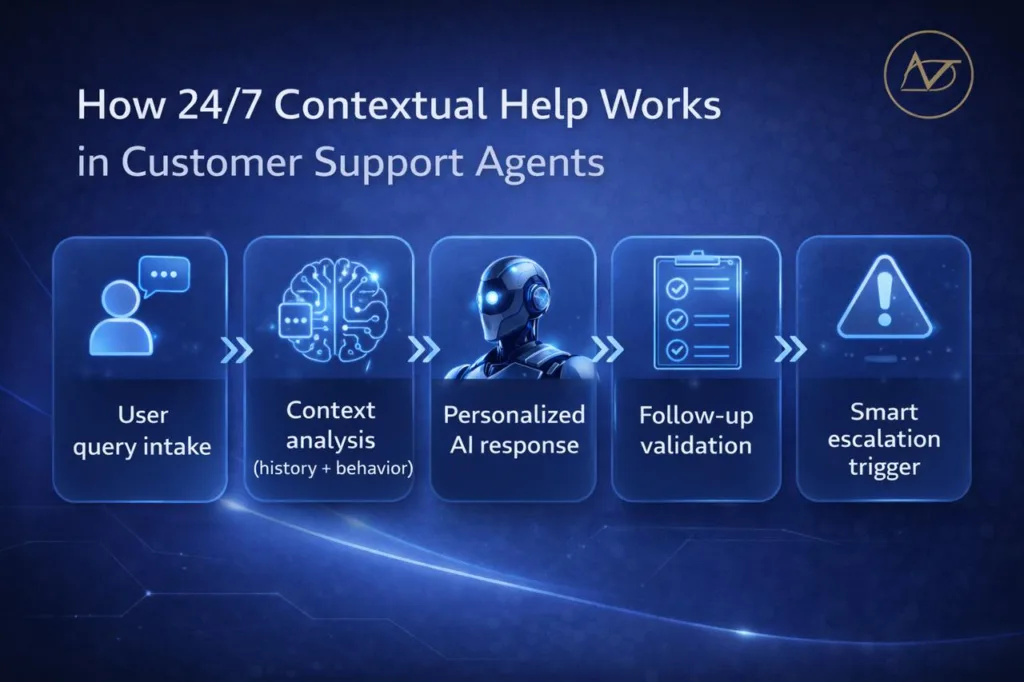
The first step is that the user enters a query. The next thing is that the AI agent interprets intent and context and retrieves pertinent data in related systems. It then cuts a personalized response and thereafter a follow up and confirmation to get a resolution. This cycle is instinctive and effective.
4. Impact on Ticket Reduction and Resolution Time
According to companies that employ contextual AI, the number of support tickets reduces to as low as 40 percent as most problems are solved within seconds. The time to resolution reduces, there is less customer frustration, and the human agents are relieved of the tedious work.
Smart Escalation Strategies
1. When AI Agents Should Escalate to Humans
Even customer support AI agents, which are the best ones, should not do everything. When the confidence declines, queries are complicated or emotional cues such as frustration are seen, escalations are instigated. Sentiment analysis is important in this regard.
2. Seamless Escalation Workflow Explained
AI agents do not make customers repeat but forward the conversation context to human reps. The agent marks the problem, plucks the main information, and leaves without any difficulties, without any information loss.
3. Business Benefits of Intelligent Escalations
Quick resolution, increased CSAT grades, and improved morale by the agents will all be achieved through smart escalations. Human teams are working on purpose, whereas AI is taking up quantity. Win-Win to the customers and businesses.
Customer Support Agents vs Traditional Support Tools
1. Limitations of Legacy Support Systems
Common tools such as ticketing systems, macros, and FAQ pages are very useful as they store information, but they have a high dependence on human intervention to read and take action. Agents switch tools, which slows down processes and raises the error rate.
2. How AI Agents Act, Reason, and Coordinate
The customer support AI agent is also able to reason problems, activate workflows and update systems and coordinate between platforms unlike the static tools. They do not simply help, they make things happen.
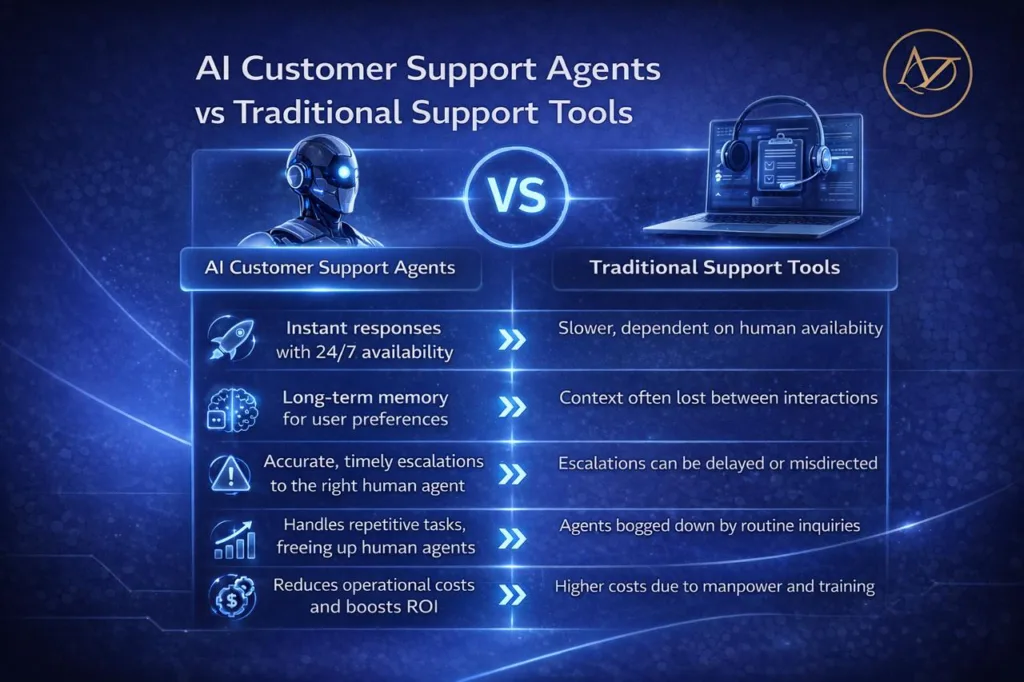
3. AI vs Traditional Support Tools Comparison
The distinction in terms of the AI and the traditional support tools is simple, therefore: the traditional support tools assist humans; AI agents assist customers directly and independently. The future of help desk automation is characterized by this shift.
Benefits for Customers and Support Teams
1. How Customers Experience Better Support
The customers receive quicker answers, a reduced number of handoffs, and customized solutions. No waiting. No repeating details. Just answers that make sense.
2. How Support Teams Gain Efficiency
There is a decrease in the volume of tickets, increased prioritization, and productivity in support teams. With AI in CX, agents are able to concentrate on complex and high-value interactions rather than repetitive work.
3. Business Impact on Costs and Loyalty
Reduced cost of operation and increased satisfaction result into long time loyalty. This is where automation of customer experience is more of a driver of growth than an aiding activity.
Key Features of Top Customer Support Agents
1. Essential Capabilities to Look For
The most suitable AI agents to customer support have omnichannel communication, deep integrations, analytics dashboard and customization options that fit your brand and workflows.
2. Free vs Paid AI Customer Support Agents
Basic queries can be done on free tools, however, the advanced agents have predictive features, full session memory and high escalation accuracy.
3. Feature Comparison Table
| Feature | Basic Agents | Advanced AI Agents |
| 24/7 Availability | Yes | Yes + Predictive |
| Contextual Memory | Limited | Full Session |
| Escalation Accuracy | 70% | 95%+ |
| Pricing | Free Tier | $50+/mo |
Implementation Guide: Getting Started
1. Step-by-Step Rollout Process
Start by identifying support gaps. Choose a platform aligned with your needs, train the agent using your knowledge base, test escalation paths, and launch gradually.
2. Choosing the Right Platform
Google Dialogflow tools have strong documentation, scalability, and flexibility of integration, which suit the contemporary customer support agents deployment.
3. Common Implementation Mistakes to Avoid
The largest pit-trap is over-automation uncontrolled by human beings. Your team should not be substituted fully by AI.
Real-World Success Stories
1. E-commerce Cost Reduction Case
A retailer on the internet saved 60 percent of the support expenses by implementing customer support AI agents to deal with order tracking and returns.
2. SaaS NPS Growth Case
The introduction of contextual AI agents with intelligent escalations helped a SaaS company to raise their Net Promoter Score by 40 to 85.
Challenges and Solutions
1. Data Privacy and Compliance
The data security and GDPR questions are resolved by using encryption, access control, and architecture of compliance.
2. Preventing AI Hallucinations
Human review loops, confidence thresholds, and continuous training help reduce incorrect responses.
3. Preparing for Future Trends
Voice AI, predictive support, and hyper-personalization are shaping the next wave of innovation.
The Future of Customer Support Agents
1. From Reactive to Predictive Support
Future agents will anticipate problems before customers report them, shifting support from reactive to proactive.
2. Deeper Integration Across Business Functions
Customer support agents will connect tightly with AI in software development, AI in product management, and even AI in the legal industry, becoming true business partners.

Conclusion
The contextual assistance 24/7 with smart escalations is no longer an option, but the core of the new customer loyalty. The AI agents in customer support provide speed, customization, and scalability and enable human staffing. To have happier customers, save more costs, and be future ready, this is the time to introduce intelligent agents. Get a demo or download a support readiness checklist.
FAQs
1. What is an AI customer support agent?
An AI customer support agent is an intelligent system that uses NLP and machine learning to handle customer queries, provide contextual help, and escalate issues when needed.
2. Are AI agents better than human support?
They’re better at speed and scale, while humans excel at empathy and complex problem-solving. Together, they perform best.
3. Can small businesses use customer support AI agents?
Yes. Many platforms offer affordable plans designed for startups and small teams.
4. How do AI agents improve customer experience?
They reduce wait times, personalize responses, and ensure seamless handoffs, leading to higher satisfaction.
5. What industries benefit most from AI customer support agents?
E-commerce, SaaS, fintech, healthcare, and the legal industry see significant benefits.
