


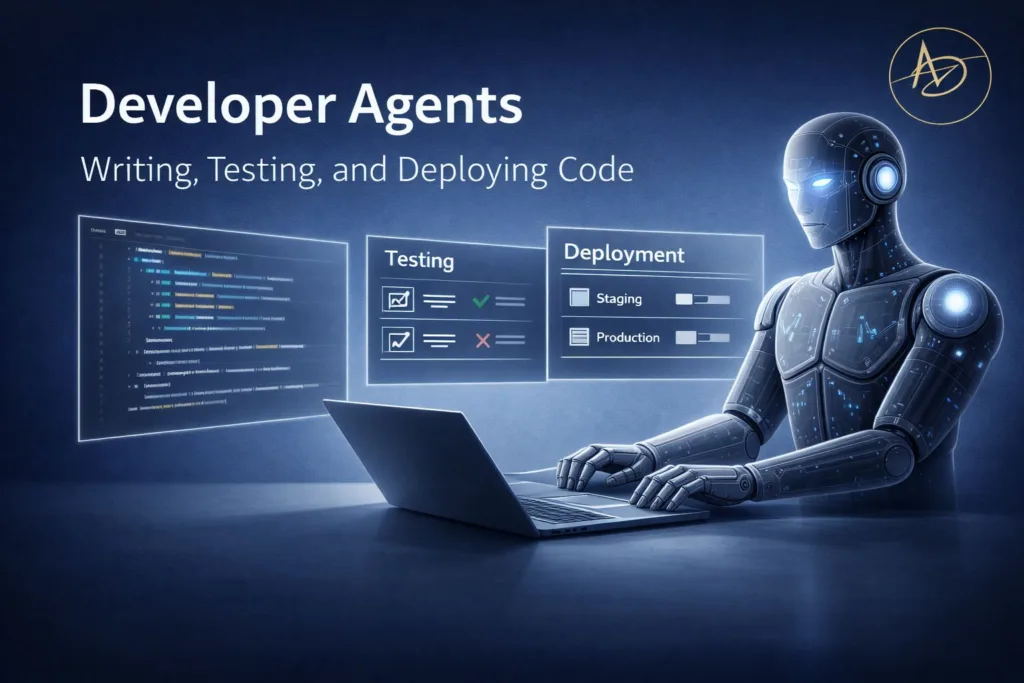
Introduction – Why Software Development Is Moving Toward Agentic Execution
Let’s be honest. The majority of developers do not spend their day joyfully writing clean and elegant code. A tremendous portion of time is wasted in the process of doing code reviews, debugging CI failures, correcting flaky tests, debugging deployment scripts, and trying to understand why something that worked last night is not working today. Contemporary software development has turned into a juggling exercise among tools, tabs and pipelines.
Here, developer agents come into the scene.
With the maturation of AI in software development, it is becoming known to teams that they need more than just help. The autocomplete and chat-based helpers are time savers in keystroke, though they do not possess results. The developers continue to have the cognitive burden of thinking about what to do next, the tool to use, and the end-to-end fix.
Developer agents represent a shift toward execution. Instead of just suggesting code, they plan tasks, interact with tools, run tests, debug failures, and even deploy applications—while developers stay in control of architecture and standards. This shift reduces friction, shortens feedback loops, and unlocks ai workflow automation across the entire development lifecycle.
From Assistants to Agents: What Are Developer Agents?
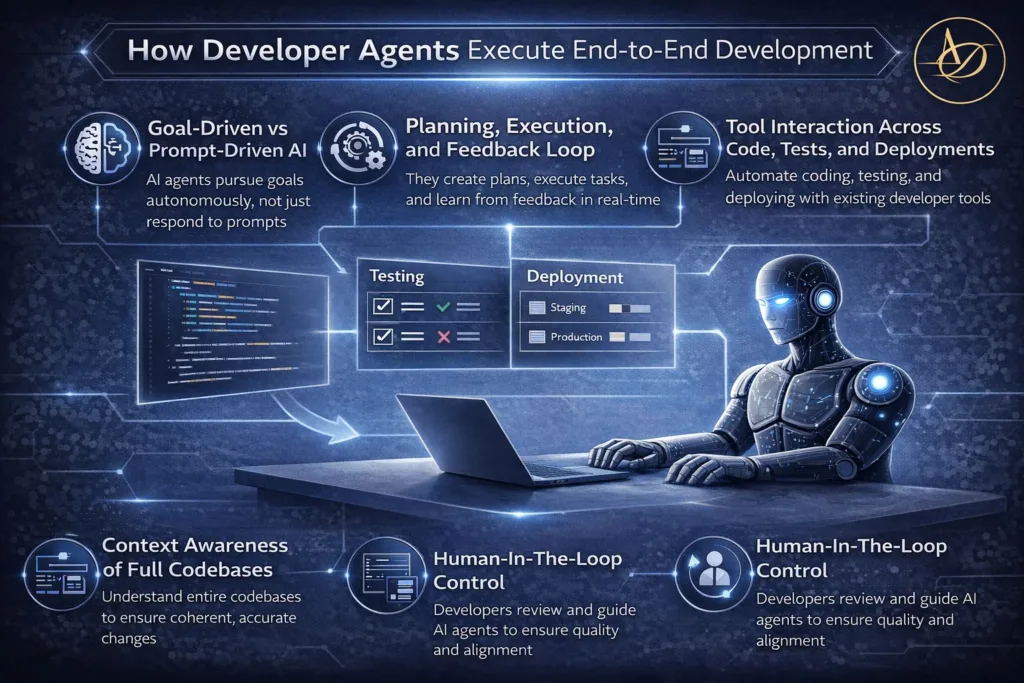
The fundamental principle of developer agents is to accomplish software development tasks under the control of goal-driven AI systems. They do not end their advice like simple scripts or chatbots.
They act.
Key Characteristics of Developer Agents
Developer agents can:
- Interpret goals from PRDs, Jira tickets, or design docs
- Write and modify code across multiple files
- Run unit, integration, and regression tests
- Debug failures using real execution feedback
- Interact with repositories, terminals, APIs, and CI/CD systems
- Deploy code across environments with safeguards
This is what makes autonomous coding more of a practical thing than a theoretical one.
How Agents Differ from Chat-Based AI Tools
Question answering tools are chat-based. Agents complete tasks.
A chat window LLM can be used to describe the failure of a test. The test suite is executed by a developer agent, the cause of the failure is identified, the root cause is traced, a fix is applied, the tests are again run, and a pull request is prepared. It is the distinction between advice and action- and why AI developer systems are quickly becoming agentic.
Read more blog : Top 10 AI Tools for Email Newsletters That Convert
Developer Agents vs Traditional Developer Tools
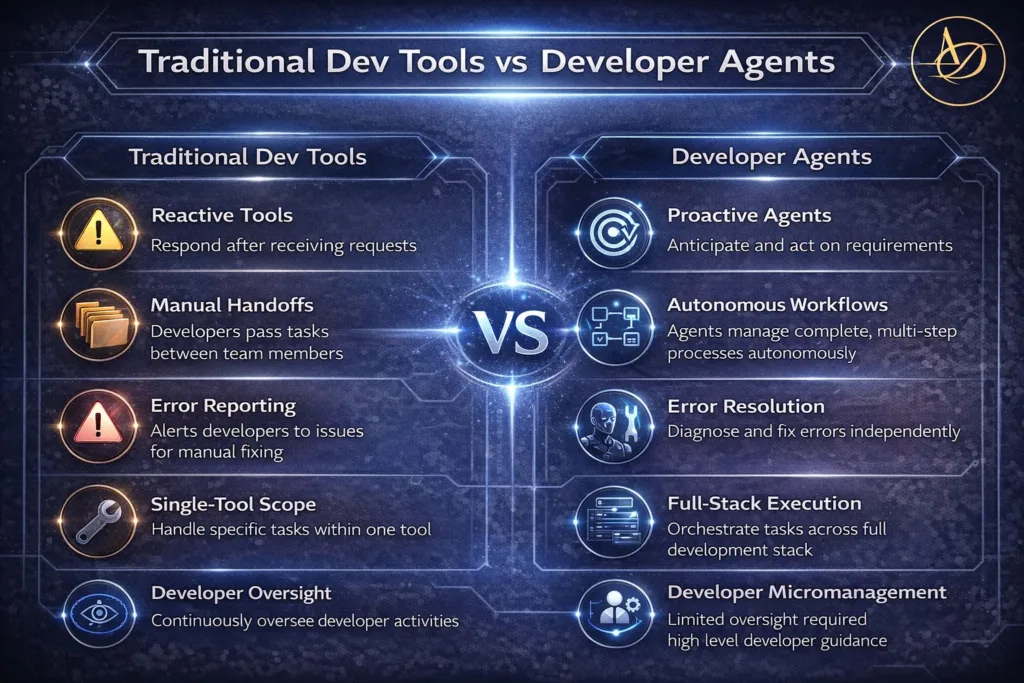
The conventional development tools are effective, but they are responsive. They can bring out information and leave it to human beings to make their decision.
That model is inverted by developer agents.
Limitations of Conventional Dev Tooling
IDEs, linters, and CI systems:
- Identify faults but do not correct them
- Present logs but do not understand them as a whole
- Manual coordination of tools
This fragmentation enhances more context switching and reduced delivery.
Agentic Reasoning vs Rule-Based Automation
Agents are reasonable, as opposed to simple scripts or macros. They make decisions and react to feedback as well as make next steps and deal with ambiguity. It is particularly useful with complicated processes such as CI/CD automation, in which failures can hardly be attributed to one constraint.
Side-by-Side Comparison Table
| Aspect | Traditional Tools | Developer Agents |
| Scope | Single task or signal | End-to-end workflows |
| Decision-making | Human-driven | AI-driven with oversight |
| Error handling | Reports issues | Diagnoses and fixes |
| Context awareness | Limited | Full codebase + history |
| Adaptability | Static rules | Dynamic reasoning |
The Architecture of a Developer Agent
In the background, developer agents are based on a layered architecture that facilitates sound execution.
Reasoning and Planning Engines
The core is a reasoning engine, which is typically driven by an LLM. It divides objectives into actions, weighs trade-offs and it alters plans when things fail. Various models strike a balance between speed, cost and depth of reasoning based on the task.
Context Awareness Across Large Codebases
It is not an easy task to comprehend a huge codebase. Ingestion of pertinent files, dependencies, and historical changes is made possible by agents using methods such as retrieval-augmented generation (RAG) or long-context windows. This situation is essential to safe agentic workflows.
Tool Execution and Feedback Loops
Agents do not simply think but do. They are executed, write code, invoke APIs and monitor outputs. They can use a constant plan-act-observe cycle to optimize actions until they achieve conditions of success, and the software automation architecture is built on this structure.
Phase I – Writing Code with Developer Agents
Code generation is often the first place teams experiment with developer agents.
Translating PRDs and Tickets into Code
With a Jira ticket, a developer agent is able to scaffold functionality, develop new modules, and connect APIs. It deals with monotonous set up labor and programmers with business logic and design choices. This partnership speeds up the process of delivery without compromising on quality.
Refactoring and Legacy Code Modernization
Agents are clearly seen in legacy systems. They are able to refactor old patterns, make code more readable and enforce style guides. Agents do not make risky, large-scale rewrites but, instead, stateless, test-backed advancements making AI code generation a maintenance superpower.
Phase II – Testing and Debugging with Developer Agents
The bottleneck of testing is usually established, but the agents transform it into a feedback engine.
Automated Test Generation
There are unit and integration tests written by developer agents being built on the basis of code behavior and edge cases. They find blank spots in the coverage and compose tests that are related to actual use reinforcing their faith in releases with AI-based automated testing.
Self-Healing Debugging Workflows
In case of test failures, errors are not simply logged in by agents. They examine stack traces, examine new changes, and suggest fixes. They minimise human involvement and shorten debugging, which is one of the most time-intensive development stages, by continuing to run tests until tests pass.
Phase III – Deploying and Releasing Code with Developer Agents
Execution is the most important in deployment.
CI/CD Pipeline Orchestration
A development agent works with build steps, environment variables and infrastructure definitions. They are able to alter pipelines dynamically and hence AI-powered CI/CD is more resilient and adaptive as compared to fixed scripts.
Human-in-the-Loop Release Gates
No matter how much it is automated, humans control it. Agents stop at specified checkpoints and seek authorization prior to release of production. This balance guarantees security but it is also advantageous in regards to automated deployment agents.
Read more blog : Top 5 AI Tools to Create Video Scripts from Blog Posts
How Developer Agents Work Across the Dev Stack
The developer agents do not exist in confusion, but they exist within all the ecosystem.
IDEs, Repositories, and Cloud Platforms
The agents are used together with IDEs to develop it locally, Git to manage version control, and deploy it to the cloud. This end-to-end connectivity allows the complete automation of the stack without disrupting the existing workflows.
Observability and Continuous Learning
The agents get to learn through real-world behavior by looking at logs, metrics and alerts. With time, they enhance the decision-making process without violating the governance regulations, developing really smart DevOps infrastructures.
Use Cases Across Teams and Organizations
The value of developer agents extends across the entire organizational structure, bridging the gap between manual coding and autonomous software delivery.
1. Startups and Lean Teams: The Force Multiplier
In the startup ecosystem, AI-driven developer automation acts as a massive force multiplier. Smaller teams leverage agents to maintain a high shipping velocity with fewer engineers.
- Operational Efficiency: Agents autonomously manage time-consuming tasks like unit testing, CI/CD deployment, and real-time monitoring.
- Scalability: Lean teams can now manage complex infrastructures that previously required a full DevOps department.
2. Enterprises and Large-Scale Systems: Governance at Scale
For large-scale organizations, developer agents are used to standardize practices and manage the complexity of sprawling microservices.
- Consistency: Agents normalize coding standards and minimize human error across thousands of repositories.
- Controlled Automation: By integrating internal policies and compliance protocols directly into the agent’s logic, enterprises achieve automation without chaos.
Risks, Limitations, and AI Governance
While the power of autonomous developer agents is immense, it requires a robust framework of accountability and oversight.
Security, Accuracy, and Human-in-the-Loop Control
If left ungoverned, AI agents may suffer from “logic hallucinations” or execute unauthorized tool calls. Maintaining a secure environment requires:
- Sandboxed Environments: Running agent-generated code in isolated containers to prevent system breaches.
- Permission Tiering: Strict API and tool-access controls based on the agent’s specific task.
- Continuous Auditing: Regular logs and reviews of agent-led deployments to ensure architectural integrity.
Policy Guardrails and Best Practices
Responsible AI adoption is built on trust and transparency. To minimize risk during the transition to AI-augmented development, organizations should prioritize:
Defined Boundaries: Setting clear operational limits to ensure agents enhance productivity without compromising security.
Mandatory Code Reviews: Ensuring a “Human-in-the-Loop” (HITL) approach for all critical production merges.
Incremental Rollouts: Testing agent workflows on non-critical microservices before full-scale integration.
The Future of Developer Agents

Developer agents are changing to be more than just task performers.
From Task Execution to System Ownership
The next-generation agents will automatically work towards performance optimization, deal with technical debt, and avoid incidents. Programmers will coordinate groups of agents and move out of manual labor to tactical control. This is what autonomous engineering and AI-first development is all about.
Conclusion – From Writing Code to Owning Outcomes
Developer agents are not concerned with taking over developers. They are concerned with liberating them of the monotonous performance and elevating their status. Agents can help teams to concentrate on results, rather than tasks, by automating writing, testing, and deployment.
Integrated with ai workflow automation, Ai Agent Business strategies, and SaaS automation, developer agents transform software development and turn it into a faster, safer and smarter process.
Frequently Asked Questions (FAQs)
Are developer agents safe for production-level deployments?
Yes, provided they are implemented with a Human-in-the-Loop (HITL) framework. Ensuring safety requires a combination of strict permission controls, code reviews, and executing agent-driven tasks within isolated sandbox environments to prevent unauthorized system changes.
Do developer agents replace human software engineers?
No. Developer agents are designed to augment, not replace, human talent. They act as force multipliers by handling execution-heavy, repetitive tasks—such as boilerplate generation and documentation—allowing engineers to focus on high-level architecture and complex problem-solving.
Can developer agents assist with legacy systems and technical debt?
Absolutely. Developer agents excel at analyzing large, undocumented codebases. They are highly effective for incremental refactoring, identifying deprecated dependencies, and suggesting modern improvements to legacy systems without disrupting core functionality.
How do developer agents optimize the CI/CD pipeline?
Agents transform DevOps by proactively diagnosing build failures, automatically adjusting pipeline configurations, and managing automated release cycles. They significantly reduce the “mean time to recovery” (MTTR) by identifying the root cause of bugs instantly during the testing phase.
What is the best way to start integrating developer agents into a workflow?
The most effective strategy is an incremental rollout. Start by assigning agents to low-risk tasks such as unit testing, internal documentation, or basic bug triaging. Once the team is comfortable with the output quality, you can gradually expand their scope to CI/CD automation and feature development.
