


Introduction – The Shift from Chatbots to Agents
Let’s be honest. The current use of AI is very few by most product managers. Open ChatGPT, type something, say write me a user story,or rephrase this stakeholder email,copy and paste the text, and continue on your document. Helpful? Yes. Transformational? Not really.
It is at this point that the change starts.
We are leaving chatbots that just talk to AI agents that are real workers. This shift is profoundly redefining the way product teams in modern organizations work, and it does so particularly effectively in product operations where time is just dripping away.
Chatbots vs AI Agents Explained
A chatbot responds. An AI agent acts.
This one difference makes all the difference. Chatbots are awaited and provide responses. AI agents accept objectives, divide them into actions, exploit tools, make decisions and implement workflows across the board. This is the actual difference that people seek to comprehend when they are searching chatbots vs AI agents explained
In product management terms:
- A chatbot replies: This is an example of a PRD template.
- One of the AI agents replies: I have researched competitors, analyzed customer comments, prepared the PRD, prepared tickets and matched them to Jira.
That’s not assistance. That’s execution.
What Are Product Management Agents?
Specialized AI systems are called Product Management Agents that deal with the working layer of product work. They link to your tools, know your context, and do things such as roadmap updates, PRD writing, backlog grooming, and creating tickets with little human intervention.
They occupy the crossroads of AI in product management, product operations automation and agentic AI systems.
The Real Problem PMs Face Today
The majority of PMs are not carried away by strategy. They are disrupted by upkeep.
Updating tickets. Reformatting documents. Grooming backlogs. Replicating acceptance requirements. Coordinating change between tools. This overhead cost is gradually consuming the time required to do strategic leadership on the products.
The Big Promise – AI Agents Replace Workflows
The promise is as follows: AI agents do not merely make you think faster. They also assist you to work less on low value work. They do not only replace steps in workflow, but the whole workflow. That’s why many experts now say AI agents replace workflows not jobs.
Inside an AI Agent – How Agentic Systems Actually Work
To understand why this matters, we need to go inside an AI agent
Chatbot Logic vs Agentic Logic
Chatbots have a basic structure, one input one output.
The following loop is much more rich: goal-plan-tool-action-feedback-iteration.
Such agentic behavior enables them to research, write, validate and update work at any given moment. This would provide in product management that your systems would cease to be fixed and begin to act as living processes.
Tools, Memory, and Actions
An AI agent has access to:
- Memory (past decisions, priorities of roadmap, product context)
- Techs (Jira, Linear, Notion, Slack, analytics platforms)
- Operations (issue tickets, edit documentation, mark risks)
This is what opens up the doors to actual generative AI in PMs, whereby it goes beyond a text generation tool to actual implementation.
The Agentic Workflow – Three Core Pillars
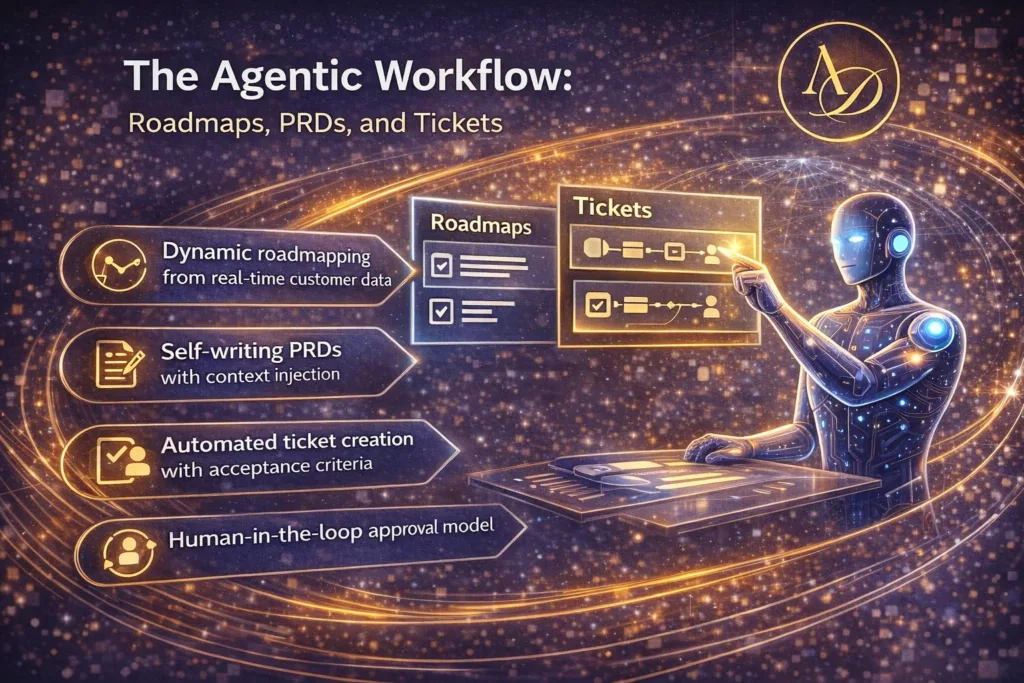
The three areas where PMs traditionally waste the most time include road mapping, PRDs, and ticket management, which Product Management Agents provide the most value.
Pillar One – Dynamic Roadmapping
The Old Way of Roadmapping
Conventional road mapping is tedious and partisan. Spreadsheets that are never updated, interminable prioritization meetings and decisions that are made by whoever yells the loudest. When a roadmap is approved it is old-fashioned.
The Agentic Way to Build Roadmaps
Using AI roadmap tools, the agents analyze real inputs continuously rather than opinions. They combine customer support platforms, sales calls, and product analytics data to bring forward real opportunities.
Roadmaps cease to be a written document but turn into a live product roadmap.
Data Synthesis from Customer Signals
The agents draw insights out of Zendesk, Intercom, Gong, and Mixpanel in order to detect common pain points. Instead of reading dozens of tickets manually, PMs receive a simplified view of the Voice of Customer.
Automated RICE and WSJF Scoring
Agents automatically use RICE score automation or WSJF frameworks using pre-defined criteria. This eliminates prejudice and offers sanity in prioritization discussion.
Living, Self-Updating Roadmaps
Dependent changes are immediately flagged by the agent when engineering dependencies change. This is not quarterly guesswork, but dynamic roadmap software that is in action.
Pillar Two – The Self-Writing PRD
Why PRDs Drain PM Time
PRDs are mentally costly to write. It is not only the writing that is slow, but also the formatting, edge cases, and alignment work.
Context-Driven PRD Generation
In automated PRD generation you feed the agent with a transcript of a meeting, or a feature brief. The agent is aware of the surroundings and creates a structured document according to your standards.
Drafting Complete PRDs Automatically
The agent will create parts of the problem, solution, user stories, assumptions, success measures, and out-of-scope. It has been mainstreamed using tools such as ChatPRD.
Critic Agents and Quality Control
The PRD is reviewed by specialized critic agents to determine the existence of edge cases, ambiguous requirements, and possible security attacks. This drastically decreases the rework in the future.
Pillar Three – Automated Ticket Creation and Management
From PRD to Jira Without Manual Work
After approving a PRD, an agent creates an automatic PRD to Jira sync that creates epics, stories, and tasks. This saves hours of redundant labour.
Acceptance Criteria and Gherkin Syntax
Given/When/Then style The acceptance criteria are written in good Given/When/Then style that enhances clarity of tests and minimizes QA friction.
Bi-Directional Sync Between Engineering and Docs
In response to adding constraints by engineers in Jira, the PRD is automatically updated by the agent. This agile workflow automation manages to keep documentation in line with reality.
Comparison Table – Chatbots vs AI Agents in Product Management
| Aspect | Chatbots | AI Agents |
| Core Function | Text generation | Workflow execution |
| Tool Access | None or limited | Full integrations |
| Memory | Session-based | Persistent context |
| PM Impact | Speeds up writing | Eradicates working activity |
| Strategy Enablement | Low | High |
The Tech Stack Powering Product Management Agents
The product stack 2025 ecosystem is rapidly changing, although there are several groups that shine through.
AI PM systems, such as ChatPRD, Collato, and Kraftful, are all-in-one platforms, which concentrate on documentation and insight synthesis. Jira Intelligence and Linear AI are project management tools (they incorporate agentic capabilities into workflows).
In more technical teams, Slack, Notion, and Jira are linked in pipelines, fully automated with custom AI agents developed with Zapier Central or LangChain.
The Human-in-the-Loop – Avoiding the Auto-Pilot Trap
Automation without oversight is dangerous.
The Context Window Problem
Agents are not always politically savvy or long term. A feature can be significant due to an impending partnership, and not usage data.
Hallucinations and Engineering Debt
In case an agent creates an engineering capability that is technical in nature, it may present high engineering debt. That is why human-in-the-loop AI cannot be compromised.
The New Skillset for Product Managers
The PM is no longer involved with grooming of tickets but rather with auditing, system design and strategy. Timely engineering and AI governance will become skills.
AI Drafts, Humans Decide
A mere guideline ensures the protection of teams: AI writes, humans sign.
Case Study – A Day in the Life of an Agent-Powered PM
The PM receives a customer insight summary, which was created by the agents, at 9:00 AM. By 10:05, a draft PRD exists. At 10.35, tickets are on board Linear.
Total time: 1.5 hours. Previously: two full days.
This is what speedy-up time-to-market actually appears to be.
The Strategic Impact on Product Leadership
PMs become product architects as they get older. The competitive edge is not associated with working harder anymore but with creating superior systems that the agents should work under.
Conclusion – The Future Belongs to Agent-Driven PMs
The PMs are not being substituted by Product Management Agents. They are substituting the management load that had deprived PMs of performing their best jobs. The future of product management is in those who take up agents as force multipliers and are strategic, visionary, and impactful.
FAQs
1. What is the difference between chatbots and AI agents in product management?
Chatbots generate text, while AI agents execute workflows across tools.
2. Can AI agents fully replace product managers?
No, They replace operational tasks, not strategic thinking.
3. Are AI agents safe to use for PRDs and tickets?
Yes, with proper human review and governance.
4. What tools support product management agents today?
ChatPRD, Jira Intelligence, Linear AI, and custom LangChain workflows.
5. Is this the future of product management?
Yes, Agentic systems are shaping the next evolution of strategic product leadership.
