


In today’s fast-paced digital landscape, speed and reliability aren’t just advantages—they are survival requirements. CI/CD, standing for Continuous Integration and Continuous Delivery/Deployment, represents the gold standard of modern software engineering. By automating the journey from a developer’s keyboard to the end-user’s device, CI/CD minimizes risks, eliminates manual bottlenecks, and ensures a constant flow of value.
1. Decoding the CI/CD Framework
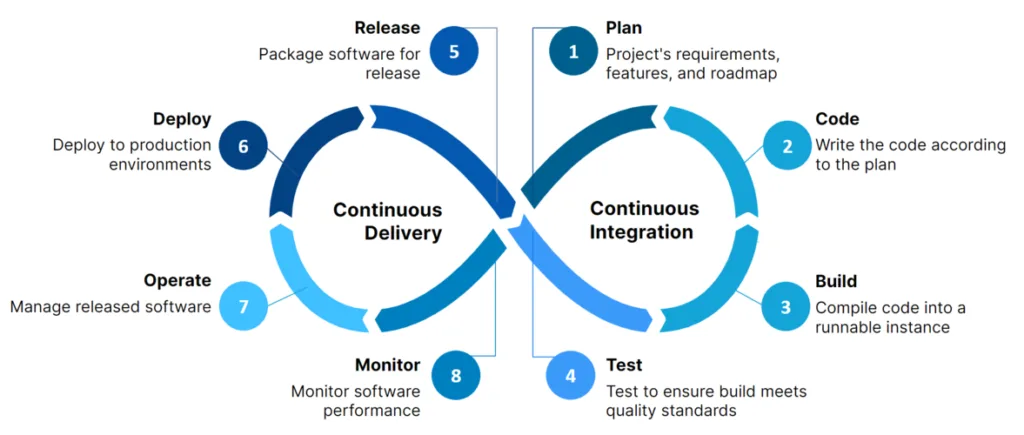
Understanding CI/CD requires breaking down the pipeline into its functional halves. While often grouped together, they solve different parts of the development puzzle.
What is Continuous Integration (CI)?
CI is the practice of merging all developer working copies to a shared mainline several times a day. It’s designed to prevent “integration hell”—the nightmare that occurs when developers wait weeks to merge their code, only to find hundreds of conflicting changes.
- Frequent Merges: Small, incremental updates make it easier to identify which specific change caused a failure.
- Automated Testing: Every commit triggers a series of tests. If the build “breaks,” the team is notified immediately.
- Consistency: By building the code in a clean environment every time, you ensure that the software works on more than just “the developer’s machine.”
What is CD? (Delivery vs. Deployment)
The “CD” can represent two different levels of automation:
- Continuous Delivery: The code is always in a “release-ready” state. It passes through automated testing and staging environments, but the final push to production is a business decision triggered manually.
- Continuous Deployment: Every change that passes the automated stages of the pipeline is automatically released to production. There is no human intervention between a “pass” and a “live” update.
2. The Strategic Importance of CI/CD
Why has this become the industry standard? Because it addresses the core inefficiencies of traditional “Waterfall” or manual development.
- Accelerated Time-to-Market: Features reach customers in hours or days rather than months, allowing businesses to pivot quickly.
- Superior Code Quality: With automated unit, integration, and security tests running constantly, bugs are caught in the “nursery” rather than the “wild.”
- Seamless Collaboration: CI/CD fosters a DevOps culture, breaking down silos between developers who write code and operations teams who maintain it.
- Reliability through Automation: Humans are prone to error during repetitive tasks like manual server configuration. Scripts and automation are not.
- Data-Driven Feedback: Faster releases mean faster user feedback, allowing product teams to iterate based on real-world usage data.
Read more Blogs : Hands-Free Deployment: Achieving Seamless CI/CD Pipeline Automation
3. Comparing CI/CD Implementation Model
| Feature | Continuous Integration | Continuous Delivery | Continuous Deployment |
| Primary Goal | Error-free code merging | Release-ready artifacts | Instant user value |
| Automation Level | Build and Test only | Build, Test, and Staging | Fully Automated to Production |
| Human Intervention | Required for fixes | Required for final release | None (unless tests fail) |
| Risk Level | Low | Moderate | Higher (requires robust tests) |
4. The Anatomy of a CI/CD Pipeline
To build a professional-grade pipeline, you must integrate these five core components:
- Version Control (The Foundation): Systems like Git (GitHub, GitLab, Bitbucket) track every change and act as the trigger for the entire pipeline.
- Build Automation: Tools like Maven, Gradle, or Webpack package the code into executable formats or containers (like Docker).
- Automated Testing Suite: This must include Unit Tests (individual parts), Integration Tests (how parts work together), and Regression Tests (ensuring old features don’t break).
- Artifact Repository: Once a build is successful, the “artifact” (the versioned software package) is stored in a secure repository like JFrog Artifactory or Amazon ECR.
- Deployment & Orchestration: Tools like Kubernetes or Terraform manage the infrastructure and ensure the software is deployed correctly across servers.
5. Industry-Leading Tools for 2026
- Jenkins: The classic, highly-extensible open-source automation server.
- GitHub Actions: Native CI/CD directly within your code repository for seamless workflow.
- GitLab CI/CD: A powerhouse for all-in-one DevOps, from planning to monitoring.
- CircleCI: Renowned for speed and optimized for cloud-native applications.
- AWS CodePipeline: Perfect for teams heavily invested in the Amazon ecosystem.
Why “Arunangshu Das” Approaches it This Way:
- Automation as a Standard: It’s about moving away from human intervention to reduce the “margin of error.”
- Predictability: The workflow is designed so that every deployment feels routine, not like a high-stakes event.
- Scalability: This framework allows a project to grow in complexity without slowing down the speed of delivery.
- Quality First: By catching bugs at the “Integration” stage, the final “Deployment” remains premium and professional.
Read more blogs: How to Use Copilot in Software Testing
Conclusion
CI/CD has transformed the software development landscape, enabling faster, more reliable, and higher-quality releases. By integrating and deploying code changes continuously, teams can respond to feedback, reduce errors, and build more collaborative development environments. For organizations looking to stay competitive, adopting CI/CD practices is not just an option—it’s a necessity.
Incorporating CI/CD requires a mindset shift and commitment to automation and continuous improvement. However, the benefits of CI/CD, from faster release cycles to improved collaboration, make it an invaluable tool for modern software development. Whether you’re a small team or a large enterprise, embracing CI/CD can help you deliver better software and exceed user expectations.
Frequently Asked Questions (FAQs)
What is the main difference between CI and CD?
CI (Continuous Integration) focuses on the early stages of the pipeline—merging and testing code. CD (Delivery/Deployment) focuses on the later stages—getting that tested code into the hands of users.
Can we have CD without CI?
Technically, you could automate deployment without automated testing (CI), but it would be extremely risky. CI provides the confidence required to make CD possible.
Does CI/CD require a DevOps culture?
While they are often discussed together, CI/CD is a set of technical practices, whereas DevOps is a cultural philosophy. However, CI/CD is considered the “backbone” that allows a DevOps culture to thrive.
Is CI/CD only for large enterprises?
Not at all. Small teams actually benefit more from CI/CD because it allows them to move as fast as larger competitors without needing a massive QA or Operations department.
