


Introduction – Why Legal Work Is Ready for Agentic Automation
Law firms are under the current strain. The sales, procurement, HR and compliance volumes of contracts are increasing but the legal departments are supposed to work more rapidly without the need to increase the workforce. A lot of the time spent by a lawyer is still in the monotony of negotiating similar contracts, checking template clauses and negotiating long contracts and summarizing them to business groups. The standard legal automation tools assist in formatting or storing, but they fail to go far beyond that.
Here the legal agents come into action. Legal based on AI developments in technologies used in the legal industry are the next solution to static automation, as they are goal-focused systems that serve to adapt to evolving conditions. These agents do more than just store documents or even provide templates, and instead of just drafting, reviewing, and summarizing contracts, they provide contextual information on a contract. Imagine them as legal assistants who will never tire but will make the human judgment stay in control of the working process.
Understanding Legal Agents
Definition of Legal Agents
Legal agents are law-specific, goal-oriented AI programs that can be configured to handle specific law-related tasks, including contract drafting, contract review, and contract summarization. They are not trained or programmed like generic AI-based tools and are developed to interpret legal terms, intent of a contract, legal particularities and corporate rules.
Legal are at the bottom line a combination of legal principles of automation and high-level reasoning. They are not substituted to lawyers, but rather they have limitations, policies and approval processes that make them reliable and accountable.
How Legal Agents Differ from Chatbots
The popular perception is that law are merely sophisticated chatbots. As a matter of fact, chatbots are isolated prompt-reactors whereas AI legal agents are workflow pursuers. A legal agent is capable of creating a contract, running clauses against an internal playbook, pointing out risks, creating a summary, and directing the output to the approving authority in a single process.
Goal-Oriented vs Rule-Based Automation
Classical legal instruments are based on rulebooks: Flag it when you see X. Legal agents go further. They reason over context. As an example, a liability provision can be permissible in one jurisdiction and dangerous in another. Legal are more flexible than rule-based systems because they change their output, depending on the goals.
Legal Agents vs Traditional Legal Tools
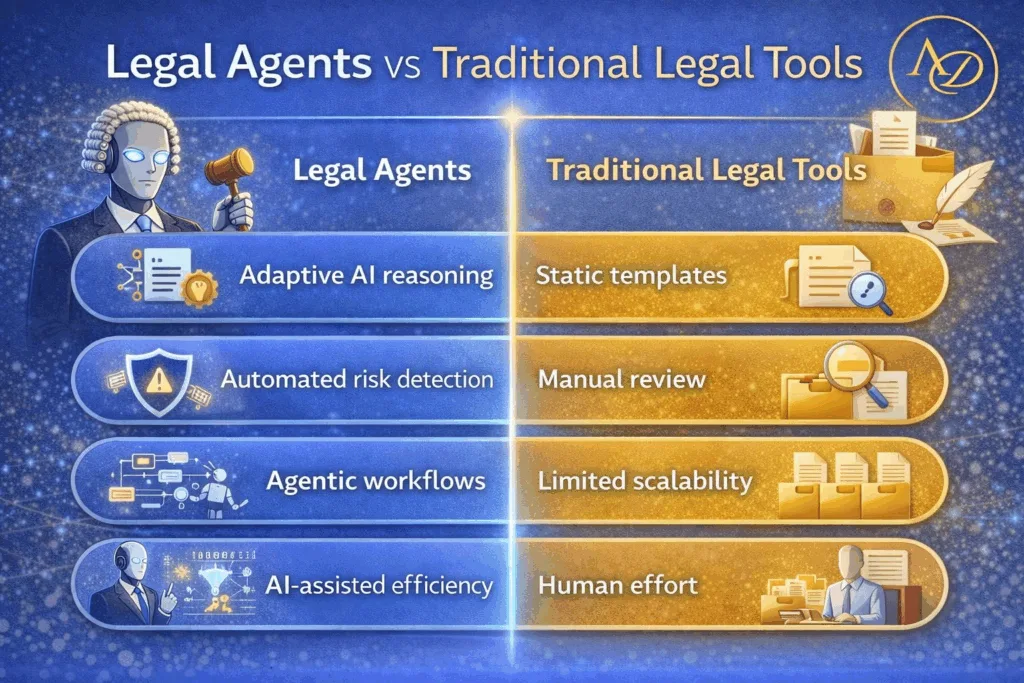
The use of traditional tools such as document templates, libraries of clauses and contract management software has existed over the years. They save manual labor and still make lawyers do the hard part of work – selecting clauses, understanding words and identifying risks.
This is transformed by legal agents. The agent produces a complete first draft which is in line with the internal policies instead of seeking the services of a lawyer to compile a contract bit by bit. The agent does not have to go through each clause one by one because he emphasizes the deviations and the reason why they should be noticed. This automation in legal documents to smart assistance is a significant step in the right direction.
| Feature | Traditional Legal Tools | Legal Agents |
| Adaptability | Low | High |
| Context Awareness | Limited | Strong |
| Workflow Automation | Minimal | End-to-end |
| Learning from Past Contracts | No | Yes |
| Human Oversight | Required | Built-in |
Core Capabilities of Legal Agents
Drafting Contracts with Legal Agents
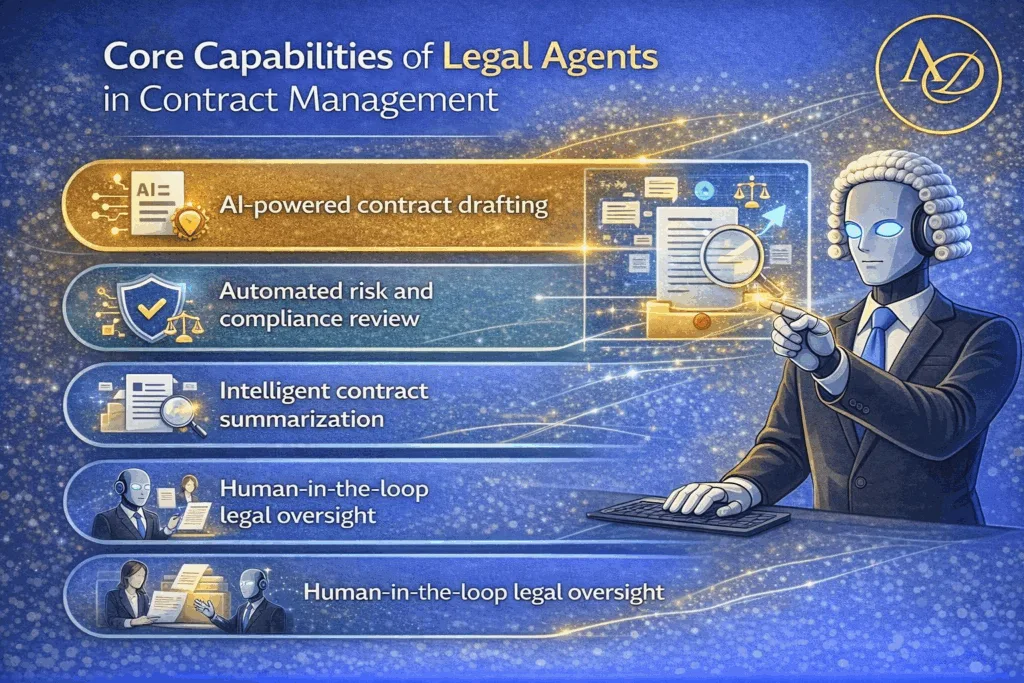
AI contract drafting is one of the most effective uses of legal. With the assistance of structured inputs, such as deal value, jurisdiction, the type of counterparty, and internal standards, legal can create the first drafts within several minutes. They draw on accepted libraries of clauses, modify language to organizational tone, and make sure that the internal policies are adhered to.
As an illustration, a sales team asking to receive an NDA does not have to wait days. An agent of the law generates an obedient draft immediately, which enables the lawyers to concentrate on negotiation, not on boilerplate.
Reviewing Contracts for Risk and Compliance
Another field of legal drafting where AI artificial intelligence excels is in contract review. Third-party contracts are analyzed by legal to discover dangerous terms, omissions, and non-conformance. They compare documents with internal playbooks and point out deviations with explanations.
This AI contract review layer serves as a second pair of eyes, which is reliable, quick, and inexhaustible, but human lawyers make the final decisions.
Summarizing Contracts for Faster Decision-Making
Executives do not have time to read 40 page contracts. Legal agents address it by producing organized summaries based on obligations, deadlines, renewal terms, penalties, and risks. Such summaries of legal documents allow making more informed decisions quicker and without simplification of the key information.
How Legal Agents Work Under the Hood
Large language models, legal knowledge bases, libraries of clauses, and workflow engines are combined to serve as power sources to legal. Modern systems are mostly based on agentic workflows of AI which are used to decompose tasks into steps and then perform them rationally.
One of the techniques is retrieval-augmented generation (RAG). The agent retrieves the pertinent internal documents (not model memory) as sources of grounding (past contracts or legal playbooks) and combines them with the memory. This will enhance precision and minimize the risk of hallucinating.
By keeping a human-in-the-loop, it is possible to ensure that the outputs undergo review and are then executed to ensure there is trust and accountability in the use of legal AI software.
Key Use Cases Across Industries
Law firms are not the only legal agents. They are used by enterprises to hasten the process of vendor onboarding, review procurement contracts, and compliance. They are used by the HR to enter employment contracts and startups to manage large-scale legal operations without employing substantial teams.
Legal in law firms assist in the due diligence, the analysis of a contract, and the review of documents, all of which do not place a premium on creative legal strategy.
Benefits of Using Legal Agents
Legal agents have more than just speed benefits. They enhance uniformity on contracts, minimise the operational costs, and augment visibility of risks. They are able to deal with repetitive work and leave lawyers to negotiate, strategize, and make difficult judgments.
This is similar to the trend where AI sales agents are enhancing their lead qualification, AI marketing automation is maximizing campaigns, and AI agents in the finance sphere are managing reconciliations and forecasting. In the world of industries, productivity is being redefined by agentic AI.
Limitations and Ethical Considerations
Legal are not perfect regardless of their promise. Among the risks are the interpretations that are hallucinated, jurisdiction, and the issue of confidentiality. Effective governance, safe data management, and well-defined accountability systems are all that is needed in ethical use.
It should not be legal instead of licensed professionals. The presence of human control is still necessary to be accurate, fair and meet the legal standards.
Best Practices for Implementing Legal Agents
The implementation process begins with small, low-risk applications like NDAs or contract summaries. Organizations must establish explicit guardrails, approval programs, and monitoring procedures. The continuity and trust ensure that it is integrated with the existing legal tools.
Scaling legal responsibly is driven by the governance structures, frequent audits and continuous improvement.
The Future of Legal Agents
The new generation of legal will be pro-active and not reactive. They will keep track of obligations, keep track of renewals, recommend renegotiations, and modify contracts with changing regulations. Although full autonomy is not highly likely to happen, the work processes of agents will become the standard in legal operations.
Conclusion
Legal agents exemplify an efficient development of legal automation, as they are fast, reliable, and possess contextual intelligence. They enable legal teams to operate effectively in a high-volume world by supplementing but not substituting human judgment. Those organizations that embrace legal agents who are also accountable achieve strategic advantage and make legal work an enabler rather than a bottleneck of the business.
FAQs
1. Are legal agents replacing lawyers?
No, The legal agents assist lawyers in performing mundane tasks as humans retain their judgment and decision-making powers.
2. How accurate are legal agents?
The accuracy relies on the quality of the data, governance and human control. They are aimed to support, not to make decisions.
3. Can small businesses use legal agents?
Yes, Legal agents assist startups and small businesses to launch legal operations without massive teams.
4. Are legal agents secure?
They observe high data privacy and security when done properly.
5. How do legal agents compare to other AI agents?
Similar to AI sales agents, AI marketing automation, and legal agents of the financial field, legal agents are aimed at efficiency, consistency, and decision support in their field.
