

Introduction: Why Traditional Sales Execution Is Breaking at Scale
Sales used to be simple. List of leads, some emails, some calls, and some hard work of CRM. That playbook was functional in small team setups and pipelines that are controllable. However, the scale is all different.
The contemporary teams in sales are submerged in manual cold outreach, ad hoc CRM updates, and extremely slow follow-ups. Reps are supposed to customize emails, change deal status, make notes, call at an opportune time, and close revenue. It is as though you are asking a single individual to carry a torch on a unicycle and juggle flaming torches, at first everything works out fine, but after a time one of the torches falls down.
The execution of sales that is dependent on humans generates gaps in data, leakage in pipelines, lost opportunities and burnouts. No deals failure is due to unwell intention, but rather no one timely followed up. The CRM data is not reliable as they are not updated at all or the delay in updating makes it unreliable. It becomes a matter of speculation.
This is the point where sales come in.
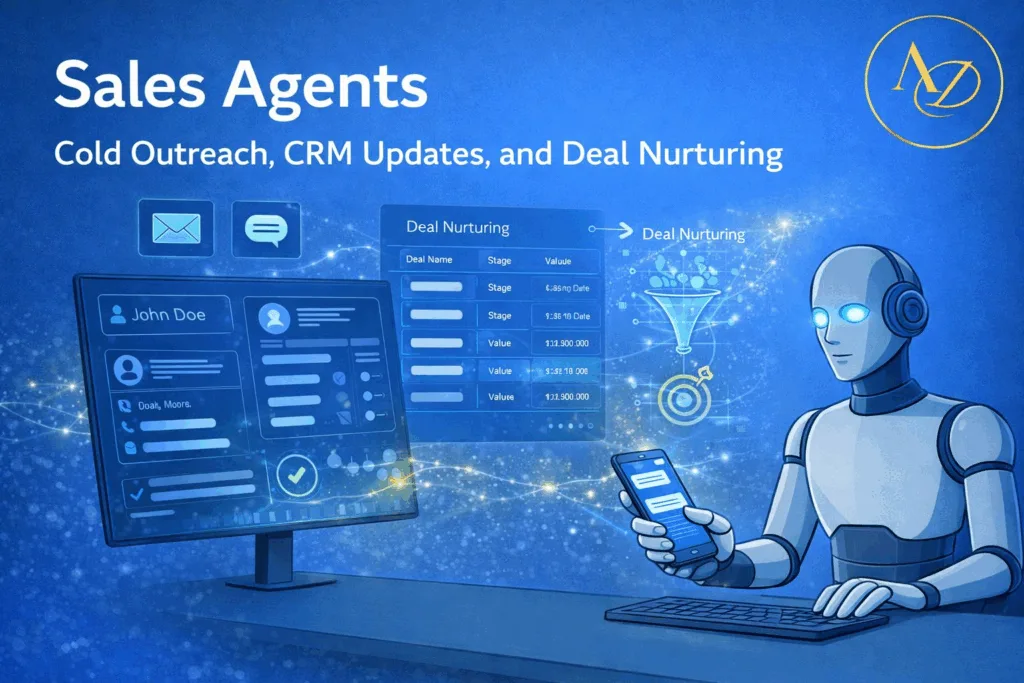
Sales agents are autonomous systems, which are aimed at running sales workflows in a continuous manner. They do not exhaust, forget follow-ups, and CRM updates. They instead do outreach, engagement tracking, system updates, and deal nurturing, making conversion efficiency at scale better with AI sales automation, autonomous sales workflows, and AI sales capable of actually thinking before they take action.
What Are Sales Agents? From Assistive Tools to Autonomous Revenue Workflows
Sales are AI-powered, goal-oriented frameworks, which program, screen, and streamline sales functions in email, CRM, calendars, and communication channels.
Sales agents have a purpose unlike in traditional tools which wait until given instructions. It is a goal defined by you: book meetings, progress deals, clean pipeline and the calculates how to accomplish it.
They entail a combination of reasoning, memory, context, and decision-making. This enables them to be flexible on prospect behavior, timing and deal health.
How Sales Agents Think and Act
Sales agents see signals (opens, clicks, replies, silence), infer intent, make the next move, perform it and learn. This loop distinguishes them radically as compared to simple automation.
They sit at the center of ai workflow automation, connected to an Ai Agent Stack that includes data sources, communication tools, CRMs, and analytics engines. This stack enables true autonomy instead of scripted actions.
Sales Agents vs Chatbots
Chatbots react. Sales plan.
Chatbots reply to inquiries. Sales take deals on the initiative. They recollect about the previous experiences, comprehend about funnel stages and change behavior. This is the reason why they are commonly known as agentic sales AI or autonomous sales systems as opposed to tools.
Sales Agents vs Traditional Sales Automation Tools
The conventional sales automation is based on fixed rules:
- Send Email B in case of no response within 3 days.
- That reasoning fails the moment a shift in buyer behavior takes place.
Why Rule-Based Automation Falls Short
Sequences which are based on rules do not comprehend context. They are not in a position to know whether a prospect opened an email five times and failed to respond. They do not stop when one clicks a price link. When intent spikes, they do not escalate.
This is where sales automation and AI agents come to actual terms. Old fashioned tools implement instructions in a blind manner. The sales agents react and decide based on cues.
Static Workflows vs Dynamic Decision-Making
Dynamically changing agents modify the timing, tone and channel of outreach and escalation according to real-time interaction. They address the ancient issue of CRM automation limitation through a constant synchronization of actions and data within systems.
Core Capabilities of Sales Agents
Cold outreach does not work when it is cold.
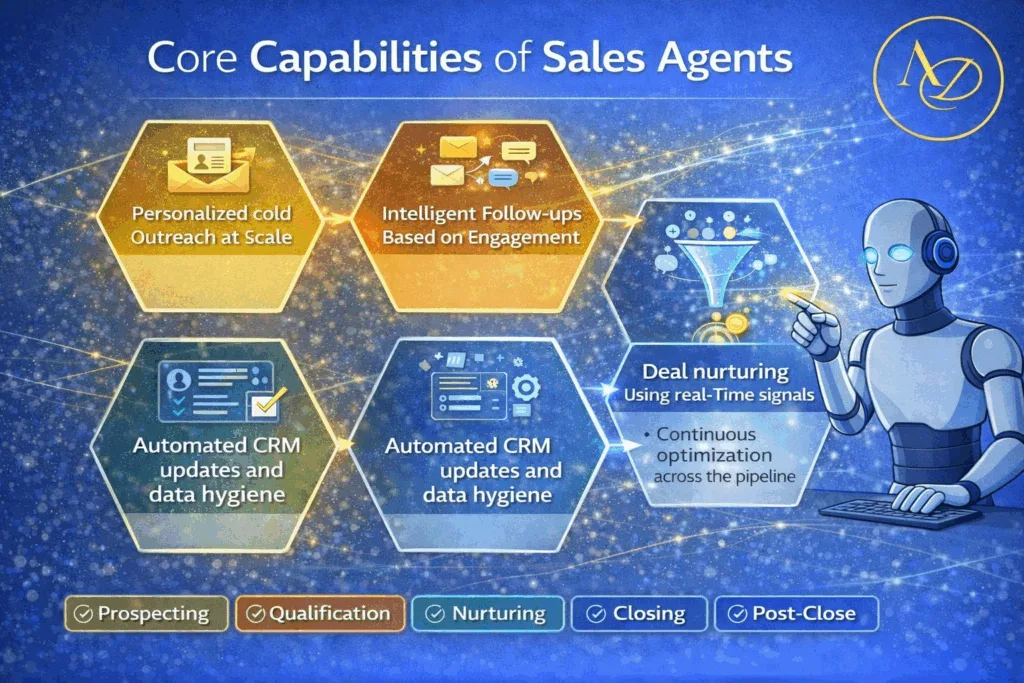
The solution to this is being given by sales agents who create prospect-specific messages based on firmographics, intent data, job roles and past responsiveness. Even in large scale, each message seems to be addressed to an individual.
They handle AI cold outreach in email, LinkedIn, and message platforms, and change tone and value propositions under different audience segments. This renders automated prospecting more human and not robotic.
Suppose an agent treats a startup founder and enterprise procurement head differently with outreach- this is automatic.
Intelligent Follow-Ups and Response Handling
Deals are won or lost during follow-ups.
Sales agents track opens and clicks, replies and even silence. No one disregards the silence: everything is interpreted. Agents will determine the actions to take, based on engagement signals, to follow up, pause, transfer the conversation with a human rep, or switch the message.
Such a practice changes the AI follow-up practice to a live interaction system. Rather than poking prospects, agents act smartly enhancing sales response rate and the conversion in general.
Automated CRM Updates and Pipeline Hygiene
CRMs can only be as good up to the data they contain, and updating them manually is the lowest of lows.
Email, calls, notes, meetings, and changes of stage are automatically logged by sales agents. All the interactions are recorded without human intervention. This guarantees clean data, proper forecasting and dependable reporting.
This is achieved by automated CRM updates which help the agents remove the aspect of the administration, but enhance the pipeline visibility. These CRM AI agents are the unseen drivers that make the revenue systems healthy.
Deal Nurturing and Pipeline Progression
Not all of the deals will be prepared to close today.
Sales agents foster opportunities by reminding, posting information, printing appointments, and re-inspiring stalled deals with deal health indicators.
They detect risk in good time and take action before it is too late. This transforms the automation of deal nurturing into an active process and provides pipelines with living systems instead of dead lists.
How Sales Agents Operate Across the Sales Funnel
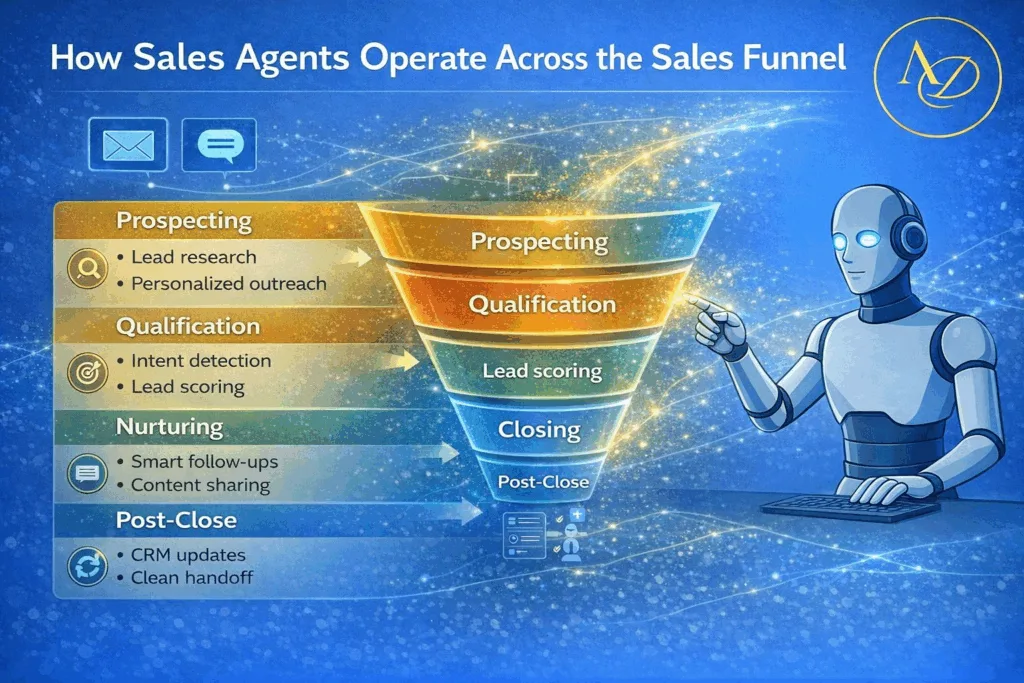
| Funnel Stage | Agent Actions | Business Impact |
| Prospecting | Lead research, outreach creation | Higher reply rates |
| Qualification | Intent detection, scoring | Better lead quality |
| Nurturing | Follow-ups, content sharing | Faster deal movement |
| Closing | Time management, objections management | Improved close rates |
| Post-Close | CRM updates, customer handoff | Cleaner data and retention |
The sales agents play the role of a connective tissue throughout the funnel and no stage is overlooked.
Real-World Use Cases of Sales Agents
B2B SaaS
Outbound prospecting, demo booking, and pipeline nurturing are all done outbound using sales agents by SaaS companies. The first-touch outreach and follow-ups are managed by agents, whereas the reps concentrate on the high-intent conversations.
Agencies and Services
The marketing and consulting firms send their agents to re-contact previous leads, filter the incoming requests, and handle CRM clean-up. This reduces the sales cycles and maximizes utilization.
Real Estate and Enterprise Sales
In complicated sales settings, agents observe lengthy sale cycles, initiate reminders and remain engaged throughout months something that humans do not always manage.
These sales AI use cases show how AI agents for business unlock efficiency across industries.
Benefits of Using Sales Agents for Revenue Teams
The sales representatives minimize the operational burden and enhance uniformity. They allow them to perform sales 24/7 without new hires.
Key benefits include:
- Faster response times
- Better data accuracy
- Expansions without burnouts
- Smooth flow of pipelines
With the sales productivity AI combined with scalable sales operations, teams can optimize AI revenue without personalization loss.
Risks, Limitations, and Human Oversight
Uncontrolled over-automation may result in fatigue of messages, compliance risk and dilution of brands.
Where Humans Still Matter
Even high value deals should be done by humans. That is why effective groups have guardrails, approvals and review loops. The ethical use, openness, and regulation are the key points in implementing AI governance in sales.
Sales representatives complement humans they do not substitute them.
How to Implement Sales Agents Successfully
Start narrow. Select a workflow: such as follow-ups or CRM updates. Combine agents and existing tools. Define clear goals. Measure performance.
Expand into outreach, nurturing and forecasting over time. Giving constant feedback will prepare agents to be better.
The deployment will require an effective sales automation approach and a well-integrated Ai Agent Stack to succeed.
Future of Sales Agents: From Execution to Revenue Intelligence
The sales agents are becoming much more than execution. The future is autonomous revenue operators which maximise real-time pricing, forecasting and account strategy.
The future of autonomous revenue systems and agentic sales platforms is characterized by this shift of automating tasks to result-oriented systems.
Conclusion: Sales Execution Is Becoming Agent-Driven
The sales agents are redefining cold outreach, CRM management, and deal nurturing. They introduce speed, accuracy and consistency to revenue teams that have problems with scale.
Companies implementing agent-based business processes have a competitive edge that is extremely decisive: They can sell smarter, go faster, and grow like Teflon coats. Sales implementation is no longer an automated thing. It’s intelligent.
FAQs
1. What are sales agents in simple terms?
Sales agents are artificial intelligence (AI) systems engaged in independent, automated sales actions such as outreach, follow-ups, and CRM updates.
2. Are sales agents better than traditional automation?
Yes, since they are dynamically adjusted depending on the behavior of the prospect and context of the deals.
3. Can sales agents replace human sales reps?
No, They supplement human reps by doing routine work with the humans being able to work on the relationships and strategy.
4. Are sales agents suitable for small businesses?
Absolutely, They can be used to have small teams grow without adding more people.
5. How long does it take to see results?
The response rates, the pipeline hygiene, and efficiency improve in most teams within weeks.
