


Introduction: Why Marketing Automation Is No Longer Enough
In the art of marketing, it is like playing with flaming torches. SEO tools over there, ad dashboards over there, email programs over there, and analytics in their own world. Regardless of the sophisticated AI marketing automation, the majority of teams remain stranded in assembling everything manually. One of them monitors keywords, and another puts up advertisements, and another sends e-mail, and human beings are in the middle, trying to make all the sense out of it.
Such a disjointed system instills burnout, delays in performance, and lost chances. Not all campaigns can be stopped as ideas are not bad, but as implementation is overloaded with manual coordination. In this very place marketing come into play.
Unlike traditional tools, marketing don’t wait for instructions. They plan, execute, monitor, and optimize campaigns across the entire funnel on their own. Think of them less like assistants and more like autonomous teammates powered by AI agents for business
What Are Marketing Agents?
Marketing are AI-based, goal-focused systems, intended to perform intricate marketing procedures on SEO, content, advertisement, CRM, and analytics platforms. They constantly improve via reasoning, context, and looped feedback, as opposed to just a player being subjected to fixed rules.
How Marketing Agents Think and Act
An agent of marketing does not simply do SEO. It knows the objective, e.g. more qualified leads. Then it calculates the way to go there. This can be the release of new material, better internal search, redistribution of advertising funds, or the change of email messages depending on customer actions.
This is what distinguishes autonomous marketing and simple automation. They don’t just execute steps. What steps are important is up to them.
Marketing Agents vs AI Tools
The majority of AI tools require intervention by humans. You prompt, they respond. Marketing on the other hand work on their own. They monitor performance, learn through the results and change strategies without micromanagement. It is this transformation that has been dubbed agentic marketing AI.
Marketing Agents vs Traditional Marketing Automation
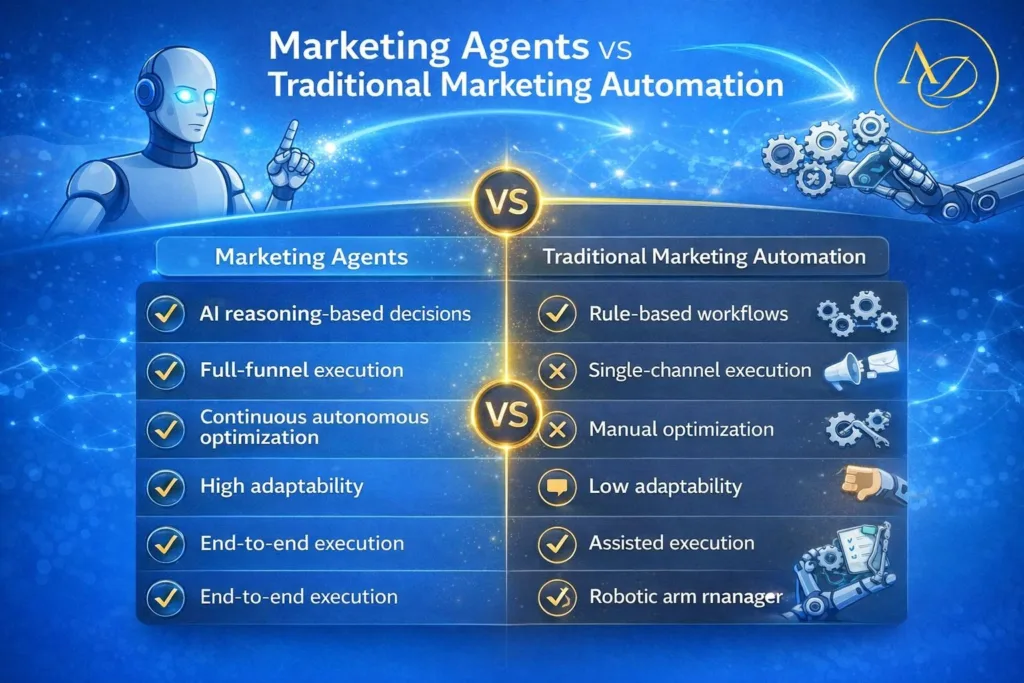
The conventional automation assisted the marketer to scale repetitive activities but it reached a limit in a short period of time. Workflows that are based on rules are broken when the moment conditions are altered.
Key Differences in Decision-Making
Automation reacts, reason. Automation will email upon receiving a condition. A marketing agent will question on the effectiveness of sending that email at this point in time in enhancing a probability of conversion.
Comparison Table: Automation vs Agents
| Aspect | Traditional Marketing Automation | Marketing Agents |
| Decision Making | Rule-based | AI reasoning-based |
| Scope | Single channel | Full-funnel |
| Optimization | Manual | Continuous & autonomous |
| Adaptability | Low | High |
| Execution | Assisted | End-to-end |
This is the jump that is causing the use of autonomous marketing workflows to substitute fixed automation stacks.
Core Capabilities of Marketing
Autonomous SEO Execution
SEO is no longer a matter of keywords, but systems. AI SEO manage all the stages of the research process to the optimization without supervision.
Keyword Research and Content Gaps
Marketing interpret search patterns, content of competitors and ranking statistics to discover opportunities that would not be noticed by humans. They do not use volume as a criterion, but conversion potential and therefore automation of SEO is much more strategic with the use of AI.
Technical SEO and Continuous Optimization
Agents check the health of the sites, crawling errors, page loading time and internal linkage in real-time. As soon as the rankings fall, they do not wait to be reported, they take action.
Content Creation and Distribution
Creation of content was linear. Now it’s cyclical. Marketing create briefs, develop content, improve on-page search engines and publish posts on blogs, email and social media.
Feedback is what makes AI content marketing powerful in this case. Engagement, rankings and conversions are analyzed by the and automatically refined by automated content distribution to make the content more continual.
Paid Ads and Performance Marketing Automation
It is tiresome to coordinate advertisements on different platforms. It is simplified by marketing agents who are in charge of creatives, bidding and budget allocation on Google Ads, Meta Ads, etc.
They keep an eye on ROI indicators and move the budgets over time. It is the best form of performance marketing AI, there are no emotional factors, but rather AI campaign management, which involves execution, based on the data.
Lead Nurturing and CRM Orchestration
Leads do not turn into straight lines. Marketing agents follow behavior and personalize messages, and they also start email workflows automatically. They will update CRM without the human intervention to maintain clean data and improved segmentation.
As AI lead cultivates and markets CRM automation, agents use intent-driven optimization of every touchpoint rather than guesswork.
Full-Funnel Attribution and Optimization
Attribution is never very clean. This is solved by marketing agents, who will monitor the users up to the conversion page. They prioritize lifetime value with AI attribution models and full-funnel marketing automation instead of maximizing their individual metrics.
How Marketing Agents Execute the Full Funnel
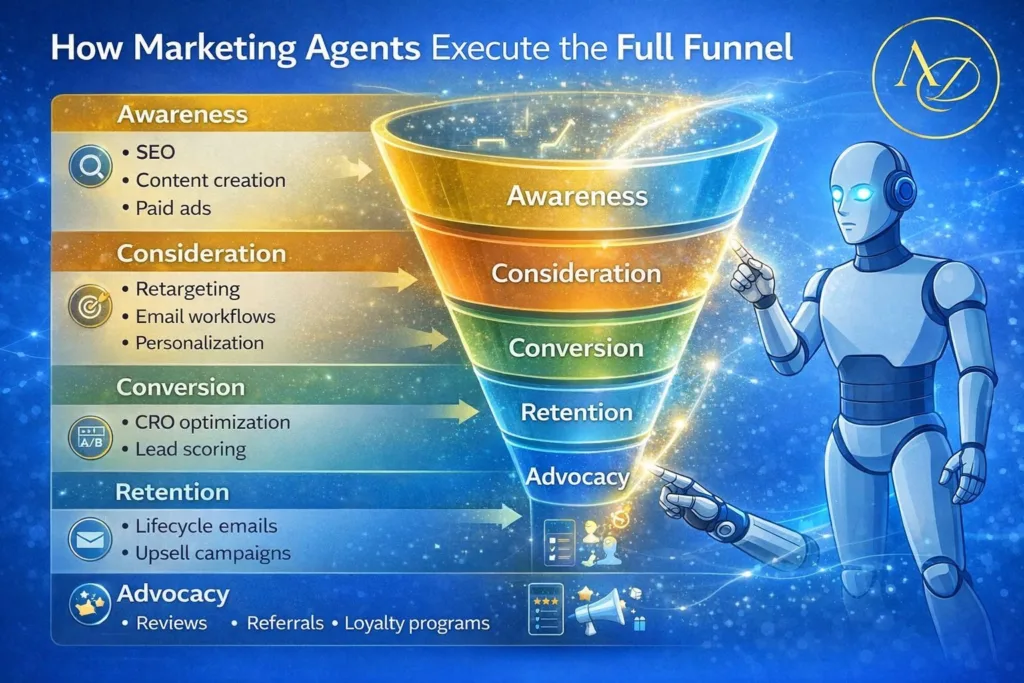
Marketing agents do not silo-think. They think in funnels.
| Funnel Stage | Agent Responsibilities |
| Awareness | SEO, content creation, ads |
| Consideration | Retargeting, email workflow, content personalization |
| Conversion | Lead scoring, CRO optimization |
| Retention | Lifecycle messages, upsell messages |
| Advocacy | Loyalty programs, Reviews, referrals |
The stages are self-improving, with one stage feeding the other.
Real-World Use Cases of Marketing Agents
SaaS Growth Teams
Artificial intelligence growth agents are set up by SaaS companies to operate constantly-on acquisition engines. Agents are test landing pages, optimization of onboarding emails and minimization of churn with a small huge team.
Ecommerce Brands
In the case of ecommerce, marketing agents automate product releases, handle advertising, streamline category pages and customize the post purchase experiences. This stage of performance could not be done manually.
Marketing Agencies
Agencies are using autonomous marketing systems to serve several clients using a limited number of resources. Execution is managed by agents whereas the strategy and relationships are addressed by humans.
Benefits of Using Marketing Agents
Scalability is achieved by marketing agents without anarchy. They facilitate quicker experimentation, repeatability, lower CAC, and increase in ROI. Teams change their focus to performing tasks to overseeing results.
In the case of Ai Agents for Startups this is further potent. Startups are able to receive enterprise level execution without enterprise level budgets.
Challenges and Risks to Consider
No system is perfect. Quality of data is crucial to marketing agents. Making poor decisions is a result of poor inputs. The other concern is AI data privacy since it requires the brand to use it ethically and legally.
Uncontrolled over-automation may water down brand voice. The creativity, the ethics, and the vision of the long term all require human supervision.
The Future of Marketing Teams in an Agent-Driven World
The positions of marketing are changing. Operators turn to architects. Systems are designed by the teams rather than tasks executed. Outcome-based marketing substitutes channel-based thinking, which defines the future of marketing automation and AI marketing teams.
Conclusion: From Campaign Managers to Marketing Architects
The appearance of the execution is re-determined by marketing agents. They work independently of each other, with respect to SEO and content, and ads and CRM. The companies that are capable of designing, training and deploying marketing agents will have competitive advantage.
FAQs
1. What makes marketing agents different from automation tools?
Marketing agents are rational, versatile, and take the best decisions, whereas automation is based on set rules.
2. Are marketing agents suitable for small businesses?
Yes, particularly, Start-Up Ai Agents since they decrease human workforce and expenses.
3. Do marketing agents replace human marketers?
No, they transform human beings into creative and strategic positions.
4. How do marketing agents handle data privacy?
By making it compliant and using AI data privacy rules.
5. Can marketing agents manage the entire funnel alone?
They are capable of implementing end to end, although human control would provide compliance with brand and ethics.
