


At a surface level, SaaS applications feel simple. A user logs in, navigates a dashboard, and completes tasks without thinking about what powers the experience. But beneath that simplicity lies a carefully orchestrated architecture that determines how the system scales, how reliably it performs, and how sustainably it supports growth.
For engineering leaders, SaaS architecture is not just about infrastructure. It is a strategic decision-making layer that directly influences development speed, operational efficiency, and long-term cost structures. Every architectural choice shapes how a product evolves under real-world conditions.
To understand SaaS architecture properly, not be viewed as independent components, but as a connected system where user interaction, service execution, and data processing operate as a continuous flow.
Key Takeaways
- What it Is: SaaS architecture hosts applications centrally in the cloud, removing infrastructure management and update overhead entirely from the customer.
- The Multi-Tenancy Balance: Serving multiple customers (tenants) on shared infrastructure requires strict access controls. Platforms choose between Siloed (dedicated instances), Pooled (shared instances with row-level security), or Hybrid models.
- The 4-Layer System:
- Edge Layer: Uses CDNs and WAFs to reduce latency and block security threats.
- API Gateway: Authenticates requests and uses rate-limiting to prevent “noisy neighbor” speed issues.
- Application Layer: Runs independent, stateless microservices (often via Kubernetes) for zero-downtime updates.
- Data Layer: Isolates tenant data and splits daily transactions from heavy analytics (using patterns like CQRS and Kafka) to avoid bottlenecks.
- Strategic Growth: Scalability must be paired with cost-awareness (like using reserved instances and automated scaling) to ensure that growing user demand doesn’t erase profit margins.
Also Read:- 9 Best Analytics Software for Startups and SaaS Companies
What Is SaaS Architecture?
SaaS (Software-as-a-Service) architecture refers to a model where applications are hosted centrally in the cloud and delivered to users over the internet. Instead of installing software locally, users interact with a shared system through browsers or APIs, while the provider manages everything behind the scenes.
This way, organizations no longer need to manage infrastructure or handle updates. Instead, they subscribe to a service that continuously evolves without disruption.
To understand it better, it helps to distinguish SaaS from other cloud models:
- Infrastructure-as-a-Service (IaaS) supplies raw compute, storage, and networking resources.
- Platform-as-a-Service (PaaS) provides managed environments for building and deploying applications.
- Software-as-a-Service (SaaS) delivers complete business applications with zero operational overhead for customers.
The defining factor is ownership of complexity ( infrastructure, scalability, updates, and maintenance). In SaaS, that responsibility shifts entirely to the provider.
Also Read: 9 Best Customer Support Software for SaaS Startups
How Does Multi-Tenancy Work in SaaS Architecture?
Multi-tenancy means one SaaS application serves many customers at the same time, while keeping each customer’s data separate and secure. It does this using shared infrastructure, but with strict access controls so one tenant cannot see another tenant’s information.
This approach enables efficiency and scalability, but it also introduces complexity. Data must remain isolated even though the underlying system is shared. Achieving this balance requires careful architectural design.
Architecturally, this is achieved through one of several models:
- Siloed architecture: Each tenant receives a dedicated application and database instance. High isolation, but costly and rigid.
- Pooled architecture: All tenants share a single application instance, with row-level controls enforcing data isolation. Highly efficient, but demanding in security design.
- Hybrid architecture: A mixture of shared services (e.g., authentication, reporting) and tenant-specific components (e.g., data stores or compute tiers).
Multi-tenancy depends on tenant-aware access mechanisms, such as identity tokens carrying tenant metadata, and database isolation tactics like schema-per-tenant or row-level filters. Encryption at rest and in transit, coupled with regional data residency management, ensures compliance and trust.
How SaaS Architecture Works as a Layered System
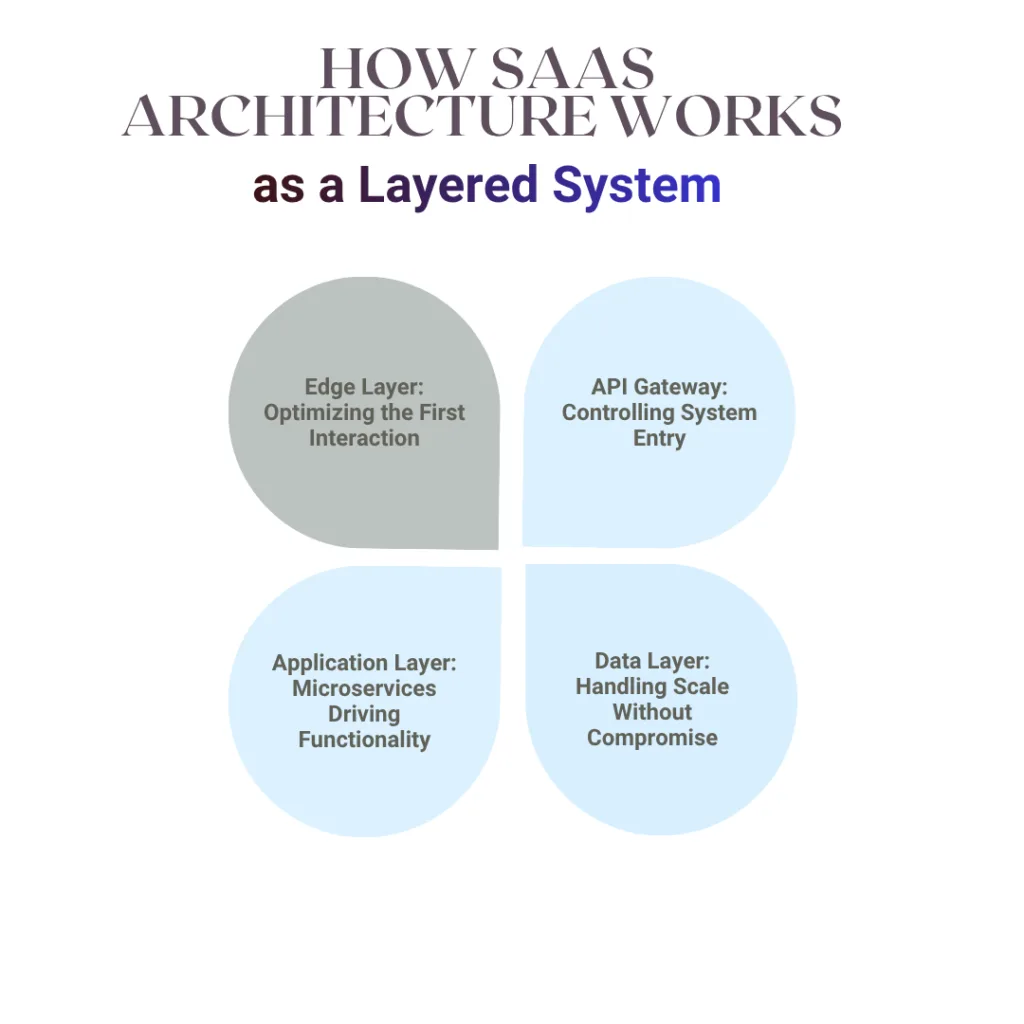
Modern SaaS platforms operate as layered architectures where each layer performs distinct responsibilities while interacting seamlessly.
| Architectural Layer | Core Responsibility | Multi-Tenancy & Data Strategy | Engineering Solution Delivered |
| 1. Edge Layer (Cloudflare, CloudFront) | Optimizing first interaction: Minimizes latency via global caching; filters malicious traffic before it hits the network. | Global routing rules; handles incoming tenant subdomains/custom domains securely. | Prevents Downtime: Mitigates DDoS attacks via WAF and handles traffic spikes seamlessly. |
| 2. API Gateway (Kong, Apigee, AWS Gateway) | Centralized Entry Point: Authenticates identity, validates requests, and routes traffic to internal microservices. | Extracts tenant metadata from identity tokens (OAuth 2.0 / OpenID Connect). | Solves “Noisy Neighbor” Issues: Enforces rate-limiting and traffic throttling per customer. |
| 3. Application Layer (Kubernetes, Istio) | Executing Business Logic: Runs isolated, stateless microservices (billing, notifications) in containerized pods. | Keeps application code shared or isolated depending on the model chosen (Siloed vs. Pooled). | Enables Zero-Downtime Updates: Uses feature flags, versioned APIs, and staged rollouts to deploy without disruptions. |
| 4. Data Layer (PostgreSQL, Redis, Kafka) | Scalable Storage & Analytics: Splits day-to-day writes from heavy analytics to prevent bottlenecks (CQRS). | Isolates data using strict row-level filters, separate database schemas, or geo-partitioned nodes. | Ensures Compliance & Performance: Offloads server strain via caching; keeps data localized for laws like GDPR. |
Edge Layer: Optimizing the First Interaction
Every request begins at the edge,composed of CDN nodes, load balancers, and Web Application Firewalls (WAF), where performance and security are addressed before the request even reaches the application.
This layer minimizes latency through content caching and global routing, while mitigating security threats via DDoS protection and TLS termination. Services like AWS CloudFront, Azure Front Door, or Cloudflare handle these optimizations automatically.
API Gateway: Controlling System Entry
As requests move inward, they pass through an API gateway, which acts as a centralized control point. This layer ensures that every request is authenticated, validated, and routed correctly.
It implements OAuth 2.0 or OpenID Connect for identity control, manages rate limiting, and enforces request validation policies. Popular implementations include Amazon API Gateway, Kong, and Apigee. Centralizing this control improves consistency across distributed services.
Application Layer: Microservices Driving Functionality
The application layer executes business logic through microservices, small, independent components often deployed in containers or Kubernetes pods. Each microservice owns a specific domain function such as billing, notifications, or analytics.
Key patterns include:
- Stateless service design to enable horizontal scaling and rolling updates.
- Service discovery via systems like Consul or Kubernetes DNS.
- Inter-service communication managed by service meshes (e.g., Istio or Linkerd) that enforce security, load balancing, and observability across traffic flows.
This modular design lets teams deploy features independently, isolate faults, and scale individual services rather than monolithic stacks.
Data Layer: Handling Scale Without Compromise
As SaaS platforms scale, data management becomes a defining factor in performance. Systems must handle large volumes of reads and writes without introducing bottlenecks.
SaaS platforms often separate transactional and analytical workloads for performance efficiency:
- Transactional data stored in distributed SQL or NoSQL databases (e.g., Amazon Aurora, PostgreSQL, MongoDB).
- Analytical reads served via replicated or cached data stores—Redis, ElasticSearch, or purpose-built data warehouses like Snowflake or BigQuery.
Advanced architectures apply the CQRS (Command Query Responsibility Segregation) pattern, splitting read and write operations through event streaming tools such as Apache Kafka or Amazon Kinesis. Event-driven design enables near-real-time updates, audit trails, and resilient recovery from faults or delays.
Also Read: Top 10 AI-Powered SaaS Tools Transforming Businesses in 2026
Designing for Scalability and Cost Efficiency
SaaS systems operate in unpredictable environments where usage patterns can change rapidly. A system that performs well under normal conditions must also handle sudden spikes without degradation.
To achieve this, scalability is built into the architecture from the beginning. Systems are designed to expand and contract dynamically based on demand, ensuring that resources are used efficiently.
However, scalability alone is not enough. Without cost control, growth can quickly erode profitability. This is why modern SaaS architectures incorporate cost-awareness as a core principle.
Effective strategies often include:
- Allocating reserved resources for predictable workloads
- Using flexible compute options for non-critical tasks
- Continuously analyzing usage patterns to optimize spend
This combination allows organizations to scale sustainably while maintaining healthy margins.
Summing Up
For modern enterprises, SaaS architecture is more than just a technical blueprint—it is a strategic lever. It directly dictates how fast teams can innovate, how reliably customers are served, and how sustainably costs scale alongside usage.
As generative AI and real-time analytics redefine cloud ecosystems, core architectural principles like modularity, isolation, observability, and scalability remain the bedrock of continuous evolution. Ultimately, the strongest architectures do more than just deliver software—they build adaptable ecosystems engineered for tomorrow’s demands.
What’s Next? Stay tuned for our next deep dive into the enterprise tech trends driving digital transformation.
Also read:- 7 SaaS Tools That Will Save You Hours Every Week
Frequently Ask Question :
1. What is the difference between multi-tenant and single-tenant SaaS architecture?
In a single-tenant architecture, each customer (tenant) gets their own dedicated software instance, database, and infrastructure, offering higher isolation and customization. In a multi-tenant architecture, multiple customers share the same application instance and database infrastructure, though their data remains logically isolated. Multi-tenancy is much more common in modern SaaS because it reduces infrastructure costs and simplifies updates.
2. Why do modern cloud applications use microservices architecture over monolithic design?
Modern cloud applications favor microservices because they break a large application down into independent, loosely coupled services. This allows development teams to scale, update, and deploy specific features (like payment processing or user authentication) independently without risking a complete application downtime. It significantly increases agility, fault tolerance, and cloud resource efficiency.
3. What are the key security and compliance standards for modern SaaS products?
Modern SaaS architectures must incorporate strict security controls to protect distributed cloud data. The primary frameworks include SOC 2 Type II (for security, availability, and confidentiality processes), ISO/IEC 27001 (for robust information security management systems), along with regulatory mandates like GDPR for data privacy and HIPAA for handling healthcare information.
4. How do SaaS architectures manage data isolation in shared cloud databases?
In shared multi-tenant environments, architectures secure data isolation through three main approaches:
Database-per-tenant: Separate database engines for complete isolation.
Schema-per-tenant: Sharing the database engine but using distinct database schemas.
Shared database, shared schema: Using a single table structure where every row contains a unique tenant_id foreign key, strictly enforced by application-level data access policies to prevent cross-tenant data leaks.
