


Bootstrapping vs VC funding for SaaS startups is a crucial decision that shapes the trajectory of a company. Choosing between self-funded growth and venture capital investment affects control, speed of scaling, and risk exposure.

Bootstrapping allows founders to retain ownership and focus on profitability, while VC funding provides capital for rapid expansion but comes with investor expectations and diluted control. Understanding the pros and cons of each approach is essential for SaaS founders to align funding strategies with their business goals, product roadmap, and long-term vision.
This article explores both funding paths, their benefits and drawbacks, and practical guidance to help startups make informed financial decisions.
Table of Contents
Understanding Bootstrapping vs VC Funding for SaaS Startups
Bootstrapping vs VC funding for SaaS startups represents two very different approaches to financing early-stage companies. Bootstrapping relies on personal savings, revenue from initial customers, or small loans to fund operations. Founders retain full ownership, make independent decisions, and grow at a pace dictated by available resources. This approach emphasizes profitability, careful spending, and gradual scaling.
Venture capital funding, on the other hand, involves raising capital from external investors who provide significant financial resources in exchange for equity. VC funding allows startups to accelerate growth, invest in marketing, hire talent, and scale operations quickly. However, it also comes with expectations for rapid returns, board oversight, and shared decision-making.
Choosing between these options depends on several factors: the startup’s market potential, the speed at which it needs to scale, the founder’s appetite for risk, and long-term strategic goals. A careful evaluation helps founders align funding decisions with business objectives and ensures sustainable growth.
Many SaaS startups even adopt a hybrid approach, combining initial bootstrapping with later VC rounds to balance control and expansion.
Pros and Cons of Bootstrapping and VC Funding

Control and Ownership
Bootstrapped founders retain full control of their SaaS startup, allowing them to make decisions without external approval. VC funding, however, often requires board seats and investor input, which can influence strategic direction and company policies.
Speed of Growth
VC funding enables rapid expansion, aggressive marketing, and quick hiring, giving startups a competitive edge. Bootstrapped startups grow more gradually, constrained by limited resources but often maintaining sustainable development.
Financial Risk and Pressure
In bootstrapping, founders assume personal financial risk but avoid external pressure. VC-backed startups face high performance expectations from investors, requiring faster revenue growth and frequent reporting.
Flexibility and Strategic Direction
Bootstrapped startups enjoy the freedom to pivot, experiment, and test new ideas without approval. In contrast, VC-funded companies may need investor consent for major decisions, balancing innovation with accountability.
Understanding these pros and cons helps SaaS founders choose a funding path aligned with their goals, risk tolerance, and growth plans.
Key Considerations When Choosing a Funding Model
Choosing between bootstrapping vs VC funding for SaaS startups is a strategic decision that impacts growth, ownership, and long-term success. Founders must evaluate multiple factors to align their funding choice with business goals.
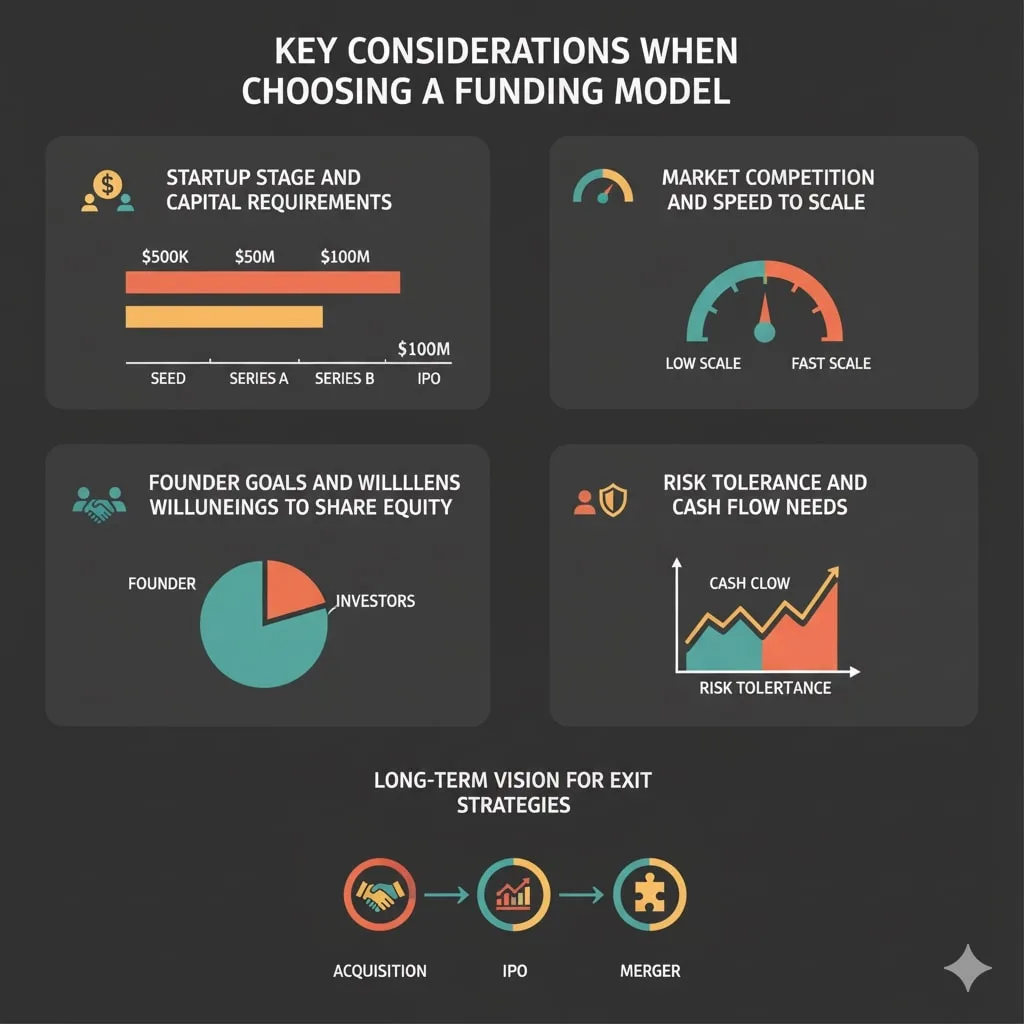
- Startup Stage and Capital Requirements
The stage of your startup largely determines which funding option is feasible. Early-stage startups with limited revenue often rely on bootstrapping to validate their product-market fit without taking on external obligations.
They can prioritize essential development, test the business model, and iterate based on early customer feedback. In contrast, startups aiming for rapid expansion, large-scale infrastructure, or national/international launches often need venture capital.
VC funding provides immediate access to significant financial resources that can accelerate product development, hiring, and go-to-market strategies.
- Market Competition and Speed to Scale
Highly competitive markets require startups to scale quickly to secure market share. Venture capital allows companies to invest aggressively in marketing, sales, and operations, giving them an edge over competitors. Bootstrapped startups, limited by self-funding, may grow more slowly and need careful prioritization to compete. While slower growth can be sustainable, it risks missing early opportunities in fast-moving industries like SaaS.
- Founder Goals and Willingness to Share Equity
Control and ownership are central to the founder’s vision. Bootstrapping lets founders retain full decision-making authority and keeps equity within the founding team.
Those who choose VC funding must be comfortable giving up a portion of ownership and decision-making power. For some founders, equity dilution is acceptable if it enables accelerated growth, access to mentorship, or strategic connections.
- Risk Tolerance and Cash Flow Needs
Bootstrapped startups assume personal financial risk, as founders often invest their savings or reinvest early revenue. This approach minimizes external pressure but can limit resources for ambitious projects. VC-backed startups, meanwhile, gain external capital, reducing personal financial exposure.
However, they face continuous scrutiny from investors, performance targets, and strict cash flow expectations, adding pressure to deliver rapid results.
- Long-Term Vision for Exit Strategies
A startup’s long-term goals influence funding decisions. Companies planning for acquisition, IPO, or rapid scale may benefit from VC guidance, industry connections, and credibility.
Bootstrapped startups often prioritize sustainable growth, profitability, and maintaining control, focusing on long-term resilience rather than quick exits. The funding choice should align with the intended trajectory of the company and the founder’s vision for its future.
Common Challenges for Bootstrapped vs VC-Funded SaaS Startups
Bootstrapped and VC-funded SaaS startups face distinct challenges that can influence growth and operational decisions. Understanding these hurdles helps founders choose the right funding path and implement effective scaling strategies.
Bootstrapped startups often struggle with self-funded growth, as limited capital constrains hiring, marketing, and infrastructure development. Teams must carefully prioritize product development and customer acquisition to avoid overextending resources. This can slow progress in competitive markets and make scaling more challenging compared to VC-backed competitors.
VC-funded startups, while benefiting from significant financial resources, face investor expectations that can create pressure on founders. Venture capitalists typically expect rapid growth, measurable performance metrics, and clear reporting. Failing to meet these expectations may lead to conflicts or reduced investor confidence, affecting strategic decisions.
Balancing growth, product improvement, and investor relations is another challenge. Bootstrapped SaaS startups must focus on sustainable funding options and efficient resource management to maintain profitability. In contrast, VC-backed companies need to integrate SaaS startup funding with investor guidance while ensuring innovation and customer satisfaction remain on track.
Both funding models require careful planning. By anticipating challenges related to venture capital, self-funded growth, and scaling strategies, SaaS founders can design resilient business plans and minimize risks associated with their chosen funding path.
How Funding Choices Shape SaaS Startup Success
The landscape of SaaS funding is evolving. Many startups are adopting hybrid funding models, combining initial bootstrapping with later VC rounds to maintain some control while accelerating growth.
Angel investments and micro-VCs are becoming more accessible, providing smaller, flexible funding options for early-stage companies. This enables founders to test markets without giving up significant equity upfront.
Feedback-driven and iterative funding strategies allow SaaS startups to optimize growth, manage cash flow, and retain decision-making flexibility. Startups that balance bootstrapped discipline with strategic external funding can scale efficiently while protecting product improvement and customer experience.
In the coming years, successful SaaS companies will increasingly leverage mixed funding strategies, aligning financial decisions with market demands, innovation goals, and founder vision. This approach fosters sustainable growth and long-term competitiveness.
FAQS
What is the biggest advantage of bootstrapping?
Complete Control and Ownership. As a bootstrapped founder, you answer only to your customers. You can build the product and company at your own pace, pursue a niche market without pressure for massive scale, and retain all equity and profits. Your company’s destiny is 100% in your hands.
Besides the money, what are the key benefits of taking VC funding?
Venture Capital brings strategic advantages: speed, credibility, and expertise. The funding lets you hire top talent, scale marketing aggressively, and outpace competitors. Additionally, a good VC partner provides a valuable network, mentorship, and operational expertise that can be crucial for navigating hyper-growth.
Is one path inherently better or more successful than the other?
Not inherently. The “best” path depends entirely on your goals, market, and personality. Bootstrapping is excellent for building a sustainable, profitable lifestyle business or a company in a niche market. VC funding is often necessary for capital-intensive ideas or winner-take-all markets where you need to scale globally and rapidly. Both are valid paths to success.

