

Preparing for a Python interview can feel challenging, especially when interviewers combine programming fundamentals, object-oriented concepts, problem-solving, and practical development scenarios. Whether you are a fresher preparing for your first Python developer interview or an experienced professional targeting a senior role, practicing the right questions can significantly improve your confidence. This guide covers frequently asked Python coding questions, Python concepts, and practical scenarios that commonly appear in a Python technical interview and Python programming interview.
Along with Python preparation, candidates often search for core java questions asked in interviews, full stack interview questions, and coding interview questions with solutions when preparing for broader software-development roles. The questions below focus primarily on Python while also helping candidates understand the programming concepts that overlap with other technology stacks.
Why Prepare for a Python Interview?
Python is widely used for web development, automation, data analysis, artificial intelligence, machine learning, scripting, and backend development. Because of its broad ecosystem, interviewers may evaluate candidates on everything from basic syntax to advanced programming concepts.
A typical interview can include:
- Python fundamentals and syntax
- Data types and collections
- Functions and modules
- Exception handling
- Object-oriented programming
- Iterators and generators
- Decorators
- File handling
- Memory management
- Multithreading and multiprocessing
- Python coding problems
- Database and API concepts
- Framework-related questions
- Real-world debugging and optimization
Top Python Interview Questions and Answers for Freshers
1. What is Python?
Python is a high-level, interpreted, general-purpose programming language known for its readable syntax and extensive standard library. It supports multiple programming paradigms, including procedural, object-oriented, and functional programming.
Python is commonly used for web applications, automation, data science, AI/ML, scripting, testing, and backend development.
2. What are the main features of Python?
Important features include:
- Easy-to-read syntax
- Interpreted execution
- Dynamic typing
- Automatic memory management
- Object-oriented programming support
- Extensive standard library
- Large third-party ecosystem
- Cross-platform compatibility
- Support for functional and procedural programming
3. What is the difference between a list and a tuple?
A list is mutable, meaning its elements can be changed after creation. A tuple is immutable.
numbers = [10, 20, 30]

numbers.append(40)

values = (10, 20, 30)
Lists are generally used when data needs to change, while tuples are useful for fixed collections of values.
4. What are mutable and immutable objects in Python?
Mutable objects can be modified after they are created. Examples include:
- List
- Dictionary
- Set
Immutable objects cannot be modified after creation. Examples include:
- Integer
- Float
- String
- Tuple
- Boolean
Understanding mutability is important when working with function arguments, references, and data structures.
5. What is a dictionary in Python?
A dictionary stores data as key-value pairs.
student = {

    "name": "Rahul",

    "age": 22,

    "course": "Python"

}

print(student["name"])
Dictionary keys must be hashable, while values can generally be of any Python type.
6. What is the difference between == and is?
== compares values, whereas is checks whether two references point to the same object.
a = [1, 2]

b = [1, 2]

print(a == b)  # True

print(a is b)  # False
This distinction is a common topic in Python technical interview discussions.
7. What are Python functions?
A function is a reusable block of code designed to perform a particular task.
def greet(name):

    return f"Hello, {name}"

print(greet("Amit"))
Functions improve code organization, readability, testing, and reusability.
8. What is a lambda function?
A lambda is a small anonymous function generally used for simple operations.
square = lambda x: x * x

print(square(5))
Lambda functions are frequently used with functions such as map(), filter(), and sorted().
9. What is list comprehension?
List comprehension provides a concise way to create lists.
squares = [x * x for x in range(1, 6)]

print(squares)
The equivalent traditional approach would use a loop to construct the list.
10. What is exception handling in Python?
Python uses try, except, else, and finally blocks to handle exceptions.
try:

    result = 10 / 0

except ZeroDivisionError:

    print("Cannot divide by zero")

finally:

    print("Execution completed")
Exception handling prevents expected runtime errors from unnecessarily terminating an application.
Python Interview Questions: Quick Revision Table
| Question | Key Concept | Short Answer |
| What is Python? | Language fundamentals | High-level, interpreted programming language |
| List vs tuple? | Data structures | Lists are mutable; tuples are immutable |
| == vs is? | Object comparison | == compares values; is compares identity |
| What is a dictionary? | Collections | Key-value data structure |
| What is a lambda? | Functional programming | Anonymous function |
| What is list comprehension? | Python syntax | Concise list creation |
| What is exception handling? | Error handling | Managing runtime exceptions |
| What is a module? | Code organization | Python file containing reusable code |
Python OOP Questions and Answers
Object-oriented programming is an important part of a Python developer interview, particularly for experienced candidates. Understanding OOP concepts such as inheritance, polymorphism, encapsulation, and abstraction is also valuable when preparing for c sharp interview questions and answers, as these concepts are fundamental to both Python and C# development.
11. What is object-oriented programming?
Object-oriented programming, or OOP, organizes software around objects that contain data and behavior.
The four commonly discussed OOP principles are:
- Encapsulation
- Inheritance
- Polymorphism
- Abstraction
12. What is a class in Python?
A class is a blueprint for creating objects.
class Employee:

    def __init__(self, name, salary):

        self.name = name

        self.salary = salary

    def display(self):

        print(self.name, self.salary)

employee = Employee("Priya", 50000)

employee.display()
13. What is an object?
An object is an instance of a class. It contains the state and behavior defined by its class.
For example, if Employee is a class, employee = Employee(“Priya”, 50000) creates an object of that class.
14. What is inheritance?
Inheritance allows one class to acquire properties and methods from another class.
class Animal:

    def speak(self):

        print("Animal speaks")

class Dog(Animal):

    def bark(self):

        print("Dog barks")

dog = Dog()

dog.speak()

dog.bark()
15. What is polymorphism?
Polymorphism allows the same interface or method name to behave differently depending on the object.
class Dog:

    def sound(self):

        return "Bark"

class Cat:

    def sound(self):

        return "Meow"

for animal in [Dog(), Cat()]:

    print(animal.sound())
16. What is encapsulation?
Encapsulation involves combining data and methods within a class and controlling how internal data is accessed.
Python uses naming conventions and mechanisms such as properties to support encapsulation.
17. What is method overriding?
Method overriding occurs when a child class provides its own implementation of a method inherited from its parent class.
class Parent:

    def show(self):

        print("Parent")

class Child(Parent):

    def show(self):

        print("Child")

obj = Child()

obj.show()
18. What is self in Python?
self refers to the current instance of a class. It is used to access instance variables and methods.
class Student:

    def __init__(self, name):

        self.name = name
Python OOP Concepts at a Glance
| OOP Concept | Meaning | Example |
| Class | Blueprint for objects | class Student: |
| Object | Instance of a class | Student(“A”) |
| Encapsulation | Bundling data and behavior | Class attributes and methods |
| Inheritance | Reusing parent functionality | class Dog(Animal) |
| Polymorphism | Same interface, different behavior | Overridden methods |
| Abstraction | Hiding unnecessary implementation details | Abstract classes |
Python Coding Questions and Answers
Coding exercises are an important part of a Python programming interview. Interviewers often use short programming tasks to evaluate logic, syntax, data structures, and problem-solving skills.
19. Write a Python program to reverse a string.
text = "Python"

reversed_text = text[::-1]

print(reversed_text)

Output:

nohtyP
20. How do you check whether a number is prime?
def is_prime(number):

    if number < 2:

        return False

    for i in range(2, int(number ** 0.5) + 1):

        if number % i == 0:

            return False

    return True

print(is_prime(17))
21. How do you find duplicate elements in a list?
numbers = [1, 2, 3, 2, 4, 5, 3]

duplicates = set()

for number in numbers:

    if numbers.count(number) > 1:

        duplicates.add(number)

print(duplicates)
For larger datasets, an approach based on a frequency dictionary or set can be more efficient.
22. How do you count character frequency in a string?
text = "python"

frequency = {}

for char in text:

    frequency[char] = frequency.get(char, 0) + 1

print(frequency)
23. How do you find the largest number in a list?
numbers = [10, 25, 7, 40, 15]

largest = max(numbers)

print(largest)
24. How do you check whether a string is a palindrome?
def is_palindrome(text):

    return text == text[::-1]

print(is_palindrome("madam"))
25. How do you remove duplicates from a list?
numbers = [1, 2, 2, 3, 4, 4, 5]

unique_numbers = list(set(numbers))

print(unique_numbers)
If the original order must be preserved, a different approach should be used.
Common Python Coding Problems
| Coding Problem | Common Approach | Difficulty |
| Reverse a string | Slicing | Easy |
| Check palindrome | String comparison | Easy |
| Find maximum value | max() or iteration | Easy |
| Count characters | Dictionary | Easy |
| Remove duplicates | Set | Easy |
| Check prime number | Iteration up to square root | Medium |
| Find duplicate values | Set/frequency map | Medium |
| Fibonacci sequence | Loop or recursion | Easy / Medium |
Python Interview Questions for Experienced Developers
Experienced candidates can expect questions that go beyond basic syntax. Interviewers may focus on performance, architecture, concurrency, memory management, testing, and real-world application development.
26. What are decorators in Python?
A decorator is a function that modifies or extends the behavior of another function without changing its source code.
def logger(func):

    def wrapper():

        print("Function started")

        func()

        print("Function completed")

    return wrapper

@logger

def greet():

    print("Hello")

greet()
Decorators are commonly used for logging, authorization, caching, instrumentation, and validation.
27. What are generators?
Generators produce values lazily using the yield keyword.
def numbers():

    for i in range(5):

        yield i

for number in numbers():

    print(number)
Generators can reduce memory usage because they do not need to store the entire sequence in memory at once.
28. What is the difference between an iterator and an iterable?
An iterable is an object that can return an iterator. An iterator implements the iterator protocol, primarily through __iter__() and __next__().
Lists, tuples, strings, and dictionaries are examples of iterables.
29. What is the Global Interpreter Lock?
The Global Interpreter Lock, commonly called the GIL, is a CPython mechanism that allows only one thread at a time to execute Python bytecode within a process.
This can affect CPU-bound multithreaded programs. For CPU-intensive workloads, multiprocessing or other approaches may be more appropriate, depending on the application.
30. What is the difference between shallow copy and deep copy?
A shallow copy creates a new outer object but may retain references to nested objects. A deep copy recursively copies nested objects.
import copy
original = [[1, 2], [3, 4]]

shallow = copy.copy(original)

deep = copy.deepcopy(original)
31. What is *args in Python?
*args allows a function to accept a variable number of positional arguments.
def total(*args):

    return sum(args)

print(total(10, 20, 30))
32. What is **kwargs?
**kwargs allows a function to accept a variable number of keyword arguments.
def display(**kwargs):

    for key, value in kwargs.items():

        print(key, value)

display(name="Amit", role="Developer")
33. What is monkey patching?
Monkey patching involves dynamically modifying or replacing attributes, functions, or methods at runtime. It can be useful in testing but should be used carefully because it can make code harder to understand and maintain.
34. How can Python application performance be improved?
Common approaches include:
- Choosing appropriate data structures
- Avoiding unnecessary loops
- Using generators for large sequences
- Caching repeated computations
- Profiling before optimizing
- Reducing unnecessary database queries
- Using asynchronous programming where appropriate
- Using multiprocessing for suitable CPU-bound workloads
- Optimizing algorithms and database access
Python Interview Preparation Compared With Other Developer Interviews
Developers often prepare for multiple technology stacks simultaneously. Python concepts such as OOP, exception handling, collections, APIs, databases, and algorithms overlap with many other development ecosystems.
For example, candidates may also encounter asp net core interview questions, java spring boot interview questions, java developer interview questions, and c sharp interview questions and answers when applying for full-stack or backend roles.
The exact framework questions will differ, but core programming concepts remain important across languages.
| Interview Area | Python | Java/Spring Boot | ASP.NET Core/C# |
| OOP | Classes, inheritance, polymorphism | Classes, interfaces, inheritance | Classes, interfaces, inheritance |
| Collections | List, tuple, set, dictionary | List, Set, Map | List, Dictionary, HashSet |
| Error Handling | Exceptions | Exceptions | Exceptions |
| Web Development | Django, Flask, FastAPI | Spring Boot | ASP.NET Core |
| APIs | REST APIs | REST/Spring MVC | Web API |
| Database | SQL/ORM libraries | JDBC/JPA/Hibernate | Entity Framework Core |
| Concurrency | Threads, multiprocessing, async | Threads, executors | Tasks, async/await |
Tips for a Successful Python Developer Interview
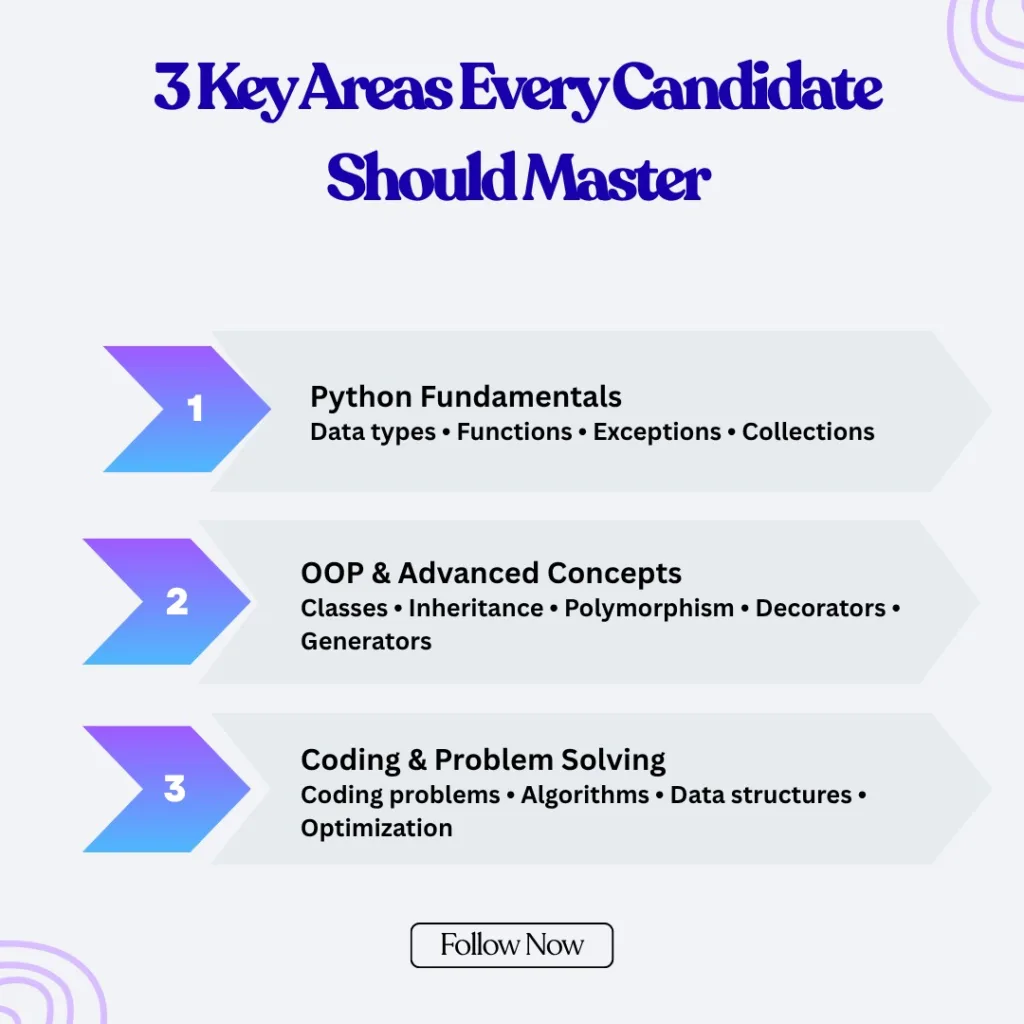
1. Master Python fundamentals
Do not skip basic concepts because interviewers frequently use them to evaluate how well you understand the language.
2. Practice coding problems
Solve problems involving strings, arrays/lists, dictionaries, sets, recursion, searching, sorting, and algorithms.
3. Understand OOP
Be prepared to explain classes, objects, inheritance, polymorphism, encapsulation, abstraction, constructors, and method overriding.
4. Know how Python works
For experienced roles, understand topics such as memory management, iterators, generators, decorators, exception handling, concurrency, and performance.
5. Explain your approach
During coding interviews, explain your thought process, assumptions, complexity, and possible edge cases before writing the final solution.
6. Prepare for practical questions
Interviewers may ask how you would design an API, optimize a slow application, handle errors, test a component, or debug a production issue.
7. Review your projects
Be ready to explain your responsibilities, architecture decisions, technologies used, challenges, and measurable results from previous projects.
Final Thoughts
Preparing for a Python technical interview requires a combination of language knowledge, coding practice, problem-solving ability, and practical development experience. Freshers should begin with Python fundamentals and basic Python coding questions, while experienced developers should also prepare for architecture, optimization, concurrency, testing, and advanced Python OOP questions.
Regularly practicing Python coding problems and explaining solutions clearly can make a major difference during interviews. If you are also targeting Java, .NET, or full-stack positions, expanding your preparation to include asp net core interview questions, java spring boot interview questions, java developer interview questions, and c sharp interview questions and answers can help you prepare for a wider range of software-development opportunities.
The goal should not be to memorize answers. Instead, understand the underlying concepts, practice implementing them, and learn how to explain your decisions clearly. That combination will help you approach both beginner and experienced-level Python interviews with greater confidence.
Frequently Asked Questions
1. Is Python easy to learn for freshers?
Yes. Python has relatively simple and readable syntax, making it accessible to beginners. However, becoming interview-ready requires more than learning syntax. Candidates should practice problem-solving, data structures, OOP, debugging, and real-world programming.
2. What Python questions are commonly asked for freshers?
Freshers are commonly asked about Python data types, lists, tuples, dictionaries, sets, functions, loops, exception handling, list comprehensions, OOP fundamentals, and basic coding problems.
3. What Python questions are asked for experienced developers?
Experienced candidates may face questions about decorators, generators, iterators, memory management, concurrency, the GIL, asynchronous programming, testing, performance optimization, architecture, APIs, and database integration.
4. How many coding problems should I practice before a Python interview?
There is no fixed number. Focus on mastering common patterns rather than memorizing solutions. A well-rounded preparation set should include strings, arrays, dictionaries, sets, sorting, searching, recursion, linked lists, stacks, queues, and basic algorithmic problems.
5. Can Python interview preparation help with other developer interviews?
Yes. Many concepts overlap across languages, including OOP, data structures, algorithms, databases, APIs, exception handling, testing, and software design. However, candidates should separately study the syntax, libraries, frameworks, and ecosystem-specific topics of the target technology.
