


Hiring managers are looking for developers who can build secure, scalable, and high-performance applications using the .NET ecosystem. Preparing with the right c# interview questions helps candidates strengthen their understanding of object-oriented programming, .NET architecture, asynchronous programming, collections, LINQ, Entity Framework, APIs, and design principles. Whether you’re a fresher or an experienced developer, reviewing practical interview scenarios can significantly improve your confidence.
Many candidates preparing for core java questions asked in interview also compare C# concepts with Java because both languages share object-oriented principles. If you’re transitioning between technologies, understanding similarities and differences will help you perform better in technical interviews.
Likewise, professionals searching for c sharp interview questions often prepare alongside java developer interview questions to broaden their backend development skills. Modern organizations frequently hire developers with experience in multiple programming languages, making cross-platform knowledge highly valuable.
If you’re also revising java spring boot interview questions, you’ll notice that concepts such as dependency injection, REST APIs, exception handling, multithreading, and microservices are equally important in .NET interviews. This guide covers beginner, intermediate, and advanced C# interview questions with practical answers.
Why C# Interview Preparation Matters
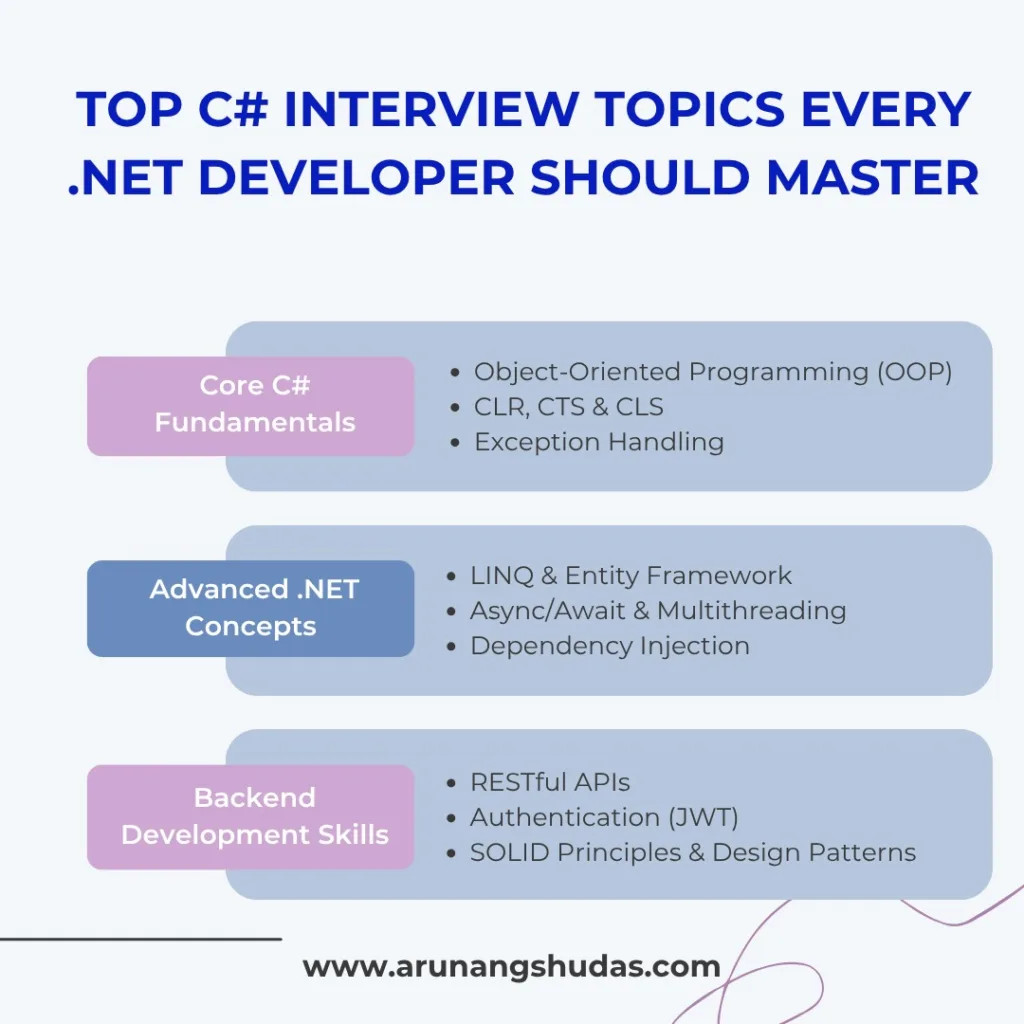
Employers assess much more than syntax. They evaluate your understanding of:
- Object-Oriented Programming
- Memory Management
- .NET Runtime
- Entity Framework
- LINQ
- Async Programming
- Multithreading
- REST APIs
- Dependency Injection
- Design Patterns
- SQL Integration
- Cloud Deployment
- Performance Optimization
Skills Evaluated During C# Interviews
| Skill | Importance | Interview Focus |
| OOP Concepts | High | Classes, Objects, Inheritance |
| Collections | High | List, Dictionary, HashSet |
| LINQ | High | Query optimization |
| Entity Framework | High | CRUD operations |
| Async Programming | High | async/await |
| APIs | High | RESTful Services |
| SQL | Medium | Queries and Optimization |
| Design Patterns | Medium | SOLID Principles |
Basic C# Interview Questions
1. What is C#?
C# is an object-oriented programming language developed by Microsoft for building desktop, web, mobile, gaming, and enterprise applications on the .NET platform. While preparing for C# interviews, many candidates also review interview questions on html css to strengthen their front-end fundamentals for full-stack development roles.
2. What are the features of C#?
Answer:
- Object-Oriented
- Type Safe
- Automatic Garbage Collection
- Rich Library Support
- Cross Platform (.NET)
- Async Programming
- Language Integrated Query (LINQ)
3. Explain CLR.
CLR (Common Language Runtime) executes .NET applications and provides:
- Memory Management
- Security
- Exception Handling
- Thread Management
- Garbage Collection
4. What is CTS?
CTS stands for Common Type System. It ensures all .NET languages use the same data types.
5. Explain CLS.
CLS (Common Language Specification) ensures interoperability between different .NET languages.
6. Difference Between .NET Framework and .NET
| .NET Framework | .NET |
| Windows Only | Cross Platform |
| Older Runtime | Modern Runtime |
| Limited Updates | Continuous Updates |
| Legacy Applications | Cloud & Modern Apps |
Object-Oriented Programming Questions
7. Explain Encapsulation.
Encapsulation hides internal implementation while exposing necessary functionality.
Example:
class Employee

{

    private decimal salary;

    public void SetSalary(decimal amount)

    {

        salary = amount;

    }

}
8. Explain Inheritance.
Inheritance allows one class to acquire properties of another class.
9. What is Polymorphism?
Polymorphism allows methods to behave differently based on implementation.
Types:
- Compile Time
- Runtime
10. Explain Abstraction.
Abstraction hides complexity and exposes only required features.
Interview Preparation Roadmap
| Preparation Stage | Focus Area |
| Beginner | C# Basics, OOP |
| Intermediate | Collections, LINQ, EF |
| Advanced | Async, APIs, Design Patterns |
| Expert | Microservices, Azure, Performance |
| Final Revision | Mock Interviews & Coding Practice |
Intermediate C# Interview Questions
11. What is Boxing and Unboxing?
Boxing
Converting value type into object.
Unboxing
Converting objects back into value types.
12. Difference Between String and StringBuilder
| String | StringBuilder |
| Immutable | Mutable |
| Slower for modifications | Faster |
| Creates new object | Updates existing object |
| More memory usage | Better performance |
13. What is Garbage Collection?
Garbage Collection automatically removes unused objects from memory.
Benefits:
- Prevents memory leaks
- Improves application performance
- Automatic cleanup
14. What are Delegates?
Delegates are type-safe function pointers. They allow methods to be passed as parameters.
15. Explain Events.
Events notify subscribers whenever a specific action occurs.
Frequently Asked .NET Concepts
| Topic | Interview Frequency | Difficulty |
| CLR | Very High | Easy |
| Collections | Very High | Medium |
| LINQ | Very High | Medium |
| Entity Framework | High | Medium |
| Async/Await | Very High | Medium |
| Dependency Injection | High | Medium |
| JWT | High | Medium |
| Microservices | High | Advanced |
LINQ Interview Questions
16. What is LINQ?
LINQ (Language Integrated Query) enables querying collections using C# syntax.
Example:
var result = numbers.Where(x => x > 10);LINQ is also a common topic included in full stack interview questions, especially for roles that require expertise in both backend development and database querying.
17. Benefits of LINQ
- Readable
- Less Code
- Strongly Typed
- Compile Time Checking
Entity Framework Questions
18. What is Entity Framework?
Entity Framework is Microsoft’s ORM framework. It maps database tables into C# objects.
19. What is Code First?
Code First creates the database from C# classes.
20. What is Database First?
Database First generates classes from an existing database.
Async Programming Questions
21. Explain async and await.
They allow non-blocking execution of long-running tasks.
Example:
await Task.Delay(1000);22. Difference Between Task and Thread
| Task | Thread |
| Lightweight | Heavy |
| Managed | OS Managed |
| Better Performance | Higher Memory |
| Recommended | Less Preferred |
API Interview Questions
23. What is REST API?
REST APIs enable communication between client and server using HTTP.
REST concepts are frequently covered in restful api interview questions to evaluate a candidate’s understanding of web services, HTTP methods, and API design principles.
24. HTTP Methods
- GET
- POST
- PUT
- DELETE
- PATCH
25. What is Dependency Injection?
Dependency Injection reduces tight coupling by injecting dependencies instead of creating them manually.
Advanced C# Interview Questions
26. What is Reflection?
Reflection allows runtime inspection of assemblies and types.
27. What is Middleware?
Middleware processes HTTP requests inside ASP.NET Core.
28. Explain SOLID Principles.
- Single Responsibility
- Open Closed
- Liskov Substitution
- Interface Segregation
- Dependency Inversion
29. What is JWT Authentication?
JWT securely authenticates users using signed tokens.
30. Explain Microservices.
Microservices divide applications into independently deployable services.

Common Coding Topics
| Coding Area | Example Questions |
| Arrays | Reverse Array |
| Strings | Palindrome |
| Linked List | Reverse List |
| Stack | Valid Parentheses |
| Queue | Circular Queue |
| Trees | Binary Tree Traversal |
| Recursion | Fibonacci |
| Dynamic Programming | Coin Change |
FAQs
1. What are the most important C# interview questions for beginners?
Focus on OOP concepts, CLR, CTS, CLS, collections, exception handling, delegates, events, and basic LINQ queries.
2. Are C# interview questions and answers enough for experienced developers?
No. Experienced candidates should also prepare for ASP.NET Core, Entity Framework, asynchronous programming, dependency injection, design patterns, microservices, cloud deployment, and system design discussions.
3. What coding topics are commonly asked in C# programming interviews?
Interviewers frequently ask array manipulation, string problems, linked lists, stacks, queues, trees, recursion, dynamic programming, and algorithm optimization.
4. How should I prepare for senior .NET developer interviews?
Practice advanced C# concepts, API development, multithreading, performance tuning, SOLID principles, design patterns, system architecture, SQL optimization, and real-world coding challenges.
5. Do companies ask both C# and Java interview questions?
Yes. Many organizations hiring backend or full-stack developers expect familiarity with multiple technologies, so candidates often prepare C#, Java, Spring Boot, REST APIs, SQL, and data structures together to increase their opportunities.
