


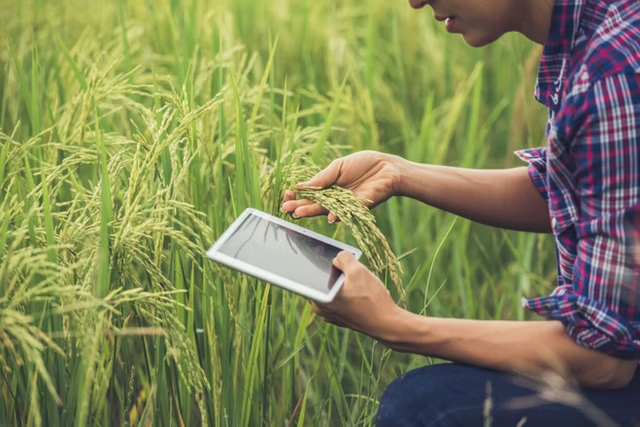
IoT in Smart Agriculture is changing how farmers grow crops, manage resources, monitor field conditions, and improve agricultural productivity. By connecting sensors, machinery, irrigation systems, weather stations, drones, and software platforms, farmers can collect real-time data and use it to make more informed decisions.
Agriculture faces several challenges, including water scarcity, unpredictable weather, increasing input costs, labor shortages, and the need to produce more food efficiently. Traditional farming knowledge remains essential, but modern technologies can provide farmers with additional information to improve everyday decisions.
This is where IoT in agriculture is becoming increasingly important. Connected devices can continuously monitor soil, crops, weather, livestock, and equipment. When this information is combined with automation and data analytics, it can support more efficient sustainable farming practices.
Table of Contents
What Is IoT in Smart Agriculture?
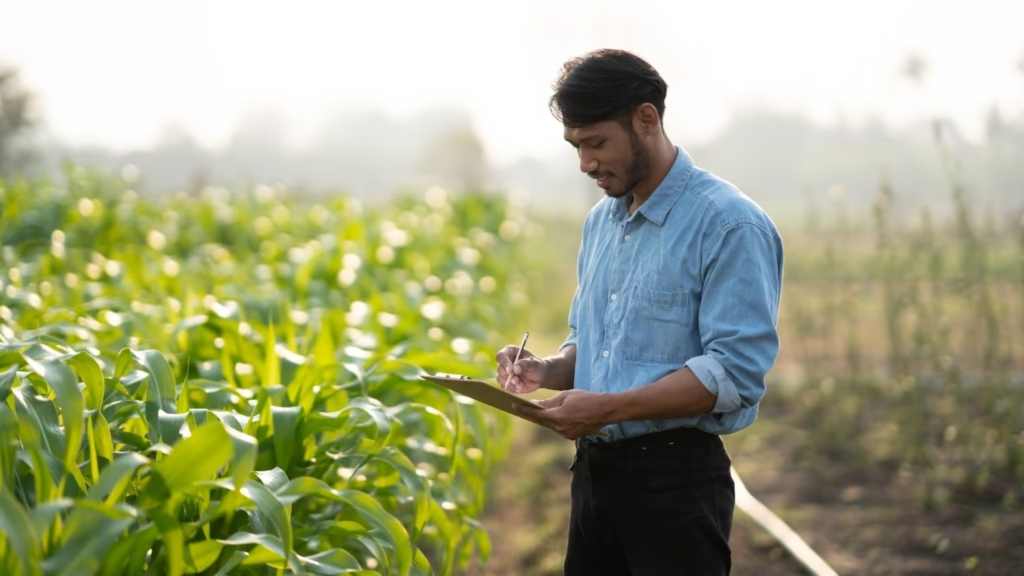
IoT in Smart Agriculture refers to the use of Internet of Things technology to connect agricultural devices, collect data, and provide useful insights for farming operations.
IoT devices can include soil moisture sensors, temperature sensors, weather stations, GPS-enabled machinery, drones, cameras, irrigation controllers, and livestock tracking devices.
These devices collect information and transmit it through wireless networks or other communication technologies. The data can then be processed using cloud platforms or edge-computing systems and displayed through dashboards or mobile applications.
For example, a soil moisture sensor can detect when the soil becomes too dry. The system can notify the farmer or automatically activate irrigation equipment. This allows water to be supplied based on actual field conditions rather than a fixed schedule.
How IoT in Smart Agriculture Works?
The basic process behind IoT in agriculture involves several connected stages.
Data Collection
Sensors collect information about soil moisture, temperature, humidity, crop conditions, rainfall, and other agricultural factors.
Data Transmission
The collected information is sent to a central platform using technologies such as cellular networks, Wi-Fi, Bluetooth, or long-range wireless communication.
Data Processing
Software processes the incoming information and organizes it into useful data that farmers can understand.
Analysis and Decision-Making
Farmers can analyze the information through dashboards and applications to identify problems, monitor trends, and make decisions.
Automation
Advanced systems can automatically perform specific actions based on sensor readings. For example, an irrigation system can start when soil moisture falls below a predefined level.
This combination of monitoring, analytics, and automation makes IoT an important technology for modern sustainable farming.
Key Applications of IoT in Agriculture
There are many ways IoT in agriculture can be used to improve agricultural operations.
Smart Irrigation
Water management is one of the most important applications of IoT technology. Soil moisture sensors can determine when crops need water, while automated irrigation systems can control pumps and valves.
Instead of watering an entire field according to a fixed schedule, farmers can provide water based on actual soil conditions.
This can reduce unnecessary water usage and support more efficient irrigation practices, making smart irrigation an important part of sustainable farming.
Soil Monitoring
IoT sensors can monitor soil characteristics such as moisture, temperature, pH, and nutrient conditions.
Farmers can use this information to understand how conditions vary across different areas of a field. This can help them make more targeted decisions about irrigation, fertilization, and crop management.
Continuous soil monitoring can also help identify potentially unfavorable conditions before they significantly affect crop growth.
Crop Health Monitoring
Cameras, drones, and connected sensors can help farmers monitor crop health across large fields.
Changes in plant appearance, growth patterns, or other indicators can signal potential problems such as pests, diseases, or nutrient deficiencies.
Instead of manually inspecting every section of a large farm, farmers can use technology to identify areas that require closer attention.
Weather Monitoring
Weather conditions have a major impact on agricultural activities. IoT-enabled weather stations can collect local information about temperature, humidity, rainfall, wind speed, and other environmental conditions.
Farmers can use this information to plan irrigation, spraying, planting, and harvesting activities.
Local weather data can also complement broader weather forecasts and help farmers understand conditions at specific locations on their farms.
Livestock Monitoring
IoT technology can also be used in livestock farming. Wearable sensors and tracking devices can monitor animal movement, activity, location, and other indicators.
Farmers can receive alerts when unusual behavior is detected. This can help them identify animals that may require closer observation.
Livestock monitoring can be particularly useful for large farms where manually observing every animal is difficult.
Benefits of IoT in Smart Agriculture
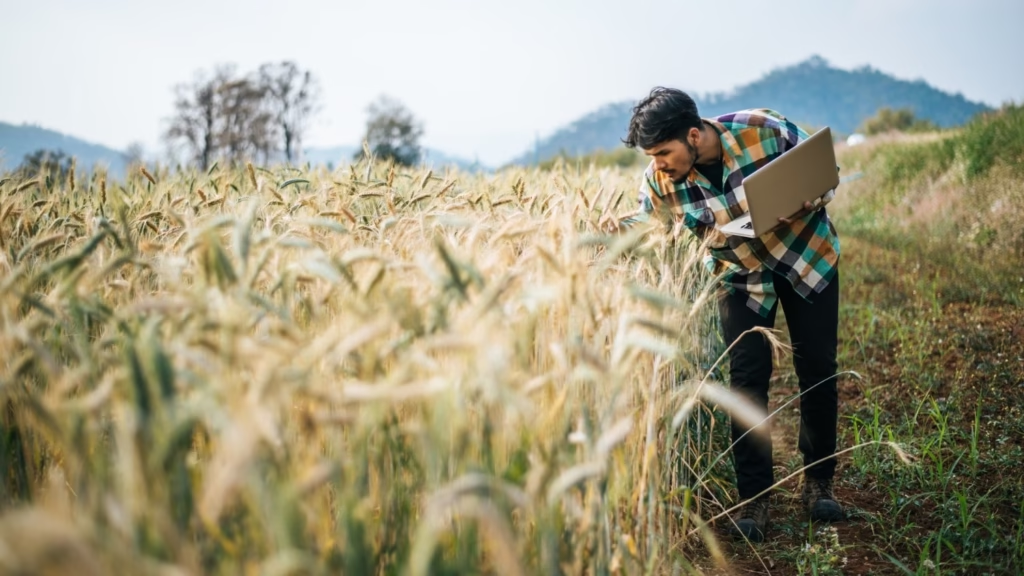
The growing adoption of IoT in Smart Agriculture can provide several advantages for farmers.
Better Resource Management
One of the major benefits is the ability to use agricultural resources more efficiently. Real-time data can help farmers determine where water, fertilizers, and other inputs are actually needed.
This can reduce unnecessary resource consumption and support sustainable farming.
Improved Decision-Making
Farmers can use real-time data instead of relying exclusively on manual observations or assumptions. Information about soil, crops, weather, and equipment can support better-informed decisions.
Increased Operational Efficiency
Connected devices and automated systems can reduce repetitive manual tasks. Farmers can monitor multiple areas of a farm through a centralized dashboard rather than physically checking every location.
Early Problem Detection
Sensors can continuously monitor agricultural conditions and identify unusual changes. Early warnings can give farmers more time to investigate potential problems and take corrective action.
Reduced Waste
Precision monitoring can help reduce unnecessary applications of water, fertilizers, pesticides, fuel, and other inputs. Using only what is required can improve efficiency while reducing waste.
Support for Sustainable Farming
By helping farmers optimize resource usage and reduce waste, IoT can contribute to more sustainable agricultural practices.
However, IoT is not a replacement for responsible farming methods. Its effectiveness depends on how accurately data is collected and how well farmers use that information.
IoT and Sustainable Farming
Sustainable farming focuses on producing agricultural products while managing natural resources responsibly and maintaining long-term productivity.
IoT can support these goals by making farming more precise and data-driven.
For example, smart irrigation can help reduce unnecessary water consumption. Soil monitoring can help farmers understand field conditions before applying inputs. Weather monitoring can help prevent unnecessary agricultural operations during unfavorable conditions.
Another important advantage is precision agriculture. Instead of treating an entire field in exactly the same way, farmers can use data to identify differences between areas and adjust their practices accordingly.
As IoT in agriculture becomes more advanced, these capabilities can help farms balance productivity with more efficient resource management.
Challenges of IoT in Smart Agriculture
Despite its benefits, implementing IoT in Smart Agriculture can present several challenges.
High Initial Costs
Sensors, connectivity equipment, software, automated machinery, and installation can require significant investment. This can be challenging for smaller farms.
Connectivity Limitations
Some rural areas may have limited internet or cellular connectivity. Reliable communication is important for many IoT applications.
Data Security
Connected agricultural systems collect and transmit large amounts of information. Farmers and agricultural businesses need appropriate cybersecurity measures to protect their data.
Technical Knowledge
Farmers may need training to install sensors, operate connected systems, interpret data, and maintain equipment.
Maintenance
Sensors and other devices may operate in challenging outdoor environments. Dust, moisture, heat, and physical damage can affect equipment, making regular maintenance important.
The Future of IoT in Smart Agriculture
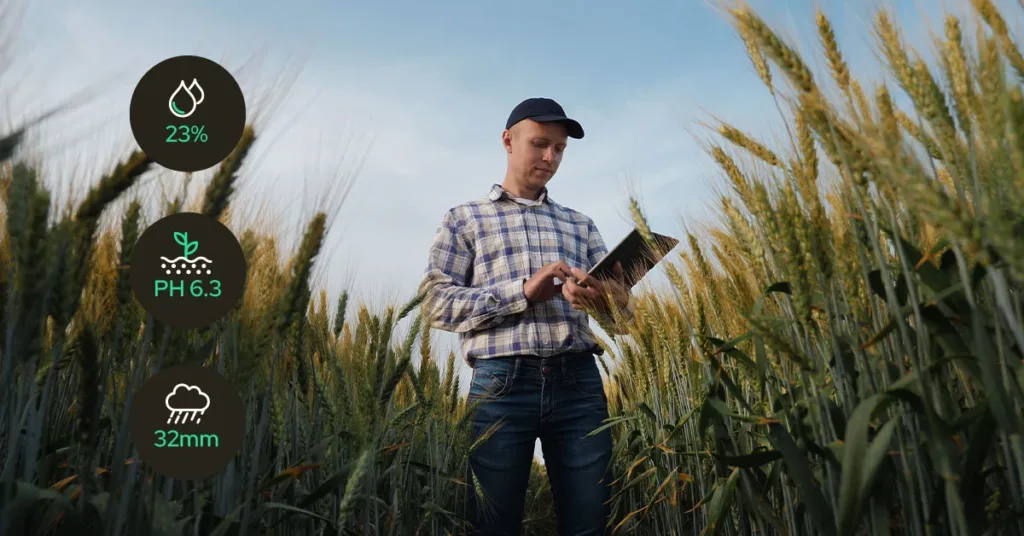
The future of IoT in Smart Agriculture is likely to involve greater integration with artificial intelligence, robotics, drones, satellite imagery, and autonomous machinery.
Artificial intelligence can analyze large amounts of data collected by IoT devices and identify patterns that may not be immediately visible. This could help farmers receive more advanced recommendations about irrigation, crop health, pest risks, and harvesting.
Robotics can also work alongside IoT systems to automate specific agricultural tasks. Autonomous tractors and other machines could use sensor and GPS data to perform operations with greater precision.
As IoT devices become more affordable and connectivity improves, smaller farms may also gain access to technologies that were previously limited to large agricultural operations.
These developments could make sustainable farming more data-driven while helping farmers manage resources more efficiently.
Conclusion
IoT in Smart Agriculture is playing an increasingly important role in the transformation of modern farming. Connected sensors, weather stations, irrigation systems, drones, machinery, and software can provide farmers with real-time information about their operations.
From smart irrigation and soil monitoring to crop health analysis and livestock tracking, IoT in agriculture offers a wide range of applications that can improve efficiency and decision-making.
At the same time, the technology can support sustainable farming by helping farmers use water, fertilizers, energy, and other resources more efficiently.
Although challenges such as cost, connectivity, cybersecurity, and technical expertise remain, continued advances in IoT, artificial intelligence, robotics, and automation are creating new opportunities.
As agriculture becomes increasingly connected and data-driven, IoT can become an important tool for producing food efficiently while supporting more responsible and sustainable resource management.
FAQs About IoT in Smart Agriculture
1. What is IoT in Smart Agriculture?
IoT in Smart Agriculture is the use of connected sensors, devices, machines, and software to collect and analyze agricultural data. It can be used for monitoring soil, crops, weather, livestock, irrigation, and farm equipment.
2. How does IoT support sustainable farming?
IoT can support sustainable farming by helping farmers use resources such as water, fertilizers, and energy more efficiently. Real-time monitoring can also help reduce waste and improve precision.
3. What are the main applications of IoT in agriculture?
Common applications include smart irrigation, soil monitoring, crop health monitoring, weather tracking, livestock monitoring, greenhouse automation, equipment monitoring, and precision agriculture.
4. What are the challenges of using IoT in agriculture?
The main challenges include initial investment costs, connectivity limitations, cybersecurity concerns, technical knowledge requirements, and ongoing device maintenance.
